x




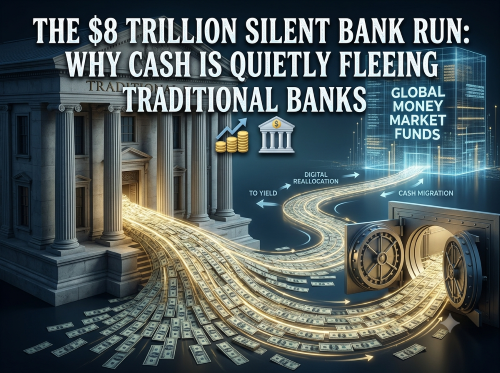
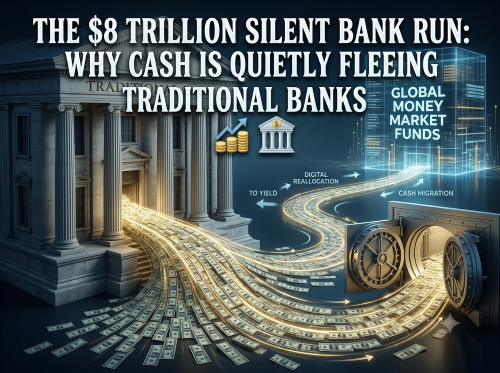
There are no queueing crowds stretching around high street corners this morning, no emergency weekend press conferences from banking regulators, and no high-profile lenders being carried off into receivership. On the surface, the global banking system appears entirely calm. Yet beneath this tranquil exterior, a historic structural shift is taking place: nearly $8 trillion has quietly walked out of traditional commercial banks, triggering an invisible squeeze that threatens to starve local businesses of vital credit.
Unlike traditional bank panics driven by sudden fear and hysteria, this modern capital flight is guided entirely by cold, rational mathematics.
For decades, the standard arrangement between depositors and commercial banks was simple, albeit unrewarding. Savers deposited their funds into standard savings accounts, received negligible interest, and allowed banks to lend those funds out at a healthy profit margin. Because alternative options were inconvenient or unfamiliar, most people simply left their cash where it was.
That equation has fundamentally changed. According to regulatory data, the average traditional bank savings account yields between 0.38% and 0.61%. Meanwhile, four-week Treasury bills—backed by the very same government that guarantees bank deposits—offer returns of approximately 3.7%.
The Math in Plain Sight: A saver moving cash from a standard bank account into short-term government debt receives over six times more interest for virtually identical risk.
In the digital age, reallocating savings doesn't require waiting in line at a branch. It takes a few taps on a smartphone app. When millions of individual households independently make this rational choice, the cumulative result is an unprecedented drain of liquidity from traditional banking institutions.
Where has all this capital migrated? The vast majority has flowed directly into money market funds—pooled investment vehicles that hold short-term government debt and pass the underlying yield straight back to the investor.
The scale of this shift is staggering:
In effect, everyday savers have constructed a parallel financial ecosystem that rivals—and at times surpasses—the balance sheet of the world’s most powerful central bank. Yet because this migration has occurred without a single dramatic crash, it has largely escaped mainstream headlines.
It is vital to distinguish this ongoing movement from the acute banking crisis of early 2023. The collapse of Silicon Valley Bank (SVB) was a classic, velocity-driven bank run. Uninsured venture capitalists panicked on social media, resulting in $42 billion in withdrawal requests in just 24 hours.
By contrast, today’s phenomenon is:
The largest mega-banks—such as JPMorgan Chase, Bank of America, and Wells Fargo—are well-positioned to withstand this shift. They possess immense scale, highly diversified corporate deposit bases, and direct access to wholesale funding markets to replace departing retail cash. The real vulnerability lies further down the financial ladder.
Outside of the top-tier institutions, there are more than 9,000 smaller community and regional commercial banks across the United States, collectively holding around $5.5 trillion in deposits. These lenders serve as the primary growth engine for local economies, yet they lack the wholesale funding infrastructure required to easily replace lost retail deposits.
Compounding this deposit drain is a growing structural vulnerability in commercial real estate (CRE):
Regional lenders now find themselves caught in a severe double squeeze: a steadily shrinking deposit base on one side, and a looming wall of maturing property loans on the other.
While balance sheet Mechanics may sound abstract, the real-world consequences inevitably ripple down to businesses and consumers. Banks generate income through the net interest margin—the difference between what they pay for deposits and what they charge for loans. When cheap deposits disappear, banks are forced to curtail lending.
This credit tightening manifests in subtle but impactful ways:
The economic indicators are already reflecting this pressure. Small business optimism has lingered below its 52-year historical average for months, corporate hiring plans have cooled significantly, and commercial bankruptcy filings under Subchapter 5 recently jumped by 36% year-over-year.
Adding to the complexity is the Federal Reserve’s monetary policy stance. Facing headline inflation measures such as the Personal Consumption Expenditures (PCE) index printing at 4.1%, central bankers are under pressure to maintain elevated interest rates or even consider further tightening.
However, raising interest rates creates a unintended feedback loop:
Because much of the recent inflation spike has been driven by supply-side energy cost fluctuations, aggressive rate hikes risk breaking the bank credit channel without addressing the underlying commodity price pressures.
The current financial landscape is defined not by sudden panic, but by systematic yield optimisation. As capital continues to flow out of regional banking channels into money market alternatives, the broader economy faces a protracted credit slowdown. Whether monetary policymakers recognise this feedback loop in time—or continue tightening into a silent credit contraction—will determine how smoothly Main Street navigates the years ahead.
Finance Bureau - The INVISIBLE Bank Run ($8 Trillion Already Gone)
"Almost $8 trillion has exited traditional banks and poured into money market funds, starving small lenders of cash in a bank run nobody’s talking about. There’s no panic and no headlines—but the effects are showing up in tighter credit, rising business bankruptcies, and local economies under strain.
See why this silent migration is accelerating, how it affects your savings or job, and why the Fed could make it worse while focusing on the wrong data. Don’t miss the full story before the impact hits Main Street."
~ TIMESTAMPS ~
00:00 – The $8 Trillion Bank Run Nobody Noticed
02:08 – The Simple Math Draining America’s Banks
04:24 – A Cash Pool Bigger Than the Federal Reserve
07:47 – The $4 Trillion Banking Time Bomb
10:19 – The Credit Crunch Has Already Started
Source: 👉 https://www.youtube.com/watch?v=nShiWkjF2fI
Disclaimer: This article is provided for informational purposes only, mistakes may be made, and it's not offered or intended to be used as legal, tax, investment, financial, or any other advice.