x




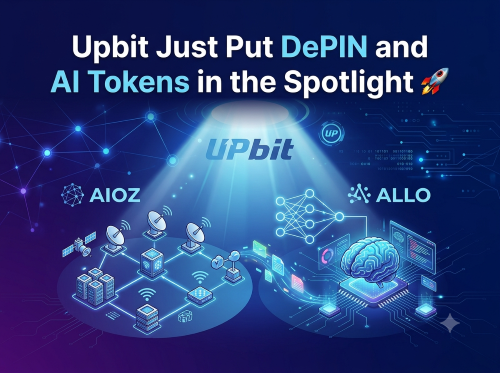
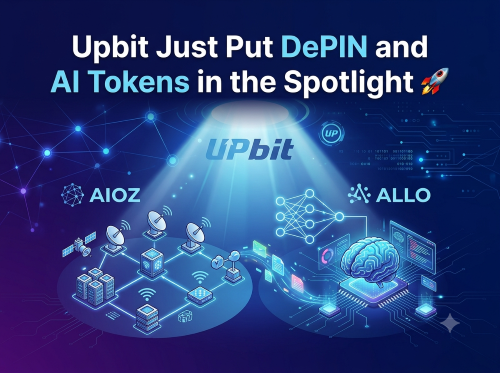
A major cryptocurrency exchange has just put two of blockchain's hottest emerging narratives firmly back in focus.
Upbit has listed six new digital assets, including AIOZ Network (AIOZ) and Allora (ALLO), giving traders greater access to projects working across decentralised physical infrastructure, artificial intelligence and blockchain-based computing.
The move could prove significant for the rapidly developing DePIN and decentralised AI sectors, particularly as investors search for blockchain projects with applications beyond cryptocurrency trading.
According to reporting on the listings, Upbit added CYS, ICNT, XAN, EDEN, AIOZ and ALLO, with BTC and USDT markets supported for the new assets. (CryptoRank)
But the most interesting part of the announcement may not be the exchange listing itself.
It is what AIOZ and ALLO represent.
Both projects are part of a much bigger shift towards combining blockchain technology with the infrastructure and intelligence needed to power the next generation of the internet.
The cryptocurrency market has moved through several major narratives over the years.
First came the rise of Bitcoin and digital payments. Then Ethereum and smart contracts opened the door to decentralised finance, NFTs, DAOs and increasingly sophisticated on-chain applications.
Now, attention is increasingly moving towards infrastructure.
DePIN — short for Decentralised Physical Infrastructure Networks — is attempting to use blockchain-based incentives to coordinate physical resources such as computing power, storage and connectivity.
At the same time, decentralised AI projects are exploring whether machine-learning models and AI services can operate through open networks rather than depending entirely on a small number of centralised technology companies.
That is where AIOZ and ALLO become particularly interesting.
AIOZ Network has built a DePIN ecosystem designed around distributed computing, storage and content delivery.
The project's longer-term vision increasingly includes artificial intelligence.
In its latest Vision Paper, AIOZ describes its goal of creating a unified DePIN layer connecting infrastructure for storage, content delivery, streaming and AI inference.
That matters because AI has an infrastructure problem.
Training and running modern AI models requires enormous quantities of computing power. The technology industry has responded by building increasingly large data centres packed with specialised hardware.
AIOZ's approach is very different.
Instead of relying exclusively on centralised infrastructure, the network aims to bring distributed computing resources together and make them available to applications.
Its AIOZ AI platform is designed to use AIOZ's decentralised infrastructure for AI workloads, including models and datasets.
The project has also continued developing its developer infrastructure. AIOZ's June 2026 ecosystem update says AIOZ AI V2 enables developers to connect applications with models running across the DePIN network through APIs and SDKs.
That is potentially more important than the token itself.
If developers begin using the infrastructure to run real AI workloads, DePIN moves from being a cryptocurrency narrative towards becoming an actual technology marketplace.
Allora is approaching the AI opportunity from another direction.
Rather than primarily focusing on the physical infrastructure needed to run AI, Allora is building a decentralised intelligence network designed to coordinate machine-learning models.
The project's mainnet announcement describes Allora as a decentralised Model Coordination Network, where different machine-learning models can contribute predictions and intelligence.
The idea is intriguing.
Instead of relying on one AI model to produce an answer or prediction, a decentralised network can coordinate contributions from multiple models and evaluate their performance.
The system is intended to reward useful contributions while creating an open marketplace around machine intelligence.
The ALLO token plays a role in that ecosystem, with Allora describing it as being used for network incentives, staking, governance and inference-related activity. Its tokenomics announcement provides further detail on the token's role.
The Upbit listing comes at a fascinating time for the AI industry.
Artificial intelligence is growing at extraordinary speed, but that growth is placing pressure on the infrastructure underneath it.
AI models need:
And increasingly, access to these resources is becoming a strategic issue.
Today, a significant proportion of AI infrastructure is controlled by major cloud providers and technology companies.
DePIN projects are effectively asking a different question:
What if some of that infrastructure could be coordinated through open, distributed networks?
That does not mean decentralised infrastructure will automatically replace traditional cloud providers.
Centralised infrastructure has enormous advantages, including scale, reliability, specialised hardware and established enterprise relationships.
But decentralised networks could potentially offer different benefits, including permissionless participation, geographic distribution and access to underutilised computing resources.
AIOZ is explicitly targeting this opportunity. The project's DePIN overview outlines its approach to using distributed CPU and GPU resources for decentralised AI computation.
Exchange listings can dramatically increase the visibility of smaller blockchain projects.
For AIOZ and ALLO, being made available through Upbit puts the projects in front of a large pool of cryptocurrency traders in one of Asia's most important digital-asset markets.
The initial market reaction also showed just how quickly exchange listings can attract speculative interest.
Reporting following the announcement indicated that some of the newly listed tokens experienced sharp price movements, while reactions varied significantly between projects. (BeInCrypto)
That distinction is important.
A listing can increase liquidity and awareness, but it does not prove that a project has achieved product-market fit.
The excitement surrounding a new listing can disappear quickly.
What happens afterwards is much more important.
For AIOZ, the biggest question is whether its infrastructure attracts sustained demand.
That means looking beyond the AIOZ token price and examining whether developers actually use its computing, storage and AI services.
The same applies to Allora.
The long-term value of a decentralised AI network depends on whether developers and applications find its intelligence useful enough to pay for.
That creates a critical distinction between crypto speculation and infrastructure adoption.
A token can experience a dramatic price increase without its underlying network gaining meaningful users.
Conversely, a network can quietly build useful infrastructure before the wider market recognises its potential.
For DePIN and decentralised AI, network utilisation could therefore become one of the most important metrics to watch.
There is another reason this story deserves attention.
DePIN and AI can potentially reinforce each other.
AI creates demand for computing resources.
DePIN provides a mechanism for coordinating those resources.
AI applications generate workloads.
Those workloads create demand for infrastructure.
Infrastructure providers can then be rewarded for supplying computing capacity.
If the economic model works, a network can potentially grow as demand increases.
This creates a potentially powerful feedback loop.
It also explains why investors and developers have increasingly started looking at DePIN as something more substantial than another cryptocurrency trend.
The sector is attempting to connect blockchain-based incentives with physical infrastructure and real-world economic activity.
The DePIN model is not without risks.
Decentralised computing needs to compete against some of the world's largest and best-funded technology companies.
Reliability is another challenge.
A business running an AI application cannot necessarily tolerate unpredictable computing performance, hardware failures or significant latency.
Security, data privacy, workload verification and network coordination also become more complicated when infrastructure is distributed among thousands of independent participants.
Token economics are another critical factor.
If network participants are primarily motivated by token rewards rather than genuine demand, growth can become dependent on incentives that may not be sustainable.
That is why the next phase of DePIN development could be particularly revealing.
The industry needs to demonstrate that decentralised infrastructure can generate real economic demand, rather than simply attracting speculative capital.
The immediate price reaction to AIOZ and ALLO will undoubtedly attract attention, but longer-term observers should look elsewhere.
For AIOZ, important indicators include developer adoption, AI workloads, GPU utilisation, network activity and demand for its decentralised infrastructure.
The continued development of AIOZ AI and its APIs and SDKs could be especially significant because developer adoption can create recurring demand for the underlying DePIN network.
For Allora, attention should focus on network growth, participating models, prediction quality, applications using its decentralised intelligence and demand for inference.
For the wider DePIN sector, the biggest question remains whether distributed infrastructure can become economically competitive with centralised alternatives.
The Upbit listings may ultimately prove to be a relatively small event in the much larger story of blockchain and artificial intelligence.
But they highlight something important.
The cryptocurrency industry is increasingly attempting to connect tokens with real infrastructure and real-world services.
AIOZ is trying to build decentralised infrastructure capable of supporting AI, storage and content delivery.
Allora is attempting to create an open network for coordinating machine intelligence.
Both projects represent different answers to the same broader question:
Can blockchain networks play a meaningful role in the infrastructure powering the AI economy?
It is far too early to know the answer.
But with major exchanges increasing their exposure to projects operating at the intersection of AI, DePIN and decentralised infrastructure, the market is clearly paying attention.
The next stage will be less about exchange listings and more about execution.
If AIOZ, Allora and their peers can turn increased visibility into developers, users, workloads and sustainable network revenue, today's AI and DePIN narrative could become one of the more important chapters in the evolution of Web3.
For now, the Upbit listing has put the spotlight on them.
What happens next may determine whether that spotlight turns into lasting adoption.
Disclaimer: This article is provided for informational purposes only, mistakes may be made, and it's not offered or intended to be used as legal, tax, investment, financial, or any other advice.