x





A decade ago, Germany initiated a discreet campaign to repatriate its gold reserves, a move that has since spurred a global reevaluation among central banks regarding the control of sovereign wealth. Peter Boehringer, a key figure in Germany's gold repatriation program, highlighted that what began as a parliamentary debate in Germany has evolved into a worldwide trend. Between 2013 and 2017, Germany successfully transferred 674 tonnes of gold back to Frankfurt from the Federal Reserve Bank of New York and the Banque de France, a significant operation reflecting a growing distrust in foreign custodianship, especially given the lack of a full independent audit of U.S. gold reserves at Fort Knox since 1953. This scepticism is not unique to Germany; a 2025 survey by OMFIF indicates that 70% of central banks cite U.S. political instability as a deterrent to holding dollars, leading one in three reserve managers to plan an increase in gold allocations within the next two years.
This shift reflects a broader concern about the sustainability of the fiat currency system and increasing "custodial risk." Boehringer argues that central banks have failed economically and morally by printing money without a solid foundation, making the current fiat system unsustainable and necessitating a return to physical assets like gold. The article notes that spot gold is currently trading around $3,330 an ounce, up 27% year-to-date, a performance attributed to global central bank demand, monetary debasement, and heightened awareness of custodial risk. With the dollar's share of global reserves projected to decline, Boehringer emphasizes that gold could become the universal common denominator, urging individuals to observe central bank actions of buying and repatriating gold as a critical signal before it's too late. Watch the podcast
Gold and silver prices are currently experiencing pressure from low trading activity, diminishing economic fears, and easing geopolitical tensions, potentially keeping gold below $3,300 an ounce in the near term. As the summer trading season approaches with the upcoming July 4th long weekend, analysts like Jesse Colombo of the Bubble Bubble Report anticipate gold to remain within a broader range of $3,200 to $3,500. Gold recently traded at $3,271.49 an ounce, down almost 3% for the week, though it managed to hold initial support at $3,250. Lukman Otunuga, a senior market analyst at FXTM, noted that an improving market mood, driven by progress in U.S.-China trade talks and a ceasefire between Israel and Iran, is pushing investors towards risk assets and away from safe havens, contributing to gold's bearish turn and potential for further losses.
Despite the near-term bearish outlook, underlying factors are expected to provide solid support for gold throughout the summer. Experts like Jesse Colombo and Robert Minter from abrdn highlight the unsustainable rise in sovereign debt and the renewed growth in the global M2 money supply, which has surged by $1.2 trillion this year while U.S. national debt hit $37 trillion. Federal Reserve Chair Jerome Powell's reiteration that the central bank is in no hurry to cut interest rates due to inflation risks also contributes to the consolidation phase. However, Minter anticipates that traditional investment demand will drive the next rally, expecting the Federal Reserve to cut interest rates by at least 50 basis points before year-end, providing a solid floor for gold above $3,000 an ounce. Furthermore, the weakening U.S. dollar, which is near a three-year low, continues to make gold an attractive hedge against declining purchasing power. Source
Wall Street analysts have adopted a bearish outlook on gold for the upcoming week, marking a significant shift in sentiment. This pessimism is largely attributed to a lack of escalation in geopolitical tensions, particularly after a week where the anticipated surge in gold prices following such events failed to materialize. Furthermore, moderating economic data and a general increase in investor risk appetite have diminished gold's appeal as a safe-haven asset. Experts like Daniel Pavilonis foresee geopolitical and tariff-driven bids for gold retreating, especially if progress is made on trade agreements. Technically, gold has shown clear weakness, breaking below key support levels and struggling to maintain prices above $3,300, reinforcing the short-term bearish perspective among institutional investors.
Conversely, Main Street investors maintain a slightly bullish bias towards gold, driven by persistent underlying uncertainties and expectations of future monetary policy adjustments. Despite the easing of immediate geopolitical fears, analysts like Rich Checkan and Darin Newsom believe that broader uncertainties will continue to underpin gold prices. Crucially, the prospect of interest rate cuts in the latter half of the year, as hinted by Federal Open Market Committee (FOMC) members including Chair Powell, is a significant bullish factor. Lower interest rates typically reduce the opportunity cost of holding non-yielding assets like gold, making it more attractive. This, combined with ongoing long-term buying interest and potential inflation concerns, provides a floor for gold prices from the perspective of individual investors. Source

Image Source: Kitco News
Gold futures experienced a significant rebound, gaining approximately $33 or 1.02% during Monday's trading session, reaching a level not seen since May 20th. This recovery coincided with a renewed weakening of the US dollar, which accounted for roughly half of gold's gains. The dollar index (DXY) fell by 0.50% to 96.786, continuing a trend that has seen it lose nearly 13% of its value this year, potentially marking its fifth consecutive monthly decline and worst six-month performance since January 2017. This persistent dollar weakness is largely attributed to market expectations of a Federal Reserve rate cut in September, amplified by concerns over the expanding US government deficit and recent comments from President Donald Trump favouring lower interest rates.
Beyond the dollar's depreciation, an increase in bullish market sentiment towards gold also propelled its price higher, particularly in the latter hours of trading. This optimism, driven by the prospect of monetary policy easing, was reflected across broader financial markets, with US equity indices like the Nasdaq Composite, S&P 500, and Dow Jones Industrial Average all reaching new record highs for the second consecutive session. The synchronized strength across equities and gold suggests investors are positioning for a policy shift that could benefit both growth-oriented assets and inflation hedges. The combination of a weakening dollar, anticipated Fed accommodation, and renewed investor interest in precious metals indicates a potentially sustained recovery for gold. Source
According to analysts at Heraeus, gold has retreated from its April peaks, and its elevated prices may further suppress demand in India. India's gold consumption saw a 5% increase in 2024 despite a 26% price rally, but a further 27% rise in 2025 has led to a 15% decline in demand during Q1'25, with preliminary import data for April and May showing significant drops. While June and July are typically slow months, a continued increase in gold prices could dampen August imports and overall annual Indian gold demand. Gold prices declined for the second consecutive week, influenced by a renewed risk appetite that saw oil prices return to previous levels, with gold closing at $3,275/oz last Friday.
The outlook for silver and platinum suggests that their recent strong performance may be short-lived. Despite record-breaking solar panel installations in China in May, regulatory changes are expected to slow this momentum in the second half of the year, potentially leading to a contraction in China's solar PV demand for silver year-on-year. Although silver has held above $35/oz, its price is facing resistance. Platinum's recent surge to an 11-year-high may also correct in the latter half of the year as South African supply normalizes and demand in China needs further confirmation. However, the current high platinum prices are benefiting South African miners by easing pressure on profit margins, as the PGM basket price, including palladium and chrome, has risen significantly this year. Source
Despite silver's current struggle to maintain the $36 an ounce support level while gold consolidates below $3,300, Natixis analysts, specifically Bernard Dahdah, remain bullish on silver's prospects for the latter half of 2025. Dahdah projects silver prices to reach approximately $38 an ounce by year-end, driven by a significant decoupling of its price from gold. Historically, the correlation between the two metals was very high, around 0.8, but it has recently fallen to 0.55. This weakening relationship suggests that silver is less susceptible to gold price movements, providing a more independent path for its value. The analyst notes that while gold has outperformed silver in the last two years due to safe-haven demand amidst economic and geopolitical uncertainties, silver began to catch up in May as investors sought better value within the precious metals sector.
Looking ahead, the primary driver for silver's performance is expected to be industrial demand, which now accounts for 59% of global consumption, up from 51.5% in 2019. A significant portion of this increase comes from the growing demand for silver in the renewable energy sector, particularly solar, where its share of total demand has surged from 6% in 2015 to an estimated 20% in 2024. However, Dahdah cautions that the green energy transition also presents the biggest risk to silver's outlook; any setback in the broader energy transition narrative or in copper prices could lead to rapid declines in silver. Furthermore, a proposed U.S. Senate tax on wind and solar projects using Chinese components, slated for after December 31, 2027, combined with new tax breaks for coal production, could potentially dampen future silver demand. Source
The Kitco commentary highlights that platinum has been the standout precious metal, experiencing its largest rally in over 40 years with a more than 38% increase since late May. This surge has benefited major platinum miners like Sibanye and Impala, pushing their stock prices above key moving averages and demonstrating how operational leverage to rising metal prices is valued by the market. Palladium also performed strongly, catching up after lagging platinum, with the potential for auto manufacturers to reverse their substitution of platinum for palladium as the latter is now significantly cheaper. Meanwhile, gold, despite a weekly decline of nearly 3% due to a ceasefire in the Middle East and prospects of new trade deals, saw renewed buying interest with sustained ETF inflows.
However, the article also outlines weaknesses and threats to the precious metals market. Mexico's new President Sheinbaum has affirmed a policy of no new mining concessions, continuing a restrictive stance on the mining sector. Producer valuations in the mining industry remain compressed, trading at a significant discount to their 5-year averages, while royalty companies are closer to their historical valuations. Additionally, the cash-strapped government of Mali is working to restart production at Barrick's Loulo-Gounkoto gold complex after taking over its management. Threats include a controversial new mining fee in Ecuador, which the industry views as a "shake-down," and growing informal/illegal mining in Peru, which jeopardizes formal operations and could empower criminal groups. The potential unlocking of over $15 billion in shares from Chinese jeweler Laopu Gold Co. this Friday could also add downward pressure on gold prices. Source
Gold prices saw a moderate increase while silver experienced a slight dip during Monday's midday U.S. trading. Despite gold hitting a five-week low overnight, it rebounded as bargain hunters stepped in. The prevailing risk-on trading sentiment at the start of the holiday-shortened U.S. trading week has, however, limited the upward movement of safe-haven metals. U.S. stock indexes, including the Nasdaq and S&P 500, reached new record highs, reflecting a stronger risk appetite in the broader market. Concerns about potential U.S. tariffs and inflation, as highlighted by Barrons, could temper the stock market's summer rally.
Technically, August gold futures bulls currently hold a near-term advantage, though it is showing signs of fading. The next upside target for bulls is to close above $3,400.00, while bears aim to push prices below $3,200.00. Key external market indicators show the U.S. dollar index at a 3.5-year low, and Nymex crude oil futures trading weaker around $65.00 a barrel. The yield on the 10-year U.S. Treasury note is approximately 4.25%. This holiday-shortened week includes a significant U.S. data release on Thursday: the June employment situation report from the Labor Department, with U.S. markets closed on Friday for Independence Day. July silver futures bulls also hold a near-term technical advantage, but trading has been choppy and sideways at higher levels recently. Source
Over the past three years, silver and gold have experienced spectacular price rallies, with silver rising 67% (17% in the last year) and gold outperforming it with an 83% increase (43% in the last year). While gold has shown lower price volatility compared to silver, making it appear more advantageous for long-term investors based on simple price performance, historical analysis of the gold-silver ratio reveals significant fluctuations and periods where silver has outperformed. Currently, both metals are firmly in a bull market, fundamentally supported by increasing risks within the international financial architecture and escalating global conflicts. The current gold-silver ratio, at around 92, suggests that silver is undervalued relative to its long-term trend value of 68.2, implying a potential for silver to significantly outperform gold and reach approximately $49 per troy ounce.
The article emphasizes that gold and silver are indispensable components of an investment portfolio, offering crucial liquidity and insurance, especially as the fiat money system faces increasing challenges. Unlike bank deposits, these precious metals carry no default or fulfillment risk and retain their exchange value, particularly during turbulent times. For investors concerned about potential government interventions or a gold ban, holding silver provides a natural diversification option, enhancing liquidity and fungibility. The expected global economic and political changes could propel precious metal prices even higher, suggesting that long-term investors should maintain their positions. Ultimately, silver is expected to become significantly more attractive, driving its price further up and reinforcing its value for long-term portfolio inclusion. Source
Canada's mining sector is poised for a new direction with Blue Lagoon Resources' Dome Mountain project, set to begin commercial gold production in the third quarter. This initiative aims to challenge the traditional pursuit of multi-million-ounce gold deposits by demonstrating the viability of organic growth through smaller, more efficient operations. Despite the increasing difficulty in finding large gold reserves—with only five major discoveries since 2020, according to S&P Global—Blue Lagoon, under CEO Rana Vig, highlights its unique approach to rapid development. The company has achieved full permitting in just five years, a significant reduction compared to the decade or more typically required for larger projects, thanks to its underground mine design minimizing environmental impact, strategic location with existing infrastructure in Northern British Columbia, and an off-site toll-milling agreement.
The Dome Mountain project, an underground mine projected to yield 15,000 ounces of gold annually, is presented as a model for generating substantial free cash flow that will fuel Blue Lagoon's organic expansion. This strategy contrasts with the industry's struggle to find and develop large-scale deposits, emphasizing that smaller, more agile companies can also deliver significant returns for shareholders. Yannis Tsitos, Chair of Blue Lagoon's Mining Committee, advocates for more organic growth models, suggesting that Blue Lagoon could serve as a "lighthouse" for the sector by showcasing what can be achieved with a focused, sustainable approach to mining in an evolving market. Source
Joseph Wu, Vice President and Portfolio Manager at RBC Wealth Management, suggests that gold is experiencing a "regime change" as its price is increasingly driven by new factors, moving away from its traditional inverse relationship with real interest rates. While this inverse correlation was stable for 25 years until 2021, gold has shown resilience and even rallied since 2022 despite rising or flat real interest rates. This shift is attributed to the relatively inelastic supply of gold and the growing influence of the "marginal buyer." Central banks, especially in emerging markets, have become a significant and price-insensitive source of demand, acquiring over 1,000 net tons of bullion annually for three consecutive years—double the average from 2010 to 2021. This trend is expected to persist, driven by geopolitical concerns such as the freezing of Russia's foreign-currency assets in 2022, which highlighted the risks associated with holding U.S. dollar-based reserves.
Beyond central bank accumulation, Wu identifies portfolio diversification and gold's enduring role as a store-of-value alternative as additional structural drivers under this new paradigm. A more fragmented geopolitical landscape, coupled with anxieties over escalating government debt and the long-term status of the U.S. dollar, strengthens gold's appeal as a hedge against elevated uncertainty. While gold lacks conventional valuation anchors due to its absence of cash flows, its historical function as a crisis hedge and its low correlation with equities—particularly during economic downturns or when stocks and bonds move in tandem—reinforce its value proposition. Wu advises viewing gold as a long-term strategic allocation, emphasizing its potential for protection and diversification benefits during periods of heightened market stress. Source
In this week’s Live from the Vault, Andrew Maguire explains why gold sells off during market crashes, revealing that short-term speculators are being forcibly liquidated in an orchestrated effort to mask gold’s safe haven strength and stability.
Andrew highlights that while gold’s price is still driven by paper markets, control is shifting towards Eastern physical exchanges, where real demand, supported by Basel III compliance, is starting to reflect the growing strength of physical gold.
Disclaimer: These articles are provided for informational purposes only. They are not offered or intended to be used as legal, tax, investment, financial, or any other advice.
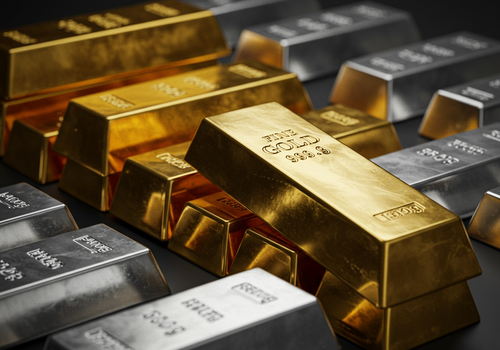
Featured Image generated with Google AI Studio















