x



Physical silver investment is a highly volatile but crucial component of global silver demand. The top four markets for physical silver, which are the United States, India, Germany, and Australia, account for nearly 80% of global demand for bars and coins. Over the past 15 years, this segment has fluctuated dramatically, with demand reaching a record high in 2022. The recent increase in silver prices, which have outperformed both gold and Bitcoin this year, is attributed to rising geopolitical tensions, government debt, and a growing belief among investors that silver is undervalued compared to gold.
The article highlights unique trends in each of the four major markets. The United States is the largest market, with investors buying a combined 1.5 billion ounces of silver between 2010 and 2024, most of which they hold onto long-term. India is the second-largest market, with a long-standing tradition of silver ownership, primarily in bars, and a reluctance to liquidate holdings. Germany's market, the third largest, has been extremely volatile, surging during the pandemic but slumping after a tax law change in 2022. Finally, Australia has emerged as the fourth-largest market, seeing a significant increase in demand driven by favourable tax structures and the metal's use in retirement accounts. Source
According to investment firm Schroders, gold has further potential to rise in value as it tests resistance just below $3,400 an ounce. This positive outlook is based on rising inflation pressures and a continued loss of confidence in the US dollar. Schroders views gold as a valuable diversifier and "portfolio insurance" in an environment of policy volatility and fiscal uncertainty. The firm has shifted its stance on equities to neutral, believing investors are underestimating risks related to both inflation and economic growth.
While gold's price has already increased by nearly 30% this year, Schroders' Fund Manager for Metals, Jim Luke, suggests that investment demand can still grow significantly. He notes that although investment demand in the first half of the year was at its fastest pace since 2020, it remains within the post-2010 range. Luke specifically anticipates that Western demand from North America and Europe will begin to catch up with the record investment levels already seen in Asia, signalling a potential for a "truly global bid for gold" to emerge, which has not yet occurred. Source
Saxo Bank's Head of Commodity Strategy, Ole Hansen, explains how the steepening U.S. Treasury yield curve is making gold and silver more attractive to investors. Hansen notes that the yield spread between the two-year and ten-year U.S. Treasury notes is at its steepest level in over five years. This "bull steepener" is driven by a drop in short-term yields due to expectations of future rate cuts by the Federal Reserve, while long-term yields remain high because of concerns about the Fed’s independence, inflation, and a growing U.S. debt load. These dynamics are supportive of gold, as lower short-term yields decrease the opportunity cost of holding non-yielding assets.
Additionally, the article highlights that rising long-term yields, which are typically seen as a headwind for gold, are actually supportive in this scenario because they reflect investor concerns about fiscal risk and monetary policy credibility. This diminishes the appeal of Treasuries as a safe-haven asset, making gold a more attractive alternative. Silver also benefits from this environment, both as a monetary metal and due to its industrial demand, particularly if inflation worries increase the demand for hard assets. Hansen concludes that the overall effect of the current curve dynamics is broadly positive for investment metals. Source
Gold prices recently climbed to a one-month-high, reaching over $3,400 per ounce, a rally driven by persistent weakness in the U.S. dollar. Analysts at Bank of America anticipate this upward trend will continue, maintaining their projection that the value of the yellow metal will reach $4,000 an ounce by the first half of 2026. The bank's report cites a combination of falling interest rates and a depreciating dollar, which they believe creates a favourable environment for gold's appreciation, particularly if rate cuts occur while inflation remains elevated.
The market widely expects the Federal Reserve to begin cutting rates as soon as September, a forecast supported by recent data showing a cooling U.S. labor market. Bank of America also noted that political pressure on the Fed, including criticism from President Donald Trump, could further weigh on the dollar. While acknowledging the possibility of a temporary U.S. dollar rally if upcoming inflation data is higher than expected, the bank views such a relief rally as likely to be short-lived, with a continued weakening trend expected to support gold's gains. Source
According to Ian Samson, a multi-asset portfolio manager at Fidelity International, gold has significant price upside despite its recent strong performance. He notes that gold was a top-performing asset in Fidelity's portfolios last year, and its bull markets often last for many years. Samson believes that gold serves multiple purposes for investors, including providing diversification, acting as a safe haven, and offering protection against inflation and loose economic policies, making it a valuable asset to hold.
Fidelity's base case predicts a potential U.S. economic slowdown or stagflationary environment, driven by the Federal Reserve's likely interest rate cuts amid still-elevated inflation and the effects of tariffs and a slowing labor supply. This combination of falling rates, sticky inflation, and weak growth should bolster gold prices and lead to a weaker U.S. dollar, which is gold's main competitor. Furthermore, long-term support for gold comes from the large U.S. budget deficit, which raises concerns about monetary debasement, and strong structural demand from central banks and foreign reserve managers, who are diversifying away from the dollar. Source
Despite facing modest selling pressure, gold is maintaining a price above $3,400 an ounce, even as U.S. inflation remains elevated. The U.S. Department of Commerce reported that the core Personal Consumption Expenditures (PCE) index, which is the Federal Reserve's preferred measure of inflation, rose 0.3% in July and 2.9% over the past year. This report was in line with market expectations and has not diminished the anticipation for an interest rate cut by the Federal Reserve next month.
Some analysts suggest that in the current economic climate, rising inflation could actually benefit gold. This is because higher inflation paired with expected monetary policy easing is anticipated to push real interest rates sharply lower, which reduces the opportunity cost of holding a non-yielding asset like gold. According to the CME FedWatch Tool, markets are still assigning a high probability of a rate cut next month. Personal spending and income also showed stable increases in the report, aligning with forecasts. Source
The gold market experienced a significant increase in value after a report from the University of Michigan showed a decline in U.S. consumer sentiment for August. The final reading of the Consumer Sentiment survey was 58.2, which was a decrease from July's reading and below the preliminary estimate for the month. According to the report, this decline in sentiment was widespread across various demographic groups and reflected heightened concerns about high prices, which impacted consumer spending on durable goods and personal finances.
Furthermore, the data indicated a worsening inflation outlook, as both one-year and long-run inflation expectations rose, ending two consecutive months of receding expectations. The report noted that the increase in inflation expectations was observed across multiple demographic groups. This combination of falling consumer confidence and rising inflation expectations contributed to the sharp rally in gold, as investors often turn to the precious metal as a safe haven asset during periods of economic uncertainty and heightened price pressures. Source
December gold futures saw a significant price jump on Friday, breaking above $3,500 an ounce and hitting a three-week-high. The rally was driven by a combination of technical buying, a sell-off in U.S. stock indexes, and the historical tendency for the stock market to face volatility during the months of September and October. The strong closes for the week and the month position gold for further chart-based buying interest when trading resumes after the U.S. Labor Day holiday.
The price movement highlights gold's role as a safe-haven asset, as investors turn to it during periods of stock market weakness and economic uncertainty. The confluence of a decline in equities and the start of a historically turbulent period for stocks provided a strong catalyst for the precious metal's upward momentum. Source
While gold has been commanding attention by reaching new record highs, silver is also gaining momentum and could be poised to outperform the yellow metal. Silver's price is making a run toward $40 an ounce, a level not seen since 2011. This renewed interest is highlighted by a recent investment from the Saudi Central Bank, which bought millions of dollars in iShares Silver Trust and a silver miners ETF. This move is significant because, traditionally, institutional investors have focused on gold as a safe-haven asset, while silver has been more of a retail investment.
The growing institutional interest suggests that silver's value is being seen as more than just a play on industrial growth, even though its market is only about half the size of gold’s. This is also driven by silver’s relative value to gold, as indicated by the gold/silver ratio. Although the ratio has recently declined, it remains elevated compared to its historical average, suggesting that silver is still undervalued relative to gold. The fact that a sovereign wealth fund is now seeing value in silver could signal a significant shift in the precious metals market. Source
Gold is currently in a strong rally, ending the month at record highs, with futures contracts trading above $3,500 an ounce. This surge is attributed to the Federal Reserve’s dovish shift, with Chair Jerome Powell’s recent comments suggesting a potential policy adjustment to address an economic slowdown and a weakening labor market. Analysts believe this new focus means the Fed is likely to cut interest rates, which weakens the U.S. dollar and makes gold—a non-yielding asset—more attractive. The latest inflation data, while rising, is not expected to deter the Fed from this path, with a rate cut anticipated for the next meeting.
In addition to the monetary policy, analysts point to other factors supporting gold's upward trend, including the risk of stagflation and ongoing geopolitical uncertainty. A weak jobs report could further solidify the case for a rate cut, boosting gold prices. Furthermore, political tensions, particularly a U.S. President's ongoing conflict with the Federal Reserve, are seen as damaging confidence in the U.S. dollar, thereby enhancing gold's appeal as a monetary metal and a safe haven. This combination of economic data, central bank policy, and political instability is creating a strong bullish momentum for gold, with some analysts forecasting that prices could continue to climb. Source
Gold prices have surged to a four-month high, fueled by a steady stream of downbeat economic data that has cemented market expectations for a September interest rate cut by the Federal Reserve. This has prompted a renewed bullish sentiment among both Wall Street analysts and Main Street investors, as reflected in the latest Kitco News survey. The survey found an overwhelming majority of experts and retail traders are confident that gold's upward trajectory will continue, with many looking for the price to break above the key psychological resistance level of $3,500 an ounce. This breakout, following a five-month period of consolidation, suggests that the market is releasing built-up energy and is poised for further gains.
The rally is also being supported by technical factors and geopolitical uncertainties, including ongoing political conflicts that are weakening confidence in the U.S. dollar. Analysts believe a weak August nonfarm payrolls report, due next week, would further validate the Fed's easing cycle and provide a catalyst for gold to climb even higher. While some experts are cautious about a potential short-term pullback for profit-taking, the overall consensus is that the long-term bull market for gold is now back in full swing. Source
In this week’s Live from the Vault, Andrew Maguire welcomes Thomas Coughlin, CEO of Kinesis, to explore his journey from hedge fund manager to creator of a monetary system grounded in sound money principles, designed to challenge debt reliance.
Thomas explains how his drive for freedom and awareness of systemic fragility inspired Kinesis as a transparent and fair alternative to failing fiat currencies, empowering individuals to safeguard their wealth in gold and reclaim financial sovereignty.
Disclaimer: These articles are provided for informational purposes only. They are not offered or intended to be used as legal, tax, investment, financial, or any other advice.
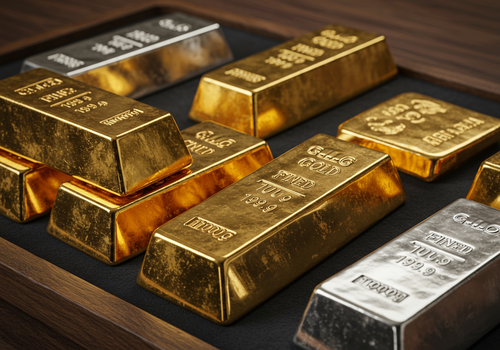
Featured Image generated with Google AI Studio















