x




Gold rose to a six-week high and silver climbed to fresh records as safe-haven interest increased at the start of the week, driven by concerns surrounding Japan’s bond market. U.S. stock indexes slipped but recovered from earlier lows, while a weaker dollar and firmer crude oil added support for precious metals. Gold futures traded around 4,270.20 and silver around 59.22 as technical momentum and chart-based buying strengthened both markets.
Political developments also influenced sentiment, with President Trump signalling he has chosen a new Federal Reserve chair and hinting at future interest-rate cuts. Kevin Hassett is viewed as the likely nominee, a prospect considered supportive for gold and silver. Traders also noted key technical levels, with gold aiming to break resistance near 4,433.00 and silver eyeing 60.00, both maintaining strong bullish postures in the near term. Source
Federal Reserve officials have become increasingly divided over interest rate decisions as slowing job growth and stubborn inflation pull the central bank’s mandates in opposite directions. The recent government shutdown delayed key data, leaving policymakers entrenched ahead of the December meeting, where several dissents are expected regardless of the outcome. Up to five of twelve voting members have expressed doubts about further rate cuts, while several governors firmly support them, raising the likelihood of an unusually split vote. Such division could weaken the Fed’s messaging at a time when markets already question its independence, especially with comments from influential figures like John Williams suggesting more easing while others caution restraint.
Officials are openly debating how dissent affects their influence and the Fed’s ability to guide expectations, with historical research showing markets respond more strongly when policymakers align with the chair. Analysts warn that a narrow split, such as seven to five, would create uncertainty for rates markets and broader risk assets. The rising number of Trump-appointed governors pushing for lower rates and Powell’s term ending in May add a political dimension to the evolving dynamics. Looking ahead, observers note that persistent divisions between regional bank presidents and Washington-based governors could spark deeper governance questions as the balance of political appointments shapes the central bank’s direction. Source
A rare overnight technical outage at CME halted futures trading after a cooling issue at a data centre, but activity resumed ahead of the North American session with limited market disruption. Over-the-counter spot trading continued throughout the halt and showed strong demand for precious metals, helping gold test resistance around 4,200 an ounce and trade near 4,175, while silver hovered just below 54 after an eight percent weekly gain. Analysts noted that the outage occurred during thin holiday trading, muting its practical effect despite sparking conspiracy theories on social media.
Silver’s push toward new highs drew particular attention as persistent physical demand and a long-running supply deficit continued to support prices. Market strategists dismissed claims that the exchange intentionally halted trading to prevent a breakout, emphasizing that the timing was coincidental and that both metals remain in strong uptrends. With U.S. markets partially closed for the Thanksgiving period and spot markets driving price action, gold and silver maintained their upward momentum despite the temporary disruption. Source
Russia’s central bank has started selling gold directly into the domestic market for the first time, providing state companies, banks, and investors access to sovereign reserves as the government struggles with declining liquid assets. The National Welfare Fund’s available resources have plunged from 113.5 billion dollars in 2022 to 51.6 billion dollars in 2025, and its gold holdings have more than halved, pushing the central bank to use gold to stabilize the ruble, cover budget gaps, and ease corporate liquidity strains. Estimates suggest the bank may sell up to 230 tons of gold this year valued at 30 billion dollars and another 115 tons next year, a strategy that offers short-term support but erodes long-term financial resilience.
Analysts warn that relying on gold sales deepens the depletion of liquid reserves and exposes the government to greater vulnerability, especially as sanctions narrow Moscow’s financial options. At the same time, the CBR notes rising central bank demand for gold across emerging markets, driven by efforts to diversify reserves as G7 nations discuss using frozen Russian assets, most of which are held in Europe. Russia’s overall reserves remain sizeable at 734.1 billion dollars, but the growing dependence on asset sales signals mounting pressure on the country’s financial system. Source
Silver has surged to record highs as supply chain disruptions, falling stockpiles in London and China, and expectations of a Federal Reserve rate cut drive strong investment demand. Physical shortages, a multi-year global supply deficit, and industrial consumption outpacing output have tightened the market, pushing silver to 55.33 an ounce and delivering its best weekly gains since 2020. The metal’s rapid ascent has pulled the gold/silver ratio to its lowest point since mid-2024, highlighting silver’s outperformance as traders react to constrained availability and shifting global demand patterns, including concerns over potential U.S. tariffs on critical minerals.
Gold is also benefiting from the renewed momentum across the precious metals sector, breaking above the 4,200 level as traders interpret improving odds of a December rate cut as the end of the recent consolidation phase. Analysts point to robust retail interest, strong central bank accumulation, and expectations of looser monetary policy through 2026 as key drivers supporting higher prices. With limited government economic data available and slowing private-sector employment signalling softer conditions, markets now assign more than an 85% probability to imminent rate cuts, reinforcing bullish sentiment and lifting both metals as traders await key manufacturing, employment, and inflation indicators in the coming week. Source
UBS expects gold demand to strengthen into the first half of 2026 as interest rate cuts, falling real yields, rising fiscal risks, and U.S. political uncertainty drive sustained buying from central banks and investors. The bank has raised its mid-2026 gold target to 4,500 per ounce and its upside case to 4,900, citing the potential for heightened political and financial stress. UBS sees continued strength in ETF inflows, ongoing accumulation by central banks, and resilient bar, coin, and jewelry demand, supported by the World Gold Council’s data showing accelerating purchases. Analysts argue that the recent pullback was purely technical, and that underlying fundamentals remain strongly bullish.
UBS also warns that a more hawkish Federal Reserve or unexpected gold sales from central banks could challenge its outlook, though it maintains that investors remain underallocated and should treat dips as buying opportunities. With central bank purchases on track for 900 to 950 metric tons in 2025 and ETF inflows already exceeding 200 metric tons, the bank sees demand staying robust as fiscal pressures mount and geopolitical risks persist. Spot gold is ending the Thanksgiving week with solid gains, trading around 4,215.96 as investors position ahead of shifting macro and political dynamics. Source
Gold surged throughout the week, repeatedly breaking resistance levels and finishing near record territory after a steady climb from early dips around 4,044. Strong buying across global sessions pushed prices through 4,100, then toward 4,170, and ultimately to a weekly high of 4,226.91 as enthusiasm spread across the metals complex, with silver and copper also strengthening. This momentum reinforced bullish sentiment among both Wall Street analysts and retail investors, with most survey participants expecting further gains in the coming week, driven by expectations of near-term Federal Reserve rate cuts and ongoing geopolitical tensions.
Analysts highlighted technical breakouts, shifting interest rate expectations, and weakening dollar conditions as key drivers supporting the rally, though some warned of volatility tied to upcoming economic data and potential profit-taking after the year’s substantial rise. While several experts projected further upside and even long-term targets above 4,400, a minority anticipated a pullback toward 4,040 due to overextended positioning and evolving geopolitical developments. The week closed with spot gold at 4,215.82, up 3.5 percent and holding most of its gains into the weekend. Source
Silver has reentered the spotlight after years of underperformance, soaring above 56 an ounce and gaining 97 percent since January, while gold pushes toward 4,200 with a 61 percent rise. The gold/silver ratio, which had climbed above 100 in April, has now fallen to 74, suggesting a powerful shift in momentum that some analysts believe could continue toward its long-term average near 50. This sharp reversal reflects investors recognizing the growing scarcity of silver, a metal long overshadowed in the current gold-driven bull market but now asserting itself as industrial demand accelerates and market skepticism fades.
Underlying this surge is a deepening supply imbalance created by five consecutive years of deficits, depleted above-ground inventories, and metal trapped in the wrong locations or forms. Early-year fears of U.S. trade tariffs triggered large inflows of silver into American vaults, tightening supplies elsewhere and magnifying strains in key markets like London and India. Rising Asian demand, record lease rates, and decade-low stockpiles in Shanghai have further intensified the crunch, leaving analysts to conclude that silver’s breakout may represent a sustained structural shift rather than a temporary spike. Source
Gold is holding near 4,238 per ounce as December begins, supported by rising geopolitical tensions and mounting expectations of U.S. monetary easing. Investors are responding to signals that future Federal Reserve leadership may favor lower interest rates, which has pushed real bond yields lower and strengthened gold’s appeal. At the same time, gold continues to benefit from its safe-haven status as conflicts involving Venezuela, China, Russia, and broader Middle Eastern tensions add risk premiums across global markets. These forces have helped extend the strong momentum that began in November, keeping gold firmly above key technical levels around 4,200.
Markets are now watching upcoming U.S. economic data, particularly ISM Manufacturing PMI and the ISM Prices Index, for clues about economic strength and inflation. Softer readings would reinforce expectations for a December rate cut, currently seen as highly probable, and could further support gold by reducing its opportunity cost. Stronger data, however, may temporarily limit upside. For now, sentiment remains positive as both geopolitical risk and dovish Fed expectations continue to shape trading behavior, with the next notable resistance level sitting at 4,300. Source
Gold is trading close to 4,233 per ounce after U.S. manufacturing data showed a sharper contraction in November, with the ISM Manufacturing PMI slipping to 48.2 from 48.7. The weaker-than-expected reading reflected declines in supplier deliveries, new orders, and employment, emphasizing ongoing uncertainty in the industrial sector. Inflation pressures edged slightly higher with the Prices Index rising, while new orders retreated and employment saw a deeper contraction. Production, however, moved into expansion as backlogs eased.
The mixed nature of the report highlighted softer demand conditions paired with pockets of improvement in supply chain performance and inventories. Export and import readings showed modest rebounds, though both remained in contraction territory. Despite the data, gold held firm and traded near the session’s high as the weaker manufacturing environment supported expectations for further monetary easing, helping keep investor interest strong. Source
Gold prices have remained elevated above 4,200 per ounce as rising odds of a Federal Reserve rate cut support investor demand. Despite mixed economic data, markets now see more than an 80 percent chance of a rate reduction at the December Fed meeting, up sharply from just 30 percent two weeks ago. This shift, combined with gold breaking through prior resistance near 4,200, has kept the metal in a strong trading range, reinforcing its safe-haven appeal amid ongoing macroeconomic uncertainty.
Silver is also surging, driven by strong investor demand and tight physical supplies. Inventories at the Shanghai Futures Exchange have dropped to a ten-year low, while COMEX stocks are down 14 percent from October highs, creating backwardation in China’s futures curve. Exchange-traded funds have accumulated significant amounts of silver, with November inflows reversing previous outflows, pushing spot prices to record levels above 58 per ounce and a year-to-date gain of 96 percent. The combination of physical scarcity and robust investor appetite suggests that silver’s rally may continue in the near term. Source
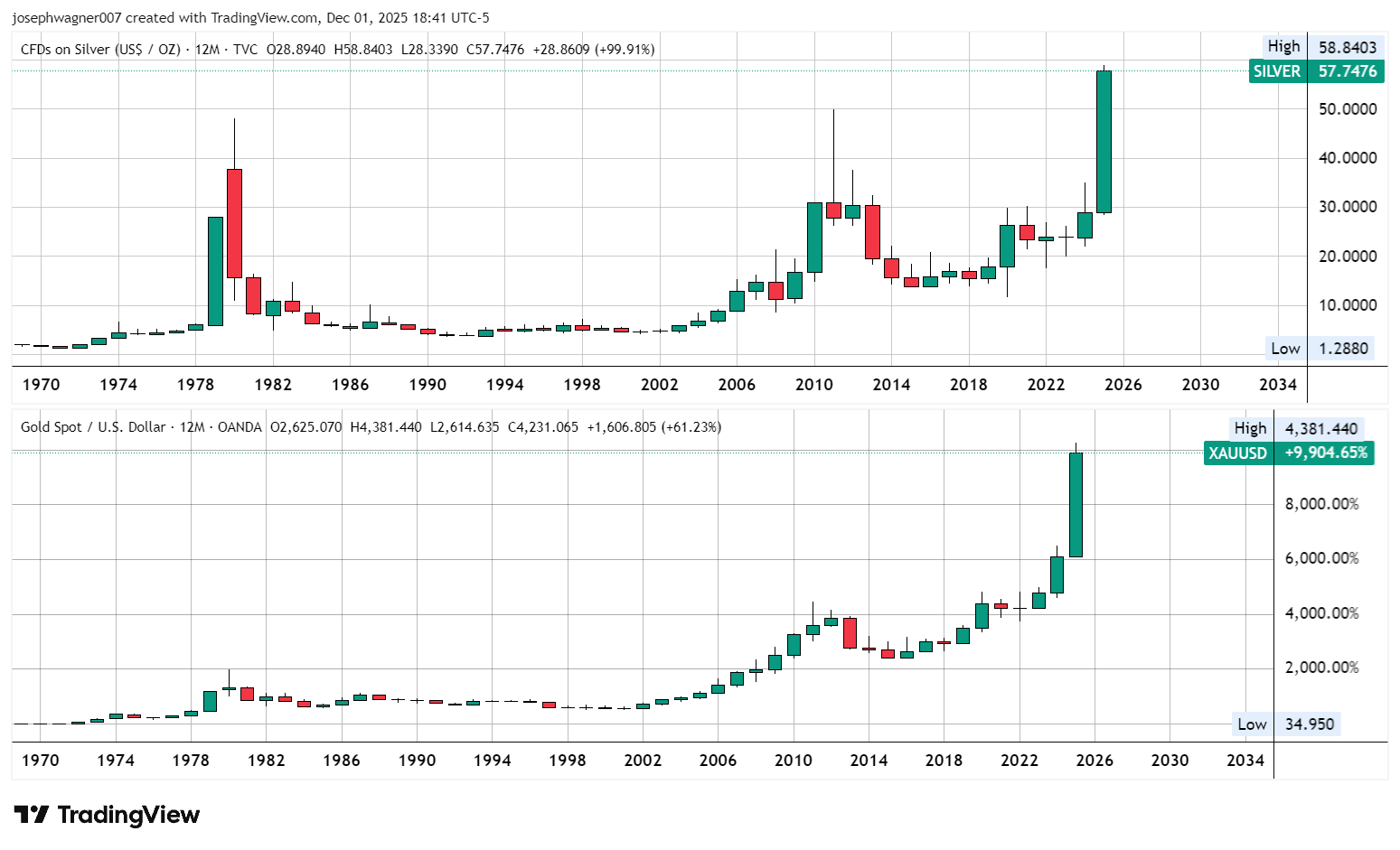
Image Source: Kitco News
Silver futures reached a new all-time high, climbing more than 6 percent in a single session and closing the week up 13.42 percent at 57.08, surpassing the previous record close from mid-October by over 11 percent. While gold has dominated investor attention over the past two years with a 95 percent gain fueled by central bank purchases, geopolitical tensions, and concerns over currency debasement, silver’s rally has been driven primarily by a widening supply deficit. Declining mining output alongside rising industrial and investment demand has created a pronounced imbalance, pushing prices higher and underscoring silver’s growing significance in the precious metals market.
Silver’s accessibility relative to gold has also contributed to its surge, offering retail investors and those priced out of the gold market an affordable alternative for physical precious metals exposure. Over the past twelve months, silver has doubled in value, outperforming gold’s gains in half the time, which may attract renewed investor focus and further fuel demand. Whether this represents a fundamental revaluation of silver or a catch-up trade, the metal has emerged from gold’s shadow, solidifying its relevance as both an investment asset and a critical industrial commodity. Source
Silver surged above 58 per ounce, reaching historic highs amid shrinking inventories, rising investor demand, and ongoing supply concerns. The rally followed disruptions caused by a CME Group outage, but analysts, including Clem Chambers, view the event as secondary to broader structural forces in the silver market. Supply constraints are evident in Shanghai Futures Exchange inventories, which are at nearly decade-low levels, while unusually large shipments from China to London have temporarily eased tightness. Elevated delivery requests on COMEX and persistent industrial demand for solar, electronics, and green-energy applications further underscore the metal’s constrained supply environment.
Chambers emphasized the growing influence of retail investors, noting that individual demand has become a powerful driver behind silver’s rally, supported by renewed inflows into silver-backed ETFs and increased coin and small-bar sales. Global mine production remains largely stagnant, and recycling volumes are stable, creating a structural supply-demand imbalance that could intensify price moves in the future. Chambers believes the current surge represents the beginning of a much larger repricing for silver, driven by constrained supply and strong investment flows, even as he focuses on other commodities like copper, platinum, and oil for potential trades into 2026. Watch the interview
In this week’s Live from the Vault, Andrew Maguire details China consolidating its position as the global physical hub, leaving Western gold and silver markets fractured and increasingly irrelevant as physical bullion flows into Beijing-aligned channels.
The London wholesaler comments on market backwardations and forced sell-downs as silver emerges as a critical pressure point in global bullion flows, with strong physical demand from major institutions steadily pushing prices higher.
Disclaimer: These articles are provided for informational purposes only. They are not offered or intended to be used as legal, tax, investment, financial, or any other advice.
Featured Image - Source: Unsplash















