x





Gold and silver sold off sharply amid a broader market collapse, but Société Générale argues the move was driven by positioning rather than a deterioration in fundamentals. Gold dropped about 10 percent in a single session, its steepest fall since the 2008 crisis, while silver plunged around 30 percent, reflecting rapid deleveraging in overstretched markets. The trigger was news that Donald Trump had selected Kevin Warsh as his preferred candidate for Federal Reserve chair, which briefly boosted the U.S. dollar after a period of weakness. With both metals heavily overbought and liquidity thin, even a modest shift in sentiment was enough to unleash stop-losses, margin calls, and systematic fund selling, particularly at month-end.
Société Générale says the underlying bullish case for gold remains intact and recently reiterated its view that a move toward $6,000 an ounce by year-end is conservative. Options market activity shows downside protection around the December 2026 $4,000 level, but also significant upside interest at $10,000 and even higher strikes, underscoring asymmetric risk skewed to the upside. Silver shows more pronounced downside caution, with heavier put positioning and limited new call buying, reflecting lingering concerns about leverage and volatility. Overall, the bank views the correction as healthy and believes that reduced uncertainty around Fed leadership removes a key risk, leaving the longer-term case for precious metals broadly supportive. Source
Gold and silver traded lower in volatile midday U.S. action after both metals fell to four-week lows overnight, following last Friday’s extreme market moves. Gold slipped to around $4,707 an ounce and silver to roughly $78, pressured by a rebound in U.S. equities and the dollar, alongside sharply lower crude oil prices. Both metals had recently hit record highs before reversing, with silver plunging from above $120 and gold retreating after failing to hold recent peaks. Additional pressure came as CME Group raised margin requirements again, amplifying the impact of already unstable trading conditions.
Sentiment was further weighed down by President Trump’s nomination of Kevin Warsh to lead the Federal Reserve, a move seen as supportive of a stronger dollar given Warsh’s hawkish reputation. Reports also pointed to heavy losses among highly leveraged Chinese traders, with at least 1 billion yuan lost after one major counterparty disappeared, highlighting the role of excessive leverage in the recent collapse. From a technical perspective, gold futures posted a bearish key reversal pattern, suggesting a potential market top, while silver bulls appear to be losing momentum. Both metals now face clearly defined resistance and support levels as traders assess whether the sharp correction has further to run. Source
The sharp selloff in precious metals was driven less by the individual nominated to lead the Federal Reserve and more by the sudden removal of uncertainty around the central bank’s future, according to StoneX analyst Rhona O’Connell. She said markets reacted to clarity itself rather than to Kevin Warsh specifically, noting that the Fed functions as a voting body rather than being controlled by a single chair. This reduction in political and financial ambiguity triggered what she described as the largest liquidity event in market history, unleashing a rapid correction after an extended period of speculative excess.
O’Connell said gold had become dangerously overcrowded with speculative long positions, while silver remains structurally risky due to its leverage and volatility, making it especially vulnerable during sharp reversals. She argued that technical factors amplified the downturn and stressed the importance of technical analysis during such extreme moves, pointing to downside Fibonacci targets around $4,225 for gold and $66 for silver. Platinum and palladium were also highlighted as nearing or reaching key technical levels. Despite the correction, she maintained that concerns over central bank independence remain a longer-term tailwind for gold, even though prices had already been carrying a significant risk premium. Source
Gold’s sharp pullback following a historic rally has shaken investors, but Metals Focus argues the volatility marks a healthy reset rather than the end of the bull market. After logging an unprecedented number of record highs in early 2026, gold and silver became primed for a correction, especially after silver surged roughly 200 percent year over year at its peak. Prices briefly fell below key support levels before rebounding, with gold and silver recovering meaningfully from their overnight lows. According to Metals Focus, such moves reflect the need to release speculative pressure after an extended, relentless rally and do not undermine gold’s role as a long-term store of value.
The firm said underlying fundamentals remain strong, led by resilient physical demand and continued central bank buying expected to total 700 to 800 tonnes this year, well above pre-pandemic levels. Portfolio allocations to gold remain low, meaning even modest increases could support higher prices, while long-term investors such as pension funds and family offices are still underrepresented. Although speculative trading amplified recent volatility, Metals Focus has not changed its outlook, forecasting average prices of about $5,500 by mid-year and $5,800 for the full year. The correction is seen as strengthening the market by resetting sentiment, drawing in physical buyers, and reinforcing the structural drivers of gold demand tied to debt, fiscal risks, and geopolitical uncertainty. Source
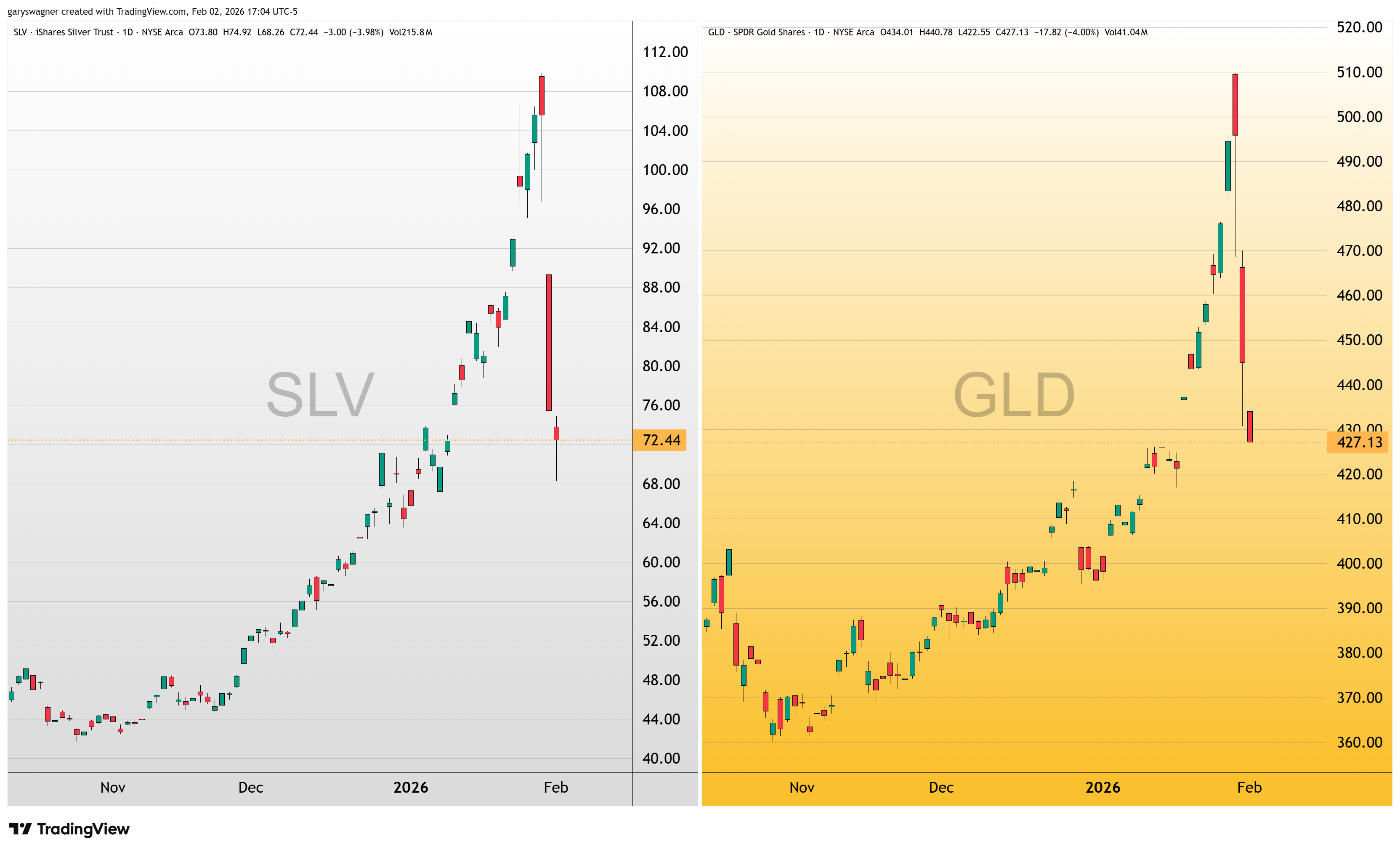
Image Source: Kitco News
Gold and silver prices continued to fall after last week’s extreme volatility, with both metals suffering sharp pullbacks from recent record highs. Silver plunged as much as 30% on Friday and gold dropped nearly 10%, reversing a powerful rally that had pushed silver above $120 and gold past $5,600. From last week’s peaks to recent lows, gold has declined about 21% while silver has lost roughly 41%, prompting debate over whether the move represents a healthy correction within a bull market or a more meaningful turning point.
The selloff has been driven largely by a strengthening US dollar and reduced expectations for aggressive Federal Reserve rate cuts, which lifted the dollar index to multi-session highs. Despite this pressure, many analysts believe the broader bullish case for precious metals remains intact, supported by geopolitical risks, continued central bank buying, and policy uncertainty. Major banks continue to forecast higher prices by year-end, viewing the recent drop as a temporary reset rather than a sustained reversal, with expectations for a near-term stabilization and recovery. Source
Gold prices are stabilizing near the $4,700 level as the metal absorbs stronger-than-expected U.S. economic data. January manufacturing activity surprised to the upside, with the ISM Manufacturing PMI jumping into expansion territory after a contraction in December, signalling renewed momentum across orders, production, and supply conditions. This improvement in factory activity has reinforced expectations of steady economic growth, which typically weighs on gold by supporting a firmer dollar and reducing urgency for monetary easing.
Despite these headwinds, gold has held key technical support following a sharp and historic selloff that briefly pushed prices toward $4,400. Prices have rebounded from overnight lows as buying interest emerges, suggesting the market is attempting to establish a base. While analysts caution that stronger manufacturing data and a resilient economy may limit near-term upside by keeping the Federal Reserve on hold, the metal’s ability to recover and hold support indicates underlying demand remains present even in a less accommodative policy environment. Source
Gold retreated modestly last week but still outperformed other precious metals as global demand reached a record high in the fourth quarter, driven by investor demand for safety, diversification away from the dollar, and strong ETF and physical buying. Despite the pullback in spot prices, gold miners continue to benefit from strong realized pricing and operating leverage, allowing for meaningful margin expansion due to largely fixed cost structures. On the silver side, companies such as Hecla Mining are sharpening their focus on silver production, improving operational efficiency and positioning themselves to benefit from higher silver prices following asset divestitures.
The sector also faces notable pressures, including sharp declines in silver and platinum prices and renewed dollar strength after a more hawkish Federal Reserve appointment, which triggered a broad sell-off across metals. Some producers reported higher costs or production shortfalls, weighing on sentiment. However, opportunities remain as gold equities trade at a significant discount to bullion, suggesting upside potential if valuations realign. Mergers, acquisitions, and financing deals continue to highlight strategic interest in quality assets, even as longer-term threats include reserve replacement challenges and concerns that the silver rally may be nearing exhaustion after historically extreme price moves. Source
Gold’s powerful rally is challenging long-standing valuation models as structural shifts in the global landscape render traditional frameworks less effective. According to WisdomTree’s Nitesh Shah, decades of historical data built around stable inflation, credible central banks, and a rules-based global order no longer capture today’s environment. Gold has surged even without the usual drivers such as extreme speculative positioning or strong, one-way ETF inflows, suggesting prices are being supported by deeper forces tied to institutional uncertainty and declining confidence in the long-term stability of the U.S. dollar. Despite trading below recent record highs, gold does not appear excessively speculative, indicating the move reflects changing fundamentals rather than irrational exuberance.
Persistent geopolitical instability and rising concerns over central bank independence are now central pillars of gold’s strength, as markets increasingly view instability as permanent rather than episodic. Shah also argues that gold remains structurally underowned, with most portfolios holding minimal exposure despite research showing significantly higher allocations could improve risk-adjusted returns. Even modest shifts from bonds into gold could have outsized price effects due to the metal’s relatively small market. While downside risks remain, Shah sees little resemblance to past collapses such as 2013, noting the absence of a clear tightening catalyst and the ongoing emergence of decentralized political and geopolitical risks that are difficult to resolve decisively. Source
Gold and silver saw dramatic selloffs after an explosive January rally pushed both metals into highly overextended territory. Gold posted its largest one-day drop on record shortly after its biggest ever single-day gain, while silver fell sharply after reaching an all-time intraday high. Analysts largely agree that the speed and magnitude of the rally made a correction unavoidable, with extreme positioning, leverage, thin liquidity, and heightened options activity amplifying volatility. The selloff is widely viewed as a technical reset following what many described as irrational exuberance rather than a signal that the bull market has ended.
Despite the violent price action, analysts believe the broader uptrend for precious metals remains intact, supported by persistent geopolitical risks, high government debt, declining confidence in the U.S. dollar, and expectations that gold will continue to act as a store of value amid policy uncertainty. Some see potential for further downside testing toward the mid-$4,600 to $4,700 range, but expect pullbacks to be met with buying interest. Shifting expectations around U.S. monetary policy, including the nomination of a more hawkish Federal Reserve chair and resilient economic data, have contributed to near-term pressure, yet many analysts still expect gold to remain well supported through 2026 as rate cuts, political pressure on central banks, and global uncertainty continue to shape investor behavior. Source
Gold prices remain under heavy pressure as hotter-than-expected U.S. inflation data reinforces concerns that price pressures are becoming more entrenched in the economy. Producer prices rose sharply in December, with both headline and core readings coming in well above forecasts, pushing annual wholesale inflation higher. This data has weighed on gold sentiment, sending prices significantly lower from recent record highs as investors reassess inflation risks and their implications for monetary policy.
The renewed inflation threat raises the possibility that interest rates may stay higher for longer, reintroducing a traditional headwind for gold that the market had recently ignored. With producer prices accelerating, analysts warn that the Federal Reserve may be forced to maintain its neutral policy stance longer than previously expected. While policymakers have signaled comfort with current settings and see reduced risks on both inflation and employment fronts, persistent inflation could limit gold’s ability to recover in the near term as markets adjust expectations for the path of interest rates through 2026. Source
The nomination of Kevin Warsh as the next Federal Reserve chair is not expected to significantly alter gold’s outlook for 2026, although it may slightly shift perceptions of the Fed’s independence from President Trump. Analysts note that Warsh, while experienced and previously a Fed governor, is seen as less politically loyal than other potential candidates, but not inherently more hawkish. This suggests that while tensions between the White House and the central bank may persist, markets still anticipate that interest rate policies could remain accommodative, supporting gold prices amid ongoing uncertainty.
Experts also highlight that gold’s recent correction after rapid gains reflects normal profit-taking rather than a fundamental shift in market trends. With Warsh’s nomination expected to maintain strategic and flexible policy, the probability remains high that the Fed may yield to political pressure for lower rates, which would continue to support the precious metals market. Analysts emphasize that gold is likely to remain well supported, and that investor confidence in the central bank’s leadership will play a key role in stabilizing markets as Warsh establishes his tenure. Source
In this week’s Live from the Vault, Andrew Maguire outlines how gold and silver advances are driven by real physical demand, sovereign accumulation, and institutional repositioning, rather than speculation or bubble narratives.
The London expert explains how rising silver scarcity, strong Asian demand, and increasing physical holdings strengthen the market, absorb paper positions, and shift the market towards a more secure, globally backed monetary system.
Disclaimer: These articles are provided for informational purposes only. They are not offered or intended to be used as legal, tax, investment, financial, or any other advice.
Featured Image - Source: Unsplash















