x





Gold price discovery shifts largely to blockchain networks after US futures markets close for the weekend, according to Iggy Ioppe, chief investment officer at Theo and former CIO at Credit Suisse. When CME gold futures stop trading at 5:00 pm Eastern on Friday and resume at 6:00 pm Eastern on Sunday, most traditional activity takes place through private over-the-counter trades in Asia that are not publicly reported. As a result, tokenised gold assets such as PAXG and XAUt become some of the only continuously traded and publicly visible instruments, effectively driving real-time price formation. When CME trading reopens, prices often reflect movements that have already occurred on blockchain markets, highlighting their growing influence.
The blockchain-based gold market has expanded rapidly, with tokenised gold reaching a market capitalisation of $4.4 billion after increasing by nearly $2.8 billion over the past year, while the number of wallets has almost tripled to 115,000. Gold has accounted for around a quarter of net inflows into real-world assets on blockchain networks, outpacing tokenised stocks, corporate bonds and non-US government debt combined. Market makers and cross-venue liquidity providers dominate trading during the futures market closure, exploiting arbitrage opportunities between digital and traditional platforms, although most major financial institutions still view onchain pricing as informational rather than actionable. Despite improving regulatory clarity, lower liquidity, jurisdictional fragmentation and varying custody and capital rules remain obstacles, and blockchain bullion is expected to develop alongside, rather than replace, traditional gold products. Source
Gold and silver prices are likely to decline further before reaching a floor, despite support from geopolitical tensions and trade uncertainty, according to analysts at Heraeus. They noted that dramatic rallies earlier this year saw silver surge 72% in a month and 322% since the start of 2025, while gold rose 30% and 115% over the same periods. Although silver rebounded to retrace around half of its recent drop and gold recovered roughly 70% of its decline, past episodes in 1980 and 2011 show that similar rallies towards $50 per ounce in silver were followed by prolonged downturns. Previous sharp rallies have typically been followed by declines of 40% to 70%, and while silver has already fallen 37% in just over a week, history suggests it may take months or even years before a lasting low is established. Heraeus said excessive optimism built up during the rapid price surge will likely require more time and lower prices to unwind.
In the near term, the conflict involving Iran has driven safe-haven demand, with missile strikes by the US and Israel and retaliatory action from Iran pushing oil prices higher, equities lower and lifting gold and the US dollar. Gold had already rebounded more than 10% in February, suggesting some geopolitical risk was priced in. Additional uncertainty followed a US Supreme Court ruling that President Trump lacked authority for most of his trade tariffs, though new blanket 10% tariffs have been introduced for 150 days, casting doubt over trade agreements and costs for importers. Heraeus also highlighted that Newmont’s production is expected to fall to 5.3 million ounces in 2026 before recovering in 2027, while silver ETF holdings rose by more than 18 million ounces last week to 834 million ounces, though still below levels at the start of the year. Lower margin requirements on Chinese exchanges could support liquidity, yet both metals have retreated from recent highs, with gold trading around $5,294 per ounce and silver near $87.660 per ounce. Source
Gold remained higher on the day but retreated roughly $100 from its overnight peak, while silver reversed earlier gains and fell sharply as the US dollar index climbed to a five-week high. The stronger dollar, alongside profit taking and weak long liquidation in futures markets, weighed on precious metals. Risk aversion that had dominated overnight trading began to ease by midday. April gold futures were last up $65 at $5,311.50, while March silver fell $4.877 to $87.645. Meanwhile, money markets reduced expectations for interest rate cuts in the US, UK and eurozone as conflict in the Middle East pushed oil prices higher and fuelled inflation concerns. Traders sharply pared back bets on multiple rate reductions by the Federal Reserve, the Bank of England and the European Central Bank, with short-term bond yields rising more than longer-dated maturities in response to stronger inflation signals.
Crude oil reached an eight-month high overnight before easing to around $70.50 per barrel, while the yield on the benchmark 10-year US Treasury note hovered near 4.00%. In gold futures, bulls are targeting a close above the record high of $5,626.80, with resistance seen at $5,434.10 and $5,500.00, while bears aim for a drop below key support at $5,000.00. Silver bulls are looking for a break above $100.00, whereas downside support lies at the February low of $71.815, with nearer levels at $85.00 and $82.50. Market ratings suggest gold retains a stronger technical position than silver, even as both metals pull back from recent highs. Source
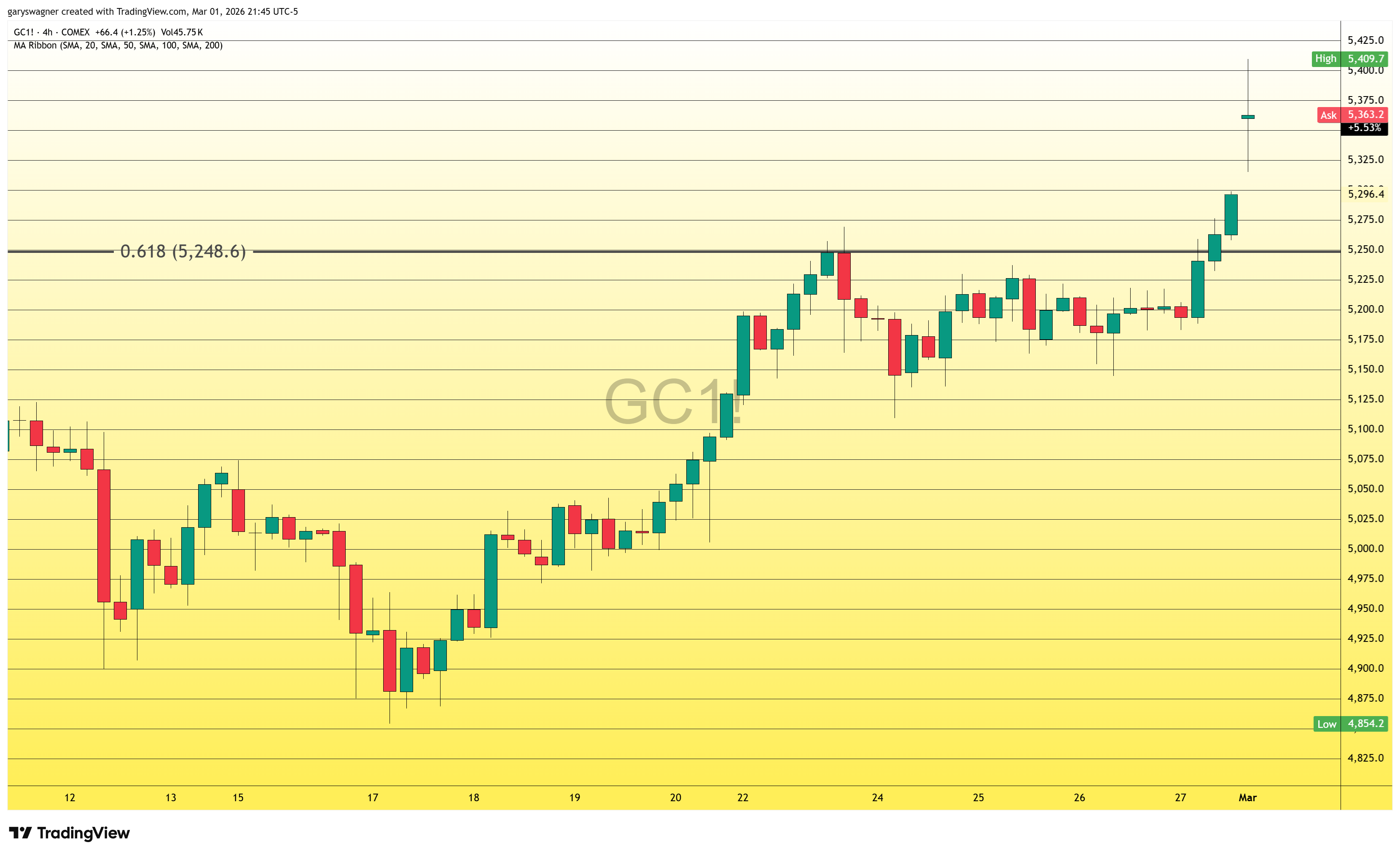
Image Source: Kitco News
Coordinated US and Israeli airstrikes on Iran in the early hours of 28 February 2026, which Iranian state media said killed Supreme Leader Ayatollah Ali Khamenei, triggered immediate retaliation and sent shockwaves through financial markets. Spot gold surged from around $5,100 per ounce to above $5,300 in a single session, later climbing to a high of $5,418 before settling near $5,384, marking one of the largest intraday dollar gains on record. The metal had already risen for seven consecutive months, supported by persistent inflation, central bank buying and trade policy concerns, with major banks such as J.P. Morgan and Bank of America reiterating targets near or above $6,000. Iran’s threat to disrupt shipping through the Strait of Hormuz pushed oil prices up more than 6%, intensifying inflation fears and complicating expectations for Federal Reserve rate cuts, reinforcing gold’s appeal as a hedge against escalating geopolitical and economic uncertainty.
At the same time, the conflict exposed vulnerabilities in the physical bullion market. Temporary flight suspensions at Dubai International Airport, a key transit hub for gold shipments between London and Asia, forced traders to reroute consignments, recalling logistical disruptions seen during the pandemic and highlighting strains in global supply chains just as demand accelerates. Gold later pared some gains as analysts weighed the possibility that sustained oil-driven inflation could prompt tighter US monetary policy, with higher real yields potentially limiting further upside. However, some argue that any prolonged regional escalation would ultimately bolster gold by lifting inflation expectations while safe-haven demand keeps real yields contained, leaving markets braced for a protracted conflict and the prospect of further volatility in bullion prices. Source
Gold traded near session highs after fresh data showed the US manufacturing sector remained in expansion in February, despite a slight slowdown. The Institute for Supply Management said its Manufacturing Purchasing Managers Index eased to 52.4 from 52.6 in January, beating expectations of 51.8. Manufacturing activity continued to expand for a 16th consecutive month, although at a slower pace, with two of the five key subindexes indicating weaker growth and both Employment and Inventories remaining in contraction.
Market reaction saw spot gold climb to an intraday high of $5,419.66 before settling at $5,342.05 per ounce, up 1.20% on the day. Within the report’s components, New Orders expanded for a second month at 55.8, though down from January, while Production slipped to 53.5. The Prices Index surged to 70.5, marking its highest level since June 2022, and the Backlog of Orders rose to 56.6, its strongest reading since May 2022, while the Employment Index edged up to 48.8 but remained in contraction. Source
Gold headed into the weekend above $5,200 an ounce as investors sought protection against the risk of renewed geopolitical tensions in the Middle East, preferring the safety of bullion amid uncertainty. Silver followed suit, consolidating above $93 an ounce and remaining part of the broader safe-haven rally despite cooling momentum. Both metals are closing the month near record levels after a turbulent start, with gold rebounding around 19% from lows near $4,400 and silver surging more than 45% from troughs near $64, underscoring the resilience of the broader uptrend despite early heavy selling.
Beyond geopolitics, rising global debt, persistent fiscal deficits and trade tensions have reinforced gold’s appeal, with some analysts projecting further gains towards $6,000 or even $6,750 as the US political calendar intensifies. However, elevated inflation, with wholesale prices rising 2.9% over the past year, could prompt the Federal Reserve to maintain its policy stance for longer, potentially limiting further upside if rate-cut expectations are delayed. Even so, with uncertainty high and policymakers navigating a complex global landscape, investors continue to add to gold and silver on dips, viewing them as essential portfolio insurance. Source
Paul Wong of Sprott argues that accelerating de-globalisation, rising fiscal dominance and intensifying geopolitical fragmentation are reshaping the global monetary order, strengthening gold’s role as a neutral reserve asset. As alliances fray and countries diversify away from the US dollar, central banks are increasing gold purchases to hedge systemic risk and currency debasement. Wong believes gold is likely to retain a broadly unified global price despite geopolitical blocs, as it serves as a mutually accepted reference point for trade. He contends that persistent deficits, expanding debt and accommodative monetary policy are entrenching a long-term debasement trend, prompting investors and sovereigns alike to rotate into hard assets amid growing doubts about fiat currencies.
He also highlights the breakdown of global metal inventory systems, resource nationalism and strategic competition over refining capacity, particularly China’s dominance in processing critical minerals, as further evidence of a fragmenting world. With governments effectively tolerating higher inflation to manage debt burdens and central banks injecting liquidity to stabilise funding markets, Wong sees a sustained high-inflation environment ahead. In this unstable landscape, he argues gold stands alone as the most credible neutral reserve asset, forming a central pillar of what he describes as an inevitable monetary reset akin to a Bretton Woods III, even if its final structure remains unclear. Source
Gold posted sharp gains through the week, driven by renewed geopolitical tensions and strong technical momentum, climbing from an opening near $5,146 to close at a weekly high of $5,281.15 per ounce. After early advances and a brief pullback to $5,100, prices consolidated between $5,150 and $5,200 before surging on Friday following US evacuation orders in the Middle East, pushing gold to a fresh weekly peak above $5,250. Analysts pointed to persistent safe-haven demand, solid dip-buying and constructive chart patterns, with many arguing that the broader uptrend remains intact despite elevated price levels and occasional profit-taking.
Sentiment surveys reflected the bullish tone, with 67% of Wall Street analysts expecting prices to move above $5,300 in the week ahead and 76% of retail investors forecasting further gains. While some cautioned that easing geopolitical tensions or a significantly stronger-than-expected US jobs report could trigger short-term selling, most market participants highlighted ongoing uncertainty, central bank buying, resilient technicals and continued investor demand as supportive factors. Even those anticipating temporary pullbacks acknowledged that the dominant trend remains higher as gold challenges the $5,300 level. Source
Gold has climbed back above $5,200 an ounce ahead of the weekend as geopolitical tensions in the Middle East fuel renewed safe-haven demand. With the S&P 500 struggling and down nearly 1% on the week at 6,858, analysts say investors are favouring bullion over equities. Spot gold was last trading at $5,232.50, up more than 2% on the week, while silver surged to $93.39, gaining over 10%. February’s rebound underscores the shift in sentiment, with gold up 19% from lows near $4,400 and silver rallying more than 45%, reinforcing their role as portfolio diversifiers during equity weakness.
Despite the strong recovery, some analysts see consolidation rather than an immediate breakout to fresh highs, noting resistance around $5,400 for gold and questioning whether silver can decisively clear $100. Hotter-than-expected wholesale inflation of 2.9% over the past year could complicate the outlook by encouraging the Federal Reserve to hold rates steady for longer, potentially capping gains. At the same time, falling bond yields, with ten-year rates dipping to 3.95%, may present competition if recession fears intensify. Still, with key US data including nonfarm payrolls and retail sales due next week, many expect volatility but maintain that the broader bullish case for gold remains intact. Source
Silver has surged into the low $90s amid what Eric Sprott describes as a mounting physical short squeeze, signalling a structural shift in global capital flows as gold stabilises in the low to mid $5,000s. Speaking ahead of the 2026 PDAC convention, Sprott argued that tightening physical supply is exposing stress in Western paper markets, pointing to recent trading interruptions on the CME and declining inventories on major exchanges including Shanghai. He claims that large short positions, largely held by banks, are increasingly vulnerable as physical stocks are drawn down, particularly in Asia. At the same time, regulatory changes in India allowing mutual funds to allocate up to 35% of assets into gold and silver, alongside a move to domestic pricing benchmarks, mark what he sees as a decisive shift in pricing power from West to East.
Sprott maintains that a reversion in the gold to silver ratio towards 15 to 1, or even 10 to 1, could imply silver prices above $300 given current gold levels, especially as industrial demand tightens supply further. He highlighted direct purchasing agreements between manufacturers and miners as evidence of scarcity, and detailed his own aggressive investment push into junior mining companies, including expanding his stake in Hycroft Mining and backing several other silver-focused firms. Criticising major producers for failing to capitalise on favourable conditions through acquisitions, Sprott argued that the era of paper-driven price suppression is ending and that growing investor rotation into hard assets could trigger a historic repricing across the precious metals sector. Source
Video - The Banks Have ‘Lost Control’: $300 Silver, India’s Bid & the End of Western Pricing - Eric Sprott
A technical failure on the CME Globex platform halted metals and natural gas trading for over 90 minutes on Wednesday, disrupting markets just as silver futures were testing highs above $91 per ounce. The outage led to cancelled day orders while standing GTC orders remained active, prompting confusion among traders and widespread online criticism. Market participants noted the timing was particularly sensitive, coinciding with the first notice day for March silver, and some suggested the disruption raised questions about market integrity amid record physical demand and speculative activity.
Industry observers, including Eric Sprott and Peter Schiff, pointed to accelerating physical outflows in Asia, notably a 10% inventory drop in Shanghai, and argued that Western institutions remain heavily short as supplies tighten. Sprott emphasised that banks hold the bulk of remaining Comex short positions, highlighting a structural squeeze in silver. Despite the outage and market uncertainty, silver broke decisively above $91 on Friday, driven by safe-haven flows ahead of U.S. evacuation orders related to Middle East tensions, closing at $93.47 per ounce for a daily gain of nearly 6%, underscoring the ongoing strength of physical demand. Source
Global financial markets experienced a sudden disruption when the CME Group halted electronic trading for metals and natural gas due to a technical failure on the Globex platform. The suspension occurred just as silver prices tested highs above $91 per ounce, prompting criticism from Peter Schiff, CEO of Euro Pacific Asset Management, who suggested the official explanation might obscure deeper liquidity issues. Metals trading resumed after a short delay, but the interruption coincided with sensitive market timing, notably the first notice day for March silver, raising concerns about transparency and market integrity during a period of significant physical demand.
Schiff also highlighted broader economic challenges, including potential inflation risks linked to President Donald Trump’s One Big Beautiful Bill Act, which proposes sweeping tax cuts while maintaining high entitlement spending. He argued that such policies could undermine purchasing power if financed by money creation. Meanwhile, regulatory changes in India are shifting precious metals price discovery eastward, allowing investors to bypass banks through tokenized gold and silver holdings. Schiff further identified junior gold miners as key targets for institutional investment, citing recent mergers and acquisitions as evidence of growing consolidation and opportunity in the sector. Source
Video - CME Halts and Silver Volatility: Peter Schiff on the Shift to Physical Demand
The yen and euro weakened as tensions in the Middle East intensified, raising concerns over energy supply and prompting investors to seek safety in the U.S. dollar. The conflict, involving Israeli and U.S. air operations against Iran and retaliatory strikes from Tehran, has disrupted regional energy production, including Qatar’s suspension of liquefied natural gas output. Japan’s Finance Minister Satsuki Katayama signalled that currency intervention could be used to support the yen, while markets also awaited comments from Bank of Japan Governor Kazuo Ueda for guidance on potential rate hikes. Analysts highlighted that Europe and Japan remain particularly vulnerable due to their reliance on imported energy, putting pressure on their currencies.
The dollar index rose as safe-haven demand increased, while the euro stabilised slightly after earlier losses and the yen recovered modestly following Monday’s drop. Expectations of delayed U.S. Federal Reserve rate cuts added support to the dollar, with traders now pricing in potential reductions later in the year rather than in July. Other currencies reacted to regional instability, with the Swiss franc strengthening and Australian and New Zealand dollars seeing small gains. Cryptocurrencies were affected as well, with bitcoin and ether both recording declines amid broader market caution. Source
In this week’s Live from the Vault, Andrew Maguire examines the possibility of a historic end to silver price suppression, showing how market intervention, physical demand, and shifting liquidity are putting pressure on Western futures markets.
The precious metals expert explores how China’s accumulation and fully backed benchmarks challenge paper pricing models, exposing risks in legacy short positions and reinforcing the case for transparent, physically backed holdings.
Disclaimer: These articles are provided for informational purposes only. They are not offered or intended to be used as legal, tax, investment, financial, or any other advice.
Featured Image - Source: Unsplash















