x




The Toronto Stock Exchange (TSX) continued its upward trajectory, reaching yet another record high on Monday, driven largely by a broad rally in commodity prices. This surge reflects growing optimism in the resource sector, with energy and mining stocks performing particularly well. The rising price of crude oil, supported by expectations of continued strong global demand and ongoing production cuts from OPEC+, contributed significantly to the TSX's gains. Similarly, an increase in base metal prices, influenced by a recovering industrial economy and potential supply constraints, further bolstered the performance of mining companies on the exchange.
This sustained bullish sentiment on the TSX is indicative of a robust economic environment, especially within Canada's resource-dependent economy. The positive momentum in commodity markets suggests a potential hedge against inflationary pressures, as higher commodity prices can signal strong demand. Investors are increasingly looking towards these sectors for growth, given their historical performance during periods of economic expansion. The sustained record highs on the TSX highlight a confident outlook among market participants regarding the future of commodity prices and the overall health of the Canadian economy. Source
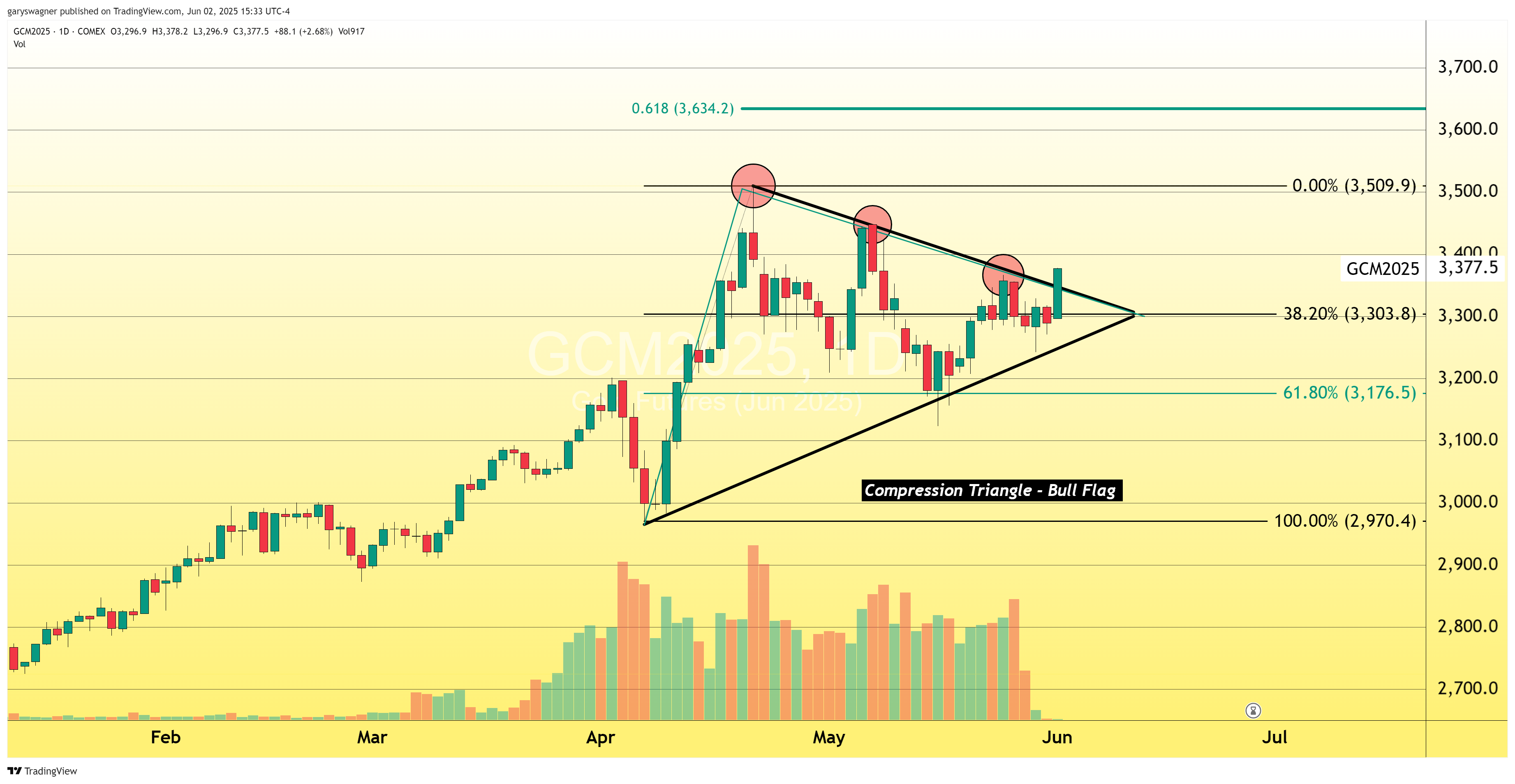
Image Source: Kitco News
Gold prices experienced a significant rally on Monday, driven by strong safe-haven demand as investors sought refuge from escalating global tensions and renewed trade disputes. The precious metal, often seen as a reliable store of value during times of uncertainty, surged by over 2.5%, with June 2025 gold futures settling at $3,377.50, marking a three-week-high. This upward movement was largely catalysed by a confluence of factors, including President Donald Trump's accusations that China violated a recent trade deal and his announcement of plans to double tariffs on steel and aluminium imports to 50% by June 4. These trade frictions, coupled with reports of the European Union considering retaliatory measures, intensified market concerns about global economic stability.
Further contributing to gold's ascent were heightened geopolitical risks, particularly an escalation in the Russia-Ukraine conflict. A successful Ukrainian drone strike reportedly damaged a significant portion of Russia's bomber fleet, occurring just before scheduled peace negotiations that ultimately concluded with no meaningful progress. This intractable conflict, alongside the renewed US-China trade tensions, has reinforced gold's fundamental appeal as a safe-haven asset. The current market environment, characterized by ongoing threats to global economic stability and continued volatility across multiple asset classes, suggests that precious metals markets will remain sensitive to developments on both the trade and geopolitical fronts, positioning gold to benefit from any further deterioration in international relations or economic cooperation. Source
Despite recent volatility, the long-term drivers for gold prices remain firmly in place, suggesting continued upside potential for the precious metal, according to analysts. Key factors underpinning this bullish outlook include persistent geopolitical instability, ongoing inflationary pressures, and the continued weakening of fiat currencies globally. Central bank gold accumulation, a trend that has accelerated in recent years, also provides significant underlying support for prices. However, in the near term, investors should exercise caution due to potential headwinds such as an aggressive stance from the Federal Reserve regarding interest rate hikes and a strengthening U.S. dollar, which could temper gold's appeal.
Market participants are advised to adopt a balanced approach, considering both the compelling long-term narrative for gold and the immediate challenges that could trigger price corrections. While the fundamental arguments for holding gold as a safe-haven asset and inflation hedge are robust, the current economic climate, particularly the trajectory of monetary policy, introduces a degree of uncertainty. Therefore, strategic allocation to gold remains prudent for diversification and wealth preservation, but tactical entry and exit points should be carefully considered in light of evolving macroeconomic indicators and central bank communications. Source
The gold market has experienced significant volatility in recent months, with April and May 2025 seeing considerable price swings. Despite these rapid shifts and the often overwhelming "noise" of daily market fluctuations, investors are urged to step back and focus on the long-term fundamentals that continue to support gold. President Donald Trump's "weaponization" of U.S. trade policy and erratic decisions are pushing central banks globally to diversify away from the U.S. dollar, with gold remaining the only global monetary asset free from third-party risk. This ongoing trend, coupled with persistent economic uncertainty and geopolitical instability, ensures that central banks will continue to accumulate gold, solidifying its role as a critical safe-haven asset.
Furthermore, economic data indicates a potential slowdown in U.S. consumption, as reflected by a contraction in the first-quarter GDP and a rise in the savings rate. This consumer cautiousness, as individuals brace for a potential economic storm, positions gold to shine as a protective asset. The article emphasizes that while short-term market movements can be distracting, the underlying drivers for gold, such as declining trust in fiat currencies, trade tariffs impacting the economy, and the enduring appeal of gold as a non-sovereign asset, suggest a path for gold to "break through the noise" and continue its upward trajectory. Source
Gold prices surged on Monday, finding strong support as a confluence of economic woes and intensifying trade tensions rekindled safe-haven demand among investors. The precious metal, a traditional refuge during times of uncertainty, benefited from disappointing U.S. ISM manufacturing PMI data, which indicated a continued contraction in the industrial sector and raised concerns about decelerating economic momentum. This weak macro data typically leads to lower Treasury yields and fuels expectations of easier monetary policy, both of which are generally supportive of gold prices. However, the primary catalyst for gold's rally was the escalating geopolitical and trade backdrop, particularly President Trump's announcement of a new 50% tariff on steel imports, which sent shockwaves through global markets and heightened fears of inflationary pressures and a potential stagflationary environment.
The re-emergence of U.S.-China trade tensions and the ongoing Russia-Ukraine conflict further solidified gold's appeal as a dual hedge against inflation and geopolitical risk. Investors are increasingly seeking the relative safety of precious metals as equity markets become more volatile. Rising ETF inflows into bullion-backed funds signal that institutional investors are also seeking cover amidst the uncertainty. While there's a flicker of optimism for potential constructive engagement between leaders, the market remains unconvinced of a quick or painless resolution. This environment, characterized by persistent geopolitical risk, slower global growth, and policy uncertainty, is structurally supportive for gold, suggesting its safe-haven bid is likely to continue in the weeks ahead. Source
Gold prices maintained their position near session highs on Monday, continuing to attract safe-haven bids despite disappointing economic data from the U.S. manufacturing sector. The Institute for Supply Management (ISM) reported that its Manufacturing Purchasing Managers Index (PMI) fell to 48.5% in May, a slight decline from April's 48.7% and below the anticipated 49.3%. This indicates a deeper contraction in the manufacturing sector. While the immediate reaction in the gold market to this specific data point was not pronounced, analysts suggest that weak manufacturing numbers tend to offer underlying support for gold due to rising fears of a potential recession. Spot gold was last trading up 2.5% on the day at $3,371.70 an ounce, with the overall bullish momentum driven more significantly by escalating geopolitical tensions at the start of the week.
The ISM report highlighted broad-based weakness within the manufacturing economy, with 57% of the sector's GDP contracting in May, an increase from 41% in April. While the New Orders and Production Indexes saw minor increases, they remained in contraction territory. The Employment Index also continued to struggle, staying below 50%. The Prices Index, however, remained elevated at 69.4%, suggesting persistent inflationary pressures. Economists noted that headwinds from U.S. government trade policies, including tariffs and associated uncertainty, are beginning to impact the manufacturing sector. The Federal Reserve is expected to take note of these widespread price increases, which could signal a pickup in inflation later in the year, potentially influencing their monetary policy decisions. Source
According to analysts at Heraeus, the demand for physical gold in the form of bars and coins is currently lagging behind the robust demand for gold-backed Exchange Traded Funds (ETFs), even as overall gold prices rally. Despite gold's significant appreciation year-to-date, with strong investor demand for stability and long-term value preservation, physical sales remain relatively weak. Data from the World Gold Council for Q1 2025 indicates only a 3% year-on-year improvement in total bar and coin demand, with sales from major global Mints, such as the US Mint's Gold Eagle coins, showing a 40% year-on-year decrease to the end of April. This suggests that investors are primarily utilizing ETFs to gain exposure to gold, particularly in Asia, rather than opting for direct physical purchases, which may be influenced by the elevated price of gold.
The article also highlights a "two-sided risk" for silver prices, largely influenced by the volatile demand from China's solar production sector. While China is experiencing a record-breaking year for photovoltaic capacity deployment, with 105 GW installed as of April 2025, there's a risk that solar silver demand may remain flat or even fall slightly below last year's level. This is attributed to the rapid increase in silver nitrate production in April, followed by a reported decline in capacity utilization at silver nitrate plants, suggesting a potential downside risk for solar silver demand in the coming months. This inconsistency in demand from a major industrial consumer creates uncertainty for silver prices, which, despite outpacing gold's strong performance on Monday, are subject to this fluctuating industrial influence. Source
Gold and silver prices experienced significant gains on Monday, with gold reaching a three-week high and silver hitting a two-month high, driven by a strong resurgence in safe-haven demand. This renewed interest in precious metals comes as trade tensions between the world's two largest economies, the U.S. and China, are escalating once again. President Trump's recent accusations of China violating a trade deal and his announcement of increased tariffs on steel and aluminum have heightened global market uncertainty, pushing investors towards traditional safe-haven assets. Additionally, a weaker U.S. dollar index and rising crude oil prices are acting as further bullish external factors for the precious metals, reinforcing their appeal in a climate of increasing risk aversion.
The escalating geopolitical landscape, particularly the Russia-Ukraine conflict, also played a significant role in fueling safe-haven buying. Reports of a successful Ukrainian drone strike damaging Russia's bomber fleet just prior to peace negotiations that yielded no significant progress added to the global instability. Furthermore, warnings from financial figures like JP Morgan chief Jamie Dimon regarding a potential "crack in the bond market" due to spiraling U.S. national debt have contributed to the risk-off sentiment. These combined factors—resurfacing trade wars, ongoing geopolitical conflicts, and concerns over global financial stability—are creating a conducive environment for gold and silver to continue attracting strong investment as investors seek security and diversification. Source
Despite recent consolidation, the gold market is poised for further gains driven by ongoing economic uncertainty and geopolitical instability, which continue to fuel safe-haven demand. However, MarketGauge's Chief Market Strategist, Michele Schneider, suggests that silver presents an even more compelling opportunity. While she has been neutral on both metals, she indicates a strong buy signal for silver if it breaks decisively above $34 an ounce, potentially paving the way for $40. This outlook is supported by a recent spike in the gold/silver ratio to a five-year high of 107 points, which has since dropped below its 50-day moving average, signaling a potential rotation into silver, similar to the pattern observed in 2020 when the ratio corrected significantly after reaching record highs.
A key factor expected to propel both gold and silver higher is the anticipated action from the Federal Reserve. Schneider believes that the Fed will be compelled to cut interest rates sooner rather than later, despite elevated inflation, due to a slowing economy. Furthermore, the U.S. dollar is facing significant downside risk, having broken below an eight-year business cycle, due to growing sentiment among foreign investors that they cannot trust the U.S. This diminishing trust in the U.S. dollar will continue to benefit both precious metals, although gold holds a unique advantage as a more important monetary metal favored by central banks for their reserves. Source
The World Gold Council (WGC) is advocating for gold to be recognized as a High-Quality Liquid Asset (HQLA) under Basel III regulations, arguing that its performance rivals that of long-term U.S. Treasuries, which are already classified as such. While gold is currently recognized as a Tier-1 asset under Basel III, allocated gold held in bank vaults enjoys the same recognition as cash, and gold used as collateral is subject to a 20% haircut. However, unallocated gold is treated like other commodities, facing an 85% required stable funding factor, due to its non-HQLA classification. The WGC's latest report highlights that gold has consistently demonstrated key characteristics of HQLAs over the past six months, a period marked by significant market volatility. This includes comparable volatility to 30-year U.S. Treasury bonds, narrow bid-ask spreads even during stress periods, and a deep pool of liquidity with average daily trading volumes similar to U.S. Treasuries.
The WGC emphasizes that gold's universal recognition, freedom from credit risk, and acceptance across borders make it uniquely suited to meet the global and stress-tested liquidity standards required for Level 1 HQLA classification. This call comes in contrast to a recent European Central Bank (ECB) paper that questioned gold's safe-haven role and warned of potential market destabilization from renewed investment demand. Despite such concerns, the WGC's research underscores gold's resilience and liquidity, arguing that its consistent performance during crises, low correlation with risky assets, and active market solidify its position as a high-quality liquid asset that should be formally acknowledged within the Basel Framework. Source
In this week’s Live from the Vault, Andrew Maguire reveals how BRICS nations, led by China, are accelerating the Basel III shift to physical gold, as the US faces rising pressure to audit Treasury holdings and expose the true state of its gold reserves.
With bullion banks trapped in derivative losses and June market tightness signalling limited supply, Andrew tracks a bullish coiling pattern in gold and silver, pointing to a looming price revaluation that Western institutions can no longer stall.
Disclaimer: These articles are provided for informational purposes only. They are not offered or intended to be used as legal, tax, investment, financial, or any other advice.
Featured Image - Source: Unsplash















