x




The World Bank forecasts that gold and silver will continue their strong performance through 2026, with gold expected to average around $3,575 per ounce and silver about $41 per ounce. This represents moderate gains of 5% and 7.9%, respectively, compared to current levels, following a period of remarkable growth driven by investment demand, geopolitical tensions, and a weakening U.S. dollar. Gold prices are anticipated to increase by 42% in 2025, marking one of the most significant rallies since the late 1970s. However, the World Bank emphasizes that this surge is largely supported by unprecedented central bank purchases rather than by inflation or energy shocks as seen in previous cycles.
By 2027, the World Bank expects the rally to fade, with gold prices declining to around $3,375 per ounce and silver dropping to $37 per ounce, though both metals are projected to remain well above their 2015–2019 averages. Silver’s continued strength will likely be underpinned by its dual role as a safe-haven asset and an industrial metal vital to renewable energy and semiconductor production. The outlook remains cautiously optimistic, as renewed geopolitical tensions or financial volatility could push prices higher than projected, while easing tensions or tighter monetary policy could dampen demand. Source
Federal Reserve officials are increasingly split ahead of their December 9–10 policy meeting, with contrasting views on whether to continue cutting interest rates amid uncertainty caused by the federal government shutdown. Fed Governor Lisa Cook described the situation as a balance between maintaining employment and controlling inflation, emphasizing that keeping rates too high risks damaging the labor market, while cutting them too much could unanchor inflation expectations. Her remarks come amid her legal dispute with former President Trump over his attempt to remove her from office, with the Supreme Court expected to hear the case next year.
Other Fed officials have expressed sharply different opinions, highlighting the deep division within the central bank. Governor Stephen Miran advocates for deeper rate cuts, arguing that restrictive policies threaten economic stability and that strong financial markets do not necessarily indicate loose monetary policy. Conversely, Chicago Fed President Austan Goolsbee and Kansas City Fed President Jeffrey Schmid warn that inflation remains too high and that further easing could worsen the problem. San Francisco Fed President Mary Daly maintains an open stance, supporting cuts only if the labor market shows signs of weakening. The split underscores the complexity of the Fed’s dual mandate and signals a contentious debate heading into the December meeting. Source
Ray Dalio, founder of Bridgewater Associates, argues that gold should be viewed as fundamental money rather than a speculative asset, advising investors to hold 5% to 15% of their portfolios in gold, and even more during times of war or fiat currency devaluation. He explains that throughout history, monetary systems have alternated between asset-backed and fiat currencies, with the latter often leading to inflation and loss of purchasing power when excessive debt or money creation occurred. Since the world moved entirely to fiat currency in 1971, Dalio notes that central banks have repeatedly resorted to creating money during crises, typically resulting in higher gold prices. Gold’s enduring strength, he says, comes from its independence from governments or intermediaries and its resilience against confiscation, cyberattacks, and devaluation, making it the most reliable form of money over centuries.
Dalio emphasizes that gold performs well during monetary breakdowns, debt crises, and conflicts, as it maintains value when other assets fall. He considers gold not just as a hedge, but as a strategic component of a well-balanced portfolio, determined by its risk, return, and correlation characteristics rather than short-term speculation. Most investors, he contends, mistakenly treat gold as a market-timing asset rather than as part of a long-term allocation. While gold is not productive like stocks or bonds, Dalio believes it remains essential in preserving wealth and protecting against systemic risks. In times of heightened geopolitical or monetary instability, he advises overweighting gold holdings as a safeguard against loss of value in fiat money. Source
Gold prices appear to be stabilizing around the $4,000-per-ounce level, despite ongoing selling pressure and uncertainty about the Federal Reserve’s next moves. The Fed’s recent 25-basis-point rate cut met expectations, but Chair Jerome Powell’s cautious remarks cast doubt on whether another cut will follow in December. This shift in sentiment, combined with easing U.S.-China trade tensions, has limited gold’s safe-haven appeal, keeping prices near $3,900 an ounce. Analysts say gold currently lacks the momentum to break above resistance, with key levels identified at $4,050 and $4,175. While near-term direction remains uncertain, several market strategists suggest that weaker labor market data or continued rate cuts could help gold regain bullish traction.
Despite recent weakness, the long-term outlook for gold remains positive, supported by central bank demand and its role as a portfolio hedge amid persistent geopolitical and economic risks. Analysts expect continued consolidation as markets digest mixed signals from monetary policy and global trade developments. Some believe that a sustained close above $4,000 could improve sentiment, while dips below $3,950 present potential buying opportunities. Broader economic factors — including the prolonged U.S. government shutdown, rising consumer stress, and upcoming economic data on employment and manufacturing — will likely influence short-term movements. For now, patience and cautious optimism dominate the outlook as gold holds steady near this critical price threshold. Source
Gold prices spent the week fluctuating around the $4,000-per-ounce mark, with attempts to rally repeatedly stalling amid shifting expectations for U.S. monetary policy and easing trade tensions between the United States and China. Spot gold began the week near $4,105 before sliding to a low of $3,886 and then rebounding toward $4,037 as traders reacted to comments from Federal Reserve Chair Jerome Powell, who signalled that another rate cut in December was uncertain. This uncertainty, combined with the ongoing government shutdown and a stronger dollar, has kept gold in a tight trading range. Analysts remain divided, with some predicting further tests below $4,000, while others view the recent stabilization as a sign of resilience and potential support for renewed gains.
The latest Kitco News Weekly Gold Survey reflected this split sentiment, with Wall Street analysts evenly divided between bullish, bearish, and neutral outlooks, while retail investors remained firmly optimistic. Many traders see gold’s consolidation as a healthy pause after its strong rally earlier in the year, expecting continued range-bound movement until new catalysts emerge. Upcoming U.S. economic data, including manufacturing and services PMI reports, ADP employment figures, and consumer sentiment readings, could influence short-term direction. Despite short-term weakness, several experts maintain that gold’s long-term fundamentals remain intact, supported by central bank demand, inflation concerns, and historical patterns of seasonal strength from November through January. Source
Gold prices are stabilizing near $4,000 per ounce after an 11% correction from recent highs, marking a second consecutive week of declines. Despite this pullback, sentiment among investors and industry participants remains strongly optimistic, with forecasts from the London Bullion Market Association’s annual conference suggesting gold could test levels just below $5,000 per ounce within a year. Major banks including HSBC, Bank of America, and Société Générale echo these expectations, predicting a rise to $5,000 by 2026. Analysts attribute the metal’s resilience to ongoing geopolitical risks, a likely shift toward looser Federal Reserve policy, and a softer U.S. dollar, all of which support demand for safe-haven assets.
While the World Bank and Natixis have issued more conservative outlooks, expecting gold to average between $3,800 and $3,575 in 2026, neither expects a downturn. Central banks continue to provide a strong foundation for the market, with global purchases expected to total between 750 and 900 tonnes this year after accumulating over 3,000 tonnes since 2021. Additional buying interest from institutions such as South Korea’s central bank underscores this trend. Analysts see the current consolidation phase as an opportunity for investors to establish strategic positions, anticipating that gold’s next major rally could push prices closer to the long-awaited $5,000 milestone. Source
Market strategist Gareth Soloway has cautioned that despite Wall Street’s record-breaking rally led by major technology firms, the market may have reached a critical peak. The S&P 500 surged near 6,900 points, driven by gains from giants like Amazon and Nvidia, which recently surpassed a $5 trillion market capitalization. However, Soloway argued that the market’s elevated valuation levels and investor euphoria reflect exhaustion rather than sustainable growth. Comparing the current AI-driven rally to the 2000 dot-com bubble, he warned that extreme valuations relative to GDP—such as Nvidia’s market cap equating to 16% of U.S. GDP—signal a possible speculative bubble. He further noted that institutional investors appear to be selling into the rally while retail investors continue to buy, an imbalance that often precedes market corrections.
Supporting his bearish outlook, Soloway highlighted growing disparities in the economy, describing a “K-shaped recovery” where wealthier households benefit from asset growth while lower-income consumers struggle with debt and slower wage gains. U.S. credit card debt has climbed to $1.33 trillion, and spending patterns show declining demand for luxury goods while discount retailers thrive. Soloway also pointed to Bitcoin’s muted performance as a potential warning sign for stocks, noting that in previous cycles, Bitcoin peaked weeks before major equity selloffs. Despite the risks in equities and cryptocurrencies, he views gold’s recent pullback as a strong buying opportunity, projecting a potential rise to $5,000 by 2026. Watch the full interview with Gareth Soloway
Gold prices hovered near $4,030 per ounce after new data revealed further weakness in the U.S. manufacturing sector. The ISM Manufacturing PMI fell to 48.7 in October from 49.1 in September, missing expectations for a 49.5 reading and signaling a deeper contraction. According to ISM Chair Susan Spence, declines in production and inventories contributed to the weaker figure, reflecting continued uncertainty and a lack of sustained growth in the sector. While some components showed modest improvement, including new orders and employment, most indicators remained in contraction territory, underscoring ongoing headwinds for manufacturing.
The ISM report presented a mixed picture overall, with inflation pressures easing as the Prices Index declined to 58 from 61.3, while production slowed and inventories fell further. The Supplier Deliveries Index rose to 54.2, suggesting slower delivery times for the third consecutive month, and the Inventories Index dropped to 45.8. Despite some improvement in demand-related indicators, such as new and export orders, manufacturing activity continues to contract. Following the report’s release, spot gold extended gains, last trading at around $4,028.64 per ounce, up 0.65% on the day as investors responded to signs of economic softening. Source
Gold prices edged higher while silver dipped slightly as both precious metals steadied following recent volatility. Near midday Monday, December gold rose by $13.20 to $4,010.40, while December silver slipped $0.105 to $48.055. Market participants noted that after recent fluctuations, prices have stabilized, creating a neutral environment for traders awaiting new catalysts. In broader markets, the U.S. dollar index ticked slightly higher, crude oil traded around $61.25 per barrel, and the 10-year U.S. Treasury yield stood at 4.11%.
In international news, China’s decision to remove a long-standing tax incentive on gold sales is expected to raise costs for domestic buyers while boosting government revenue. The change affects both investment-grade gold products and jewelry or industrial uses. In technical trading terms, December gold futures face resistance at $4,100, with support near $3,800, while silver’s resistance stands at $50 and support at $45. Both metals hold a Wyckoff Market Rating of 6.0, indicating mild bullish control as traders monitor for fresh fundamental developments to drive the next major price move. Source
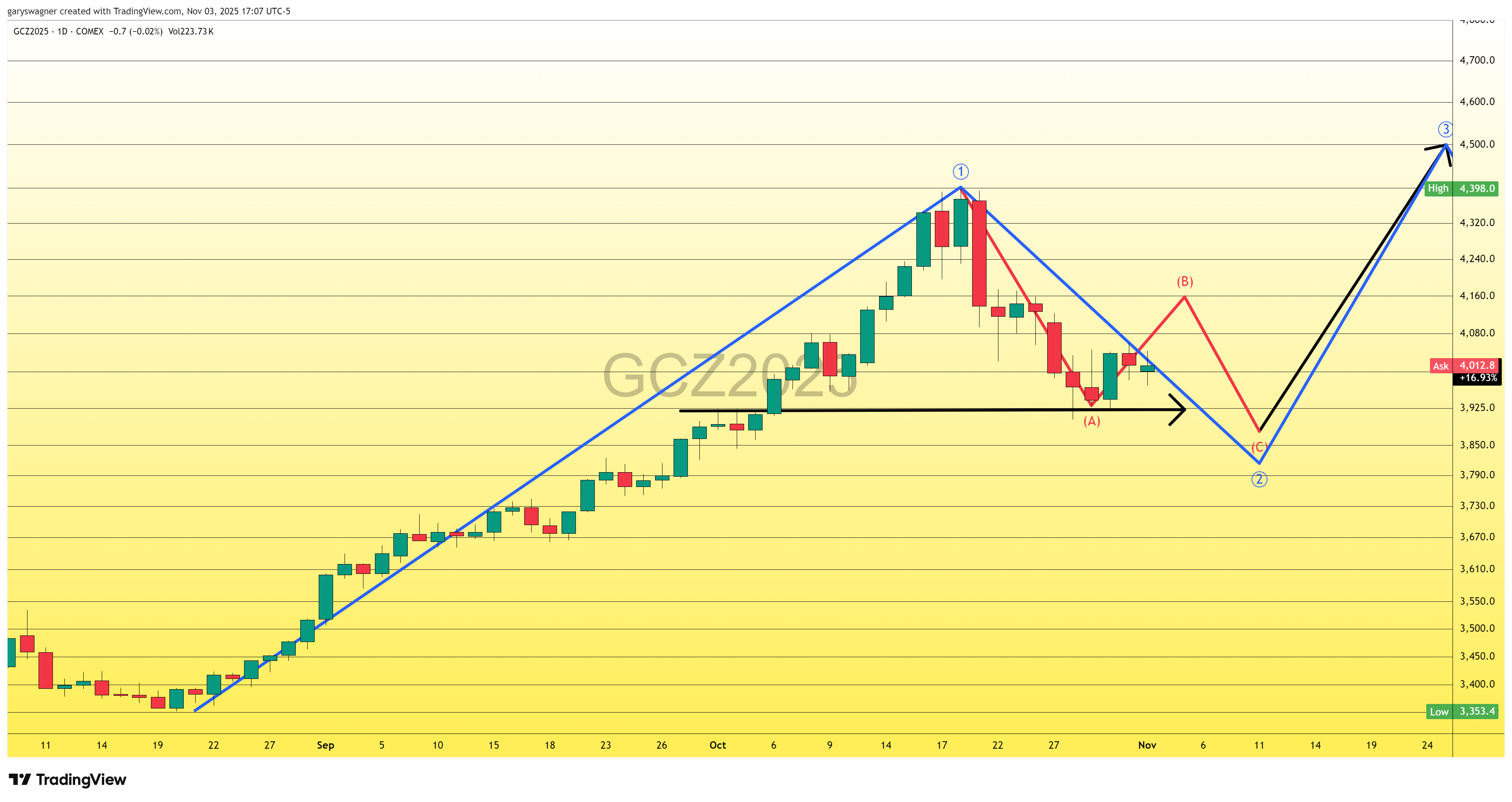
Image Source: Kitco News
Gold prices remained above $4,000 as traders assessed upcoming employment data amid an uncertain monetary policy environment. December gold futures settled at $4,013.80, unchanged from Friday, showing resilience despite pressure from a stronger U.S. dollar. Market participants are closely watching the ADP non-farm payroll report for insights into labor market conditions, which could influence the Federal Reserve’s decisions at its December meeting. Expectations for a December rate cut have fallen sharply, reflecting a recalibration after recent Fed comments and a 25-basis-point rate reduction at the latest FOMC meeting.
In addition, developments in China, the world’s largest gold consumer, have added new complexity for the precious metals market. The removal of a long-standing tax exemption for gold retailers sparked immediate selling pressure on major jewelry stocks, while silver prices fell more noticeably, closing below $48. The greenback’s recent strength has also weighed on metals, with the U.S. Dollar Index approaching 100 following a sustained four-day rally. Market analysts suggest that the combination of monetary policy shifts, currency movements, and demand trends in key markets will continue to influence gold and silver prices in the near term. Source
Gold prices are stabilizing around $4,000 an ounce after a modest correction, marking an 11% decline from last week’s highs. Despite this pullback, long-term sentiment remains strongly bullish, with delegates at the London Bullion Market Association’s Global Precious Metals Conference predicting gold could approach $5,000 an ounce within the next year, a gain of roughly 25% from current levels. Major banks such as HSBC, Bank of America, and Société Générale, along with research firm Metals Focus, echo similar forecasts for gold and silver, citing supportive factors including global geopolitical uncertainty and expectations for looser U.S. monetary policy that could weaken the dollar.
Central bank activity continues to underpin the market, with purchases of approximately 200 tonnes in the third quarter and projections of 750 to 900 tonnes for the year. South Korea’s central bank also indicated potential future acquisitions, reflecting sustained long-term demand. While some institutions like the World Bank and Natixis offer more moderate forecasts, even these anticipate prices well above historical averages. Analysts suggest that current consolidation offers strategic opportunities for investors to position themselves ahead of a potential major rally in gold, as overall market fundamentals remain supportive. Source
Coeur Mining announced it will acquire New Gold in an all-stock transaction valued at approximately $7 billion, creating a major North American-focused precious metals producer. The deal, the largest gold-sector merger of 2025, comes amid gold prices above $4,000 an ounce and reflects a broader industry trend toward consolidating assets in politically stable regions. Under the agreement, New Gold shareholders will receive 0.4959 shares of Coeur for each New Gold share, representing a 16% premium, with Coeur shareholders owning 62% and New Gold shareholders 38% of the combined company. Analysts view the merger as a strategic move in a "two-tier" market, allowing the new entity to gain scale, access cheaper capital, and attract major index funds.
The merged company will operate seven mines across Canada, the U.S., and Mexico, including Rainy River, New Afton, and five Coeur operations. It is projected to generate $3 billion in EBITDA and $2 billion in free cash flow in 2026, positioning it as a significant cash flow powerhouse. Both companies emphasized the strategic benefits of scale, jurisdictional safety, and long-term growth, while maintaining key offices and exploring a Toronto Stock Exchange listing. The deal is expected to close in the first half of 2026, pending shareholder and regulatory approval. Source
In this week’s Live from the Vault, Andrew Maguire explains how the mid-October gold and silver correction forced short-term traders to sell on COMEX, transferring physical metal to long-term holders and creating a solid base for the next rally.
The precious metals expert highlights tight COMEX liquidity, steady sovereign accumulation, and the shift from paper to physical markets, noting that both gold and silver are set for a strong rebound that could leave speculative traders behind.
Disclaimer: These articles are provided for informational purposes only. They are not offered or intended to be used as legal, tax, investment, financial, or any other advice.
Featured Image - Source: Unsplash















