x





Silver Price News: Silver Rebounds to One-Week High
Silver prices made gains for a second day on Tuesday, rebounding back above the $31.00 an ounce mark as the markets increased bets on upcoming interest rate cuts.
Prices climbed to an intraday high of $31.21 an ounce, compared with around $30.65 an ounce in late trades on Monday. That was the highest price for silver since November 25th.
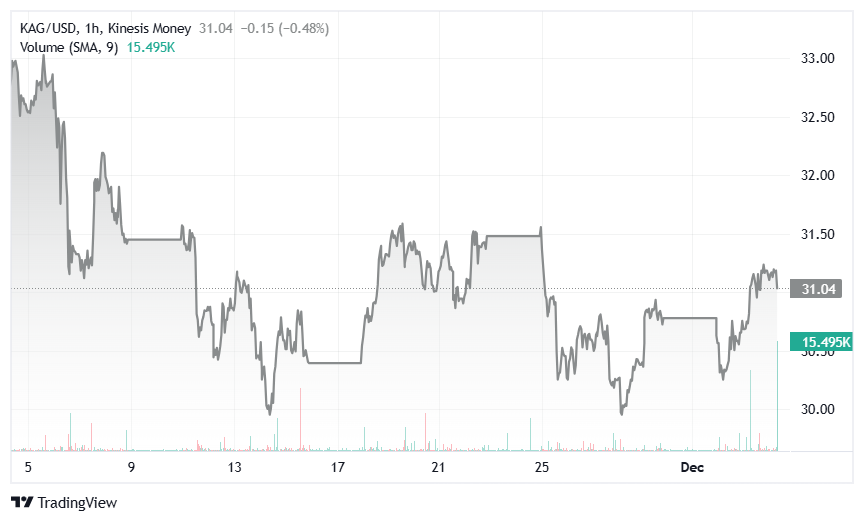
Silver KAG/USD – 1hr view – Kinesis Exchange
US interest rate cut seen in coming weeks:
The markets appear to be increasing bets on an interest rate cut by the US Fed at its upcoming meeting on December 18th – a supportive factor for non-interest-bearing assets like gold and silver. Data from interest rate traders suggests a 74% probability of a 25-basis point cut at the December meeting, compared with around 65% a few days ago.
Technical analysis:
On the technical charts, a potentially supportive price signal has come from a ‘double bottom’ that emerged in recent weeks when prices twice tested downside support at around $29.90 an ounce on November 14th and again on November 28th. A rally above $31.30 an ounce would help solidify this as a bullish indicator. This level also coincides with rising oblique minor support at $29.90 an ounce, which helps explain silver’s reluctance so far to break below this level. Silver also crossed the 20-day moving average on Tuesday at $30.77 an ounce. Should this renewed positive momentum continue, silver may encounter rising oblique minor resistance at $31.55 an ounce. Read More
Gold Price News: Gold Edges Higher Ahead of US Economic Data
Gold prices were slightly higher on Tuesday, gaining modest ground from Monday’s dip to below $2,630 an ounce.
Prices moved in a narrow range of $2,634 to $2,655 an ounce on Tuesday, compared with around $2,642 an ounce in late deals on Monday. However, the day’s price action showed a modest increase from Monday’s intraday low of $2,623 an ounce.
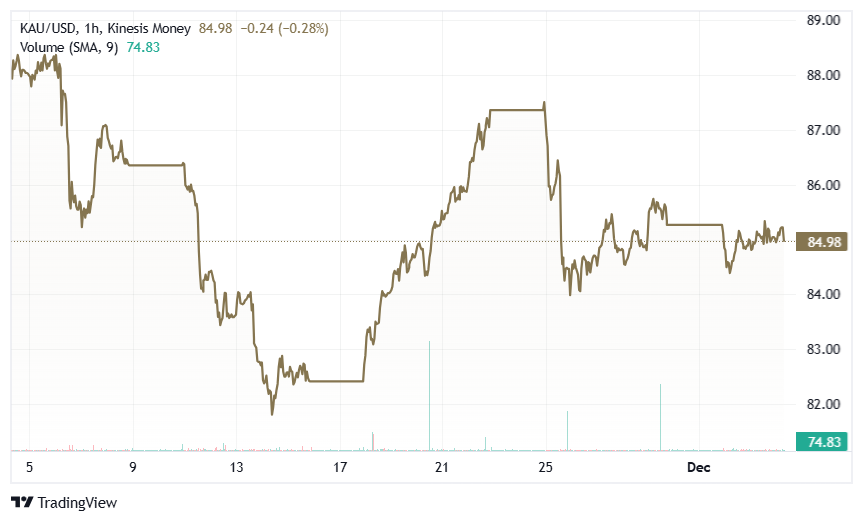
Gold KAU/USD – 1hr view – Kinesis Exchange
Barring a slight uptick, the markets were broadly stable on Tuesday, looking ahead to the latest round of US economic figures on Wednesday.
Markets eye further interest rate cuts:
The US JOLTs job openings figures came out on Tuesday showing open positions increased by 372,000 to 7.744 million in October, some way above market expectations of 7.48 million. Signs of a stronger labour market can indicate lower chances of interest rate cuts in the coming months. However, traders appear to have increased bets this week on the chances of a 25-basis point cut by the US Fed at its next meeting on December 18th. Read More
Gold prices continue to consolidate as ADP says 146K jobs created in November
The gold market continued to hold initial support above $2,650 an ounce but remains under pressure, even as the U.S. labor market slows, with fewer-than-expected private sector jobs created in November, according to private-sector payroll processor ADP.
On Wednesday, ADP reported that 146,000 jobs were created last month. The data slightly missed expectations, as consensus forecasts anticipated job gains of 152,000.
October’s employment figures were also revised lower to 184,000, down from the initial estimate of 233,000.
“While overall growth for the month was healthy, industry performance was mixed,” said Nela Richardson, chief economist at ADP, in the report. “Manufacturing was the weakest we've seen since spring. Financial services and leisure and hospitality were also soft.”
Gold prices moved off their lows in the initial reaction to the latest employment report; however, the market remains in a broad consolidation pattern. February gold futures last traded at $2,663.30 an ounce, down 0.16% on the day. Read More
Gold trades near session high as November ISM Services PMI falls to 52.1
The U.S. service sector weakened last month, but remained in expansionary territory, according to the latest data from the Institute for Supply Management released Wednesday morning.
The ISM said its Services Purchasing Managers Index declined to 52.1 in November, down from October’s reading of 56. The data was worse than expected, as economists were looking for a reading of 55.5.
“Economic activity in the services sector expanded for the fifth consecutive month in November,” said Steve Miller, chair of the Institute for Supply Management Services Business Survey Committee. “The Services PMI registered 52.1 percent, indicating expansion for the 51st time in 54 months since recovery from the coronavirus pandemic-induced recession began in June 2020.”
Readings above 50 in such diffusion indexes signify economic growth and vice-versa. The farther an indicator is above or below 50, the greater or smaller the rate of change.
Gold prices were trading near session highs following the 10 am EDT release, with spot gold last trading at $2,651.92 for a gain of 0.31% on the daily chart. Read More
Trump will be good for gold in 2025 - CIBC
Pro-business and America-first policies from President-elect Donald Trump have drained the wind from gold’s sails heading into the new year; however, one Canadian bank expects gold’s rally is far from over.
While it could take some time for the market to adjust to Trump’s economic policies, analysts at CIBC said they remain bullish on gold in 2025. The analysts noted that investors shouldn’t be surprised by gold’s current struggles, as the same thing happened in 2016 when Trump won his first term in office.
In its 2025 outlook, the Canadian bank reiterated its summer prediction that Trump will be good for gold.
“It may take a few quarters, but reality will eventually set in on inflationary pressures, and while this may ultimately call the rate-cutting environment into question, we believe wealth preservation and flight to safety for non-U.S.-based investors and central bankers will continue to support gold prices well into this decade,” the analysts said.
CIBC sees gold prices averaging around $2,800 an ounce next year, with most of the gains coming in the second half of the year. The bank also sees prices averaging $2,800 in 2026, with prices slightly declining to $2,700 in 2027. Read More
Is the U.S. in the heat of a recession right now? Jump in bankruptcies echoes global financial crisis – Danielle DiMartino Booth
The U.S. could be in the heat of a recession right now, according to Danielle DiMartino Booth, CEO and Chief Strategist for QI Research.
A recent jump in bankruptcies in the U.S. resembles a similar pattern seen during the global financial crisis, DiMartino Booth told Kitco News' anchor Jeremy Szafron on the sidelines of the New Orleans Investment Conference.
"We've seen 19 bankruptcies of companies with $50 million or more in liabilities. The post-pandemic high was 23. The current run rate takes us back to the great financial crisis," DiMartino Booth noted. "And we're seeing small bankruptcies as well. It's filtering through into personal bankruptcies as U.S. households just have too much credit card, auto, personal loans, to say nothing of the mortgages." Watch the podcast
Gold, silver up on bargain hunting, dip in USDX
Gold and silver prices are higher in midday U.S. trading Wednesday, erasing earlier losses as bullish traders decided to step in and buy the dips on some perceived bargain buying. A modest downturn in the U.S. dollar index is also a friendly outside market development for the precious metals markets at mid-week. February gold was last up $11.10 at $2,679.00 and March silver hit a three-week high and was up $0.468 at $31.97.
French President Macron is asking French lawmakers to reject a vote of no confidence that would topple his government. “While markets have been relatively calm, investors fret the turmoil could push up French borrowing costs and weigh on the Euro,” said a Bloomberg report. The no-confidence vote was scheduled to begin today around 10:00 a.m. New York time.
It’s a busy U.S. economic data week, including the monthly employment situation report from the Labor Department on Friday. Non-farm payrolls likely rose by around 200,000 in November, according to a Bloomberg survey. Wednesday, Fed Chairman Jerome Powell participates in a panel discussion. The OPEC oil cartel meets on Thursday.
Technically, February gold bulls have the overall near-term technical advantage. Bulls’ next upside price objective is to produce a close above solid resistance at this week’s high of $2,748.00. Bears' next near-term downside price objective is pushing futures prices below solid technical support at $2,600.00. First resistance is seen at $2,690.50 and then at $2,700.00. First support is seen at today’s low of $2,654.20 and then at this week’s low of $2,644.50. Wyckoff's Market Rating: 6.0.
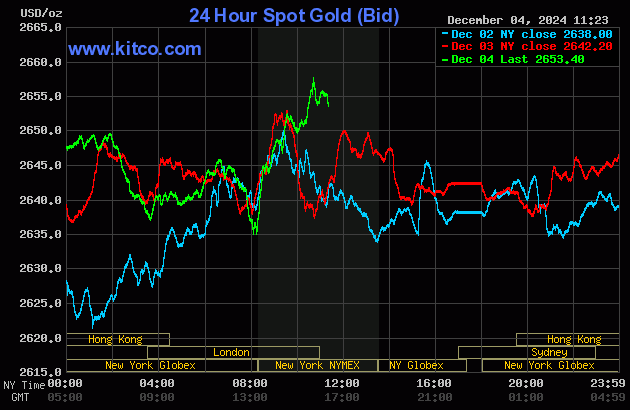
Image Source: Kitco News
March silver futures bulls have the slight overall near-term technical advantage. Silver bulls' next upside price objective is closing prices above solid technical resistance at $32.50. The next downside price objective for the bears is closing prices below solid support at $30.00. First resistance is seen at today’s high of $32.07 and then at $32.50. Next support is seen at $31.57 and then at this week’s low of $30.92. Wyckoff's Market Rating: 5.5. Read More
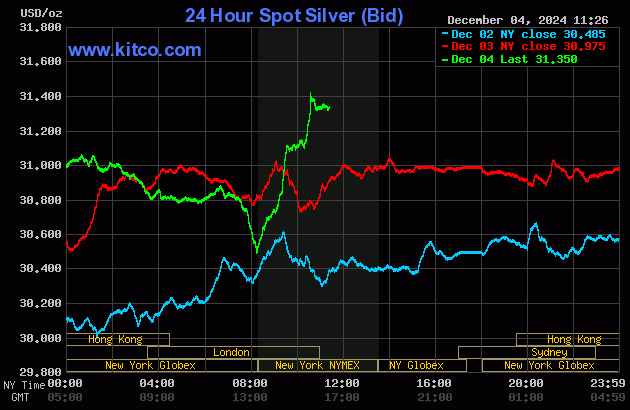
Image Source: Kitco News
Central bank gold buying skyrockets in October, led by India, Turkey and Poland – World Gold Council
Central banks reported 60 tons of net gold purchases in October, the highest amount recorded in 2024, according to the latest figures from the World Gold Council (WGC).
“The October tally doubled that of the 12-month average with the RBI leading both y-t-d purchases and those reported during the month,” wrote Marissa Salim, Senior Research Lead, APAC at the World Gold Council. “India added 27t in October, bringing its total gold purchases to 77t y-t-d. India’s y-t-d net buying represents a five-fold increase on its 2023 activity.”
“Emerging market central banks continued to dominate the market, with Turkey and Poland adding 72t and 69t y-t-d to their gold reserves, respectively,” she added. “These three central banks alone account for 60% of total global net purchases reported this year.”
Several other central banks reported net increases of one ton or more to their gold reserves in October. Read More
Powell says Bitcoin competes with gold, not the dollar, and it’s too early to talk about tariffs
Federal Reserve chair Jerome Powell seized the attention of the currency, commodity, and crypto communities on Wednesday afternoon when he shared his views on the role of Bitcoin in the U.S. economy – including the assets with which it was and was not in competition.
During an onstage interview at the New York Times DealBook Summit in New York, Powell was asked if he believes that Bitcoin’s rise in value and prominence represents a loss of faith in the U.S. dollar and the Federal Reserve system itself.
“I don't think that's how people think about it,” the Fed chair replied. “People use Bitcoin as a speculative asset. It's just like gold, only it's virtual, it's digital. People are not using it as a form of payment or as a store of value; it's highly volatile.
“It's not a competitor for the dollar,” he emphasized. “It's really a competitor for gold, that's really how I think about it.”
Both the yellow metal and King Crypto have made enormous gains this year, even as the greenback has strengthened against other currencies. Gold is up 28.44% in 2024, while Bitcoin has gained 133.87% this year, and both are priced in U.S. dollars. Read More
Economic signals and Federal Reserve expectations provide limited support for gold
The gold market experienced limited gains today, with the most active February futures contract settling at $2,673.40, reflecting a modest gain of $7.20 or 0.27%. The market's performance was influenced by the interplay of economic indicators, Federal Reserve commentary, and shifting monetary policy expectations.
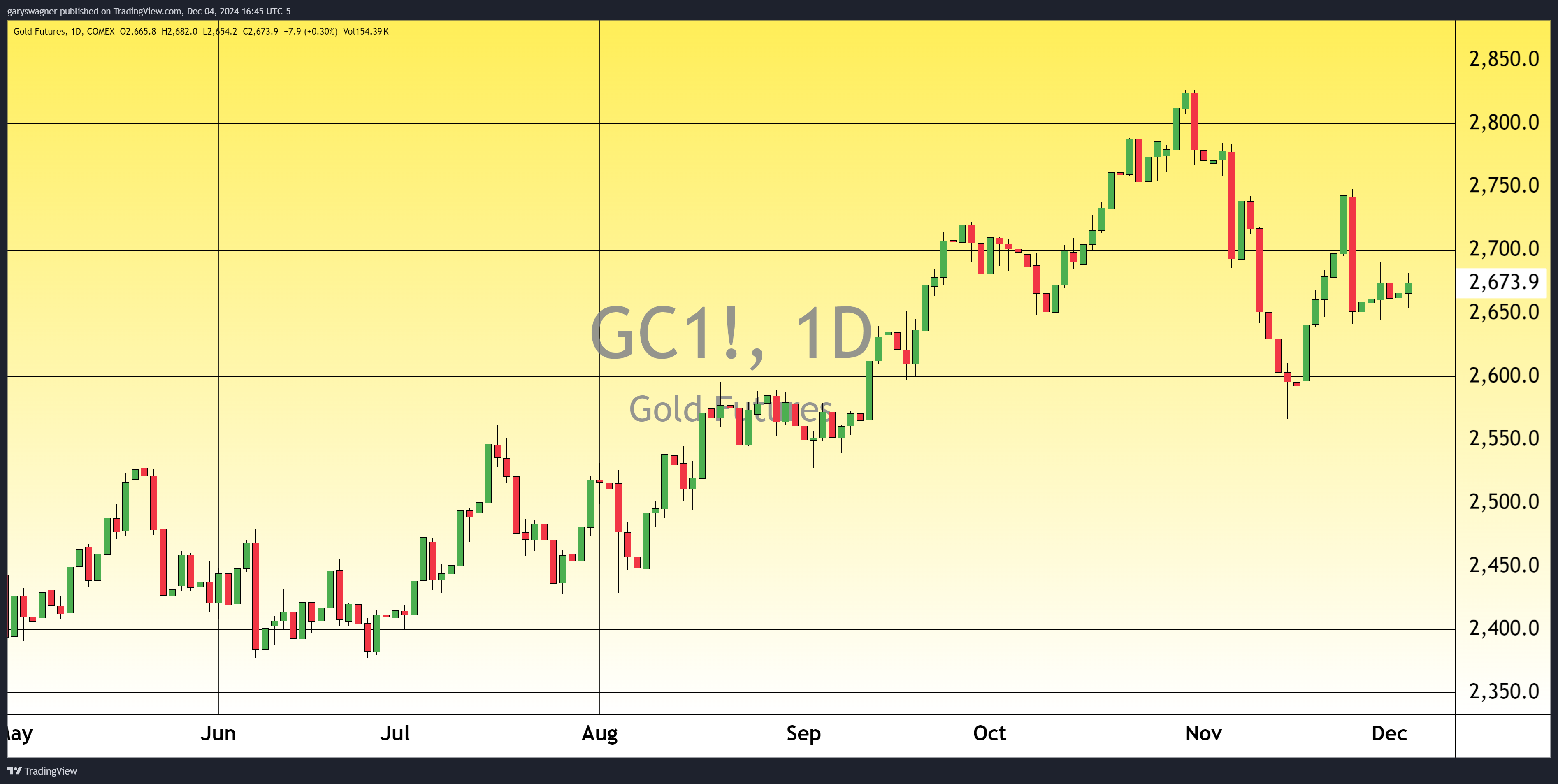
Image Source: Kitco News
The latest ADP employment report emerged as a key fundamental support for gold prices, revealing that the private sector added 146,000 jobs in November. This figure represents a notable decline from the previous month's 233,000 jobs and falls short of the MarketWatch consensus expectation of 163,000 new positions. Market participants are now eagerly anticipating the comprehensive US nonfarm payroll jobs report scheduled for release on Friday, which could provide further insights into the labor market's health.
Complementing the employment data, Treasury yields demonstrated a softening trend. The US 2-year note decreased by six basis points, reaching a yield of 4.218%, while the 10-year note declined 3.8 basis points to 4.19%. These modest yield reductions provided fractional bullish support for gold prices. Read More
Gold is never going back to $2,000: 'That's history,' prices to 3x from here – Peter Schiff
Gold prices are not dropping below $2,000 an ounce again in our lifetime following the metal's performance this year, said Peter Schiff, chief market strategist at Euro Pacific Asset Management.
"I don't think gold's going back to $2,000," Schiff told Kitco News anchor Jeremy Szafron on the sidelines of the New Orleans Investment Conference. "That's history now, and we're off to much higher levels without any resistance. The price of gold can double, triple from here, and potentially go much higher than that."
Schiff analyzed previous gold rallies and consolidations, pointing out that gold has broken out from previous levels – now up more than 28% year-to-date.
"Gold went through a long consolidation from 2011 to 2024, where it traded between $1,500 and $2,000. But that was after the big breakout from 2001 to 2011, where gold went from sub $300 to about $1,900," he described. Watch the podcast
Disclaimer: These articles are provided for informational purposes only. They are not offered or intended to be used as legal, tax, investment, financial, or any other advice.
Featured Image - Source: Unsplash















