x




Gold prices experienced a sharp decline on Friday, continuing a period of heightened volatility following the announcement of extensive US trade tariffs on April 2nd. After reaching a record-breaking high of $3,226 per ounce on Thursday, gold prices fell dramatically to $3,018 per ounce on Friday, down from $3,115 per ounce in late Thursday trading. The surge in gold prices earlier in the week was driven by market uncertainty stemming from US President Donald Trump's sweeping tariffs on imported goods, including a 10% baseline tariff and higher targeted tariffs of 54% on Chinese goods and 20% on products from the European Union. However, Friday's sell-off was largely attributed to margin calls in the equity markets, which were triggered by a sharp downturn in global stock markets. Investors were forced to liquidate their gold positions to raise cash and cover losses in equities, leading to a rapid decline in the gold price.
Additionally, market analysts suggested that the drop in gold prices reflected a typical "buy-the-rumour, sell-the-fact" scenario. In anticipation of the tariffs, gold prices had risen nearly 10% throughout March, as investors sought a safe haven amidst growing uncertainty. Once the tariffs were officially announced, some investors likely took profits, contributing to the decline. While physical gold remains exempt from the current US tariffs, its appeal as a safe-haven asset remains a key factor in its market value. Furthermore, gold's recent price surge relative to silver has pushed the gold-to-silver ratio to over 100 — the highest level since May 2020. This reflects gold’s status as a pure safe-haven asset, whereas silver also has significant industrial demand, which can weigh on its price during periods of economic uncertainty. Source
Silver prices suffered a significant decline for the second consecutive day on Friday, falling by approximately 7% in a single day and marking a bearish week for the metal. The price of silver dropped to as low as $29.26 an ounce, down sharply from $31.85 in late trading on Thursday. This steep fall mirrored the retreat in gold prices, which had plummeted from an all-time high of $3,226 an ounce on Thursday to $3,018 an ounce on Friday. The sharp decline in silver effectively wiped out nearly a month’s worth of gains in just one day. Analysts attributed the sell-off in silver and other precious metals to a wave of liquidations as investors scrambled to cover margin calls in the equity markets, which were hit hard by a broad stock market sell-off following the announcement of sweeping US trade tariffs by President Donald Trump.
Beyond the immediate pressure from margin calls and gold’s price retreat, silver also faces specific challenges related to its dual role as both a precious and industrial metal. Unlike gold, which primarily serves as a safe-haven asset, silver’s value is closely tied to industrial demand across sectors such as electronics, renewable energy, healthcare, aerospace, and water purification. With the new US tariffs raising concerns about global economic growth and the stability of international supply chains, investors are increasingly worried about the potential downturn in industrial demand for silver. As markets digest the full implications of the tariffs, attention is shifting to the longer-term outlook for silver’s industrial usage and how deeply the global economy may be affected by trade disruptions. Source
The gold-to-silver ratio has surged to its highest level in five years, surpassing 100, as escalating economic fears triggered by U.S. President Donald Trump’s global import tariffs weigh heavily on silver prices. While both gold and silver have been caught in a broader market sell-off — with the S&P 500 facing its worst weekly decline since the 2020 pandemic crash — silver has been hit much harder than gold. Gold has managed to fall only about 2% this week, last trading at $3,019 an ounce, while silver has plunged more than 13%, dropping to $29.62 an ounce. This underperformance reflects growing investor concerns about a potential recession, given silver's significant role as an industrial metal, with roughly half its demand coming from industrial applications like electronics, renewable energy, and healthcare.
Analysts warn that silver is particularly vulnerable in a slowing global economy, unlike gold, which holds its value better as a pure safe-haven asset. The threat of recession, coupled with the unwinding of arbitrage trades and excess supply flows into New York bullion vaults, has further pressured silver prices. While gold and silver were temporarily in demand as protection against Trump’s tariff threats, the metals themselves were ultimately exempt from those tariffs, leading to a collapse in the North American futures premium. Despite silver’s current weakness, some experts suggest this could present a buying opportunity. Historically, when the gold-to-silver ratio spikes this high, silver often stages a strong rebound once economic conditions stabilize or fears ease. However, analysts caution that investors should wait for clearer signs of market stability before making tactical silver investments. Source
Despite recent selling pressure in the gold market amid heightened global volatility, gold prices have managed to hold steady around $3,000 an ounce. The ongoing uncertainty stems largely from U.S. President Donald Trump’s sweeping import tariffs, which have sparked fears of a global recession and triggered a broad market deleveraging. Nevertheless, central banks continue to see gold as a valuable asset, maintaining their role as net buyers. China’s central bank remains a key player, increasing its gold reserves for the fifth consecutive month, with 13 tonnes purchased so far this year, bringing its total reserves to a record 2,292 tonnes. Analysts note that gold now represents 6.5% of China’s total reserve assets — a record share — reflecting the country’s move to diversify away from the U.S. dollar amidst increasing geopolitical tensions and trade uncertainties.
While China garners significant attention, Poland has emerged as the largest central bank buyer of gold this year. In March alone, Poland purchased 16 tonnes of gold, bringing its year-to-date total to 49 tonnes, more than half of its 2024 target of 90 tonnes. Analysts believe this trend of central banks increasing their gold reserves will continue, especially given concerns over the U.S. dollar’s reliability as a reserve asset due to deficit spending, trade policies, and rising global uncertainty. At the same time, some gold-producing nations like Uzbekistan are capitalizing on higher prices by selling portions of their reserves, having reduced their gold holdings by 15 tonnes so far this year. Overall, the current environment underscores gold’s enduring appeal as a safe-haven asset and a hedge against geopolitical and economic instability. Source
Gold prices faced a third straight day of losses, with the June futures contract falling 1.87% to close just below the critical $3,000 mark at $2,998.80 per ounce. This decline was driven by escalating trade tensions following President Trump’s announcement of new tariffs, coupled with a stronger U.S. dollar and rising Treasury yields. In contrast, silver showed more resilience, recovering from intraday losses to close higher at $29.605 per ounce. Global equity markets remained volatile, with significant losses in Asia and Europe, though U.S. markets showed some recovery. The S&P 500 and NASDAQ managed to limit their declines or even close slightly higher, suggesting tentative stabilization after previous sharp losses.
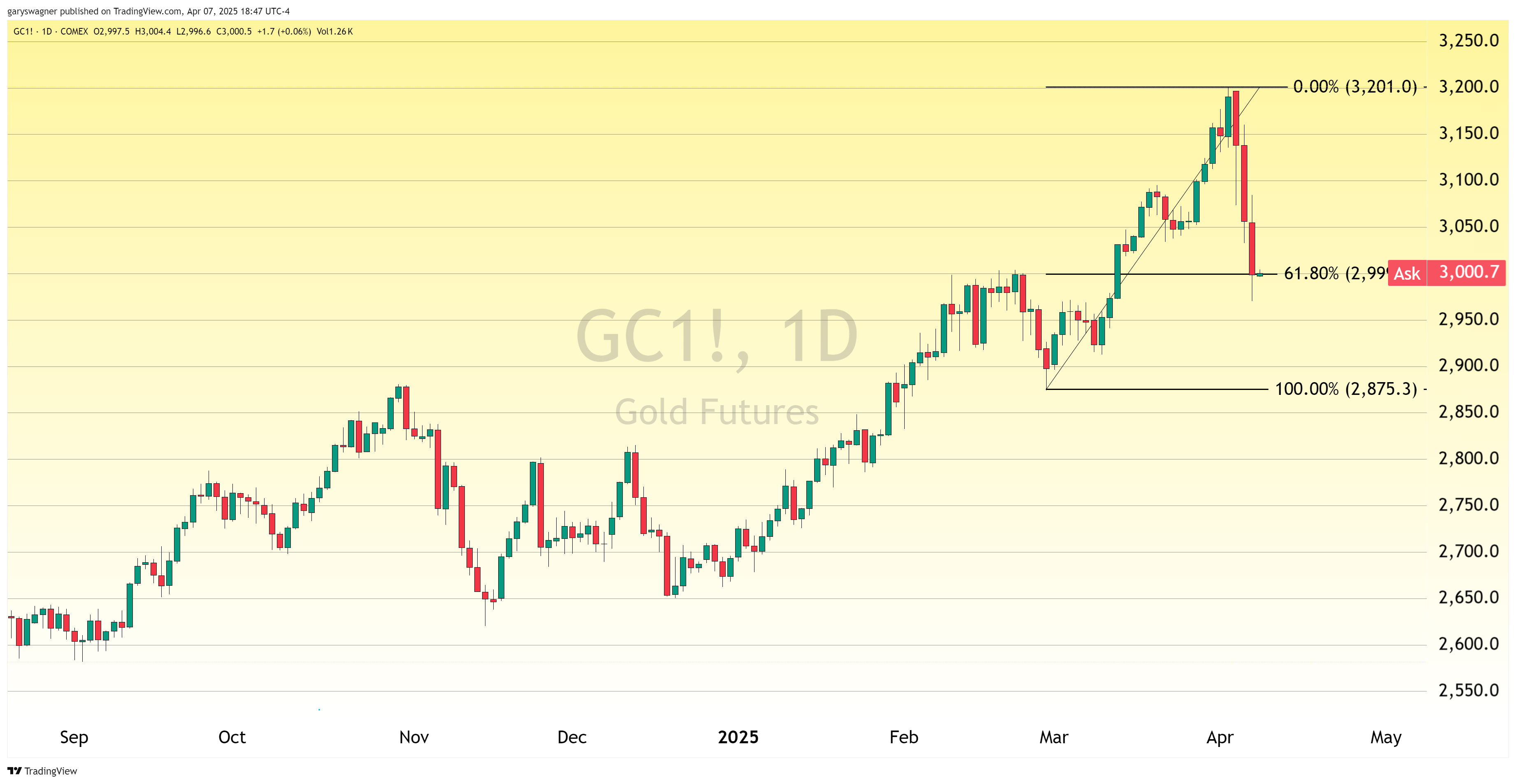
Image Source: Kitco News
Market experts have expressed serious concerns about the long-term consequences of the escalating trade war. CNBC commentator Jim Cramer warned that failure to ease tensions could trigger a market crash similar to 1987’s "Black Monday." Former Federal Reserve official James Bullard compared the current situation to the Smoot-Hawley Tariff Act of 1930, which worsened the Great Depression by stifling global trade. The recent selling pressure on gold reflects shifting investor sentiment as markets reassess risks in light of rising geopolitical tensions, potential retaliatory tariffs, and fears of a global economic slowdown. The uncertainty has left investors wary, balancing between gold’s safe-haven appeal and the broader market’s volatile reaction to unfolding trade policies. Source
Gold prices fell sharply on Monday amid volatile and fearful trading conditions, driven by weak long liquidation in the futures market, rising U.S. Treasury yields, a stronger U.S. dollar, and falling crude oil prices. Gold initially traded higher but reversed course after rumors of a U.S. tariff pause were denied by the White House, and President Trump threatened additional tariffs on China. June gold futures dropped $38.50 to $2,996.70, while May silver futures gained $0.555 to $29.79, rebounding from early losses. Global equity markets, particularly in Asia and Europe, suffered significant declines, and U.S. indexes approached or entered bearish territory. Investor fear remains high, with growing concerns that escalating trade tensions could push the U.S. and global economies into recession.
Broader market conditions reflect extreme uncertainty, with the volatility index (VIX) spiking above 50, a level rarely seen outside major crises like the 2008 financial meltdown and the 2020 pandemic. The market is now pricing in five interest rate cuts from the Federal Reserve this year, potentially including an emergency cut. Key figures, including JP Morgan’s Jamie Dimon, warn that tariffs could trigger stagflation by raising prices and slowing growth. While gold bulls still hold a technical advantage, recent selling pressure has weakened their position. Market analysts believe that a near-term bottom in both stock and commodity markets could form this week, but if it doesn’t, the risk of a recession or worse increases significantly. Silver markets appear more balanced, with both bulls and bears on equal footing, and technical indicators suggesting exhausted selling pressure and potential for price recovery. Source
Gold prices have come under pressure due to a liquidity squeeze as investors sell the metal to raise cash amidst a sharp sell-off in U.S. equity markets. Despite gold falling below the $3,000 an ounce level, Suki Cooper, Precious Metals Analyst at Standard Chartered, maintains a bullish outlook. She expects gold to average $3,300 an ounce in the second quarter, driven by safe-haven demand and its resilience compared to other assets like stocks, oil, and copper. While recent market turmoil from Trump’s harsh tariff announcements has led to gold losing 6% from its all-time highs, Cooper highlights that gold has historically sold off during risk-off events but tends to recover quickly due to its safe-haven appeal.
Looking forward, Cooper sees gold as an attractive investment amid rising recession risks and potential stagflation from higher tariffs. She notes that gold historically performs well during U.S. recessions, gaining an average of 15%, and has also shown strength during periods of stagflation. Although markets are pricing in five Federal Reserve rate cuts this year, Cooper expects the Fed to be cautious, cutting rates only if economic conditions deteriorate further. Federal Reserve Chair Jerome Powell has reinforced a neutral policy stance, signaling the Fed is in no rush to adjust rates but will act if necessary. Overall, gold remains supported by a favorable macroeconomic backdrop of weak growth, elevated inflation risks, and ongoing market uncertainty. Source
This past week saw extreme volatility in gold prices as markets reacted to President Trump's announcement of sweeping trade tariffs, sparking fears of a global trade war. Gold initially surged on safe-haven demand, reaching an all-time high of $3,168 per ounce as investors anticipated the tariffs would target commodities like gold and silver. However, after confirmation that precious metals would be excluded from the tariffs, gold prices slid sharply, exacerbated by widespread equity market sell-offs. The collapse in stock markets forced investors to liquidate profitable gold positions to cover margin calls, pushing prices down to a weekly low of $3,015.65 per ounce before stabilizing in a narrow range.
Market sentiment has since shifted, with Wall Street turning bearish in the short term, expecting continued downward pressure on gold prices, while Main Street investors maintain a moderately bullish outlook. Analysts believe that although gold may face near-term corrections due to profit-taking and broader market weakness, the long-term bullish case for gold remains intact, driven by ongoing economic uncertainties and under-ownership of gold in North America. Factors such as upcoming inflation data, Federal Reserve policy decisions, and continued market instability will likely play a critical role in determining gold's next move, with some experts cautioning that further declines to around $3,000 are possible before any sustained recovery. Source
Gold has shown strong performance recently, hitting record highs due to its safe-haven appeal amid rising global economic uncertainty, trade tensions, and geopolitical risks. Gold ETFs have seen significant inflows, boosting assets under management to the highest levels since September 2023. Central bank support and robust investor demand have further reinforced gold's bullish outlook, particularly as recent U.S. tariffs heighten fears of stagflation, recession, and inflation. Meanwhile, gold prices reached a new record of $3,160.60 per ounce, driven by falling Treasury yields and a weaker U.S. dollar.
In contrast, silver has underperformed, falling nearly 15% over the past week, with ETFs reducing silver holdings while increasing gold investments. Mining sector challenges also surfaced, with SSR Mining issuing weaker-than-expected production guidance for 2025 and Equinox suspending operations at its Los Filos mine in Mexico. However, opportunities remain, as rising gold prices could lead to substantial free cash flow for operationally strong miners. Royalty companies like Wheaton Precious and Osisko are also gaining favor for their stable cash flows. On the downside, production challenges, potential demand hits from tariffs on automotive imports, and disruptions to precious metals trade due to recent tariff policy changes pose risks to the sector. Source
In this week’s Live from the Vault, Andrew Maguire discusses how China’s strong physical silver buying is challenging the paper market, with liquidity providers exploiting the widening EFP spread to push the market towards physical settlement.
As Chinese and Indian demand intensifies, it unfolds a structural shift in the silver market, exposing the fragility of paper-based pricing and setting the stage for a breakout as silver moves further away from futures pricing.
Disclaimer: These articles are provided for informational purposes only. They are not offered or intended to be used as legal, tax, investment, financial, or any other advice.
Featured Image - Source: Unsplash















