x




Gold has been performing strongly as investors prepare for the Federal Reserve's interest rate decision, with prices reaching $3,334.89 per ounce, a gain of 2.90%. Analyst Vladimir Zernov highlighted that if gold remains above the $3,300 mark, it is likely to test the next resistance levels between $3,350 and $3,360. In contrast, silver and platinum prices have faced challenges, with silver struggling to maintain momentum and remain above key resistance at $32.50. The gold/silver ratio has risen to around 102.50, suggesting uncertainty about silver’s ability to gain against gold. As for platinum, it is weakening, driven by declining demand and a decrease in palladium prices.
Platinum prices are under pressure, with concerns about its demand contributing to a drop in value, and prices falling below $950 could signal further declines towards support at $930-$935. At midday, platinum was down 1.60%, trading at $962.80 per ounce. Meanwhile, palladium's decline by 1.7% is also negatively affecting platinum markets. Despite the overall weakness in silver and platinum, gold continues to shine as investors focus on the Federal Reserve's upcoming rate decision. Source
Edward Siedle, a former SEC attorney and whistleblower, warns that the next major financial crisis could be triggered by America's underregulated public pension system, which holds over $6 trillion. Despite being intended to be highly transparent due to involving public money, Siedle highlights how these pension funds are increasingly shifting into opaque, high-risk investments, making it difficult to track what is actually in them. He argues that public pension boards, often lacking experience, are being exploited by Wall Street to invest in complex, high-fee products with little accountability. The total liabilities of these funds now exceed $5 trillion, and Siedle describes them as "the dumbest investors in the room."
Siedle also points to troubling practices within public pension funds, including the Minnesota Teachers Retirement Association's underreporting of alternative asset fees by 400% after public pressure. He warns that some state legislatures are considering investing pension funds into cryptocurrencies, a move he sees as dangerous given the opaque nature of crypto markets and the significant risks involved. Siedle calls for comprehensive reform of the public pension system, including full transparency, indexing of pension assets, and eliminating pay-to-play politics in fund management. He predicts that taxpayers will eventually have to bail out these funds, signalling a looming financial crisis. Watch the podcast
Gold prices have surged to $3,400 an ounce as investors seek safe havens amid growing fears of a global recession. According to Mike McGlone, Senior Commodity Strategist at Bloomberg Intelligence, the widening gap between oil and gold prices is a key indicator of worsening economic conditions. Oil has seen a significant decline, falling by nearly 21% in 2025, while gold has risen by 26%, marking one of the largest disparities in a century. Gold’s strong performance, especially its recent rally to $3,500, aligns with historical patterns from 2007 and 1935, signalling potential recessionary pressures ahead. Despite oil’s recovery from its recent slump, it remains below critical resistance levels, and McGlone predicts that the current economic environment will likely continue to favour gold's upward trajectory.
McGlone foresees further gains for gold, potentially reaching $4,000 an ounce, as recession fears deepen and stock markets weaken. He notes that gold’s price could eventually align with the S&P 500, predicting a 1-to-1 ratio during a recession, which could push both gold and the S&P 500 to around 4,000 points. While gold’s price may be somewhat overextended, McGlone suggests a strong floor at $3,000 per ounce. The contrast between gold’s rise and oil’s decline reflects broader economic vulnerabilities, with McGlone emphasizing that these signals suggest challenging times ahead for the global economy. Source
Ted Oakley, founder of Oxbow Advisors, has warned that a major market correction could be imminent within the next 90 days, as corporate profit margins and stock valuations show troubling signs. He highlighted that current market conditions, with the S&P 500 trading at a 21 multiple, combined with falling earnings and margin contractions, could push the market to new lows. Oakley’s concerns are amplified by broader macroeconomic factors, such as a weakening economy and the record U.S. trade deficit, which he believes are being masked by temporary factors like front-loaded inventories. Despite these risks, Oakley criticized retail investors for their complacency, pointing out that they continue to pour money into equities, believing the market will always recover, which could lead to panic selling if the market drops significantly.
Oakley has taken a defensive stance in his portfolio, holding over 50% in short-term Treasuries while selectively investing in sectors such as fertilizers, consumer staples, and pharma. He also continues to hold gold, believing it will perform well in a weakening dollar environment. With the Federal Reserve constrained by inflation and unable to lower interest rates, Oakley predicts that market valuations are unsustainable. If earnings and multiples fall as expected, he believes the S&P 500 could drop to 4,000 or lower. He also warned retirees overexposed to equities that they should consider how they would fare if the market were to decline significantly, as nearly 60% of family wealth is now tied to stocks, a sharp increase from past decades. Watch the podcast
Bank of America has become notably bullish on gold, forecasting a potential rise to $4,000 an ounce in the second half of 2025. In their updated forecast, analysts, led by Michael Widmer, stated that achieving this target would require a significant increase in investment and stabilized jewelry demand. Specifically, investment would need to rise by 18% year-over-year, a level reached in previous years like 2016 and 2020. The catalyst behind this potential rally is expected to be growing geopolitical uncertainty, largely driven by global trade tensions, as well as concerns about the U.S. government's fiscal outlook. Bank of America sees these factors supporting gold as a safer investment compared to Treasuries, with the decline in the USD and economic uncertainty further adding to gold's appeal.
While Bank of America is optimistic about gold's future, they believe that in the short term, prices will likely remain supported above $3,000 per ounce, with a ceiling around $3,500. Current market conditions show that gold has found support at $3,200 an ounce, despite a slight pullback from its recent all-time highs. Analysts emphasized that while gold's price has been elevated, it is weighing on jewelry demand, which could limit further short-term gains. However, if global geopolitical tensions persist and the U.S. economic outlook remains uncertain, gold's upward momentum could push it toward the more aggressive $4,000 target in the latter half of 2025. Source
Berkshire Hathaway's long-standing scepticism toward gold and Bitcoin may be under reconsideration, according to Jack Mallers, CEO of Strike and 21 Capital. Mallers pointed out Warren Buffett's recent comments at the Berkshire Hathaway shareholder meeting, where he expressed concern about the U.S. dollar and the potential decline of the currency. Given Berkshire’s significant holdings in U.S. Treasuries, Mallers found Buffett's remarks on the macroeconomic environment to be particularly interesting. Historically dismissive of both gold and Bitcoin, Buffett's concerns about the dollar's future could signal a shift in perspective regarding the role of hard assets in the portfolio, especially with Berkshire sitting on $330 billion in cash and Treasuries.
The recent surges in Bitcoin and gold prices have intensified the debate over diversifying away from fiat-based investments into assets with fixed supply. Mallers suggests that the growing concerns over U.S. debt and currency stability make Bitcoin and gold increasingly attractive as macro hedges. He pointed out that Bitcoin, in particular, is uniquely sensitive to fiat liquidity and money printing. With global capital flowing into gold and Bitcoin as alternatives to government debt, Mallers believes that these assets could serve as the next key store of value, potentially prompting Berkshire Hathaway to reconsider its stance. While it remains uncertain whether Berkshire will directly invest in Bitcoin or gold, Mallers argues that the logic for doing so is becoming more compelling. Watch the podcast
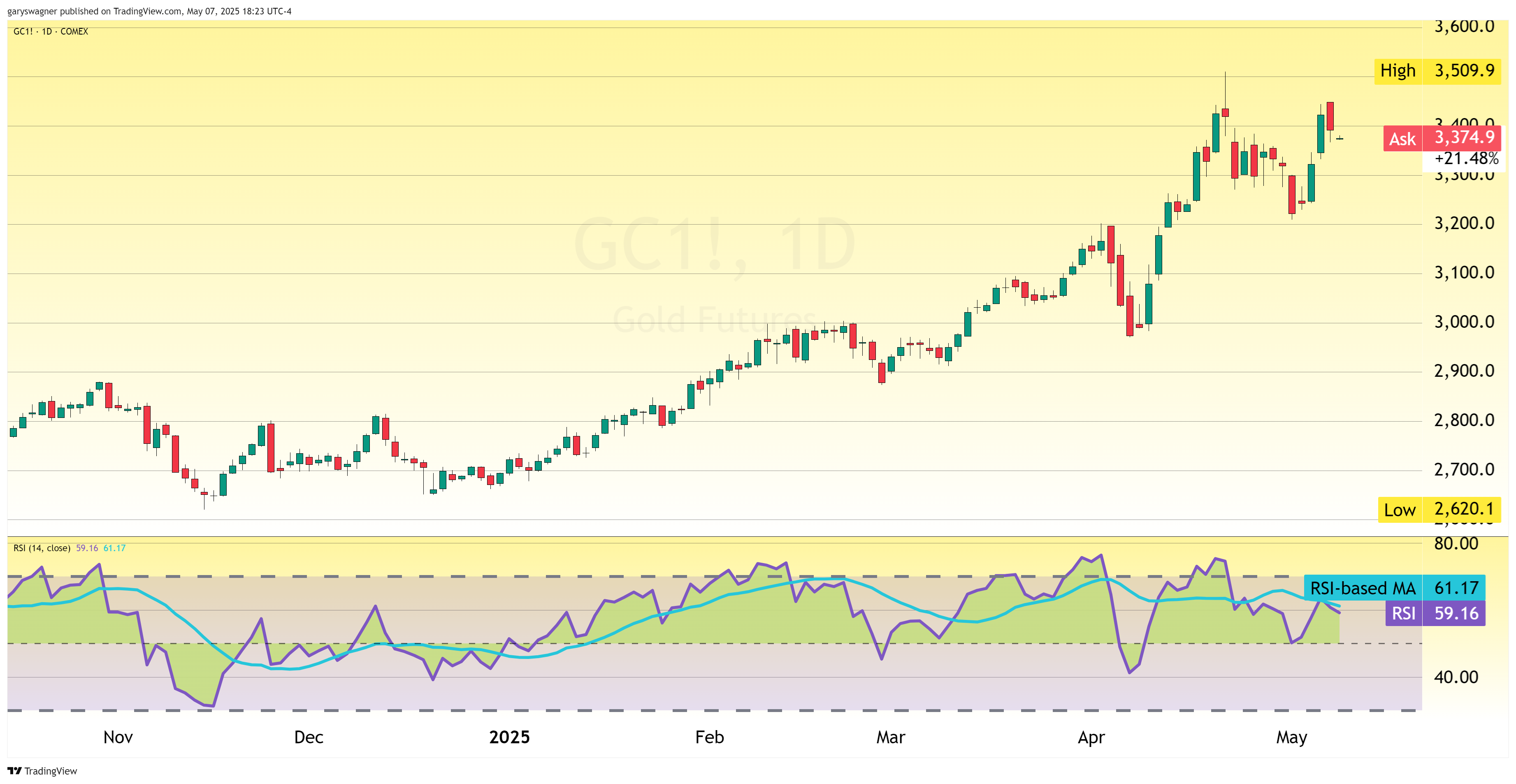
Image source: Kitco News
Gold prices dipped on Wednesday following the Federal Reserve's decision to keep its benchmark interest rate steady at 4.25% to 4.50%, where it has remained since December 2024. The Fed's move, driven by concerns over inflation risks and slowing economic growth, led to a retreat in gold futures, which closed near their daily low at $3,391.90. The Fed's stance on holding rates steady has raised fears of potential stagflation—where inflation persists despite stalled economic growth—adding to the uncertainty in the markets. The central bank’s decision comes amid heightened trade tensions between the U.S. and China, with President Trump's recent tariffs contributing to inflationary risks.
In his post-meeting remarks, Fed Chairman Powell highlighted the potential risks of the tariffs, such as higher inflation and unemployment, but emphasized the Fed's cautious approach to managing the situation. The gold market responded to these economic signals with a slight decline, as investors remained cautious, navigating the broader uncertainty caused by both monetary policy and international trade issues. Although the weakening dollar somewhat offset the gold price drop, the overall market sentiment remains fragile. Gold prices are likely to remain sensitive to future economic developments and any shifts in the Fed’s policy stance. Source
In April, China continued its streak of gold purchases, adding 2 tonnes to its reserves for the sixth consecutive month, bringing its total gold holdings to 2,294 tonnes. Despite record-high gold prices, China’s central bank has added approximately 30 tonnes over the last six months, indicating ongoing interest in diversifying away from US dollar-denominated assets like Treasuries. Other countries, including Poland and Czechia, also increased their gold reserves in April, with Poland adding 12 tonnes, raising its total to 509 tonnes, and Czechia adding 2.5 tonnes, marking 26 straight months of increases and bringing its reserves to nearly 59 tonnes.
While central bank gold purchases remain a strong market pillar, the pace of buying has slowed compared to last year’s record-setting levels. According to the World Gold Council, central banks purchased 243.7 tonnes of gold in the first quarter of 2025, a 21% decrease from the same period in 2024, though this demand remains 24% above the five-year average. Despite the slowdown, gold's role as a secure reserve asset amidst global uncertainties is expected to maintain solid demand, with analysts predicting continued central bank interest in gold in the near term. Source
New Hampshire has become the first U.S. state to pass a crypto reserve bill, allowing the state to invest in Bitcoin and other cryptocurrencies alongside traditional assets like gold and silver. Governor Kelly Ayotte signed the bill into law on May 6, which authorizes the state treasury to use funds to invest in cryptocurrencies, provided the tokens have a market capitalization of over $500 billion. The legislation positions New Hampshire as a leader in the digital asset space, with its Republican party highlighting the state's role in shaping the future of commerce and digital assets. The bill places cryptocurrencies and gold on equal footing, marking a significant step in the adoption of digital assets by state governments.
The move in New Hampshire reflects a broader trend in the U.S., where digital assets like Bitcoin are increasingly being viewed as a store of value akin to gold. The Trump administration has also shown interest in digital assets, with Bo Hines from the Presidential Working Group on Digital Assets suggesting that Bitcoin is being treated as "digital gold." Hines highlighted proposals such as revaluing government-held gold and using gold certificates to fund the U.S. Strategic Bitcoin Reserve, drawing parallels between gold and Bitcoin as valuable, long-term assets. This evolving view of Bitcoin as a reserve asset is part of the government's broader effort to accumulate and secure digital assets in the coming years. Source
Gold and silver futures prices experienced a decline on Wednesday due to profit-taking after recent gains and a slight increase in risk appetite. The Federal Reserve's FOMC statement, which confirmed no changes to U.S. monetary policy, did not lead to significant price movements in the precious metals market. The statement acknowledged that while the U.S. economy remains solid, the risks of higher inflation and unemployment have increased, and economic uncertainty is rising. Traders are now focusing on Fed Chair Jerome Powell's press conference for further insights into the central bank's future policy actions, especially regarding inflation and the ongoing global trade tensions.
In addition to the FOMC statement, there were developments in global markets, such as the U.S. and China preparing for trade talks in Switzerland and China's central bank cutting interest rates to stimulate its economy. Meanwhile, tensions between India and Pakistan have heightened due to recent air strikes. These geopolitical factors, alongside a stronger U.S. dollar and lower oil prices, have contributed to a mixed sentiment in the markets. Technically, both gold and silver futures show bullish trends, but traders are closely watching key resistance and support levels for any significant price shifts. Source
After the Federal Reserve decided to keep interest rates unchanged, Fed Chair Jerome Powell reiterated the central bank's "wait-and-see" approach in his post-meeting press conference. Powell emphasized that there is still considerable uncertainty regarding the economic outlook, particularly concerning the potential effects of trade tariffs and their impact on inflation, employment, and growth. He acknowledged that while U.S. economic growth is solid, inflation remains slightly above the 2% target, and the labor market is strong, the Fed's current policy stance is moderately restrictive and well-positioned to adapt as more data becomes available. Powell stressed that the risks of both higher inflation and unemployment have increased since March, and the central bank is carefully monitoring these developments.
Powell also addressed questions about potential rate cuts, explaining that while there are scenarios where cuts could be appropriate, it depends on the evolving economic conditions. He emphasized that the Fed’s decisions would be based solely on economic data and not influenced by external pressures, including President Trump’s repeated calls for lower rates. Powell dismissed the idea of requesting a meeting with the President, stating that the initiative for such meetings typically comes from the President. Lastly, Powell acknowledged worsening sentiment indicators due to trade tensions, but he pointed out that these concerns have yet to significantly affect hard economic data, which remains a key consideration for the Fed's policy decisions. Source
Disclaimer: These articles are provided for informational purposes only. They are not offered or intended to be used as legal, tax, investment, financial, or any other advice.
Featured Image - Source: Unsplash















