x





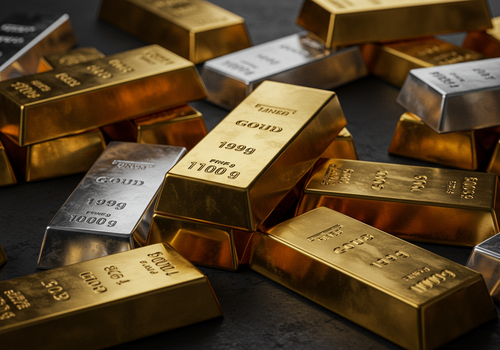
The Perth Mint anticipates robust sales of both gold and silver for the 2025 fiscal year. This outlook is detailed in a report by Kitco News, highlighting the mint's performance in the precious metals market. The article, authored by Ernest Hoffman, a Crypto and Market Reporter for Kitco News, was published on July 8, 2025. It underscores the mint's continued strength in bullion sales, encompassing both coins and bars, which are key indicators of demand within the precious metals sector.
The report also touches on broader market factors influencing gold and silver, such as ETP flows and overall demand for investment-grade coins in Australia. Kitco News, as a leading source in precious metals, aims to provide accurate and objective reporting on economic trends, stock markets, commodities, and cryptocurrencies to help individuals make informed market decisions. The article includes standard disclaimers regarding the views expressed and the informational nature of the content. Source
The second quarter of 2025 has concluded, signalling the start of a new earnings season, with major banks like JPMorgan Chase, Citigroup, and Wells Fargo set to release their results on July 15. Despite a general lack of optimism, largely influenced by ongoing trade wars, and a sharper-than-usual 4.2% average drop in S&P 500 earnings per share estimates by analysts according to FactSet, investors appear unconcerned. This is primarily due to a recurring pattern where analysts lower expectations pre-earnings, companies subsequently surpass these adjusted forecasts, and market sentiment rebounds, mirroring the surprising 12.8% year-over-year EPS increase in Q1 2025 against a 7.2% forecast. This trend suggests that conservative forecasting might be intentionally used to bolster market optimism, explaining why the S&P 500 and Nasdaq have remained largely unshaken by fears of weak results.
While trade tensions persist and the impact of recent cost increases on companies and consumers remains unclear, not all sectors are equally vulnerable. The technology sector, especially cloud-related companies, is expected to thrive with a forecasted 12.2% year-on-year revenue increase and a 25% profit margin, driven by continued AI demand. Financials and healthcare are also projected to perform strongly. The consumer sector may experience a slight slowdown in revenue growth, but no decline is anticipated. Conversely, energy companies are likely to report weaker figures. Beyond the Q2 numbers, investor focus will be on future guidance regarding tariff risks and economic concerns, as well as the stability of share buybacks, which have been crucial in supporting the market's upward momentum in the resilient U.S. economy. Source
Gold and silver prices experienced a decline in midday U.S. trading on Tuesday, primarily attributed to weak-handed long liquidation by shorter-term futures traders. This subdued market activity, characteristic of summertime trading, suggests that gold and silver bulls require a significant new fundamental catalyst to spur fresh upward price movement. As of Tuesday, August gold was down by $34.50, trading at $3,308.10, while September silver prices saw a decrease of $0.299, settling at $36.605. The broader market sentiment was affected by President Trump's announcement of additional tariffs on Japan and South Korea on Monday, alongside threats of 25% to 40% tariffs on over a dozen other countries, with a deadline for trade deals extended to August 1.
Technically, August gold futures bulls currently maintain a near-term advantage, with their next objective being a close above the solid resistance level of $3,400.00. Conversely, bears aim to push prices below the strong technical support at $3,200.00. For silver, September futures bulls also hold a near-term technical advantage, despite recent choppy and sideways trading at elevated levels. Silver bulls seek to close prices above the solid technical resistance at the June high of $37.73, while bears are targeting a close below the strong support at $35.00. The broader market context also shows the U.S. dollar index slightly up, Nymex crude oil futures firmer around $68.50 a barrel, and the yield on the benchmark 10-year U.S. Treasury note at 4.421%. Source
Copper prices experienced an extraordinary surge, rocketing 11% higher to an intraday record of $5.896 per pound on the Comex, following a surprise 50% tariff imposed by President Donald Trump on all imported copper. This abrupt tariff triggered a frantic buying spree within the U.S. and ignited widespread concerns about global copper supply. Although prices have since slightly retreated, they remain at unprecedented levels, establishing a significant premium for U.S. copper, approximately $2,000 higher than London prices. This attractive spread is anticipated to draw a substantial amount of copper inventory into U.S. warehouses, thereby intensifying pressure on already constrained global supplies.
The implementation of U.S. tariffs is set to exacerbate an already precarious copper supply situation, at a time when global demand for the metal is simultaneously escalating. This increased demand is largely driven by the burgeoning AI revolution and the consequent need for extensive new data centres, which necessitate considerable investments in energy infrastructure. While the copper breakout presents lucrative opportunities for investors, potential risks exist, primarily the challenge for the U.S. to sustain these tariffs without negatively impacting domestic manufacturing competitiveness due to increased input costs. Despite the U.S. producing only about 64% of its copper needs and importing a significant volume, a substantial correction in copper prices is deemed improbable given that U.S. demand constitutes only 8% of the global supply. Furthermore, if the London Metals Exchange (LME) aims to replenish its copper inventory, it will likely need to narrow the premium gap with the U.S., which could further propel copper prices upward. Source
Despite significant gains in the first half of 2025, with gold and silver up approximately 26% and platinum a remarkable 54%, Saxo Bank's Head of Commodity Strategy, Ole Hansen, believes that precious metals are poised for further appreciation in the second half of the year. He notes that the sector is currently in a consolidation phase, providing an opportunity for silver and platinum to catch up to gold's performance. Hansen highlights several enduring drivers, including the politically neutral nature of precious metals as a universally recognized store of value, which continues to drive central bank demand for gold as a core reserve asset. Additionally, the prospect of lower U.S. interest rates could reignite demand, particularly for metal-backed ETFs, by reducing the opportunity cost of holding non-yielding assets.
Hansen identifies several key factors supporting a constructive outlook for gold and its peers in H2 2025. These include sustained central bank demand, rising U.S. stagflation risks, ongoing geopolitical tensions and trade frictions, increasing U.S. fiscal concerns, and a shift in portfolio allocation by sovereign wealth funds and institutional investors towards tangible assets like metals. From a technical perspective, gold is in a consolidation mode, with strong support levels identified. Silver's recent breakout above $35 is seen as a precursor to further gains, driven by a structural supply deficit and the potential for the gold-silver ratio to normalize towards its five-year average. Platinum, the top-performing commodity year-to-date, is benefiting from a technical breakout and fundamental support, including a projected third consecutive annual deficit in 2025 due to recovering automotive demand and increased Chinese jewelry and bar investment. Source
Gold ETF inflows surged significantly in June 2025, reversing previous outflows and marking the strongest semi-annual performance since the first half of 2020. According to the World Gold Council (WGC), global gold-backed ETFs witnessed inflows of 74.6 tonnes, valued at $7.603 billion in June alone, contributing to a total increase of 397.1 tonnes ($38.082 billion) in the first six months of the year. This robust demand was predominantly driven by North American funds, though European and Asian markets also experienced notable gains. European ETFs saw an increase of 23.1 tonnes, partly due to a dovish stance from the Bank of England and broader economic concerns, while Asian-listed ETFs reported record growth, including significant inflows from Japan and China, the latter amidst ongoing trade tensions with the U.S.
The primary catalysts for this substantial increase in gold ETF demand are mounting geopolitical tensions and expectations of future interest rate cuts by the Federal Reserve. The escalating conflict between Israel and Iran has particularly spurred investor demand for safe-haven assets, boosting inflows into North American gold ETFs. Simultaneously, despite the U.S. Fed holding rates steady in June, persistent concerns about slowing economic growth and rising inflation have led markets to anticipate three rate cuts by the end of 2025 and two more in 2026. This outlook for lower interest rates enhances gold's appeal by reducing the opportunity cost of holding the non-yielding precious metal, further solidifying its role as a hedge against economic uncertainty and geopolitical instability. Source
The Sprott Silver Miners & Physical Silver ETF (Nasdaq: SLVR) has rapidly surpassed $100 million in assets under management (AUM) within its first five months since launching on January 15, 2025. This significant milestone, achieved by June 30, 2025, highlights robust investor interest in silver, which Sprott Asset Management believes has been considerably undervalued relative to gold. John Ciampaglia, CEO of Sprott Asset Management, noted that silver is "hitting its stride" with recent prices breaking above $35 per ounce for the first time in over 12 years. The ETF's success is attributed to its unique "pure-play" exposure to both silver miners and physical silver, catering to investors looking for direct involvement in the silver market.
The strong performance of the SLVR ETF is supported by improving fundamentals for silver, including growing industrial demand. Silver, acting as both a precious and industrial metal, is increasingly vital in new energy technologies, such as solar panels and electric vehicles, and is seeing increased use in AI-driven data centers. As silver prices rise, companies involved in silver mining are well-positioned to benefit. The ETF aims to mirror the total return performance of the Nasdaq Sprott Silver Miners™ Index (NSLVR™) by investing at least 80% of its assets in securities tracked by the index, which includes silver producers, developers, explorers, and physical silver. Source
Gold prices remained largely stable in midday U.S. trading on Wednesday, showing minimal reaction to the newly released minutes from the Federal Reserve's June monetary policy meeting. Analysts widely described the minutes as containing "no surprises," as the Federal Reserve maintained its cautious "wait-and-see" approach to U.S. monetary policy. The minutes indicated that while economic growth and the labor market are considered solid, and current policy is moderately restrictive, policymakers generally agreed that the Committee is well-positioned to await further clarity on inflation and economic activity before making significant policy shifts.
Despite some participants indicating openness to considering a rate reduction at the next meeting if data align with their expectations, the broader market is not anticipating a July rate cut. This sentiment is reinforced by expectations of reaccelerating inflation, particularly following last week's payroll release. Analysts suggest that significant improvement in inflation readings might not occur until later in the year, providing the Fed with reason to keep rates elevated. Consequently, gold, which often reacts to shifts in interest rate expectations and the U.S. dollar, saw only a modest, unsustained rally in response to the minutes, trading near $3,310 an ounce, up a marginal 0.29% on the day. Source
Gold prices maintained stability on Wednesday, hovering above $3,300 an ounce, largely unaffected by the release of the Federal Reserve's June monetary policy meeting minutes. Analysts widely concurred that the minutes contained "no surprises," reiterating the Fed's cautious "wait-and-see" approach to U.S. monetary policy. While acknowledging solid economic growth and a robust labor market, and deeming current policy moderately restrictive, policymakers generally agreed that the Committee is well-positioned to await further clarity on inflation and economic activity before implementing any significant policy adjustments. This stance suggests a preference for data-driven decisions rather than preemptive actions.
Despite a few participants expressing openness to a potential rate reduction at the next meeting if incoming data supported such a move, the broader market does not anticipate an interest rate cut in July. The CME FedWatch Tool forecasts no easing until September, reflecting market expectations. Analysts like Adam Button of Forexlive.com and Jeffrey Roach of LPL Financial noted that the minutes did not signal a shift in the Fed's neutral stance. With expectations of reaccelerating inflation, particularly following recent payroll data, and a belief that inflation readings won't significantly improve until later in the year, the Fed is likely to keep rates elevated. Consequently, gold, which typically reacts to interest rate expectations, saw only a modest and unsustained rally, ending the day up a mere 0.29% at $3,310 an ounce. Source
Gold prices are expected to continue their upward trajectory, driven by the alarming increase in U.S. deficits and escalating fiscal instability, even in the absence of an immediate financial crisis, according to analysts at the World Gold Council (WGC). These mounting uncertainties have already triggered a significant global reallocation of capital, contributing to a weakening U.S. dollar, rising gold prices, and widening U.S. Treasury yields compared to other high-grade sovereign bonds. The WGC emphasizes that as fiscal pressures intensify, bond market volatility is likely to persist, thereby bolstering demand for gold as a safe-haven asset. The sheer scale of new debt, potentially trillions more, stemming from proposals like Trump's "Big Beautiful Bill" which could add an estimated $3.4 trillion to the already $36.2 trillion national debt, is creating an environment where investors are increasingly seeking the relative safety of gold.
The WGC's analysis indicates that the rising U.S. fiscal concerns, reflected in the widening differential between U.S. Treasuries and swap rates, are statistically significant in explaining movements in gold prices. This suggests that as worries about the sustainability of U.S. government debt and deficits grow, investors are naturally gravitating towards gold. Furthermore, central bank gold purchases, particularly from emerging markets, have accelerated since 2022 due to diversification efforts, geopolitical risks, and gold's proven performance during crises, providing another strong pillar of support for the metal. While rising interest rates would typically act as a headwind for gold, this inverse correlation has been counterbalanced by investors seeking to mitigate various risks and by consistent central bank buying, reinforcing gold's appeal in a volatile global financial landscape. Source
Disclaimer: These articles are provided for informational purposes only. They are not offered or intended to be used as legal, tax, investment, financial, or any other advice.
Featured Image generated with Google AI Studio















