x





Gold Price News: Gold Ticks Higher in Range Bound Trading
Gold prices were fractionally higher on Friday, but were otherwise range bound in what proved to be a rather flat week for the yellow metal.
Prices moved in a range of $2,614 to $2,647 an ounce on Friday, compared with $2,634 an ounce in late deals on Thursday. The modest uptick on Friday capped a lacklustre week for gold, with prices struggling to break out of a narrow band of between $2,600 and $2,660 an ounce.
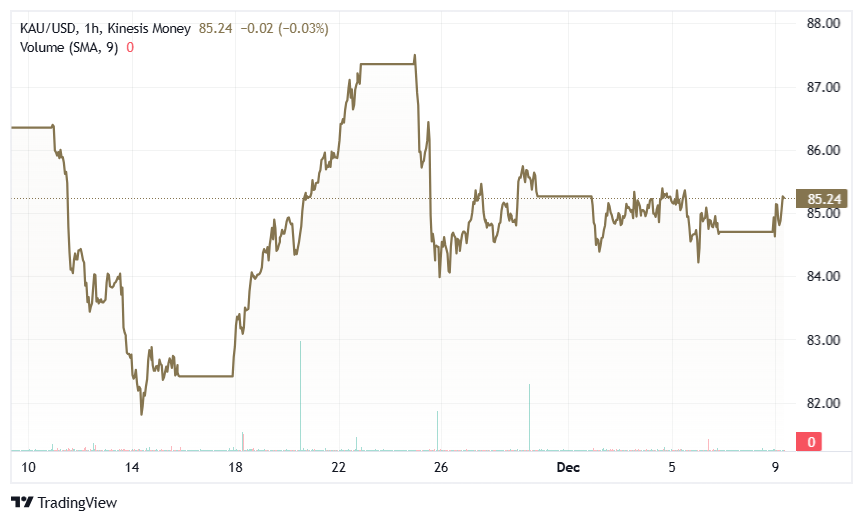
Gold KAU/USD – 1hr view – Kinesis Exchange
Opposing forces in balance:
Gold prices have to some extent been caught between two opposing forces in recent days.
On the one hand, the markets are pricing in an increasing probability of a further interest rate cut by the US Fed this month, which other things being equal, is a positive driver for gold prices. Data from interest rate traders indicates an 85% chance of a 25-basis-point cut on December 18th, compared with around 78% just a few days ago, according to data from the CME FedWatch tool: CME FedWatch – CME Group.
Interest in ETFs fades:
On the other hand, other figures show that investment into gold ETFs has looked less resilient in November, contrasting sharply with strong net inflows in October. The week to November 29th showed only 4.5 tonnes of net inflows in total, following a previous week of only 3.2 tonnes of net inflows, and net outflows of 23.6 tonnes in the week to November 15th, according to World Gold Council data: Gold ETF: Stock, Holdings and Flows | World Gold Council. That compared with the week ending October 18th which saw net inflows of 23.9 tonnes. Read More
Silver Price News: Silver Eases on Friday but Closes Week in the Black
Silver prices moved slightly lower on Friday, but managed to finish the week in positive territory on a week-on-week basis.
Prices moved in a range of $30.87 to $31.55 an ounce on Friday, compared with around $31.40 an ounce in late trades on Thursday.

Silver KAG/USD – 1hr view – Kinesis Exchange
Overall, silver moved in a relatively narrow range through the week, with prices just about clinging on to the $31.00 an ounce level for most of Friday’s session.
Interest rate hopes keep markets buoyant:
A firming up of expectations of a US interest rate cut in December have provided a supportive element for silver, while gold has been largely in a holding pattern last week, providing little convincing momentum in either direction.
Precious metals looking more subdued after October highs:
Both gold and silver posted long-term highs in October, but the market dynamic has changed since then, with gold in November posting its first monthly loss since January 2024. Both metals have been more subdued since then as the markets weighed the prospects of potential delays to interest rate cuts in 2025 amid a potentially more inflationary environment. Read More
Gold’s post-election correction comes as no surprise
“It’s been a rough few weeks. But these extreme moves, by their nature, tend to burn themselves out. In the short term, we have likely hit selling exhaustion on gold, silver and copper.”
- Paul Wong, Sprott Market Strategist
Our market strategist postulates that the recent selloff in gold and precious metals equities is largely driven by a dramatic repositioning of “algo” funds, large algorithmic hedge funds usually employing huge amounts of leverage.
Recall that ahead of the U.S. presidential election, gold was one of the most favored commodities regardless of who would win and had reached new all-time highs of $2,800 for the first time ever. But markets are forward looking and one would argue that gold was already pricing in the election. Following the election, which resulted in a red sweep, investment funds may have been pushed to liquidate, unwind their positions, sell their gold hedges and rotate. Read More
Wall Street sees gold prices steady-higher next week, Main Street more bullish ahead of CPI, PPI inflation data
While precious metals traders did ride some peaks and valleys this week, gold prices repeatedly returned to the $2,645 per ounce price level like a magnet, reinforcing the prevailing view that the market is in a holding pattern ahead of 2025.
Spot gold kicked off the week trading at $2,648.65 per ounce before sliding precipitously to $2,623 by early Monday morning, a low that ended up holding until Thursday evening. The Asian and European sessions then managed to erase all of gold's earlier losses, and by 9:00 a.m. EST, spot gold hit $2,650 per ounce for the first time. That peak proved short-lived, however, as the yellow metal then proceeded to bounce off $2,635 per ounce a number of times. Read More
Gold SWOT: J.P. Morgan says gold is the top commodity to buy in 2025
Strengths:
The best-performing precious metal for the week was silver, up 1.26%. According to BMO, the first silver pour at Aya’s Zgounder expansion was achieved, in line with previous commentary after ore processing in the new plant commenced. The plant reached nameplate capacity of 2ktpd, and commercial production continues to be targeted for year-end.
Australia’s biggest gold miner, Northern Star, has agreed to buy smaller rival De Grey Mining for $3.3 billion, as the soaring value of the precious metal bankrolls the highest price ever offered for an undeveloped Australian gold project, according to the Financial Review. On Friday, SSR Mining agreed to buy the Cripple Creek and Victor gold mines in Colorado from Newmont Corp. for an upfront cash payment of $100 million.
Gold buying by central banks surged to 60 tons in October, mainly led by the Reserve Bank of India (RBI), which added 27 tons of the precious metal to its reserves, the World Gold Council (WGC) said on Thursday. India added 27 tons of gold in October, bringing its total gold purchases to 77 tons from January to October, according to WGC data based on reported monthly data from the International Monetary Fund (IMF).
Weaknesses
The worst performing precious metal for the week was palladium, down 3.11%. According to Scotia, B2Gold announced that a strike has begun at the company’s Fekola mine in Mali with the Fekola workers union giving notice that the strike will last until December 5. BTO continues to process ore through the Fekola mill during this period and noted that it still expects fiscal year 2024 production to be toward the lower end of its 420-450k ounce guidance. Additionally, Mali issued an arrest warrant for Barrick Gold’s CEO Mark Bristow as they have not settled their tax dispute with the company.
De Beers has cut diamond prices by more than 10% across the board as the world’s biggest producer abandons attempts to put a floor under the slumping market. The diamond industry has been struck by one of its deepest and most prolonged slumps in decades, according to Bloomberg.
The day after De Beers’ announcement, Chinese lab-grown diamond companies saw their share prices surge 9% to as high as 30%. The price cut instituted by De Beers may stimulate more diamond sales, but this shows the eroding future outlook for natural stones to be undercut by synthetic stones. Read More
People’s Bank of China is back in the gold market, buying five tonnes in November
In a move surprising to absolutely no one, China’s central bank has re-entered the gold market, ending a six-month pause.
The latest data from the People’s Bank of China showed the central bank bought five tonnes of gold last month, according to Krishan Gopaul, Senior Analyst, EMEA at the World Gold Council.
He added that China’s official gold reserves have increased to 2,269 tonnes.
China’s return to the gold market came as prices experienced a sharp correction and significant volatility following Donald Trump’s victory in the U.S. Presidential election. Gold prices have continued to struggle throughout December.
Even with the six-month hiatus, the PBOC has purchased 34 tonnes of gold this year and remains one of the top gold buyers of 2024. Despite the increase, gold still represents less than 6% of China’s total foreign exchange reserves.
According to data from the London Bullion Market Association, spot gold prices last month averaged around $2,650 an ounce, down 1.4% from October’s average price.
For this reason, many analysts believed that it was only a matter of time before China jumped back into the market. In a recent interview with Kitco News, Nitesh Shah, Head of Commodities & Macroeconomic Research at WisdomTree, said he suspects China needs to increase its gold holdings to at least 10%, if not 20%, of its official foreign reserves. Read More
Bank of America sees $3000 gold in the second half of 2025
Gold is still on track to hit $3,000 an ounce next year, but investors will need to be patient, as the current consolidation period could last through the first half of the year, according to Bank of America.
"Right now, gold is just stuck in an environment where we don't have anything tangible to get investors back into the market," said Michael Widmer, BoA's head of metals research during its 2025 Outlook webinar last week.
America's second-largest bank noted that gold faces significant headwinds in the new year as Chinese demand remains lackluster, and Western investors contend with potential higher bond yields and a stronger U.S. dollar.
"The Trump administration will, in all likelihood, push through a policy mix that, through stronger growth, higher inflation, higher rates, and a stronger USD, might well limit the appetite of investors to increase gold purchases in the near term," the analysts said in the report. Read More
Gold, silver see solid gains on safe-haven bids, China demand hopes
Gold and silver prices are posting sharp gains in midday U.S. trading Monday. Gold hit a two-week high and silver a four-week high. Safe-haven demand is featured, following a weekend of important fundamental news developments. February gold was last up $29.70 at $2,689.40 and March silver was up $1.122 at $32.71.
The collapse of Syrian strongman Bashar Al-Assad’s rule has the world on watch for more Mideast turmoil. That’s prompting some safe-haven buying of gold and silver. U.S. and Israeli airstrikes hit dozens of military targets inside Syria, to prevent the new regime in Syria from accessing weapons and munitions.
Meantime, Chinese and Asian stocks rallied and the Chinese yuan gained Monday after China said it plans to be “more proactive” in stimulating its listing economy. That’s bullish for metals from a demand perspective, as China is a voracious consumer of raw commodities. Reports also say China’s central bank has been a better buyer of gold lately.
Technically, February gold bulls have the overall near-term technical advantage. Bulls’ next upside price objective is to produce a close above solid resistance at $2,748.00. Bears' next near-term downside price objective is pushing futures prices below solid technical support at $2,600.00. First resistance is seen at today’s high of $2,700.00 and then at $2,730.00. First support is seen at $2,675.00 and then at $2,650.00. Wyckoff's Market Rating: 6.5.
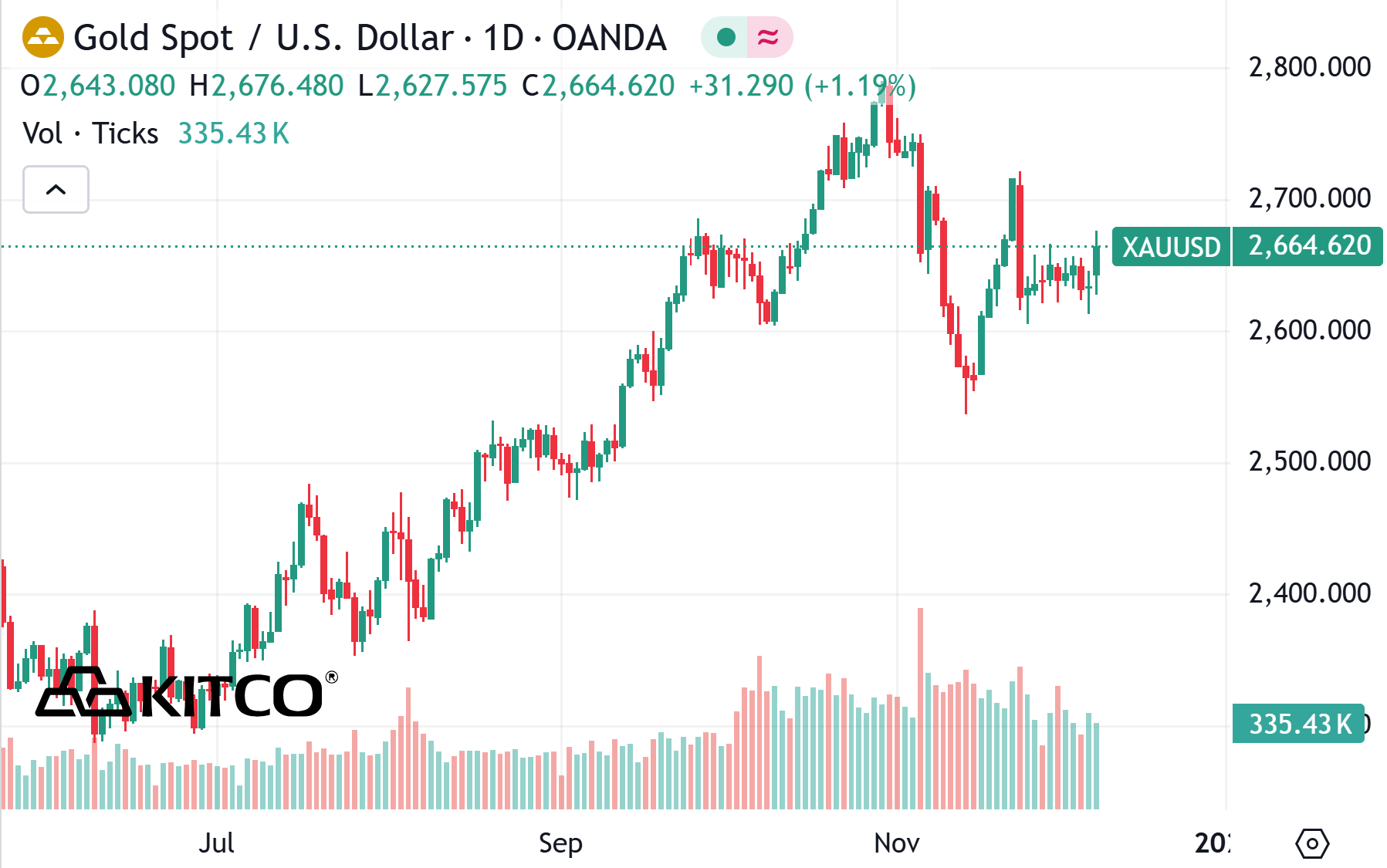
Image Source: Kitco News
March silver futures bulls have the overall near-term technical advantage. Silver bulls' next upside price objective is closing prices above solid technical resistance at $34.00. The next downside price objective for the bears is closing prices below solid support at $31.00. First resistance is seen at today’s high of $32.945 and then at $33.00. Next support is seen at $32.50 and then at $32.00. Wyckoff's Market Rating: 6.5. Read More
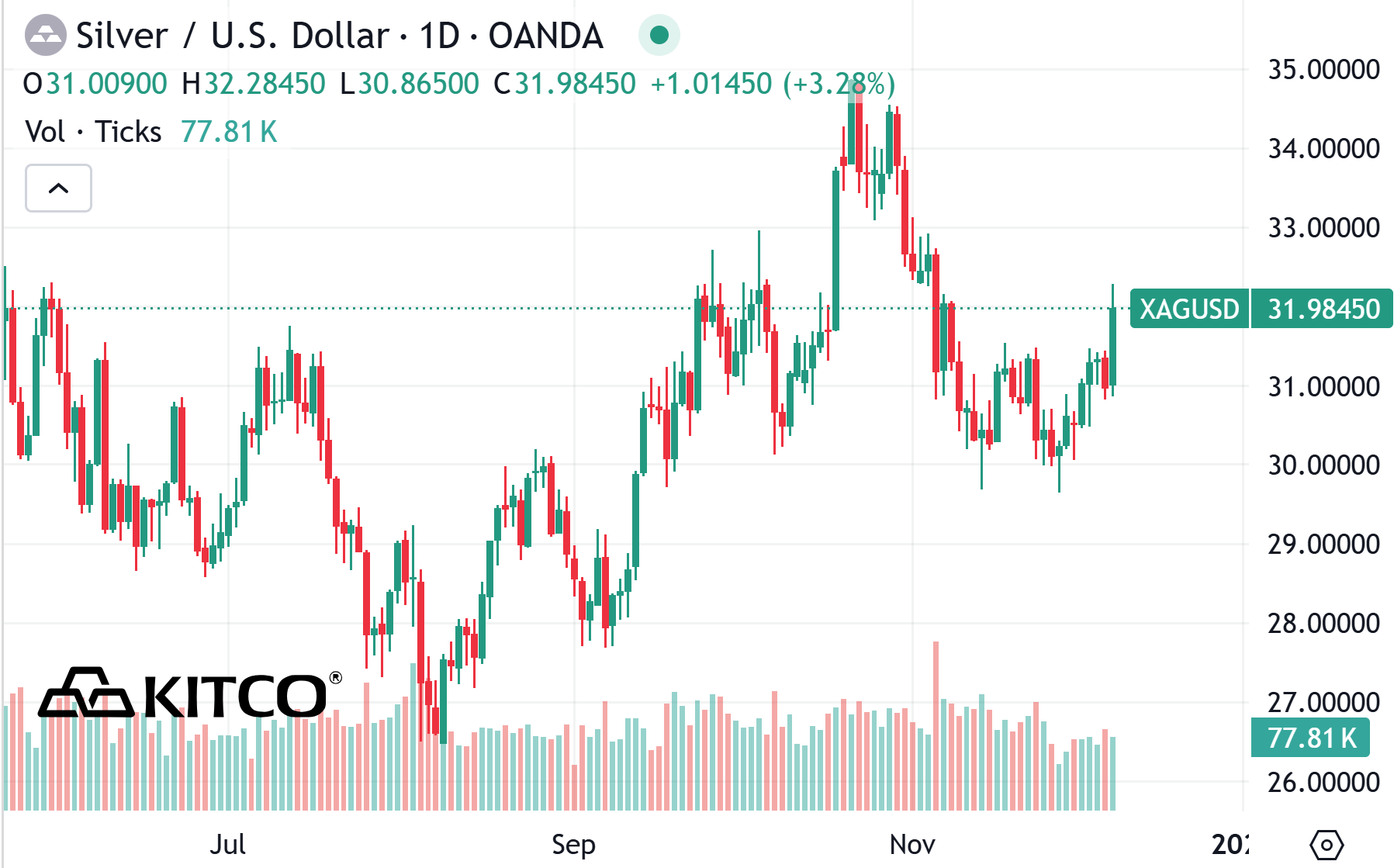
Image Source: Kitco News
CPI, ECB rate decision could be the catalyst gold needs, with $2,708 the key resistance – StoneX’s Razaqzada
Gold’s short-term outlook is showing mixed signals with firm resistance at key levels, but this week’s CPI data and the ECB rate decision could be the catalyst that breaks the yellow metal out of consolidation, according to Fawad Razaqzada, market analyst at StoneX Group.
Razaqzada wrote that the strong dollar and geopolitical uncertainties are continuing to weigh on gold, while technical signals suggest caution.
“Gold and silver rose in the first half of Monday’s session,” he noted. “A shift in China’s monetary stance provided a welcome boost for Chinese stocks and this helped to provide a positive backdrop for all China-related assets, from miners to key commodity prices. Meanwhile, geopolitical upheaval from the Middle East to South Korea and France also helped to fuel a bit of a rebound in gold and oil prices.”
Razaqzada said interest-rate decisions from major central banks and U.S. CPI and PPI inflation data will dominate this week’s economic news, while China is gearing up for a stimulative 2025. Read More
‘Biggest economic shift since Nixon’: Major U.S. monetary policy changes coming in 12-36 months – Jack Mallers
Bitcoin’s repeated surges above the $100,000 mark—and its subsequent pullbacks just below that key level—are turning what once seemed impossible into a recurring event. Against this backdrop, investors need to gear up for major changes in U.S. monetary policy coming in the next 12-36 months, according to Jack Mallers, founder and CEO of Strike.
Proposals that once sounded radical now appear plausible, Mallers tells Jeremy Szafron, Kitco News anchor. Take Wyoming Senator Cynthia Lummis’s controversial plan to gradually shift a portion of America’s gold reserves into Bitcoin: 1 million BTC over 20 years, roughly 5% of the total supply.
“If the Bitcoin Strategic Reserve is signed and put in place, I think this would be the biggest U.S. economic announcement since Nixon in ’71,” Mallers said.
This would signal a strategic pivot away from unlimited printing and debasement toward a finite, technologically advanced asset. “It’s not just a hedge,” he said. “It’s pro-business, pro-labor, pro-energy, and it shows we acknowledge the problem and we’re building towards it.”
Such moves gain significance in an economy where U.S. debt tops $36 trillion and central bankers, including Fed Chair Jerome Powell, acknowledge Bitcoin’s growing role as a competitor to gold. Watch the podcast
Live From The Vault - Episode: 202
The Dollar’s Decline: Gold, Silver, and the Great Financial Reset. Feat Stephen Leeb.
In this episode of Live from the Vault, Andrew Maguire teams up with economist Dr Stephen Leeb to dissect the seismic shifts in the global financial landscape. They uncover why the US dollar’s dominance is crumbling, the role of gold in reshaping monetary systems, and the pivotal moves by BRICS nations to establish a multipolar world order.
Delve into the implications of fiat currency failures, central bank gold strategies, and the critical importance of spiritual versus material approaches to global economics.
Disclaimer: These articles are provided for informational purposes only. They are not offered or intended to be used as legal, tax, investment, financial, or any other advice.
Featured Image - Source: Unsplash















