x




The People's Bank of China purchased two tonnes of gold in August, extending its buying streak to a tenth consecutive month. This consistent acquisition highlights a strategic shift in the global gold market, with central banks acting as a key source of demand. While the rate of purchases has slowed compared to earlier in the year, analysts believe this trend will continue and provide a strong price floor for gold, supporting its current long-term uptrend. The motivation for this diversification is a response to the weaponization of the U.S. dollar and a growing desire for greater financial independence.
Despite the recent slowdown in acquisitions, China's total official gold reserves now stand at 2,302 tonnes. However, this still accounts for a relatively small portion of the nation's total foreign reserves. Market analysts suggest that while rising gold prices could influence the pace of future purchases, central banks are less sensitive to price fluctuations than traditional investors. This ongoing demand from official institutions, combined with broader market factors, is contributing to gold's current momentum, as the price recently broke out of a multi-month consolidation to trade above $3,600 an ounce. Source
According to analysts at Heraeus, a global leader in precious metals, gold is poised to benefit from a likely prolonged depreciation of the US dollar. They note that the historical inverse relationship between the two assets—where gold strengthens as the dollar weakens—appears to be reasserting itself. This is happening despite an unusual period since 2016 where both gold prices and the US dollar have risen concurrently. The analysts believe the dollar's weakness will be driven by ongoing trade disruptions and a global trend of central banks and investors diversifying their reserves away from the dollar in response to geopolitical and economic uncertainties. This has led to a significant increase in demand for gold through ETFs and physical bars and coins.
Heraeus also highlights a new and significant trend: central banks are starting to show interest in silver for their reserves, a metal that has not historically been a central bank staple. The report cites Russia's announced plans to acquire a substantial amount of silver over the next three years as a prime example of this emerging activity. This new source of institutional demand, combined with silver's traditional industrial uses, could provide a strong tailwind for the price of silver. The analysts noted that both gold and silver have been experiencing strong upward momentum, with gold recently breaking out to new record highs. Source
According to TD Securities strategist Daniel Ghali, the silver market is nearing a "squeeze" where demand is outpacing available supply. He warns that free-floating silver stockpiles in London Bullion Market Association vaults could be exhausted within seven months, or even four if investment demand accelerates. This is due to years of structural supply deficits in the silver market, which are being exacerbated by robust industrial and renewed investor demand. The current supply shortage has pushed silver prices to their highest level in 14 years, with analysts from TD Securities suggesting that a move above $50 an ounce is likely in the coming months given the current price momentum.
Ghali notes that for the market to rebalance, there would need to be a significant dampening of demand, possibly through a severe recession, or a substantial increase in supply, which would require prices to rise even higher to incentivize new production. He believes that gold may continue to lead the precious metals rally because it has the added support of consistent central bank demand, which silver currently lacks. Despite silver's strong performance this year, the gold-to-silver ratio remains well above historical averages, indicating that silver still has room to catch up. Source
According to the World Gold Council, investor interest in gold-backed exchange-traded funds saw a significant increase in August, more than doubling July's inflows. This surge was primarily driven by North American and European demand, with investors seeking a hedge against ongoing economic uncertainty and geopolitical risks. A key catalyst for the renewed interest was growing market expectations for a Federal Reserve rate cut, a sentiment that strengthened after signs of a cooling labor market. The WGC also notes that the year-to-date inflows into low-cost gold ETFs are at a record high, which they view as a signal that investors are making long-term, strategic allocations to safe-haven assets.
While North American and European funds experienced strong inflows, a surprising trend was observed in Asia, particularly China, where gold ETFs saw outflows. This was attributed to improving sentiment in the equity market, which drew capital away from gold. Despite this regional divergence, the WGC believes that overall investment demand for gold will remain well-supported by percolating fears of stagflation, a unique economic environment of high inflation and stagnant growth that has historically been very positive for gold. Source
The silver market is showing signs of renewed tightness, as indicated by a sharp rise in silver lease rates. This is the fifth time this year that the lease rate has spiked, with the go-forward rate currently in negative territory. This unusual situation means that those who lease out silver are earning a substantial interest rate, while those borrowing the metal are willing to pay for it. According to Natixis analyst Bernard Dahdah, this is largely due to increased demand for physical silver within the United States, which is creating a shortage in London’s available leasable material. The U.S. demand is being driven by the recent addition of silver to the government's critical minerals list, which has raised concerns that the metal could be subject to tariffs.
This uncertainty has created a significant arbitrage opportunity, with silver futures trading in New York at a substantial premium over London spot prices. This is encouraging strong demand for the physical material needed to fulfil these contracts. The tightness in the silver market is also linked to historically low inventories at the London Bullion Market Association, with TD Securities analysts warning that these stockpiles could be depleted within months. While some analysts believe that a U.S. tariff on silver is unlikely due to the country's reliance on imports, the market remains on edge. The outcome of a critical minerals investigation scheduled for mid-October is expected to provide some clarity, which could potentially cause silver lease rates to ease. Source
Jerry Prior, a fund manager at Mount Lucas, suggests that gold prices could increase to $3,800 an ounce this year, primarily driven by the Federal Reserve's anticipated interest rate cuts. He believes that even with current inflation levels, a slowing economy and a cooling labor market provide the Fed with the necessary room to ease monetary policy. Prior advises investors to monitor the Fed's "dot plot" following the next meeting for clues on the magnitude of future rate cuts. He states that while a few small cuts would lead to some gains for gold, a more aggressive easing cycle would give gold prices significantly more room to grow.
Beyond rate cuts, Prior identifies two other major factors that could push gold prices higher. The first is a potential loss of control over the long end of the yield curve, where rising government debt could force the central bank to intervene by buying long-term bonds, which could have a significant bullish impact on gold. The second factor is the weakening of the U.S. dollar's role as the world's reserve currency, a trend Prior attributes to the "weaponization of the economy." He concludes that while he is bullish on gold, its true potential for exponential gains toward $4,000 would require a combination of rate cuts, a "misbehaving" long-end of the yield curve, and a continued weakening of the dollar. Source
Paul Wong of Sprott Asset Management believes that gold's recent surge above $3,500 an ounce is driven by the market's growing recognition that governments will need to devalue their currencies to manage mounting debt obligations. He notes that the technical chart for gold is highly bullish after a period of consolidation, with an immediate price target of $3,900. Wong explains that a combination of a weakening labor market and rising inflation is putting the Federal Reserve in a difficult position, forcing it to choose between its employment and inflation mandates.
The fundamental drivers behind gold's ascent are a lack of trust in the global financial system and what Wong refers to as "fiscal dominance," where monetary policy becomes subservient to expansionary government spending. With soaring public debt in developed countries and rising long-term bond yields, bond markets are losing faith in governments' ability to control spending. This environment, combined with anticipated rate cuts and a weakening U.S. dollar, makes gold a compelling safe-haven asset, as it is a non-financial and non-governmental store of value that provides a hedge against the inevitable debasement of fiat currencies. Source
Gold prices experienced volatility but ultimately saw gains after the release of U.S. Producer Price Index (PPI) data for August. The report showed that both headline and core PPI unexpectedly fell by 0.1%, which was a significant deviation from the forecasted increases. This data, which is a key indicator of inflation at the wholesale level, was a surprise to economists and followed a cooler-than-expected Consumer Price Index (CPI) report.
The market reaction to the softer PPI data suggests that investors believe this will give the Federal Reserve more reason to cut interest rates. Analysts view these falling producer prices as a leading indicator of lower consumer inflation, which would support a more dovish monetary policy. The prospect of rate cuts is a positive factor for gold, as lower interest rates reduce the opportunity cost of holding the non-yielding asset. Source
Gold prices were holding steady on Wednesday, despite a U.S. Producer Price Index (PPI) report for August that was unexpectedly tamer than forecast. The PPI fell 0.1% month-over-month, the first decline in four months, which would typically be bullish for gold as it suggests less pressure on the Federal Reserve to maintain high interest rates. However, gold’s upward movement was limited by profit-taking after it reached a record high the previous day. Additionally, rising geopolitical tensions, including Poland shooting down Russian drones and an Israeli airstrike in Qatar that disrupted ceasefire talks, are boosting gold's appeal as a safe-haven asset.
The article also highlights other factors influencing the market, such as U.S. Treasury Secretary Scott Bessent’s public comments urging the Federal Reserve to change its monetary policy following revised jobs data that showed weaker-than-expected hiring. The jobs data was revised to show 911,000 fewer payroll gains in the past year, which Bessent argued should prompt the Fed to lower interest rates to stimulate growth. From a technical analysis perspective, both gold and silver are considered to have a strong short-term bullish advantage, with specific price targets for both the bulls and bears to watch. Source
The platinum market is experiencing a "perfect storm" as a third consecutive year of supply deficits coincides with a surge in investor interest. Despite a slow start to the year, platinum prices have risen by over 50%, with the most significant gains occurring since June. The World Platinum Investment Council (WPIC) reports that while the projected supply deficit for 2025 has been slightly revised down to 850,000 ounces from an earlier estimate, the market remains undersupplied. Total platinum supply for the year is expected to be at its lowest in five years, and experts believe that a significant economic downturn would be needed to balance the market through reduced demand, a scenario they consider unlikely.
The WPIC’s report highlights a pick-up in investment and jewelry demand, particularly driven by a price discount relative to gold. In the first half of the year, platinum jewelry demand reached its highest level since 2015, with strong growth forecast for the full year in China, Japan, Europe, and North America. Chinese investors are also fueling a dramatic surge in demand for platinum bars and coins. While trade volatility has caused some short-term outflows, the WPIC maintains that platinum's investment case remains compelling, noting that current prices are not high enough to incentivize an increase in mine supply to meet the growing demand. Source
According to Roukaya Ibrahim, Chief Strategist at BCA Research, the recent surge in precious metals prices is not uniform, with gold having stronger support than silver, platinum, and palladium. She highlights four key risks for these other metals. First, they are more susceptible to a deteriorating economic outlook and a potential recession, as their price rallies have been tied to "risk-on" investor sentiment. Second, a cooling economy would directly impact their industrial demand, which accounts for a significant portion of their global consumption—60% for silver and 80% for platinum. In contrast, gold is more resilient to economic downturns.
Furthermore, Ibrahim cautions that supply deficits, while seemingly bullish, do not always translate to sustained price increases for these metals, citing historical examples where prices have fallen despite market shortages. Finally, she points to a lack of strong structural support for silver and platinum compared to gold. The ongoing record-breaking gold rally is fueled in large part by consistent sovereign demand from central banks diversifying their reserves away from the U.S. dollar, a trend that does not yet significantly extend to other precious metals due to gold’s greater liquidity and lower volatility. Source
Peter Krauth of SilverStockInvestor suggests that silver’s ongoing rally is driven by two key factors: macroeconomic conditions and a supply deficit. Like gold, silver is benefiting from market expectations that the Federal Reserve will resume its rate-cutting cycle, a move that historically precedes major price surges for the metal. Krauth notes that silver prices have previously skyrocketed, averaging a 332% gain in the 12 to 18 months following the mid-point of a Fed cutting cycle, which he believes the U.S. economy may be approaching. Additionally, silver's unique role as an industrial metal, with over half of its supply consumed by industry, creates a scarcity factor that gold does not share. Krauth believes that industrial demand, particularly from the solar and artificial intelligence sectors, is stronger than many analysts realize, and that the long timeline for building alternative power sources like nuclear plants makes the quicker-to-deploy solar and battery technology more attractive.
In addition to industrial demand, Krauth highlights a tightening supply for investment silver. The physical supplies in key markets like London remain tight, with a significant amount of silver leaving London for New York due to tariff threats and a large portion of available stock now allocated to ETFs. This leaves only a small percentage available for lending or delivery, contributing to the "doubly-squeezed" supply dynamic. Krauth forecasts that silver could reach $45 an ounce by the end of the year and $50 next year, and if historical patterns hold, prices could eventually climb above $100 an ounce. He cautions that a short-term pullback is possible once the anticipated September rate cut is announced, but this would be a buying opportunity. Source
Disclaimer: These articles are provided for informational purposes only. They are not offered or intended to be used as legal, tax, investment, financial, or any other advice.
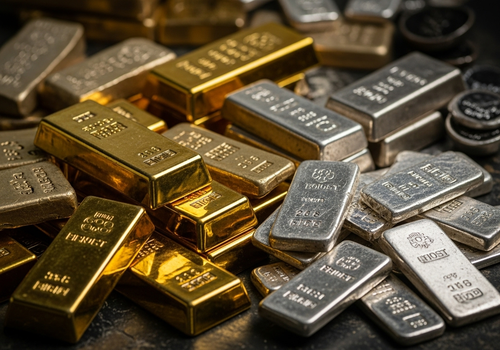
Featured Image generated with Google AI Studio















