x




Gold futures jumped after the Federal Reserve announced a 25-basis-point rate cut, with prices spiking to an intraday high of 4,268 before settling above 4,250. Silver also advanced, breaking records above 62 as the gold-silver ratio tightened toward a key technical range that could indicate a pause in silver’s rapid ascent. Both metals were supported by a weaker dollar, which fell nearly 0.6 percent following the decision.
The Fed’s move eased real rates and lifted a major constraint on bullion, though cautious forward guidance limited expectations for additional cuts. With Jerome Powell’s term nearing its end, markets anticipate a potential pause in policy changes, adding to precious metals’ safe-haven appeal. Strong structural support persisted through ongoing central bank purchases, especially from China, alongside steady ETF inflows and solid physical demand across Asia, helping sustain the rally. Source
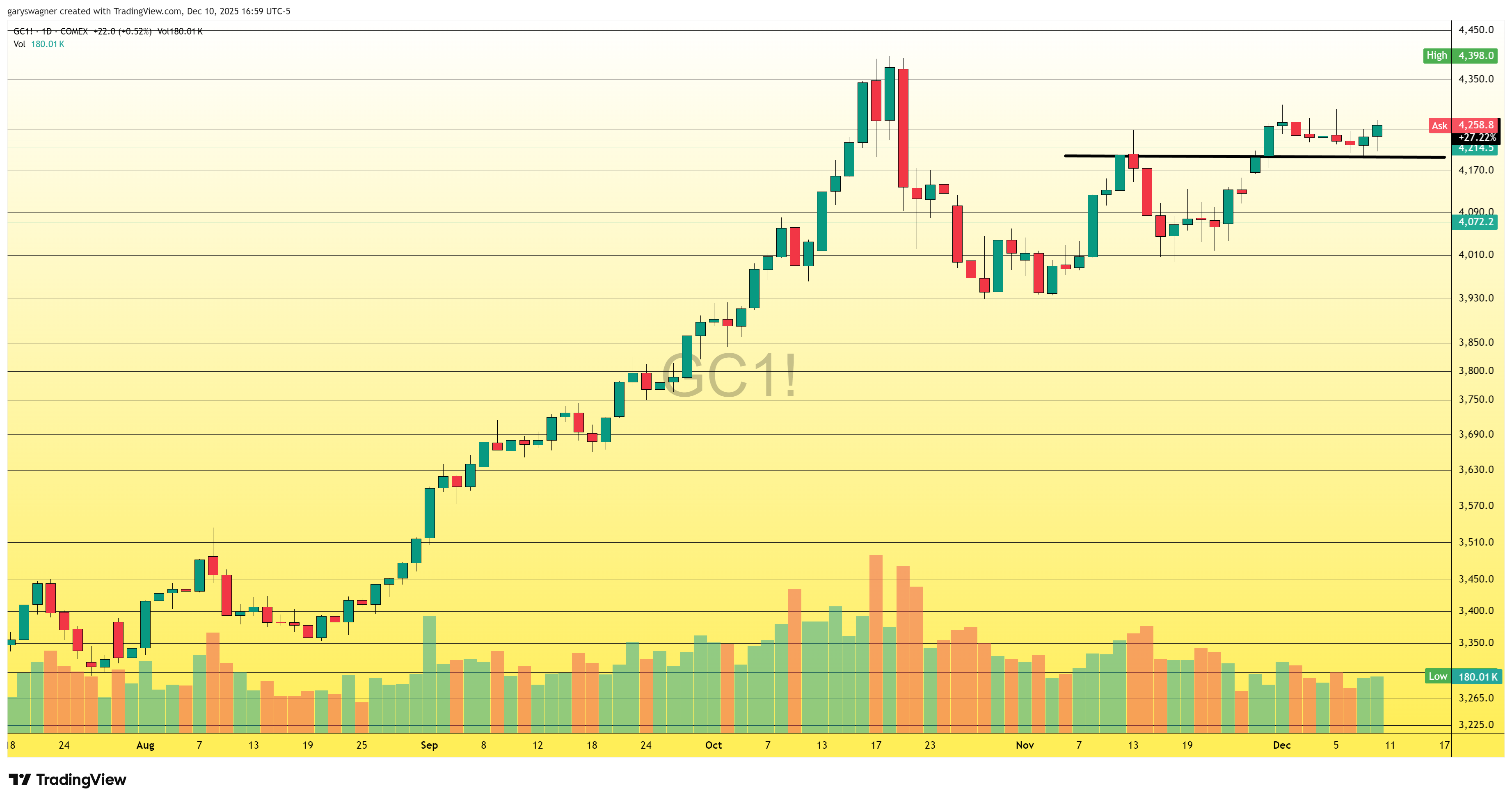
Image Source: Kitco News
Gold is holding near 4,200 even after a strong run this year, and any pullbacks are seen as opportunities to buy rather than signs of weakness. Richard Laterman of ReSolve Asset Management noted that consolidation is natural after a gain of more than 50 percent, but the drivers behind gold’s rise remain intact as geopolitical uncertainty persists, deficits grow, and interest rates are expected to fall through 2026. He also anticipates renewed quantitative easing as liquidity tightens, which would further weaken fiat currency purchasing power and increase the appeal of holding gold as a stabilizing asset during fast-moving market conditions.
Laterman expects that falling rates and expanding liquidity will support both gold and equities, creating an environment where they can rise together. This view has drawn interest to ReSolve’s Return Stacked U.S. Stocks & Gold/Bitcoin ETF, which provides simultaneous exposure to equities and a risk-weighted gold and Bitcoin allocation, though the fund currently holds no Bitcoin due to volatility. He believes gold remains essential for balance, while Bitcoin may have a growing role in 2026 as an alternative asset if its volatility declines. Source
Gold and silver are rising as traders prepare for the Federal Reserve’s expected 25 basis point rate cut, with futures markets assigning a high probability to the move. Anticipation of easing, combined with Powell’s upcoming guidance, has supported both metals, while strong central bank accumulation continues to underpin gold’s remarkable year-to-date performance. China has added to its reserves for 13 consecutive months, and steady ETF inflows highlight ongoing concerns about currency devaluation and geopolitical risks, reinforcing the structural bid beneath the market.
Mixed U.S. employment data has kept the Fed firmly data-dependent, enabling continued easing without signalling recession worries. Some analysts caution that fewer expected rate cuts next year could moderate gold’s upside, but current price action reflects confidence in broader fundamentals beyond monetary policy alone. As gold trades above 4,213 and silver above 61, their gains highlight the combined effects of dovish expectations, resilient labor conditions, and persistent official-sector demand, positioning precious metals to maintain momentum unless Powell delivers a significantly hawkish surprise. Source
Gold and the S&P 500 are consolidating near record highs in what the Bank for International Settlements describes as simultaneous bubble-like conditions not seen in fifty years. Both assets have surged in 2025, with gold up more than 50 percent and the S&P 500 gaining over 16 percent, each posting multiple record highs. The BIS attributes much of this rise to heavy retail investor inflows, noting that enthusiasm, herd behaviour, and fear of missing out have driven both gold and equity ETFs to inflated levels, even trading at premiums to their underlying value. This surge in retail participation contrasts with institutional flows, which have been flat or negative, creating a potential setup for volatility if sentiment shifts.
Although some analysts view gold’s recent highs as overbought, many argue that strong fundamentals continue to support elevated prices. Central banks are expected to purchase around 900 tonnes of gold this year, maintaining demand well above historical norms as they diversify away from the dollar. Expectations of further Federal Reserve easing through 2026, weaker bond yields, and a softer dollar add to the bullish backdrop. Elevated equity valuations may also reinforce gold demand as investors seek to balance risk, suggesting that even if bubble concerns grow, structural drivers remain firmly in place. Source
Silver has surged above 60 dollars an ounce, outperforming gold and driving the gold to silver ratio to its lowest level since 2021. The rally has been fuelled by strong industrial demand, lingering supply-chain constraints, and renewed investor interest, with prices more than doubling this year. Standard Chartered’s Suki Cooper notes that while the broader trend remains positive, shifting market dynamics such as easing Indian demand, replenished London inventories, and elevated but stabilizing lease rates could bring short-term volatility and potential corrections before further gains.
Global stock movements highlight a mixed market backdrop, with LBMA vault holdings rising significantly while Chinese inventories decline and US inventory levels ease slightly. A major driver in the near term is heavy inflows into silver-backed ETPs, which have recorded their strongest increases since 2020, though available London stocks are growing even faster. Cooper adds that silver still has room to move relative to gold, but the ratio now appears stretched, increasing the likelihood of a near-term pullback even as the overall outlook stays constructive. Source
Harvard Management Company expanded its exposure to alternative assets in the third quarter, adding significantly to its positions in both Bitcoin and gold. Its stake in the iShares Bitcoin Trust ETF rose to 6.813 million shares worth 442.88 million dollars, making Bitcoin 21% of its disclosed US equity holdings and its largest single position. The fund also boosted its allocation to SPDR Gold Shares to 661,391 shares valued at 235.1 million dollars, marking the second consecutive quarter of growth in both assets. This shift comes during a period when gold has climbed nearly 60% this year, while Bitcoin has slipped 2% amid heightened volatility.
Analysts note a growing opportunity for alternative assets as institutional investors remain underexposed. Gold advocates argue that inflation, rising deficits, and pressure on bond markets are driving renewed interest, with some suggesting that even at current record levels gold remains underowned. Others foresee an imminent rotation from bonds into gold as falling yields and central bank rate cuts undermine traditional fixed-income returns. Source
The Bank of Canada held its overnight rate at 2.25%, citing stronger third-quarter growth, moderating inflation, and an improving labor market as reasons to keep policy steady for now. Markets reacted quickly, with the Canadian dollar weakening and gold in Canadian dollars briefly dipping before stabilizing. The central bank highlighted resilience across major global economies despite elevated uncertainty, noting strong US consumption and AI-driven investment, firmer growth in the euro area, and ongoing softness in China’s domestic demand.
Canada’s economy posted a surprisingly strong 2.6% GDP increase in the third quarter despite flat domestic demand, though the Bank expects weaker fourth-quarter growth as net exports decline. The labor market has shown recent improvement, with employment gains and a lower unemployment rate, yet trade-sensitive sectors remain fragile. Inflation sits close to target at 2.2%, with core measures stable and underlying pressures near 2.5%, and the Bank expects slack in the economy to offset cost pressures linked to global trade shifts. Policymakers see the current rate as appropriate if conditions stay aligned with projections but remain ready to adjust should the outlook change. Source
Central banks kept up their strong pace of gold buying in November, with Poland and Brazil leading demand as prices consolidated after October’s record highs. Poland added 14 tonnes, bringing its holdings to 544 tonnes and lifting gold to 27% of its total reserves. Brazil followed with an 11-tonne increase, its third straight month of purchases, for a total of 43 tonnes added since September. Other active buyers included Uzbekistan with 10 tonnes, Kazakhstan with 8 tonnes, the Czech National Bank with 1.6 tonnes, and China with just 1 tonne, marking its fifth consecutive month of subdued buying.
The World Gold Council expects central bank demand to reach between 750 and 900 tonnes this year, lower than the exceptional 1,000-tonne increases of the past three years but still far above historical norms. Analysts note that appetite has remained resilient despite gold trading near 4,200 dollars an ounce after rising more than 50% in 2024, its strongest annual performance since 1979. Looking ahead, 2025 demand may not match the extraordinary levels of recent years, but central banks continue to view gold as a strategic reserve asset, keeping overall demand robust. Source
Bank of America expects gold prices to continue rising through 2026, projecting a target of 5,000 dollars an ounce as investment demand grows. Michael Widmer, Head of Metals Research, emphasized that gold rallies typically peak only when the fundamental reasons driving the market fade, not simply because prices rise. Despite a more than 50% rally this year, the market remains underinvested, particularly among high-net-worth investors, who hold just 0.5% of their assets in gold, leaving significant room for further inflows.
Widmer highlighted that both retail and institutional investors, as well as central banks, could benefit from increasing gold allocations. He noted that central bank reserves now average 15% in gold, but optimal diversification could see allocations around 30%. He also indicated that monetary policy in the U.S. will be a key factor, with easing cycles historically supporting price gains even without consistent rate cuts. Overall, gold’s strong performance and underrepresentation in portfolios suggest continued upward potential in 2026. Source
Gold prices showed minimal movement following the Federal Reserve’s expected rate cut of 0.25%, lowering the U.S. interest rate range to 3.50–3.75%. February gold futures were down slightly at 4,235 dollars an ounce, while March silver edged higher to 61.14 dollars despite retreating from earlier record levels. The FOMC noted that inflation remains somewhat persistent and indicated that additional cuts may not occur soon, with traders awaiting further guidance from Fed Chair Jerome Powell to assess the likely path of monetary policy.
Market conditions showed the U.S. dollar index lower, crude oil steady near 58.50 dollars per barrel, and the 10-year Treasury yield at 4.166%. Technical analysis places February gold resistance at 4,251.70 and 4,285.00, with support at 4,197.80 and 4,150.00, while March silver shows potential upside to 65.00 and downside support at 57.00. Liquidity in the gold market remains concentrated in the December futures contract due to year-end positioning, and the overall technical outlook signals continued volatility with modest near-term directional bias. Source
Gold rebounded to $4,205 an ounce following the Federal Reserve’s 25-basis-point rate cut, bringing the federal funds rate to a range of 3.50% to 3.75%. The move was largely in line with market expectations, but the Fed offered minimal guidance for future monetary policy, leaving investors uncertain about potential rate changes in 2026. Economic indicators suggest moderate growth, slowing job gains, and slightly elevated inflation. The Fed’s updated projections show only modest adjustments from previous forecasts, with policymakers anticipating rates to decline to 3.4% next year and long-term rates stabilizing at 3.1%, reflecting a cautious outlook for monetary easing.
Market analysts noted that much of the impact from the rate cut was already priced in, and the split vote among Fed officials highlighted the lack of consensus on the pace of future easing. The Fed expects U.S. GDP to grow 2.3% in 2026 and 2.0% in 2027, with unemployment rates holding steady around 4.2% to 4.4%. Inflation is projected to remain elevated but gradually moderate, with core consumer prices rising 2.5% next year and headline inflation expected at 2.4%. This cautious and neutral stance signals that the central bank is taking a measured approach while keeping an eye on economic stability and inflation. Source
Gold is expected to be one of the few standout performers in the commodities market in 2026, driven by strong central bank purchases, ongoing U.S. dollar depreciation, potential Federal Reserve rate cuts, and continued geopolitical uncertainty. Wells Fargo analysts highlight that while overall commodity returns may be restrained by rising crude oil supplies, gold and other precious metals are likely to benefit from these favorable macroeconomic conditions. The bank projects gold prices could rise between 5.8% and 10% next year, reaching levels of $4,500 to $4,700 per ounce, supported by central bank demand, lower interest rates, and investor demand for diversification amid persistent risks.
Analysts also point to broader market dynamics reinforcing gold’s appeal, including the weakening dollar, ongoing political uncertainties, and reduced attractiveness of alternative assets like AI-driven equities and cryptocurrencies. They note that gold continues to outperform in relative terms, offering investors a reliable hedge and source of diversification in an environment where traditional strategies may be less effective. The combination of macroeconomic tailwinds, lower real interest rates, and safe-haven demand is expected to maintain gold’s upward trajectory through 2026, even if the pace of gains moderates compared with recent years. Source
Following the Federal Reserve’s widely anticipated 25-basis-point rate cut, Chair Jerome Powell indicated that the central bank considers its policy rate to be at a neutral level and signaled that a rate hike is not currently expected. He emphasized that any further cuts would depend on incoming economic data, with the Fed closely monitoring inflation trends and labor market developments. Powell highlighted that while the labor market has shown gradual cooling and service-sector inflation has moderated, structural issues such as housing shortages remain unaddressed by interest rate adjustments. The Fed’s decision to cut in December was also influenced by these trends, along with a slight improvement in projected GDP growth due to factors like the end of the federal government shutdown and continued consumer and AI-driven spending.
Powell explained the internal division within the Federal Open Market Committee, noting the tension between the dual mandate of controlling inflation and supporting the labor market, which contributed to the split vote on the rate decision. He stressed that the base case among policymakers is either holding rates steady or modestly cutting, rather than increasing them, and clarified that tariff-driven goods inflation is expected to peak early next year and gradually ease. Powell also refrained from discussing his post-chair plans or potential successors, focusing instead on leaving the economy in strong shape with controlled inflation and a robust labor market. Following his comments, gold prices reacted positively, rising from $4,185 to $4,238 per ounce, reflecting market sentiment on a stable and potentially accommodative Fed policy. Source
"In this video, Kevin Wadsworth and Patrick Karim explore the historic bull era in gold and what it means for investors today. Dive into decades of charts showing how sectors like tech, utilities, and financials have underperformed gold, and learn how capital rotation and macro signals point to precious metals taking the lead. Whether you’re a seasoned investor or just curious about market trends, this breakdown will help you understand why gold could be the next big winner. Watch now and position your portfolio for the move ahead!" ~ Kinesis Money
Disclaimer: These articles are provided for informational purposes only. They are not offered or intended to be used as legal, tax, investment, financial, or any other advice.
Featured Image - Source: Unsplash















