x




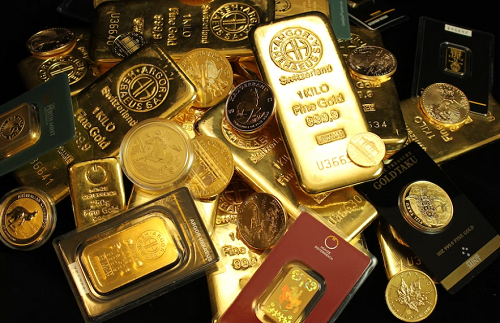
Image Source: Unsplash
Gold Back Below $1,700 as Markets Await Key US Inflation Data
Gold is starting a new week on a downward trend having fallen below $1,700 an ounce. Later in the week will bring the release of the latest US inflation figures as well as the minutes of last month’s Federal Open Market Committee.
Furthermore, there are a whole host of senior central bankers speaking over the course of the week, including Fed representatives Lael Brainard and Charles Evans later today, so there are lots of potential drivers for significant intraday price movements.
The broader outlook for gold remains one where central banks across the world look set on a course of a series of interest rate hikes to try and bring stubbornly high inflation back down towards their target figures. The impact of these ever-increasing rates has been to make gold a less desirable commodity to hold with its lack of yield making other interest-paying assets such as bonds more attractive in its place. Read More
Silver Dips Below $20 Despite Strong Support from Asian Buyers
Silver has slipped back under $20 an ounce as the markets brace themselves for a busy week of news which should provide greater clarity on the macroeconomic picture in the US as well as the Federal Reserve’s stance on how it is seeking to balance curbing inflation without tipping the country into a recession.
This reappraisal has once again seen silver suffer against the prospect of continued rate hikes by the Fed, particularly if this week’s US inflation figure remains stubbornly high. Read More
Gold price faces big risk as markets zero in on next week's inflation data
The gold market remains at risk despite its sudden recovery above $1,700 an ounce this week. Analysts point to next week's inflation data as the deciding factor between bearish and bullish sentiment going into the year-end.
After posting six months of consecutive losses between April and September, gold has kicked off the fourth quarter on a strong note. December Comex gold futures were last at $1,711.60, up 2.4% on the week.
The precious metal climbed on rising risks in the financial markets and a potential slowdown in the economy. The negative news increased bets for the Federal Reserve pivot from its aggressive tightening cycle.
"Some big risk events on the horizon helped gold recover. The U.K. if facing the deadline on its bond purchases in a week, and they might have to announce measures over the weekend. The Bank of Japan had to intervene to support the Japanese yen. And we are likely to see more emergency action from central banks, which suggests global market risks are elevated," OANDA senior market analyst Edward Moya told Kitco News. "That's why you had a lot of bets building in support of a Fed pivot sometime soon." Read More
What's ahead? More rate hikes vs. global monetary policy pivot: here's a look at global rate hikes in 2022
Central banks worldwide have been on an unprecedented synchronized rate hike cycle that is raising some serious doubts, including a warning from the United Nations. And as recession fears become ingrained, is a global monetary policy pivot just around the corner?
This year saw some of the most aggressive moves in monetary policy history, with the U.S. and Canada raising rates by 300 basis points and the ECB hiking 125 bps. Some extreme cases included Zimbabwe raising rates by 14,000 bps and Argentina hiking 3,700 bps to fight surging inflation and currency devaluation.
On the other hand, there are instances like China, Russia, and Turkey, which cut rates to remain accommodative and support their economies.
One of the leading market risks going into the year-end is the idea that central banks have gotten ahead of themselves in their fight against inflation. Many analysts forewarn that rate hikes take between nine and 18 months to filter through. And hiking so much this quickly could end up slowing the economy too much down the road.
The World Bank weighed on this very topic last month, stating that simultaneous rate hikes could lead to a "string of financial crises."
This kind of "degree of synchronicity" between central banks has not been witnessed over the past five decades, according to the World Bank. And if these rate hikes are met with financial-market stress, the global economy will suffer.
"Global growth is slowing sharply, with further slowing likely as more countries fall into recession. My deep concern is that these trends will persist, with long-lasting consequences that are devastating for people in emerging market and developing economies," said World Bank Group President David Malpass. Read More
BoE doubles size of bond buy-backs as emergency plan nears expiry
The Bank of England sought to ease concerns about this week's expiry of its programme to calm turmoil in the government bond market, announcing on Monday new safety net measures including a doubling of the maximum size of its debt buy-backs.
After finance minister Kwasi Kwarteng last month triggered a bond market rout with plans for unfunded tax cuts, the BoE said on Sept. 28 that it would temporarily buy up to 5 billion pounds ($5.53 billion) a day of gilts of at least 20 years duration.
So far, the BoE has bought far less than the minimum daily limit, but on Monday it said it was taking further steps to ensure the scheme concludes smoothly.
"In the final week of operations, the Bank is announcing additional measures to support an orderly end of its purchase scheme," the British central bank said in a statement.
The BoE has so far offered to buy up to 40 billion pounds' worth of gilts but has only bought about 5 billion pounds.
"The Bank is prepared to deploy this unused capacity to increase the maximum size of the remaining five auctions above the current level of up to 5 billion pounds in each auction," the statement said. Read More
Wall Street falls with tech shares; investors assess rate outlook
U.S. stocks declined on Monday as investors worried about the impact of more interest rate hikes and pulled out of technology shares and chipmakers after the United States announced restrictions aimed at hobbling China's semiconductor industry.
Federal Reserve Vice Chair Lael Brainard said tighter U.S. monetary policy has begun to be felt in an economy that may be slowing faster than expected, but the full brunt of Fed interest rate increases still won't be apparent for months. read more
Despite growing concerns by a number of economists and analysts that the Fed's interest rate hikes could increase unemployment, Chicago Fed President Charles Evans continued to back the central bank's attempt to lower inflation, saying that while it sounds "optimistic" he believed it could do so "while also avoiding recession." read more
"People are worried about the economy. People are worried about a possible recession," said Jake Dollarhide, chief executive officer of Longbow Asset Management in Tulsa, Oklahoma. Read More
JPMorgan's Jamie Dimon: U.S. to face recession in 6-9 months, markets could become disorderly
The U.S. economy could be in a recession by the middle of next year, warned JPMorgan Chase & Co chief executive Jamie Dimon, adding that markets could become disorderly and the S&P 500 is at risk of falling another 20%.
The situation is dire, with problematic inflation, oversized rate hikes, unknown effects from the Federal Reserve's quantitative tightening, and the war in Ukraine acting as primary triggers for a recession.
"These are very, very serious things which I think are likely to push the U.S. and the world — I mean, Europe is already in recession — and they're likely to put the U.S. in some kind of recession six to nine months from now," Dimon told CNBC Monday.
Dimon added that the S&P 500 could fall by "another easy 20%" from the current levels. And the next 20% drop is likely to "be much more painful than the first," he noted. "Rates going up another 100bps will be a lot more painful than the first 100 because people aren't used to it," Dimon said. Read More
Strong USDX, rising U.S. Treasury yields, stingy Fed punish gold, silver prices
Gold and silver prices are sharply lower near midday Monday. The safe-haven metals are being hit hard by a higher U.S. dollar index, rising U.S. Treasury yields and weaker crude oil prices to start the trading week. An aggressively tight monetary policy from the U.S. Federal Reserve is also serving as an anchor on the precious metals markets. December gold was last down $34.30 at $1,675.00 and December silver was down $0.61 at $19.645.
Global stock markets were mostly lower overnight. U.S. stock indexes are weaker at midday. U.S. government offices and many banks are closed Monday for the Columbus Day national holiday. Stock market traders will focus on a barrage of corporate earnings reports out this week.
Technically, the gold futures bears have the solid overall near-term technical advantage and gained fresh power on momentum today. Bulls’ next upside price objective is to produce a close above solid resistance at the October high of $1,738.70. Bears' next near-term downside price objective is pushing futures prices below solid technical support at the September low of $1,622.20. First resistance is seen at $1,700.00 and then at today’s high of $1,707.40. First support is seen at $1,662.00 and then at $1,650.00. Wyckoff's Market Rating: 2.0.
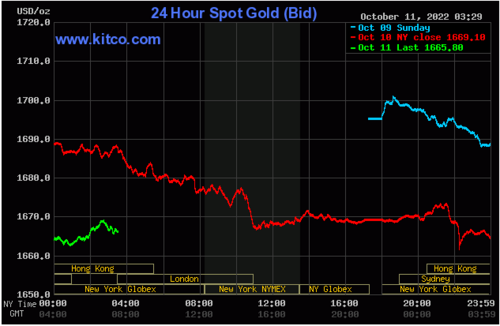
Image Source: Kitco News
The silver bears have the slight overall near-term technical advantage. Silver bulls' next upside price objective is closing prices above solid technical resistance at the October high of $21.31. The next downside price objective for the bears is closing prices below solid support at $18.00. First resistance is seen at $20.00 and then at today’s high of $20.21. Next support is seen at $19.25 and then at $19.00. Wyckoff's Market Rating: 4.5. Read More
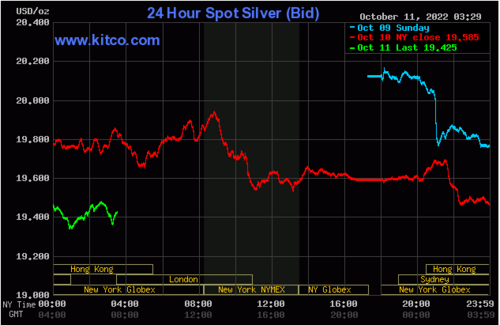
Image Source: Kitco News
.png)
Disclaimer: These articles are provided for informational purposes only. They are not offered or intended to be used as legal, tax, investment, financial, or any other advice.















