x





Asian investors are increasingly dominating both the physical and paper gold markets, as demonstrated by a surge in demand for gold-backed exchange-traded funds (ETFs) in April, according to the World Gold Council (WGC). Global holdings in these ETFs rose by 115 tonnes, with Asia accounting for a remarkable 65% of the net inflows—the region’s strongest month on record. Chinese investors were the primary drivers, motivated by economic uncertainty, currency depreciation fears, and ongoing trade tensions with the U.S. Japan also saw steady demand amid similar geopolitical concerns. While North America also posted significant inflows, European markets bucked the trend with modest outflows due to late-month price declines and profit-taking.
Despite recent price gains and gold hitting an all-time high of $3,500, WGC analysts believe there is still room for further growth. They point to the fact that ETF holdings in Western markets remain well below their 2020 peak, and speculative positions in COMEX futures are at low levels, indicating potential for more investor participation. Analysts emphasize that global trade tensions, particularly around protectionism, continue to drive demand by fuelling recession fears and equity market volatility. Additionally, global monetary policy trends—such as rate cuts and expectations of slower economic growth—are reducing gold’s opportunity cost, thus supporting its appeal as a hedge against economic instability. Source
Gold continues to show remarkable resilience and strength, rebounding quickly from short-term corrections and ending the week above $3,300 an ounce with a 3% gain. Despite being below its all-time high of $3,500, the metal has displayed significant volatility, with price swings ranging from 5% to 10% over recent weeks—well above its historical average. This heightened volatility complicates short-term trading but reinforces gold's appeal as a long-term asset, especially amid ongoing geopolitical uncertainty, rising global debt, and persistent inflation concerns.
Investor interest in gold remains high, with demand surging particularly in Asia, where investors purchased 69.6 tonnes in gold-backed ETFs last month—far outpacing North American inflows. Analysts believe this strong demand, coupled with ongoing economic uncertainty and the declining relevance of traditional investment models like the 60/40 portfolio, solidifies gold's status as a strategic asset. As central banks, institutions, and retail investors seek stability, forecasts for gold hitting $4,000 by year-end—led by Bank of America—are gaining credibility. Gold is increasingly viewed not just as a defensive hedge, but as a proactive tool for managing risk in complex global markets. Source
Gold prices remain above the key $3,300 per ounce level, recovering from a dip to $3,200 last week, though they’ve retreated from Tuesday’s high above $3,400. Analysts suggest that while the long-term uptrend remains intact, short-term momentum has softened as traders adopt a “wait-and-see” approach. The Federal Reserve’s cautious stance on interest rate cuts, paired with stable U.S. economic data and persistent inflation, has contributed to this more neutral positioning. Many institutional investors believe a summer rate cut is already priced in, limiting immediate upside potential. Despite recent volatility, dips are still being bought, indicating underlying bullish sentiment driven by broader economic uncertainties.
The biggest short-term risk for gold is the potential progress in U.S.-China trade negotiations set to take place in Switzerland. A de-escalation in geopolitical tensions could weaken gold’s safe-haven appeal and push prices closer to the $3,000 support level. Still, analysts view any correction as a buying opportunity, pointing to ongoing political instability, central bank diversification trends, and emerging market demand as long-term bullish factors. Looking ahead, upcoming U.S. economic data—including CPI, PPI, retail sales, and commentary from Federal Reserve Chair Jerome Powell—could drive further volatility. While positive trade news may trigger a pullback, the structural case for gold remains strong amid persistent global uncertainty and inflation pressures. Source
The gold market saw strong performance from palladium and platinum this week, with notable developments such as Ivanhoe Mines accessing the high-grade Platreef orebody in South Africa, positioning it as a future leading platinum producer. Gold companies like OceanaGold and Kinross also posted impressive financial results, with strong earnings, debt-free balance sheets, and significant free cash flow. Despite gold's midweek dip due to a stronger dollar and optimism over a possible U.S.-China trade deal, prices rebounded, and investors remain optimistic. Meanwhile, silver lagged behind but still gained, supported by rising production and steady industrial demand. However, setbacks included the suspension of a potential mine merger in Ghana and ongoing volatility tied to geopolitical developments.
Looking ahead, a major structural shift in the gold market is expected with the implementation of the Basel III “Endgame” rules in July 2025, which will allow U.S. banks to classify physical gold as a Tier 1 asset—equivalent to cash or government bonds. This change is likely to increase institutional demand for allocated gold, enhancing its role as a strategic, risk-free reserve asset. Opportunities also include ongoing consolidation in the mining sector and significant resource growth at key gold projects. Still, risks remain, such as potential price pullbacks if geopolitical tensions ease, waning jewelry demand, and tragic violence in Peru's gold mining regions. Despite short-term headwinds, gold's long-term outlook remains supported by structural regulatory changes and persistent economic uncertainty. Source
Gold experienced a volatile but overall positive week, with prices beginning at $3,239.76 and peaking above $3,431 before retreating to end around $3,330. Despite dramatic swings driven by trading activity across global markets—especially in Asia and Europe—investor interest remained strong. While geopolitical developments like potential U.S.-China trade negotiations and the Federal Reserve’s rate stance sparked fluctuations, gold largely held above $3,300, signalling resilience. Market sentiment remains split, with Kitco's Weekly Gold Survey showing an even divide among analysts on gold’s near-term direction. Meanwhile, retail investors maintain a bullish tilt, reflecting ongoing concerns about tariffs, inflation, and global uncertainty.
Analysts attribute gold’s current range-bound behaviour to several macroeconomic factors, including stagnant inflation, a mixed U.S. jobs market, and ambiguous Fed policy signals. Many see the yellow metal as a sensitive barometer of global trade tensions, with tariffs and negotiations—especially involving China—playing an outsized role in price movements. While some experts caution that gold may be due for a pullback toward its 200-day moving average around $2,700–$2,800, others argue that its current consolidation above $3,300 is a healthy pause that could support future gains. Upcoming economic data, including U.S. inflation, retail sales, and Fed commentary, will likely determine whether gold breaks higher or retreats in the short term. Source
Gold saw a sharp decline of over 2% on May 12, 2025, driven by a surge in global risk appetite fuelled by President Trump’s sweeping diplomatic overtures. His optimistic remarks on a ceasefire between India and Pakistan, progress in U.S.-China trade relations, and other geopolitical breakthroughs sparked a rally in equities and a retreat from traditional safe-haven assets like gold. As risk-on sentiment dominated the markets, investors shifted their focus toward growth, causing gold to tumble to around $3,212 per ounce. However, this drop appears to be more about short-term positioning than a fundamental change in gold’s long-term value.
Despite the current optimism, the article highlights that many of Trump’s promises lack concrete follow-through, and the global geopolitical landscape remains volatile. Gold’s retreat may be temporary, as upcoming economic data—including U.S. inflation reports, European sentiment indices, and UK wage growth—could quickly reshape investor expectations. If inflation runs hot or diplomatic optimism fades, the demand for gold as a hedge could quickly return. Ultimately, the piece cautions that while markets are enjoying a momentary reprieve, gold remains a crucial barometer of global uncertainty and may soon reassert itself if today’s fragile peace narrative begins to crack. Source
According to a new Gallup poll, gold has overtaken stocks as the second most popular long-term investment in the U.S., with 23% of Americans now choosing it, compared to 16% for stocks. Real estate remains the top choice for the 12th consecutive year, holding steady at 37%. The shift appears tied to rising gold prices and declining confidence in equities, influenced by recent market volatility and geopolitical tensions during President Trump’s second term. The poll was conducted in early April, a period marked by market declines following a tariff announcement, which likely influenced sentiment toward stocks.
Gallup’s data shows income plays a role in investment preferences: higher earners tend to favor stocks, while lower-income Americans lean toward tangible and perceived safer options like gold and savings accounts. Gold’s popularity is reminiscent of its 2011 peak during the post-recession period, when fear and uncertainty drove safe-haven demand. While inflation fears have slightly eased compared to prior years, it remains a top concern for many, reinforcing interest in hedging assets like gold. Ultimately, Gallup concludes that Americans are responding to economic and political events by adjusting their investment outlooks, with the potential for further shifts if volatility persists. Source
Gold and silver prices fell sharply on Monday as traders engaged in profit-taking and weak long liquidation, reacting to a surge in market risk appetite. The catalyst was a major breakthrough in U.S.-China trade relations, where both nations agreed to a 90-day period of reduced tariffs, signaling a meaningful de-escalation in their ongoing trade conflict. This development, announced after high-level talks in Geneva, has lifted investor confidence, driving U.S. stock indexes to multi-week highs. In midday trading, June gold dropped over $113 to $3,230.60, while July silver fell to $32.655.
The upbeat market sentiment also boosted the U.S. dollar, now at a four-week high, and pushed crude oil and bond yields higher, reflecting renewed optimism across asset classes. Technically, gold bulls have lost their short-term edge, with key support now eyed at $3,200 and resistance near $3,350. Silver bulls retain a slight advantage, but face pressure if prices dip below $31.00. While the metals’ retreat reflects broader enthusiasm for risk assets, the potential for future volatility remains, especially as ongoing U.S.-China trade talks continue to develop. Source
Despite recent declines in gold prices following the announcement of a temporary U.S.-China trade truce, Nitesh Shah of WisdomTree maintains a bullish outlook for the precious metal. Shah argues that ongoing geopolitical and economic instability, particularly concerns around U.S. monetary policy and the Federal Reserve's independence, will continue to support gold’s appeal as a safe-haven asset. With President Trump publicly pressuring Fed Chair Jerome Powell to cut interest rates—and Powell's term ending in 2026—investors may begin to question the Fed's autonomy, potentially undermining confidence in the U.S. dollar and driving demand for hard assets like gold.
Shah’s price forecasts reflect growing uncertainty. He sees a base case for gold to reach $3,610 by Q1 2026, with a bullish scenario targeting $4,000, fueled by inflation risks, recession fears, and deteriorating trust in U.S. institutions. He even outlines a more extreme “Mar-a-Lago Accord” scenario, where a deliberate weakening of the U.S. dollar could push gold to $5,080 as markets react to heightened debt and inflation concerns. While he acknowledges a potential downside to $2,700, Shah emphasizes that most factors favor upward momentum, positioning gold as a key strategic asset in a volatile global landscape. Source
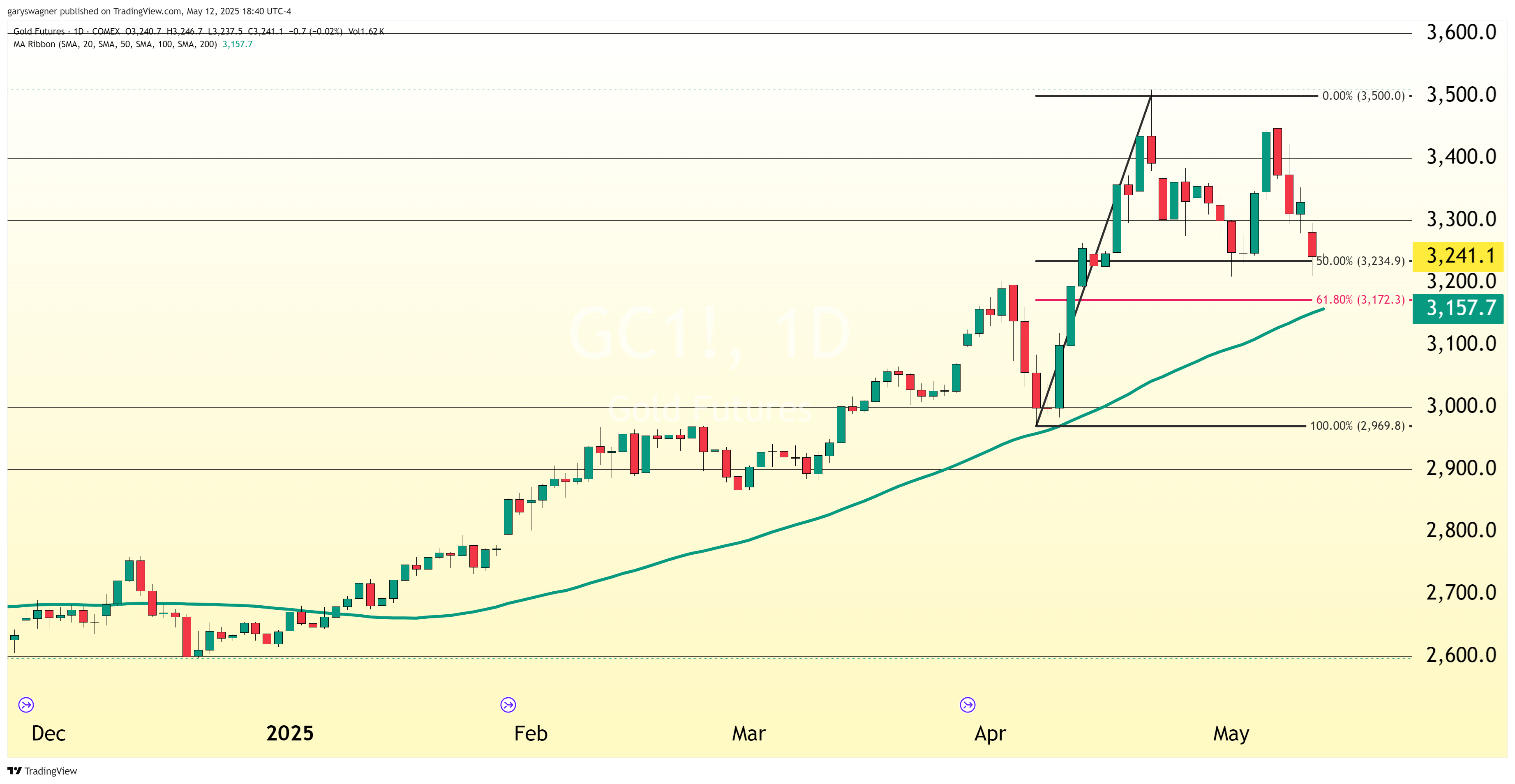
Image Source: Kitco News
Gold prices fell sharply after the U.S. finalized major trade agreements with both China and the United Kingdom, shifting investor sentiment toward economic optimism and strengthening the U.S. dollar. The June 2025 gold futures contract dropped 2.62%, or $87.30, settling at $3,241.80 per ounce—marking a significant correction from its April high. These moves were driven by a dramatic easing in U.S.-China trade tensions, as both nations agreed to slash tariffs over a 90-day period, signaling the potential end of a years-long trade war. Concurrently, the U.S.-UK trade deal is expected to unlock billions in agricultural exports, particularly in ethanol and beef, offering major opportunities for American producers.
While these trade agreements are expected to reduce inflation and spur economic growth by lowering costs and boosting exports, the implications for gold are more negative. A stronger U.S. dollar—up 1.37% following the announcements—has contributed to the precious metal's slide, as gold is inversely correlated with the dollar. Additionally, gold's appeal as a hedge against inflation and geopolitical risk diminishes in an environment of stabilizing global relations and economic expansion. Analysts caution that despite gold's previous rally, its upward momentum could face continued pressure as markets absorb the effects of these new trade dynamics and reassess inflation and interest rate expectations moving forward. Source
In this week’s Live from the Vault, Andrew Maguire welcomes back Andy Schectman to explore a disciplined, generational approach to wealth - built on the steady, unwavering accumulation of physical gold as true, enduring money.
Schectman shares insights from decades of precious metals experience, revealing how gold is fast reclaiming its monetary role amid systemic risk, BRICS-driven price reform, signalling a once-in-a-generation shift towards real-world assets.
Disclaimer: These articles are provided for informational purposes only. They are not offered or intended to be used as legal, tax, investment, financial, or any other advice.
Featured Image - Source: Unsplash















