x




The ongoing, already-parabolic rally in precious metals accelerated, fuelled by Donald Trump's threat of 100% reciprocal tariffs against China, with both gold and silver maintaining their high prices despite a subsequent slight de-escalation of the trade war rhetoric. Gold has now reached new record highs 15 times since September, with a near $100 price increase on Monday causing major financial institutions to revise their forecasts. Bank of America, for example, raised its 2026 gold price projection to a potential peak of $5,000 per ounce, with a mean estimate of $4,400. Gold futures closed higher by $94.50 (2.34%) at $4,130, marking its most significant one-day move since an earlier gain of $101.50 after “Liberation Day” on April 9th.
Silver futures have also been on a powerful upward trend since August, but only achieved a new all-time high on Monday, which was its first new record since 2011. Spot silver, however, hit its new record earlier on Thursday and Friday, and is currently trading at $52.33, which is 5.18% above its 2011 record and marks its fifth new high this month. Bank of America's outlook for silver is similarly bullish, with projections set at a high of $65 per ounce and an average of $56.25. An unusual market condition highlighted for silver is backwardation, where spot prices are below futures prices, which is an uncommon occurrence in the market. Silver futures closed up $3.26 (6.86%) to $50.7, securing a new record. Source
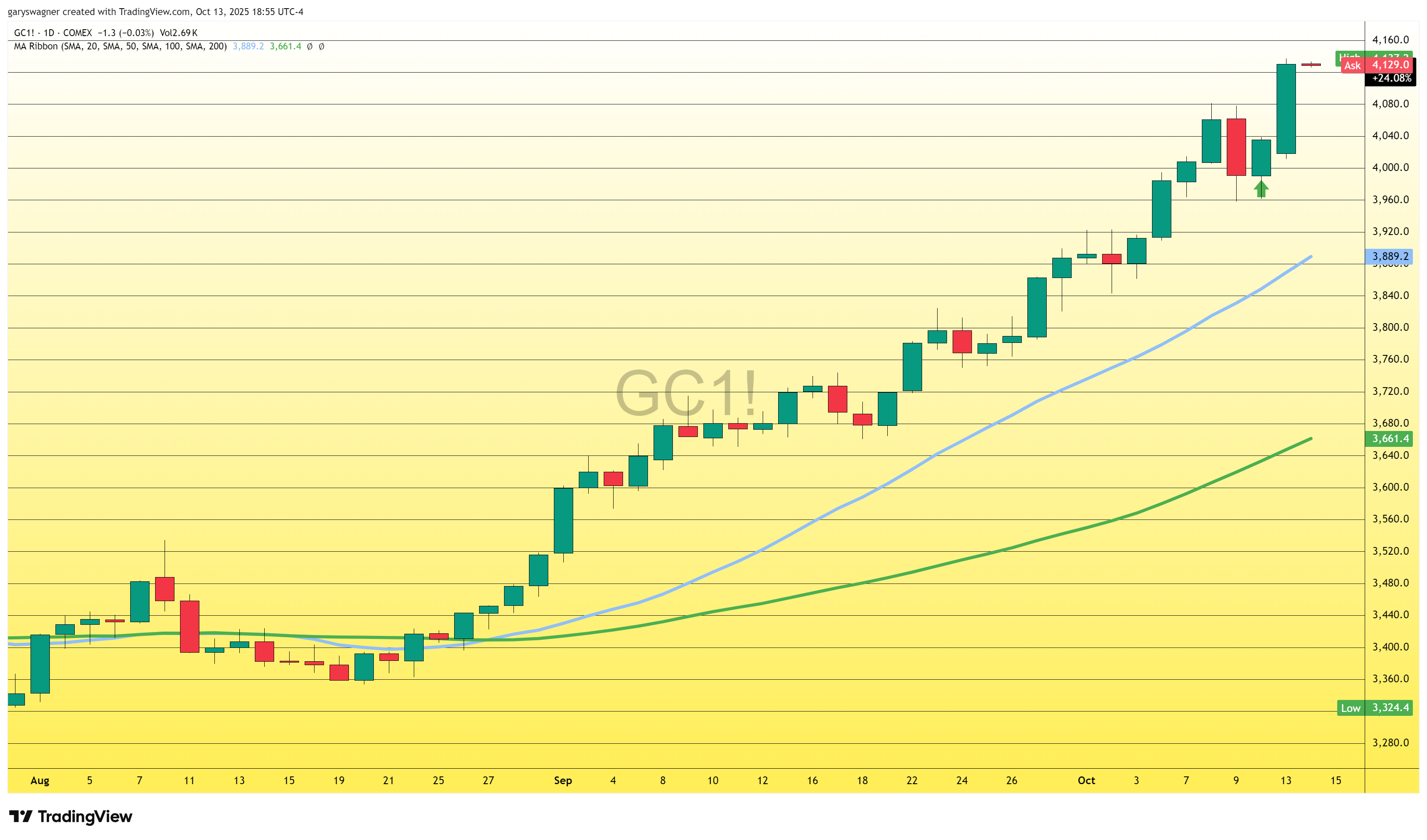
Image Source: Kitco News
The silver market currently presents a mixed picture, with strong fundamentals contrasting with a technical warning sign. On the one hand, underlying demand is robust, supported by safe-haven buying amid global geopolitical tensions, anticipated better consumer and commercial demand due to generally easier world central bank monetary policies, and major industrialized nations stockpiling rare-earth minerals like silver. On the other hand, recent trading action in December silver futures produced a bearish "key reversal" down pattern on the daily chart. This technical indicator, which formed when prices hit a new contract high before sharply reversing to close solidly down below the previous day's low, suggests that at least a near-term market peak may have been established.
The author emphasizes the belief that market history repeats itself, a factor they respect in trading. They point to two previous major peaks in silver prices to illustrate a historical pattern. In January 1980, silver peaked at $50.36 an ounce, only to eventually drop to $3.51 in 1993. The second peak occurred in 2011, when prices reached $49.52 before selling off sharply and eventually hitting a low of $11.735 an ounce in 2020. With nearby silver futures having just challenged the 1980 high by reaching $49.965 this week, the article cautions that if this chart price history repeats again, the current major bull market run in silver may be finished or close to it. This suggests that the recent surge may have already priced in, or discounted, expected future bullish fundamental events. Source
Gold and silver prices are rebounding sharply in early U.S. trading, recovering solid losses from the previous day, with December gold rising $37.10 to $4,009.10 and December silver posting sharp gains, up $1.173 at $48.355. Despite this quick recovery, the recent larger daily price swings suggest that volatility will remain high, which the article notes is not a near-term bullish sign. Against a backdrop of mixed global stock markets, geopolitical tensions are escalating as China retaliates against U.S. port fees by levying its own special fees on U.S. ships, starting at 400 Chinese yuan per MT and rising over several years. Furthermore, China’s State Administration for Market Regulation has opened an antitrust investigation into U.S. company Qualcomm Inc.’s recent acquisition of Autotalks, causing Qualcomm shares to fall 4% in pre-market trading, with these moves seen as bargaining chips ahead of a scheduled meeting between President Trump and Chinese leader Xi Jinping.
Meanwhile, the U.S. government shutdown has entered its second week, prompting the Bureau of Labor Statistics to recall staff to assemble the crucial September Consumer Price Index report, which is necessary to calculate the size of next year’s Social Security cost-of-living adjustment. In currency markets, the U.S. dollar index is set for its strongest weekly advance in a year, gaining nearly 2%, supported by weakness in the Japanese yen and Euro. Internationally, the U.S. threw a $20 billion lifeline to Argentina, finalizing a currency swap framework and carrying out a rare intervention by purchasing pesos to help stabilize the exchange rate and support President Javier Milei. Technically, while both gold and silver futures bulls still hold a firm overall near-term advantage, silver's price action scored a bearish "key reversal" down on the daily chart, suggesting a market top could be in place, though gold bulls are targeting a close above $4,100.00. Source
The silver market is supported by solid fundamentals, including safe-haven demand stemming from geopolitical hotspots globally, hints of better consumer and commercial demand due to generally easier world central bank monetary policies, and major industrialized countries continuing to hoard rare-earth minerals, including silver. However, recent price action in December silver futures saw a bearish “key reversal” down pattern form on the daily bar chart, whereby a new contract high was hit early in the session only for prices to back off sharply to close solidly down, with the session low price being below the previous day's low. This technical clue is the first signal that at least a near-term market top may now be in place for silver.
Though the author is not calling a bear market, trading history suggests that if chart price action repeats itself, the major bull market run in silver may be over, or close to it. The article notes that silver's historic peaks, such as the $50.36 all-time high in 1980 and the subsequent $49.52 high in 2011, were followed by sharp, multi-year sell-offs after the price spent only a very limited amount of time trading above the $40 mark. Silver recently hit a high of $49.965, taking out the 2011 high. Bears can argue that the market has already discounted, or priced in, expected future fundamental events given the recent surge in prices. Source
The gold market experienced a slight uplift following the release of the University of Michigan's preliminary Consumer Sentiment survey for October, which registered a reading of 55. This figure, though marginally lower than September's final reading of 55.1, still surpassed the consensus economist forecast of 54.2. Surveys of Consumers Director Joanne Hsu noted that sentiment essentially moved sideways from the previous month. The overall index components painted a mixed picture, showing improvements in current personal finances and near-term business conditions, but these were offset by a decline in expectations for future personal finances and current buying conditions for durables.
Despite the slight decline in the headline number, year-ahead inflation expectations in the report ticked down slightly from 4.7 percent to 4.6 percent, with long-run expectations holding steady at 3.7 percent, yet both remained relatively high. Consumers, however, continued to focus on "pocketbook issues" such as high prices and weakening job prospects, showing little expectation for meaningful improvement in these areas. An investment officer quoted in the article suggested the better-than-expected data showed consumer resilience amid policy uncertainty, though the absolute level of 55 remains historically low. Source
Gold and silver have had a milestone week, hitting new all-time highs above $4,000 and $50 an ounce, respectively, marking their eighth consecutive week of gains despite ending the week down from those intraday records. Gold, trading near $3,980.70, is up over 51% year-to-date, while silver, trading around $49.99, is up over 71% and continues to outperform gold due to robust industrial demand. This unprecedented bullish momentum, however, is leading some analysts to warn investors to exercise caution, noting that the $4,000 and $50 levels could signal technical exhaustion for a significantly overbought sector. Near-term appeal for gold as a safe-haven is also potentially lessened by a possible peace agreement between Israel and Hamas.
Despite short-term risks of a correction, with one strategist even exiting their positions due to what they see as too much fear of missing out sentiment, the long-term fundamentals remain solid for both precious metals. Experts suggest that while a short-term correction and consolidation is possible, the core drivers, including rising global debt, geopolitical uncertainty, and weakening confidence in fiat currencies, haven’t gone away. Central banks continue to accumulate gold, and retail investor interest in tangible assets is growing due to concerns about the modern financial order. While $4,000 is a key psychological level where the market may pause, many analysts still see the metals in the early stages of a long-term bull cycle, with strong buying support expected to meet any short-term pullbacks. Source
Gold experienced an explosive week of trading, pushing well past the $4,000 per ounce threshold to mark its eighth consecutive weekly gain. Starting the week near $3,890, the price climbed swiftly, passing $3,940 and then piercing the $4,000 level decisively on Tuesday evening. Momentum carried the yellow metal to a peak near $4,060 on Wednesday afternoon before a noticeable correction brought the price back down to firm support around $3,950 on Thursday. Buyers re-entered the market from this support level, pushing gold to briefly reclaim and trade above $4,000 per ounce heading into the weekend, closing out the period at about $4,008.
Despite the monumental climb, the latest Kitco News survey indicates that some of the strong bullish sentiment is beginning to moderate, especially among professional investors, with a large number of Wall Street analysts switching to a neutral stance after the $4,000 milestone. Meanwhile, Main Street investors also slightly tempered their bullish expectations, though a majority still anticipate further gains next week. Analysts pointed to various drivers for the rally, including ongoing geopolitical tensions, the US government shutdown, and global de-dollarization trends, with some experts suggesting the rally is a momentum play decoupled from the US dollar and that the long-term upward trend is far from over, despite near-term risks of a correction. Source
Market history suggests that recognizing a financial bubble, even when widely acknowledged, does not predict the precise timing of an inevitable crash. Technical indicators like Shiller's P/E ratio, which signaled the dot-com bubble when it went above 40, are red flags but do not automatically trigger a downturn; a correction typically requires an external catalyst, often referred to as a "push." In the case of the dot-com crash, that push was the Federal Reserve's monetary policy tightening to combat inflation, which raised interest rates, made safer assets more appealing, and pulled capital out of overvalued tech stocks. However, current circumstances suggest the Fed is unlikely to cause a similar downturn for the current "AI bubble," as minutes and tools suggest future rate cuts, meaning that a geopolitical event, such as an escalating trade war, could be the more likely factor to turn market euphoria into widespread panic across major indices like the S&P 500.
The article highlights a recent example of this principle, where geopolitical tensions immediately led to market chaos. Last Friday, the S&P 500, the Nasdaq, and the cryptocurrency market, including Bitcoin and Ethereum, experienced a sharp drop after the Trump administration announced 100% tariffs on Chinese imports and new restrictions on software exports, following China's own restrictions on rare earth metal exports. This chaos wiped nearly $600 billion from the cryptocurrency market capitalization within hours. However, by Sunday and Monday, both the US and China adopted a more conciliatory tone, signaling openness to negotiations and clarifying the new restrictions, which was enough to spark renewed optimism, causing US futures to open higher and Bitcoin to rise back above $115,000, though the risk of another sharp downturn remains if a trade agreement fails. Source
The precious metals market saw significant activity, with palladium being the week’s best performer, surging 13.65%. This rise benefited companies like Generation Mining, which saw its outlook improve as palladium prices increased by nearly 10%, a gain tied to gold’s record-breaking move above $4,000 an ounce. Furthermore, K92 Mining reported a strong quarter, producing 44,300 ounces of gold from its mine in Papua New Guinea, marking a 30% quarterly increase and positioning the company well to meet its 2025 production guidance. Meanwhile, spot silver prices reached their highest level in decades, surpassing $50 an ounce due to heightened demand for safe-haven assets and persistent supply shortages. However, the market wasn’t without weaknesses, as Barrick Gold’s sale of its Tongon Mine for up to $305 million fell below analyst expectations, and Dundee Precious Metals faced a setback when the Ecuadorian government revoked the environmental license for its Loma Larga gold project.
Looking ahead, analysts project strong free cash flow generation for North American precious metal producers in 2025, forecasting a 67% increase in total capital returns, including $5.7 billion in share buybacks. The Wall Street Journal highlighted gold’s potential as a hedge against central bank policies, noting that a shift toward government-led economic direction in major economies like Japan could fuel global inflation, further supporting gold prices. UBS analysts indicated that if gold holds above $4,000, they would significantly raise their 2026 and 2027 forecasts, suggesting continued attractiveness for miners due to healthy cash generation and production growth. Conversely, threats to the rally include warnings of a price consolidation after gold’s rapid climb driven by political instability, falling bond yields, and central bank buying, with technical indicators from Bank of America suggesting the uptrend may be losing steam and due for a correction, citing historical precedents after sustained weekly gains. Source
Gold and silver prices saw a sharp rise in early U.S. trading, with gold reaching a new record high and silver nearing its 1980 peak. This surge is driven by safe-haven demand amidst the ongoing U.S. government shutdown and an intense short squeeze in the silver market, signaling high near-term volatility. Spot silver prices hit their highest level in decades overnight, escalating a historic short squeeze in London due to a severe mismatch between demand and supply, which also caused platinum and palladium to surge. Concerns over liquidity in London have pushed benchmark prices there to near-unprecedented premiums over New York prices, leading some traders to use expensive transatlantic air transport, typically reserved for gold, to ship silver bars and capitalize on the discrepancy.
The article also touches on political and trade tensions affecting the markets. The U.S. government shutdown appears likely to be prolonged, as President Trump's permanent layoff order has deepened Democrats' distrust of Republicans, with Democrats using the funding fight as leverage to push for negotiations on healthcare costs. Concurrently, the Trump administration signaled openness to a trade deal with China, despite Beijing escalating tensions last week with new port fees, an antitrust probe on Qualcomm, and curbs on rare earth exports. Separately, crude oil futures initially dropped significantly due to the renewed U.S.-China trade war and bearish supply sentiment but rebounded slightly overnight. Technically, both December gold and silver futures bulls maintain a strong near-term advantage, with gold targeting a close above 4,200.00 and silver aiming to close above 50.00. Source
Precious metals analysts at Heraeus warn that the market is flashing cautionary signals, with gold, silver, platinum, and palladium all entering severely overbought territory based on key technical measures following their recent all-time high price surges. Silver's near-vertical rally, which pushed its price above $51 per ounce and later to $52.071, has triggered multiple warnings, including a deeply overbought Relative Strength Index and a 14-year high in volatility. The metal's significant divergence from its 200-day moving average suggests the market is extremely stretched, a situation that previously preceded a substantial price correction. Additionally, the backwardation of the silver futures curve, with contracts trading at a discount to the spot price, and a spike in one-month lease rates reflect significant physical market strain and near-term tightness, even as COMEX stocks hit a new high.
Gold, platinum, and palladium are exhibiting similar technical red flags, having also extended into severely overbought territory well beyond their 200-day moving averages. Gold, having breached the $4,000 per ounce level and setting a new all-time high of $4,104.02, is now trading nearly 20% above its long-term trend after eight consecutive weeks of gains, a rare occurrence. While such extreme readings typically precede market corrections, the strong bull market momentum could sustain the rally for a longer period before a consolidation phase begins. However, the analysts note that a correction similar in size or duration to past pullbacks would not be unusual given the current technical extremes in the yellow metal and the broader precious metals complex. Source
Gold and silver prices reached all-time highs in midday US trading on Monday, driven by safe-haven demand amidst a US government shutdown and a significant short squeeze primarily affecting the silver market. December Gold futures hit an intra-day record of $4,124.30 an ounce, while December silver futures peaked at $50.56 an ounce, demonstrating high volatility and suggesting a mature bull market. The silver surge is intensifying due to a historic short squeeze in London, leading to concerns about liquidity and causing London benchmark prices to soar relative to New York prices, prompting expensive cargo flights of silver bars across the Atlantic to arbitrage the massive premiums. This market stress is also beginning to spread to other precious metals like platinum and palladium.
The underlying geopolitical tension contributing to the safe-haven demand is the prolonged government shutdown, with Democrats hardening their stance following President Trump’s permanent layoff order. Democrats are using the funding fight as leverage, focusing on health care costs and demanding upfront negotiations, including an extension of Affordable Care Act premium subsidies, a move Republicans dismiss as political opportunism. In related markets, the US dollar index is firmer, crude oil prices are up near $59.50 a barrel, and the 10-year US Treasury note yield is at 4.06%. Technically, both gold and silver futures bulls maintain a strong near-term advantage, with gold targeting a close above $4,200.00 and silver aiming for a close above $52.50. Source
Commodity analysts at Societe Generale have significantly upgraded their gold price forecast, now projecting the yellow metal could reach $5,000 per ounce by the end of 2026, driven by unexpectedly strong investment demand. This updated target comes after gold broke above the $4,000 level and continued trading over $4,100, nearing their previous, more conservative, Q4 2026 forecast much sooner than anticipated. The French bank’s analysts attribute this rapid ascent primarily to extremely high positive flows into gold Exchange Traded Funds (ETFs), which have surpassed their initial assumptions. They observe a critical link between these strong ETF flows and elevated levels of global uncertainty, especially following recent geopolitical and trade-related events, such as China’s rare earth export controls and new US tariff announcements.
The analysis emphasizes that while a return to pre-election uncertainty normalcy is not foreseen, maintaining a cautious approach, they assume a consistent increase in gold purchasing—an extra 67 tonnes each quarter—across all categories, including central banks and ETFs, above historical norms. This conservative framework, recalibrated from the current elevated price, points to a strong price trajectory, concluding at the $5,000 target by 2026, which represents a 14% increase from their September projection. The analysts note that recent elevated ETF flows, which were 69 tonnes more than their “normal” flow assumption in Q3, were the highest since Q3 2020 and were responsible for a significant portion of the recent price rise. They view the upside risk to their new $5,000 forecast as significantly greater than the downside, underscoring the powerful impact of fear and uncertainty on gold investment. Source
In this week’s Live from the Vault, Andrew Maguire and Alasdair Macleod expose the accelerating breakdown of the Western gold market as physical supply tightens and institutional investors scramble for credible metal exposure.
Two experts analyse how China’s $5 trillion in annual household savings, combined with BRICS-led settlement reforms, is draining global liquidity and dismantling dollar dominance - signalling gold’s resurgence as the fiat era nears its end.
Disclaimer: These articles are provided for informational purposes only. They are not offered or intended to be used as legal, tax, investment, financial, or any other advice.
Featured Image - Source: Unsplash















