x





Gold prices surged to a new all-time high of $3,246 an ounce on Friday, marking a third consecutive day of gains. The rise was driven by heightened demand for safe-haven assets amid escalating tensions between the US and China over tariffs. The weakening US dollar also played a key role, falling to a three-year low against the Euro, which made gold more affordable for international buyers. This combination of global trade uncertainty and a softer dollar continues to bolster gold’s appeal as a hedge against economic instability.
Despite a brief rebound in global equity markets following President Trump’s 90-day suspension of newly imposed tariffs, investors remained cautious. Concerns lingered about the potential return of tariffs and the unpredictability of future trade policies. Meanwhile, markets are now turning attention to key economic indicators due next week, including inflation data from Canada and the UK, US retail sales figures, and the Bank of Canada’s interest rate decision, which is expected to remain unchanged at 2.75%. Source
Silver prices climbed to $32.39 an ounce on Friday, marking a strong finish to a bullish week as investors flocked to safe-haven assets in response to growing economic uncertainty. Mirroring gold’s rally, silver gained over $2 in just three days, driven by a weakening US dollar and heightened volatility in global financial markets. The dollar’s sharp decline, particularly against the Euro, made silver more attractive to international buyers, while escalating trade tensions between the US and China further fuelled interest in precious metals.
The ongoing tariff stand-off, with the US and China significantly raising duties on each other’s goods, has cast a shadow over financial markets. Although President Trump temporarily paused tariff hikes for most countries, uncertainty remains high, pushing investors toward tangible assets like silver. Additionally, lower-than-expected US inflation data has increased the likelihood of interest rate cuts by the Federal Reserve, providing further support for silver prices. Looking ahead, key industrial production data from the Euro Area, Japan, China, and the US could impact silver demand, but market sentiment is likely to remain focused on developments in the US-China trade conflict. Source
Gold surged to record highs this week as global market turmoil, trade tensions, and a weakening U.S. dollar pushed investors toward the yellow metal as the last reliable safe haven. After beginning the week at just over $3,030 per ounce and briefly dipping, gold rallied sharply, breaking through resistance levels and peaking at $3,245.48. This run was catalysed by President Trump’s surprise pause on tariffs (excluding China), which temporarily boosted risk assets but ultimately reinforced gold’s appeal as equities and broader markets returned to choppiness. With Treasury yields climbing and the dollar index falling below 100, gold’s momentum strengthened significantly through the end of the week.
Investor sentiment, both on Wall Street and Main Street, has turned strongly bullish on gold’s near-term prospects. Industry analysts and retail traders alike see further upside, citing continued geopolitical uncertainty, rising inflation expectations, and central bank dovishness as key drivers. Analysts warn, however, of potential volatility, especially if the Federal Reserve intervenes in the bond market or if yields begin to drop. Still, many believe gold’s upward trajectory is part of a broader regime change in global finance, with the precious metal positioned as the safest play amid fiscal mismanagement, geopolitical shocks, and a potential power shift in U.S. monetary policy under Trump. Source
Gold showed significant strength this week, rising 9.35%, buoyed by strong production figures and renewed central bank buying. The World Gold Council reported global central banks added 24 tons to their reserves in February 2025, with Poland, China, and Türkiye leading the purchases. Gold producers like Regis Resources and Aris Mining also posted strong quarterly outputs, bolstering investor confidence. The market is seeing gold decouple from its traditional relationship with U.S. real yields, positioning it as a universal safe haven amid rising financial uncertainty. Equities in the gold sector remain attractively priced, trading below long-term historical valuation levels, while strategic acquisitions, like New Gold’s full ownership of New Afton, are enhancing growth prospects.
However, the broader precious metals sector faces challenges. Palladium was the weakest performer despite a modest gain, hindered by tariff concerns and weaker demand from the automotive industry. While gold enjoys robust momentum, risks persist, including geopolitical uncertainties and potential overextension of margins that historically led to weak equity performance. Barrick’s approval of the Reko Diq project adds geopolitical and execution risks given its location. Additionally, the rising gold-to-silver ratio highlights deepening recession concerns, which may pose a threat to broader equity markets despite gold's current strength. Source
China's growing influence on the global gold market has reached a fever pitch, driven primarily by an explosive resurgence in futures trading on the Shanghai Futures Exchange (SHFE). Since the spring of 2024, Chinese traders have been the dominant force behind a major gold rally, pushing prices up by 23% in a matter of weeks. After a brief lull, trading volume and price action have recently surged again, indicating that a long-anticipated “Chinese gold mania” is fully underway. The rally is further confirmed by the reappearance of a domestic price premium in China, increased public participation, and renewed central bank gold purchases by the People's Bank of China (PBOC). These developments suggest that Chinese enthusiasm for gold is not only back—but accelerating—and could push prices well beyond $3,000 per ounce.
Several key policy shifts and macroeconomic trends are also fuelling this gold-buying spree. In a significant move, Chinese authorities now allow insurance companies to invest in gold, potentially unlocking billions in institutional demand. This comes as China grapples with severe economic headwinds: a collapsing real estate sector, deflationary pressures, and record-low bond yields. The broader context includes a strategic pivot by Chinese investors and institutions away from vulnerable fiat currencies and sovereign debt—especially U.S. Treasuries, which have been selling off in tandem with stocks. With the U.S. debt load nearing crisis levels and gold viewed as a more stable store of value, Chinese gold accumulation appears both a defensive measure and a deliberate strategy. In the eyes of the author, this marks a new era in the global gold market—one driven by China's cultural affinity for the metal, state support, and a desire to shield national wealth from global financial instability. Source
Gold continues to rally amid escalating trade tensions and economic uncertainty, with analysts from Heraeus noting that the metal surged to a new all-time high above $3,200 per ounce. The latest boost was driven by market volatility stemming from former President Trump’s unpredictable tariff policies, coupled with signs that the U.S. Federal Reserve may be forced to cut rates even in the face of persistent inflation. With inflation expected to rise due to tariffs and economic growth likely to slow, the Fed faces a difficult balancing act. In such a scenario, historical patterns suggest the Fed may prioritize growth by cutting rates, which would further support gold prices. Additionally, Barrick Gold’s progress on the Reko Diq project in Pakistan, one of the world’s largest untapped gold and copper deposits, could eventually add significant supply to the market, though production is not expected until 2028.
In contrast, silver is underperforming despite the broader precious metals rally, primarily due to its industrial exposure—especially in solar manufacturing. Although the U.S. temporarily delayed tariffs on solar imports, the lingering uncertainty is suppressing demand, which could further weaken silver prices. Analysts highlighted that 19% of total silver demand in 2024 came from the solar industry, and any drop in U.S. installations would be significant. Meanwhile, the gold:silver ratio has once again surged above 100, indicating gold’s outperformance. This mirrors the dislocation last seen during the COVID-19 crash in March 2020. With U.S. tariffs potentially returning in under 90 days and solar supply chains still vulnerable, silver’s price action remains constrained, recently dipping below $32 per ounce despite brief rallies. Source
Wells Fargo’s Sameer Samana believes gold remains a valuable asset amid ongoing global economic uncertainty, though he cautions against becoming overly defensive. While gold prices have held above $3,200 per ounce despite modest selling pressure, Wells Fargo has raised its year-end target to that level, up from $3,000. Samana highlights continued market instability driven by trade war tensions, especially between the U.S. and China, where steep tariffs and policy unpredictability have complicated corporate planning and dampened investor confidence. In such an environment, gold serves as a reliable hedge and diversification tool, particularly as both equities and bonds struggle to gain momentum.
Samana advises investors to maintain a balanced approach, favoring commodities—including gold and energy—as part of a broader portfolio strategy. Wells Fargo currently suggests a tactical commodity allocation of 4%–7%, with about one-third of that dedicated to gold. While recession risks remain, Samana doesn’t foresee an outright downturn, and stresses flexibility as policy shifts could rapidly change the investment landscape. In addition to commodities, he also recommends holding sufficient cash or short-term bonds to cushion against short-term market volatility. Overall, the emphasis is on building “quality and resilience” into portfolios, with gold playing a central role in achieving that stability. Source
Gold prices declined on Monday due to routine profit-taking by short-term futures traders following a strong rally that recently pushed the metal to record highs. While silver remained mostly steady, global stock markets rebounded, limiting further gains for gold. June gold futures fell by $29.60 to $3,215.10, while May silver inched up $0.06 to $31.98. Markets also reacted to news that the Trump administration temporarily exempted certain electronics, such as smartphones, from newly imposed tariffs, contributing to a modest recovery in equities. Despite the uptick in stocks, investor caution remains due to persistent concerns in corporate debt and bond markets.
From a technical standpoint, gold bulls still hold the upper hand, with the next key resistance level at $3,300. Immediate support lies at $3,193.40, followed by $3,160. Silver also shows bullish momentum, forming a V-bottom reversal pattern on charts. The next upside target for silver is $34.00, while support levels rest at $31.655 and $31.365. Although gold faced selling pressure, broader market uncertainty and lingering risk aversion continue to underpin its long-term bullish outlook. Source
Gold could be headed toward $4,000 an ounce as broader market conditions shift and traditional risk assets begin to falter, according to Bloomberg Intelligence's Mike McGlone. In an interview with Kitco News, McGlone said that the recent surge in gold, now firmly above $3,000, marks the beginning of a larger reallocation of capital as stock markets weaken, inflation expectations rise, and global economic uncertainty intensifies. With gold outperforming both Bitcoin and the long bond market, McGlone sees the metal as a leading beneficiary of structural capital shifts and declining confidence in riskier assets. Goldman Sachs also raised its forecast to $3,700 by year-end, with $3,900 possible in a downturn.
Meanwhile, equities and Bitcoin are showing signs of breakdown. The U.S. stock market has already lost $6 trillion in market cap this year, erasing half of 2023’s gains, and McGlone warns of further losses if a recession hits. He also highlighted the declining gold/Bitcoin ratio, suggesting diminishing appetite for crypto as investors rotate into safer assets like gold. Inflation expectations are rising rapidly, the Fed is stuck between high inflation and excessive past liquidity, and signs of deflation from global economies like China and Germany signal a shift in the macroeconomic environment. McGlone believes the market is undergoing a "once-in-a-generation reset" and recommends investors prioritize gold in the face of weakening stocks, bonds, and speculative assets. Watch the podcast
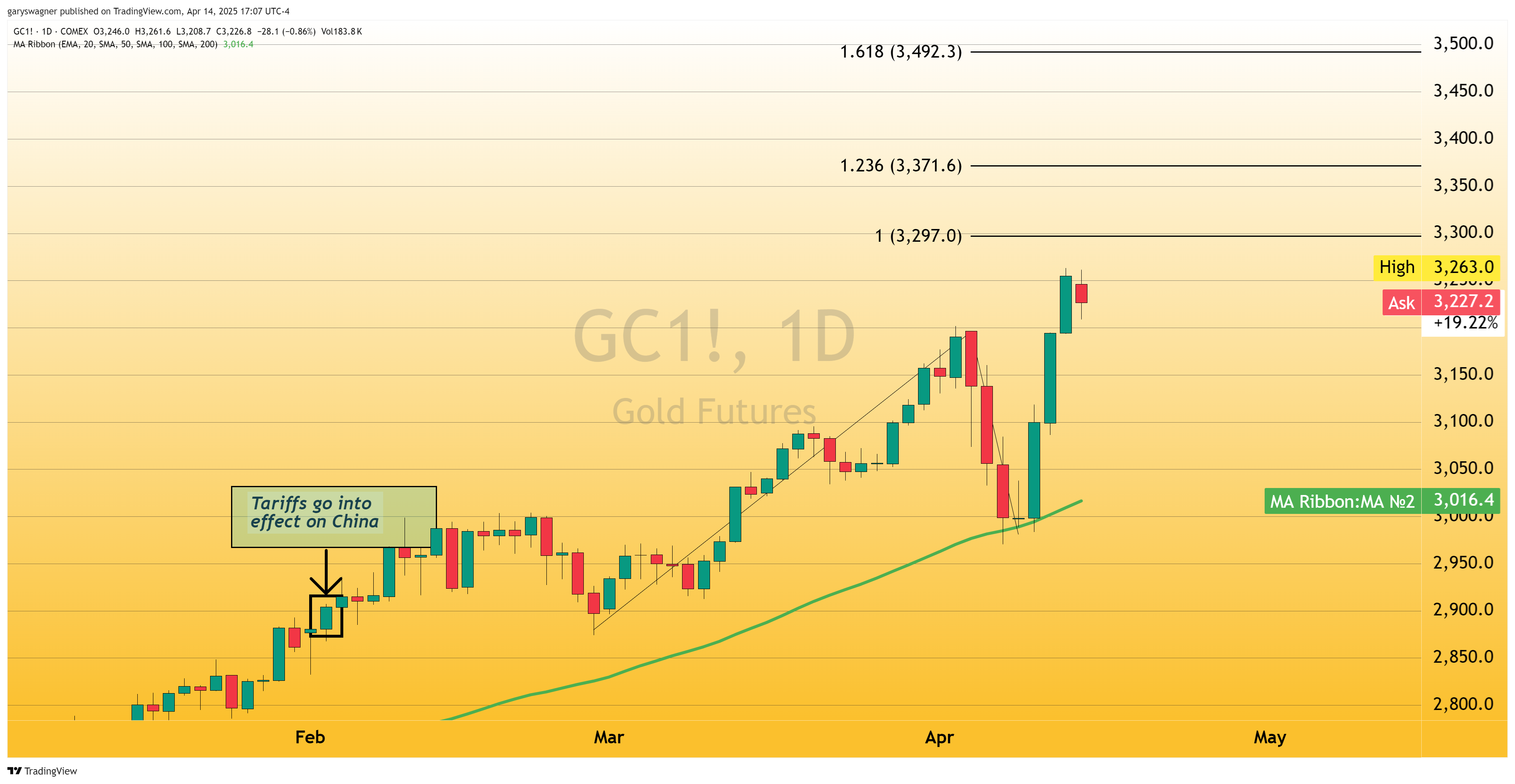
Image Source: Kitco News
Gold prices experienced a brief pullback following a record-breaking three-day rally that saw prices surge by 8.34%. From April 9 to April 11, gold futures surged by approximately $257, hitting a new all-time high of $3,210.92, driven by escalating trade tensions and President Trump's tariff policies. The recent rally began after Trump's tariffs on Chinese imports, which have played a significant role in gold's rise since February. Despite today's modest decline of $28.40, gold's recent gains are still significant, with prices remaining well above pre-rally levels, and the pullback is viewed as profit-taking rather than a fundamental reversal.
Looking ahead, the outlook for gold remains highly positive. The metal has gained about $350 over the past two months, and analysts project that the upward trend could continue. With ongoing global economic uncertainty and trade tensions, gold’s role as a safe-haven asset remains strong. Predictions indicate a minimum target of $3,297 for June gold futures, with potential for prices to approach $3,500 in the next 60 days. The continued trade dispute between the U.S. and China, alongside other macroeconomic factors, suggests that gold’s bullish momentum is likely to persist. Source
Gold's recent surge to record highs above $3,200 per ounce offers a unique opportunity for investors amidst current market uncertainty. Jerry Prior, COO of Mount Lucas Management, believes that while the rally may have pushed gold prices into overbought territory, the asset remains well-supported by the ongoing global instability. With unprecedented uncertainty due to factors like COVID-19 and the war in Ukraine, traditional market playbooks no longer apply, making gold a valuable safe-haven. Prior notes that despite gold's high prices, they are not overvalued, considering the current macroeconomic environment, and that gold investors have already seen significant profits, with prices up 22% this year and 37% over the past 12 months.
Prior also emphasizes that investors should use this opportunity to rebalance their portfolios. If an investor's allocation in gold has grown beyond its target percentage due to the rally, they can take the excess profits and seek opportunities in other markets. However, he cautions that investors don’t need to make immediate decisions, as the current volatility complicates accurate market valuations. The range of outcomes for major indices like the S&P 500 remains wide, and in such uncertain times, Prior suggests a diversified approach and advises investors to remain patient, possibly even taking a break from screens to allow for a clearer perspective. Source
In this week’s Live from the Vault, Andrew Maguire is joined by Alasdair Macleod to reveal how silver is quietly moved through private channels - largely controlled by China - keeping real supply and demand hidden from the open market.
As silver approaches a critical price point, two old friends explain how major market players may soon lose their grip, opening the door for a sharp rise in silver and a fresh wave of interest in precious metals, unwinding decades of price control.
Disclaimer: These articles are provided for informational purposes only. They are not offered or intended to be used as legal, tax, investment, financial, or any other advice.
Featured Image - Source: Unsplash















