x




Image Source: Unsplash
Gold Price News: Gold Fails to Hold Above $1,900 on Fed Hike Prospect
Gold has dropped back below $1.900 an ounce as traders and investors reassert their expectation that the Federal Reserve will still hike its benchmark interest rate by 25 basis points when the committee meets next week.
Today’s decline illustrates how closely bound up gold’s fortunes are with the actions and words of the Fed and its officials as the market conditions otherwise remain very favourable for this timeless safe haven asset. The banking sector continues to be rocked with Signature’s failure representing the biggest loss since the financial crisis of 15 years ago and sapping away at market confidence.
For some, the collapse of first Silvergate, then Silicon Valley and now Signature highlight the dangers of blindly trusting banks (or at least those starting with S!) as the place to store money and show the value gold offers with its lack of counterparty risk. Read More
Silver Price News: Silver Has Slight Dip as Markets Look Ahead to Fed Decision
Silver is experiencing a slight dip today having climbed comfortably above $21 an ounce as investors sought out its haven qualities on the back of the collapse of three US banks.
After silver was initially slow to respond to this increased haven demand, the precious metal has enjoyed a considerable upsurge with the price gaining almost $2 an ounce before slipping back slightly.
Next week’s Federal Reserve interest rate decision will have crucial importance in determining silver’s direction in the short to medium term. The sentiment is once again returning to the Fed implementing a 25 basis point hike after the initial collapses of Silvergate, Silicon Valley and Signature led to some expecting the US central bank to hold off on any further increases. Read More
SVB collapse will force Fed to pause rate hikes on March 22nd, ‘gold will start to rip' as U.S. dollar declines - Matthew Piepenburg
The second-largest bank failure in U.S. history, that of Silicon Valley Bank (SVB), transpired on March 10th, causing ripple effects through both U.S. and international markets, as well as the failure of another bank, Signature, which had $118 billion in assets under management. SVB’s collapse was triggered by significant depositor withdrawals, which forced the bank to sell assets at a loss to meet client demands.
In an effort to control high inflation, Federal Reserve Chairman Jerome Powell had previously signalled a hike of 25 to 50 basis points in March. However, concern about the contagion effects of SVB’s collapse will compel the Fed to pause its rate hikes, according to Matthew Piepenburg, Commercial Director at Matterhorn Asset Management and Author of Gold Matters: Real Solutions to Surreal Risks.
“I don’t expect a rate hike on March 22nd,” he told Michelle Makori, Lead Anchor and Editor-in-Chief at Kitco News. “Powell is going to have no choice now. He has broken something.”
Piepenburg said that SVB’s collapse was largely due to its poor management of interest rate risk as the Federal Reserve hiked rates by 450 basis points over the past year. This increased the opportunity cost of holding bank deposits when depositors could earn a better and safer yield by holding U.S. Treasuries.
It also harmed SVB’s balance sheet, since the bonds the bank held diminished in value as interest rates rose. Read More
Swiss regulators rush to assuage fears over Credit Suisse
Swiss regulators said Credit Suisse (CSGN.S) can access liquidity from the central bank if needed, racing to assuage fears around the lender after it led a rout in European bank shares on Wednesday.
In a joint statement, the Swiss financial regulator FINMA and the nation's central bank said that Credit Suisse "meets the capital and liquidity requirements imposed on systemically important banks."
Governments and at least one bank were putting pressure on Switzerland to act, said people familiar with the matter.
There were no indications of a direct risk of contagion for Swiss institutions due to U.S. banking market turmoil, FINMA and the Swiss National Bank said in their statement, alluding to the tumult unleashed by the collapse of Silicon Valley Bank and Signature Bank.
The statement came after Credit Suisse shares dropped by as much as 30% on Wednesday, leading to a 7% fall in the European banking index (.SX7P), while five-year credit default swaps (CDS) for the flagship Swiss bank hit a new record high, reviving fears of a broader threat to the financial system.
Two supervisory sources told Reuters that the European Central Bank (ECB) had contacted banks on its watch to quiz them about their exposures to Credit Suisse.
One of the sources said, however, that they saw Credit Suisse's problems as specific to that bank, rather than being systemic. Read More
Gold will outshine the other precious metals as fears of a global banking crisis grow - Mitsubishi's Jonathan Butler
According to one market analyst, the gold market should continue to outperform within the precious metals sector as investors continue to react to the growing U.S. banking crisis, which has now spread in global financial markets.
The gold market has held solid support above $1,900 an ounce as markets continue to react to the fallout after U.S. regulators took control of California-based Silicon Valley Bank and New York's Signature Bank. Although the U.S. government has tried to calm fears by saying that all depositors' money at the two banks will be guaranteed, the failure has revealed significant cracks in financial markets that are starting to impact global institutions.
One of Europe's top banks, Credit Suisse, saw its share price plummet Wednesday. The selloff came a day after the Swiss bank said in its annual report that it lost roughly $8 billion last year. Late last year, Credit Suisse said it saw "significantly higher cash withdrawals and net asset outflows in the third quarter of 2022.
Adding to its financial worries, Saudi National Bank said it would not provide further financial help, maintaining its 9.9% stake in the bank.
Turning back to the U.S., Johnathan Butler, Precious Metals Strategist at Mitsubishi Corporation, said that the U.S. bank failures have been a "watershed moment in the 'higher for longer' interest rate narrative."
He noted that gold is benefiting as broad-based demand for safe-haven assets has pushed bond yields significantly lower. Read More
Credit Suisse reignites banking fears, gold price jumps to 1.5-month highs
Investors are embracing the gold market amid the quickly escalating banking contagion fears. Strong demand for the precious metal is keeping prices at 5-week highs Wednesday.
The banking sector roiled Wednesday as shares of Credit Suisse — a Swiss bank with extensive U.S. and global operations — tumbled 31% before paring back declines to 20%. This was the biggest one-day selloff on record and managed to drag European and U.S. stocks down.
With the global market rout stoking fears of a more significant fallout, gold is trading above $1,900 an ounce and is up 5.5% since the start of the year. April Comex gold futures were last at $1,941.60 an ounce, up 1.6% on the day.
"We expect this banking turmoil to reinvigorate investor demand over the longer term," said ANZ senior commodity strategist Daniel Hynes.
Demand for the precious metal is growing, with more than 300,000 ounces added to physically-backed gold ETFs in the last trading session, according to Bloomberg data. This marked the largest increase since June.
And analysts are saying that this could just be the start of the institutional investor coming back into the gold space, with a lot more upside potential for the price. Read More
Banking crisis contagion fears fuel gold rally
Gold prices are sharply up and silver near steady near midday in the U.S. Wednesday. Both metals scored five-week highs today on safe-haven demand. Fears of a global banking/financial crisis are growing at mid-week. April gold was last up $18.80 at $1,929.80 and May silver was up $0.05 at $22.09.
The European banking sector is in keen focus as European banking stocks took a major hit today, led by Credit Suisse and worries about its financial health. The banking turmoil that started in the U.S. late last week has spread to Europe. Falling U.S. Treasury yields and a much stronger U.S. dollar index today are indicative of traders and investors who are highly stressed and want to hold those safe-haven assets. The benchmark 10-year U.S. Treasury note yield is presently fetching 3.432%.
Technically, April gold futures prices scored a bullish "outside day” up today and hit a five-week high. Bulls have the solid overall near-term technical advantage. Bulls' next upside price objective is to produce a close above solid resistance at the February high of $1,975.20. Bears' next near-term downside price objective is pushing futures prices below solid technical support at $1,850.00. First resistance is seen at today's high of $1,935.60 and then at $1,950.00. First support is seen at $1,900.00 and then at today's low of $1,889.50. Wyckoff's Market Rating: 7.5.
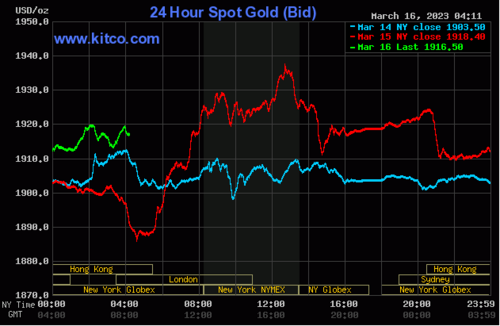
Image Source: Kitco News
May silver futures prices hit a five-week high today. The silver bulls have the overall near-term technical advantage. Prices are in a fledgling uptrend on the daily bar chart. Silver bulls' next upside price objective is closing prices above solid technical resistance at $23.00. The next downside price objective for the bears is closing prices below solid support at $21.00. First resistance is seen at today's high of $22.525 and then at $22.80. Next support is seen at today's low of $21.605 and then at $21.395. Wyckoff's Market Rating: 6.0. Read More
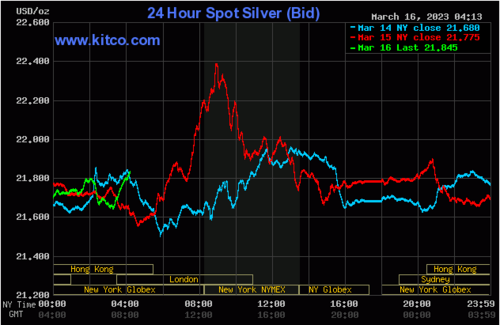
Image Source: Kitco News
A global rush to safe-haven moves gold higher
Gold prices surged today with gold futures trading to a high of $1942.50. Multiple assets traded sharply higher including gold, the dollar, and U.S. Treasuries. These gains were directly attributed to another crisis in the banking sector. This caused market participants to lighten their riskier assets and move that capital into safe-haven assets.

Image Source: Kitco News
Today’s global rush into safe-haven assets began in Europe and then moved across the pond into Wall Street as news surfaced of a new bank failure this time in Europe. Shares of Credit Suisse initially dropped 31% and when the dust settled its stock shares had declined by 13.91%. This is because of a report of a potential plan to stabilize the bank from Swiss banking regulators.
According to Bloomberg News, “Swiss authorities and Credit Suisse Group AG are discussing ways to stabilize the bank, according to people familiar with the matter, after comments by its biggest shareholder and broader financial market jitters helped trigger a plunge in the stock on Wednesday.”
The article in Bloomberg stated that the first move to shore up confidence in the Credit Suisse bank is being led by Switzerland's central bank and its financial regulator announced that Credit Suisse will receive a “liquidity backstop if needed”. Read More
The Fed is done - Axel Merk
The biggest bank failures in the U.S. since the 2008 Great Financial Crisis have revealed just how fragile financial markets are as the world comes to grips with years of cheap money abruptly halted by the Federal Reserve's aggressive monetary policy stance.
In an interview with Kitco News, Axel Merk, president and chief investment officer of Merk Investments, said that there is no question that gold prices are going higher in this environment. He noted that while the Federal Reserve may raise interest rates by 25 basis points at next week's meet, this tightening cycle has effectively ended.
"They may do one more rate hike to save some face, but the Fed is done," he said. "The ultimate mandate of the Federal Reserve is not inflation and not employment, it's financial stability. The cracks in financial stability are getting wider, so yes, they are done. They can't continue to hike interest rates when the world is on fire."
Merk added that even if there is no new contagion from the failure of Silicon Valley Bank and Signature Bank, the Federal Reserve can't afford to continue down its aggressive path. He added that while the broader financial market might be resilient for now, other threats are looming on the horizon.
"When the Federal Reserve is higher for longer, stuff is going to break; it's just a matter of when and where. Stuff is going to break, and everything else is just details," he said. Read More
.png)
Disclaimer: These articles are provided for informational purposes only. They are not offered or intended to be used as legal, tax, investment, financial, or any other advice.















