x





James Steel, Chief Precious Metals Analyst at HSBC, explained in an interview with CNBC that volatility is likely to dominate the precious metals market in 2026, driven largely by Federal Reserve policy and shifts in U.S. dollar exposure. He noted that gold’s traditional inverse relationship with real interest rates, particularly the U.S. 10-year yield, has weakened since 2022. Historically, gold prices closely tracked movements in inflation-adjusted yields, but Steel said that dynamic has been disrupted by new factors including strong retail participation, persistent geopolitical risks, and a surge in central bank buying.
Steel emphasised that confidence in the Federal Reserve’s independence remains a critical driver for gold prices, suggesting that any perceived threat to that independence tends to support the metal. He also downplayed the idea of gold purely as a debasement hedge, arguing instead that central banks are increasingly using gold to diversify away from heavy dollar exposure. Central bank purchases since 2022 have significantly exceeded long-term averages, reinforcing gold’s structural support. While gold has not recently reacted to falling yields or equity market shifts, Steel argued that this does not undermine the broader bull market. Instead, he warned that rapid price gains and earlier parabolic moves have created conditions where volatility, rather than stability, will define gold’s behaviour. Source
Gold prices are consolidating near $5,000, but ANZ has raised its second-quarter forecast to $5,800 an ounce, citing expectations that the rally still has room to run despite recent volatility. The bank argues that current market conditions differ from past peaks, pointing to anticipated Federal Reserve rate cuts and declining inflation pressures as key drivers that should keep real interest rates falling. Persistent geopolitical and economic uncertainty, along with concerns about future Fed credibility and the potential economic effects of tariffs, are expected to sustain investor demand for gold as a real asset.
ANZ also frames gold as a strategic hedge amid what it describes as a structural shift in global financial markets, where U.S. Treasuries and other sovereign bonds face growing trust and valuation challenges due to rising debt levels and risk premiums. While central bank demand is projected to remain strong through 2026, the bank expects investment flows, particularly into gold-backed ETFs, to play a dominant role this year, with holdings potentially exceeding 4,800 tonnes. Even modest portfolio reallocations from equities and bonds could significantly support prices. ANZ remains constructive on silver but expects its higher volatility and changing industrial demand dynamics to limit its ability to outperform gold. Source
Gold prices continued to draw support from strong central bank demand, with 19 tonnes purchased in December, bringing total net purchases for 2025 to 328 tonnes, according to the World Gold Council. While this represents a slight decline from 2024 levels, sovereign buying remains a key pillar of the gold market, led by the National Bank of Poland alongside notable purchases from Kazakhstan and Brazil. However, uncertainty surrounding the U.S. labor market is clouding expectations for Federal Reserve policy. Although January non-farm payrolls showed a stronger-than-expected increase, significant downward revisions to prior data painted a weaker overall employment picture, complicating projections for interest rate cuts and gold price direction.
Silver markets, meanwhile, are being shaped by both supply tightness and price-driven selling. Analysts noted ongoing constraints in China, where backwardation in Shanghai Futures Exchange contracts and declining inventories signal limited deliverable metal. Yet speculative activity appears to be moderating ahead of the Lunar New Year, which could ease short-term pressures. At the same time, elevated silver prices are prompting increased retail selling in North America, with households liquidating coins, jewelry, and silverware as values surge. This influx of secondary supply highlights how quickly market dynamics can shift when prices rise sharply, contributing to consolidation and the likelihood of continued volatility in silver. Source
Gold prices failed to sustain momentum above $5,000 an ounce during subdued holiday trading, briefly reaching an overnight high near $5,032 before drifting lower amid light market participation. With Chinese markets closed for the Lunar New Year and U.S. markets shut for Presidents’ Day, trading activity remained muted, contributing to steady selling pressure. Spot gold slipped to around $4,978, while silver followed a similar pattern, trading near $75.96 and remaining well below its recent highs above $80.
Analysts cautioned that despite gold appearing to form a trading channel near $5,000, the market is still searching for a durable bottom, suggesting volatility could remain elevated. Elior Manier of OANDA linked potential downside to shifts in geopolitical risks, while David Morrison of Trade Nation highlighted lingering overbought signals and the possibility of further consolidation. Broader expectations for Federal Reserve policy continue to shape sentiment, with Daniel Hynes of ANZ maintaining a constructive long-term outlook for gold, citing a supportive macroeconomic backdrop, persistent geopolitical uncertainty, and rising expectations for additional rate cuts later in the year. Source
Bart Melek of TD Securities said volatility is likely to remain a defining feature of precious metals markets, pointing to mixed U.S. economic data, reduced liquidity during the Lunar New Year period, and fading enthusiasm for the debasement trade. He noted that sharp corrections are typical when gold and silver reach record highs, adding that uncertainty surrounding the future path of interest rates and the strength of Asian demand is weighing on sentiment. Despite forecasting gold to average around $5,000 in the first quarter, Melek described this level as historically strong, suggesting markets are entering a consolidation phase rather than preparing for another immediate surge.
Melek also addressed silver’s recent turbulence, attributing the rally to a retail-driven gamma squeeze that forced market makers to buy physical metal to hedge options exposure in an already tight and illiquid market. While he said that dynamic has largely run its course, he maintained a constructive long-term view on silver due to persistent supply deficits. Looking ahead, Melek warned that potential clarity on trade tariffs could ease supply constraints, particularly if inventory builds in metals like silver and copper begin to reverse. Such developments, combined with uncertainty over the policy stance of a potential new Federal Reserve chair, could diminish some of the factors that previously propelled precious metals to record levels. Source
Despite ongoing weakness and consolidation in gold and silver prices, Steve Land, Lead Portfolio Manager at Franklin Templeton’s Franklin Gold and Precious Metals Fund, argued that the long-term fundamentals supporting precious metals remain intact. He pointed to persistent financial and geopolitical stress, rising global debt levels, fiscal deficits, and eroding confidence in fiat currencies as structural drivers that continue to underpin elevated gold prices. Supply constraints combined with steady demand are, in his view, sufficient to maintain strong price support even amid recent volatility.
Land highlighted what he sees as a notable valuation gap in mining equities, which have lagged bullion prices by roughly 20% in recent years. He attributed this disconnect to investor sentiment shaped by memories of past industry challenges, including cost inflation and capital misallocation, rather than current fundamentals. According to Land, mining companies now exhibit stronger balance sheets, improved capital discipline, and greater shareholder returns. At current gold price levels, miners are benefiting from operational leverage, with earnings and free cash flow rising faster than bullion prices, and sector economics remaining resilient unless gold prices were to fall significantly below US$3,500 per ounce. Source
Gold and silver markets have stabilised after recent volatility, with gold holding slightly above $5,000 an ounce and silver near $80. Analysts at Sucden Financial expect gold to consolidate around the $5,000 level in the near term as it balances its dual role as a momentum-driven trade and a safe-haven asset. They argue that gold is increasingly viewed as an expression of broader macroeconomic distrust rather than a traditional inflation hedge, supported by geopolitical tensions, uncertainty surrounding U.S. monetary policy, and gradual de-dollarisation trends. While speculative profit-taking could create temporary downside pressure, strong investment demand is expected to keep corrections limited and prevent any sustained reversal.
Silver, however, is projected to remain more unstable, trading within a wide range between $70 and $100 due to its higher sensitivity to investment flows and reduced producer hedging at elevated prices. Looking ahead, the analysts highlight potential U.S. recession risks as a key catalyst for the next rally in precious metals, pointing to vulnerabilities such as labour market weakness and possible disruptions linked to AI-driven market excesses. Although recent data from the United States Department of Labor showed stronger-than-expected job growth, concerns remain about a slowing trend and the possibility of unemployment reaching recession-signalling levels. Particular attention is being paid to the Sahm rule, which could trigger renewed market volatility and increased demand for safe-haven assets if breached. Source
Large withdrawals from Western silver vaults are pointing to rising strain in the physical market, with Registered inventories on COMEX falling below 100 million ounces after a multi-million ounce adjustment and additional metal leaving Eligible stocks. David Morgan of The Morgan Report argues that these movements reflect growing dominance of physical demand over paper pricing, highlighting a persistent premium of roughly $10 on Shanghai silver compared to Western spot prices. Under normal conditions, arbitrage would narrow such a gap, but capital controls and logistical constraints appear to be preventing flows from quickly balancing prices, suggesting deeper structural tensions.
The divergence is reinforced by differences in exchange dynamics, as Morgan notes that COMEX functions largely as a derivatives venue while the Shanghai Futures Exchange is increasingly influenced by industrial users seeking physical supply. He also links tightening conditions to the CME Group’s margin framework, which raises trading costs as prices climb and reduces speculative leverage. Strong Eastern demand, including significant ETF accumulation in India and stricter hedging rules in Shanghai, is seen as accelerating inventory drains. Morgan believes the market may be entering the late stages of its bull cycle and advises investors to prioritise physical holdings for stability amid potential systemic volatility. Source
Video - Silver’s Final Phase: Why $100 Was Only the Beginning | David Morgan
Analysts at J.P. Morgan Global Research say silver is establishing a higher price floor in 2026, forecasting an annual average of $81 per ounce, more than double last year’s average, while warning that the upside ceiling remains uncertain. Extreme volatility early in the year narrowed the gold-to-silver ratio to its tightest level in 15 years, with silver briefly outperforming gold. Policy developments played a key role, including shifting expectations around U.S. tariff decisions and market reactions to the nomination of Kevin Warsh as Fed chair, which triggered sharp declines across precious metals before prices stabilised. Despite near-term turbulence, structural constraints continue to underpin the market, particularly silver’s status as a byproduct of other metals and its heavy use in industrial applications such as solar panel manufacturing.
Gregory Shearer highlighted longer-term risks tied to substitution and efficiency trends, arguing that sustained high prices could accelerate adoption of silver-free technologies and reduce silver intensity in industrial processes. While these transitions may unfold gradually, investment flows are expected to remain the dominant driver in the near term. Unlike gold, silver lacks consistent structural demand from central banks, leaving its fair value more difficult to define and exposing the market to renewed widening of the gold-to-silver ratio. Demand dynamics in China and India are seen as critical factors influencing price support following recent pull-backs. The bank projects the strongest pricing environment in the fourth quarter, with an average of $85, and expects silver to average $85 again in 2027. Source
Texas has launched a state-run bullion distribution program, moving beyond simple storage into a closed-loop system that allows the public to purchase state-branded gold and silver directly through the Texas State Capitol announcement. The initiative introduces a government storefront operated by the Texas Comptroller of Public Accounts, offering 2026 Texas Lone Star Coins in one-ounce gold and silver alongside Texas Gold Bills containing layers of 24-carat gold. These products are integrated with the Texas Bullion Depository, enabling buyers to vault metals within state-administered, audited infrastructure, effectively creating a state-level supply chain spanning manufacturing, custody, and consumer access.
The program positions Texas differently from states such as Wyoming, which has focused on legal tender recognition and treasury holdings, by establishing what proponents describe as a “sovereign distributor” model for citizens. The rollout coincides with broader regulatory changes under Basel Three reforms, which have elevated physical gold’s role in liquidity frameworks and intensified institutional demand for allocated metal. Against a backdrop of rising prices and tightening physical supply, the expansion of state-level bullion infrastructure is framed as part of a wider shift toward jurisdictional control, auditability, and alternatives to traditional banking channels. Source
Video - Physical Metals Enter the State Economy: Texas Unveils Official Bullion Program
Gold experienced extreme volatility in early 2026, with prices spiking above $5,000 per ounce in late January before retreating after the market reacted to the nomination of Kevin Warsh as Fed Chair. Imaru Casanova of Van Eck emphasises that these swings reflect short-term speculative activity rather than fundamental weakness, noting that central bank purchases, investment demand, and gold’s role as a safe haven continue to underpin the metal. Despite pull-backs, the outlook for gold remains positive, supported by geopolitical risks, trade tensions, inflation concerns, and potential dollar weakness, suggesting that the bull market that began in 2025 is likely to extend for several more years.
Gold mining equities are positioned to benefit from this sustained environment, as the sector has historically lagged gold prices in valuation but is now seeing forecasts that assume elevated prices through 2028 and 2029. Casanova notes that mining companies are generating record cash flows with robust margins, enabling higher shareholder returns and investment in growth initiatives. As Q4 and full-year 2025 results are released, the strong financial position of gold miners is expected to support a re-rating of equities, allowing the sector to catch up to the metal itself while reinforcing confidence in the long-term bull market for gold. Source
Gold has held above $5,000 an ounce despite significant volatility, but Roukaya Ibrahim of BCA Research warns that short-term tactical risks could trigger another meaningful pullback. While the structural bull market remains intact, speculative momentum, particularly from Asian investors and inflows into gold-backed ETFs, could create sharp near-term price swings. Historical patterns suggest that corrections in previous bull markets have varied widely in duration and magnitude, and the current volatility is consistent with these past cycles. Despite these fluctuations, broad market fundamentals remain supportive, providing a base for gold to resume its ascent once investor sentiment stabilises.
Central bank demand continues to underpin the market over the long term, even if short-term purchases are price-sensitive and may slow during rapid price spikes. Ibrahim highlights China’s ongoing role in both official and private gold demand, noting that the People’s Bank of China could significantly increase its holdings to align with emerging market averages, potentially adding substantial volume to the market over time. BCA maintains long-term gold positions and strategies such as long gold/short copper and long gold/short global equities, emphasising that structural drivers like geopolitical uncertainty, growing government debt, and de-dollarization trends are likely to sustain the bull market despite near-term speculative-induced volatility. Source
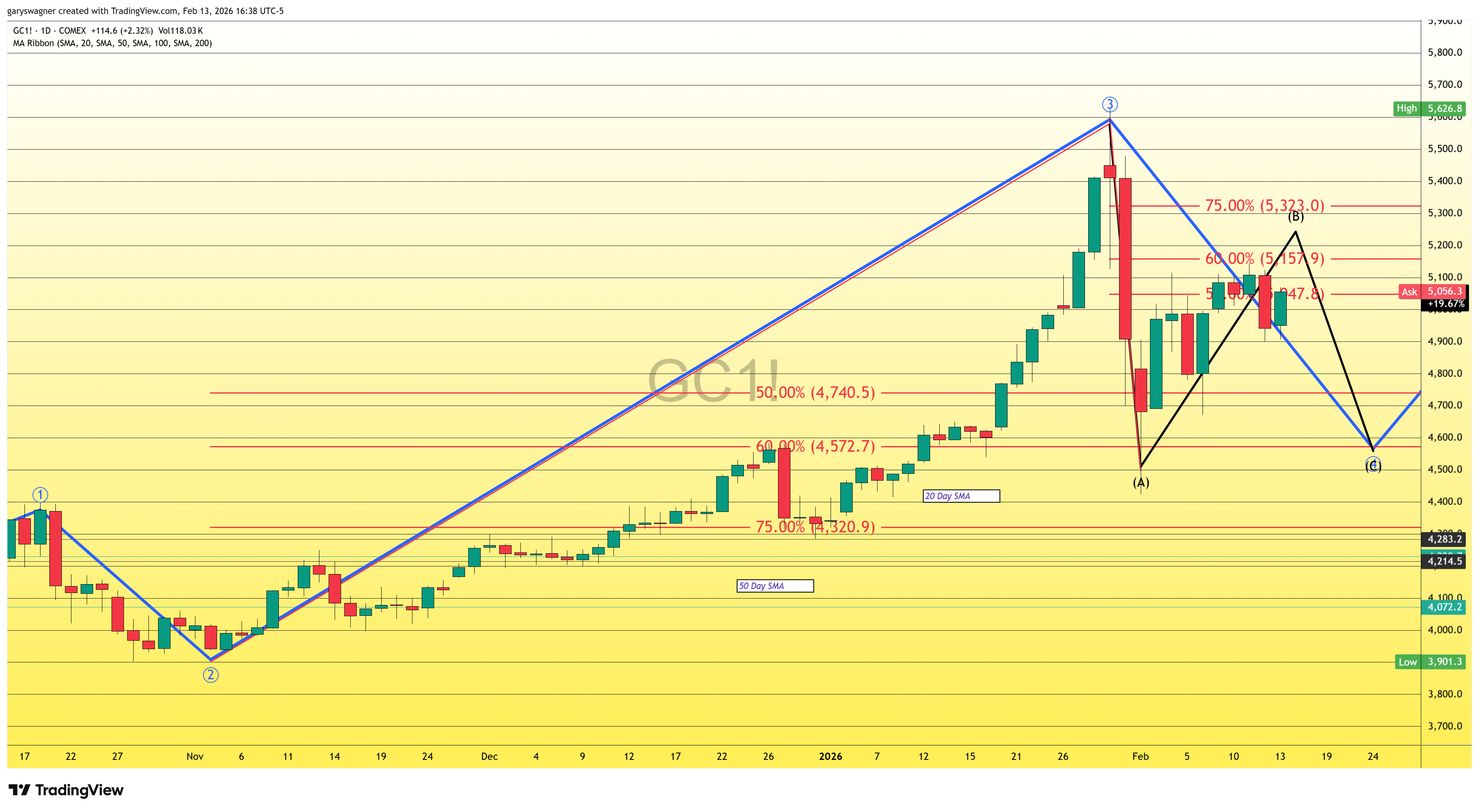
Image Source: Kitco News
Precious metals experienced extreme volatility last week, with gold and silver both opening strong before being tested by sudden mid-week selloffs. Gold briefly surpassed $5,000, supported by a weaker U.S. dollar and market expectations of future Federal Reserve rate cuts, while silver surged past $80 on the same momentum. Economic data, including weak retail sales and private payrolls, reinforced the case for accommodative policy, while persistent structural demand—particularly from the People's Bank of China—continued to underpin the market. Gold’s gains reached historic levels mid-week, converting the $5,000 threshold from resistance into technical support.
The market’s narrative shifted sharply on Thursday as forced liquidation and systematic selling triggered a rapid decline, with gold dropping over $160 and silver falling more than 10% intraday. The selloff was initially linked to weakness in AI equities and broader equity indices, cascading into commodities through momentum-driven trading strategies. By Friday, softer-than-expected inflation data helped stabilise the market, allowing gold to recover above $5,000 and silver to regain modest ground. The week underscored metals’ sensitivity to cross-asset contagion and technical dynamics, but gold’s ability to hold key support suggests the broader bullish trend remains intact despite short-term disruptions. Source
In this week’s Live from the Vault, Andrew Maguire examines how last Friday’s price drop in gold and silver showed the market had reached a turning point, with physical holders staying firm while derivative trading caused most of the decline.
The London wholesaler explains how Chinese regulators and strong buying at the Shanghai Gold Exchange are stabilising markets, prompting momentum shorts to cover and laying the groundwork for a structurally supported rally in both metals.
Disclaimer: These articles are provided for informational purposes only. They are not offered or intended to be used as legal, tax, investment, financial, or any other advice.
Featured Image - Source: Unsplash















