x




The latest Kitco News Weekly Gold Survey reveals a clear divergence in sentiment between Wall Street analysts and Main Street retail investors regarding gold's price trajectory for the upcoming week. Wall Street experts are overwhelmingly bullish, with 71% anticipating higher gold prices, driven by recent cooling inflation data and escalating geopolitical tensions in the Middle East. Only a small minority of 7% predict a decline, while 21% foresee sideways trading. Analysts like Marc Chandler from Bannockburn Global Forex expect gold to re-challenge its April highs, potentially nearing $3500, due to its enhanced role as a safe haven amidst global uncertainties and upcoming central bank rate decisions from the FOMC, BOE, and BOJ, which are largely expected to maintain current policies, with a potential rate cut from the SNB.
In contrast, Main Street's enthusiasm has waned somewhat, despite gold's recent gains. The Kitco online poll, which gathered 253 votes, shows 58% of retail traders expect gold prices to rise, a notable decrease in bullishness compared to the experts. A significant 21% anticipate a decline, and another 21% predict consolidation. This more cautious outlook from Main Street comes after a week where gold's price remained largely range-bound until Wednesday afternoon, when fresh geopolitical concerns in the Middle East prompted a sharp rally, pushing spot gold from $3324 to a weekly high of $3377. The upcoming week's focus on central bank monetary policy decisions will likely be a key factor influencing gold's performance. Source
The Kitco News article highlights a puzzling divergence in safe-haven asset performance following recent geopolitical escalation, specifically Israel's preemptive strike. While such events typically trigger a synchronized rise in both gold and the U.S. dollar, this time gold has surged to its highest level since April's all-time record of $3,500, ending the week with a 3.7% gain, while the U.S. dollar has surprisingly weakened, poised to close the week with a 1% loss at its lowest level in roughly three years. This disconnect challenges the traditional view of the U.S. dollar as a stable global anchor in times of fear. The article suggests that growing scepticism about America's reliability as a trading partner and concerns about its rising debt, particularly since President Donald Trump's "Liberation Day" and the ensuing trade war, have eroded faith in U.S. debt and contributed to this unusual market behaviour.
This "disconnect" implies a fundamental shift in how investors perceive safe havens. Gold is increasingly viewed as a truly independent asset, free from the geopolitical and economic risks associated with third-party nations. While the immediate event-driven surge in gold is noted as potentially fleeting, the underlying trend of gold acting as a refuge from a "system in flux" is presented as a compelling long-term narrative. The article cautions against chasing the market at current levels due to the potential for quick reversals once tensions ease, but emphasizes gold's growing role as an alternative monetary asset in a world where traditional certainties are unravelling. The key risk moving forward is that continued turmoil could stoke inflationary pressures, potentially leading the Federal Reserve to maintain its neutral monetary stance. Source
The Kitco News "Gold SWOT" article highlights gold bullion's increasing prominence in global reserves, now constituting 20% and surpassing the euro as the second-largest reserve asset after the U.S. dollar. This surge in central bank gold accumulation, particularly by emerging markets, is driven by a desire for diversification, a hedge against inflation, and protection against geopolitical risks, including the weaponization of currencies and the threat of sanctions. Despite recent strong price appreciation—with gold up 30% in 2024 and another 27% year-to-date in 2025—central bank holdings, though substantial at 35,000 tons, are still below the 1965 Bretton Woods peak, suggesting further room for accumulation. This trend reflects a deliberate strategic shift by central banks to enhance their portfolio resilience in an increasingly uncertain global financial and political landscape.
However, the article also notes some weaknesses and risks. While central bank buying remains a dominant force, there are signs of a temporary slowdown in Q1 2025, with a 33% drop in purchases quarter-on-quarter. This could be due to the strong run-up in gold prices or some central banks approaching their desired allocation targets. The article also touches upon the inverse relationship between gold prices and real yields, noting that a rising interest rate environment could reduce gold's appeal as a non-yielding asset, although this relationship has somewhat broken down in the current climate of global disorder. Nevertheless, the prevailing sentiment is that gold's long-term role as a neutral, sanction-resistant, and sovereign-proof store of value will continue to drive demand and support its price, with some analysts forecasting it could reach $4,000 an ounce early next year. Source
This Kitco News article, authored by Jim Wyckoff, provides a highly technical analysis of the gold market for active intra-day traders, focusing on key short-term support and resistance levels for Comex gold futures. The core of the article is a 5-minute bar chart designed to help traders identify potential buy and sell entry points. The author stresses the principle that successful traders often buy on early price strength and sell on early price weakness. This daily analytical tool is presented as a unique and exclusive resource for those actively trading gold futures, emphasizing its utility in navigating the volatile intra-day movements of the precious metal.
The analysis is presented within the broader context of recent gold market performance. While the article itself is specifically about the technical intra-day levels for June 16, it indirectly references the ongoing factors influencing gold prices, such as geopolitical tensions and central bank actions, as seen in other related Kitco News articles. The emphasis is on providing actionable insights for short-term trading based on technical indicators, rather than a fundamental long-term outlook. It serves as a practical guide for traders looking to capitalize on immediate price fluctuations in the gold market. Source
Spot gold maintained its position near $3,416 per ounce following the release of the latest New York Federal Reserve figures, which showed manufacturing activity in the New York region plunged deeper into contractionary territory. The Empire State manufacturing survey recorded a significant decline to -16 in June, a notable drop from May's -9.2 reading and considerably worse than the consensus forecast of -5.5. This indicates a continued and accelerating deterioration in business conditions across New York State, with new orders and shipments also declining. Despite the overall contraction, the report did note that employment grew slightly for the first time in several months, and firms expressed renewed optimism about future business conditions, with the relevant index rising above zero.
The immediate impact on gold prices saw the metal trading near the lower edge of its daily range after the data release, currently showing a loss of 0.49% on the session. While regional manufacturing data like the New York Manufacturing Index can influence market sentiment and the U.S. dollar, its direct and consistent correlation with gold prices is not always straightforward. Gold tends to react more to broader economic uncertainty, inflation expectations, and shifts in monetary policy. The significant drop in this manufacturing index suggests underlying economic weakness, which in some scenarios could be supportive of gold as a safe-haven asset, but the market's reaction in this instance was more subdued, indicating other factors might be at play in gold's current price action. Source
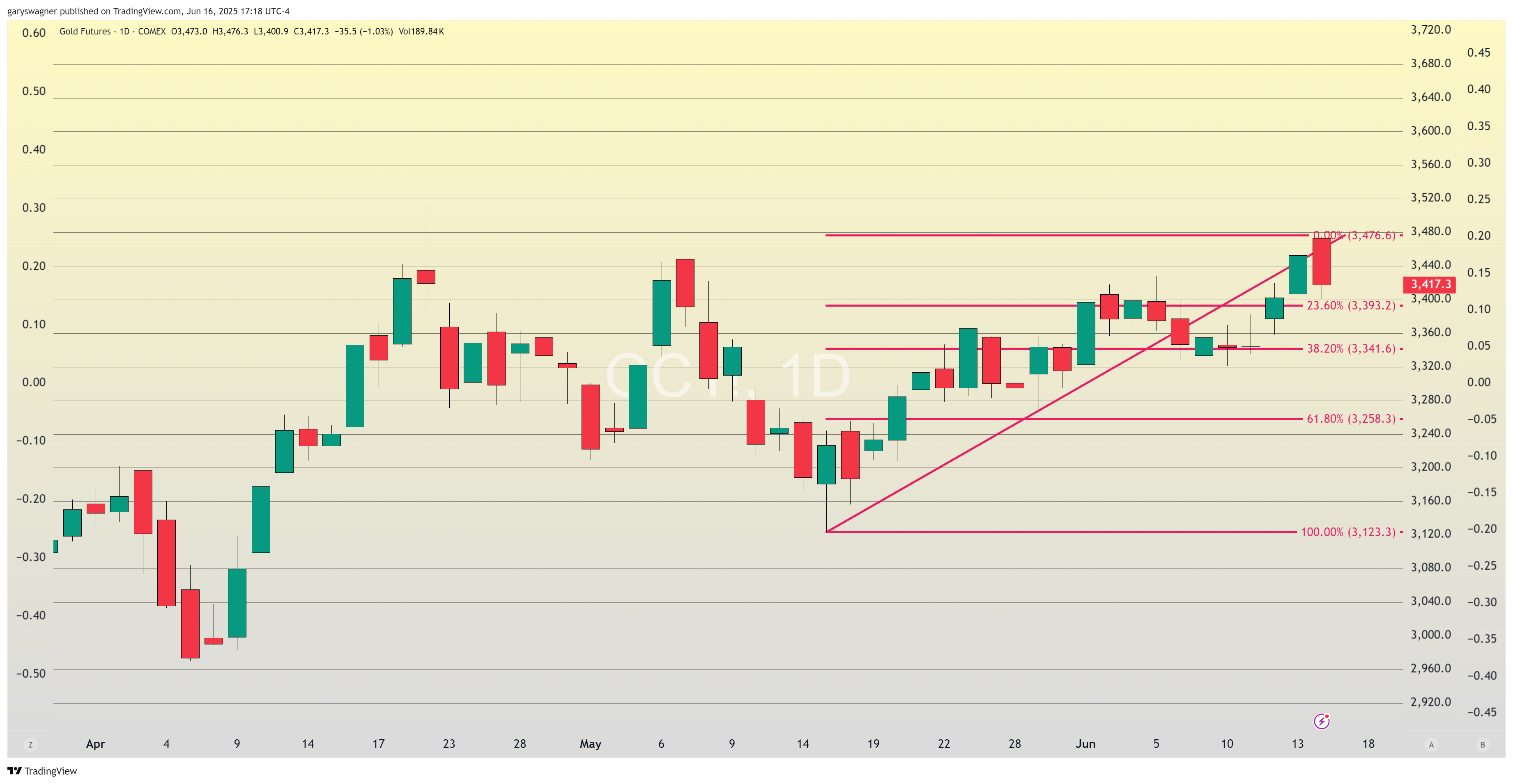
Image Source: Kitco News
Gold futures experienced a significant and dramatic reversal, declining by $50 after initially gapping higher on Monday. This volatility highlights the intricate relationship between safe-haven demand and evolving risk perceptions, particularly concerning escalating Middle East tensions. While the outbreak of hostilities between Israel and Iran had propelled gold to a record closing price of $3,452.80 on Friday, Monday's trading session saw substantial profit-taking. This shift occurred as market participants grew increasingly confident that the conflict would remain geographically contained, leading to a recalibration of risk assessments and a diminished view of broader regional escalation. The closing price of $3,403.10 represented a 1.43% decrease, signalling a strong intraday reversal from strength to weakness.
From a technical perspective, this recent price action has formed what appears to be a "triple top" configuration on daily candlestick charts, with each peak accompanied by a bearish "dark cloud cover" pattern. This pattern, characterized by a bullish candle followed by a bearish candle that gaps higher but closes in the lower half of the preceding candle's body, is a strong bearish reversal signal, especially at major resistance levels. The repeated occurrence of this pattern at gold's recent highs establishes the $3,475 level as formidable resistance. Historical precedent, such as a similar pattern on May 7 that preceded a $325 decline, suggests that gold may be poised for another meaningful correction. This convergence of resolving geopolitical uncertainty and technical weakness creates a potentially volatile environment for the precious metal. Source
Bank of America's commodity analysts, led by Michael Widmer, assert that while gold prices have recently fallen back below $3,400 an ounce, the ongoing conflict between Israel and Iran is unlikely to be the primary catalyst to propel gold to the $4,000 mark. Historically, event-driven demand for safe-haven assets like gold has not proven sustainable. Instead, Bank of America points to broader macroeconomic factors and gold's increasing appeal as a global monetary asset as the more significant drivers. The team highlights the unsustainable growth of U.S. government debt and ongoing market concerns about fiscal sustainability. They believe that sustained rates volatility and a weaker U.S. dollar, potentially forcing the U.S. Treasury or the Federal Reserve to intervene, are the key ingredients for gold to rally to $4,000 per ounce within the next 12 months.
Furthermore, Bank of America emphasizes that current investor allocation to gold, estimated at 3.5% of portfolios (including global equity and debt), is not excessive and remains below the all-time highs of 2011, suggesting ample room for further investment. Central banks, particularly from emerging economies, are continuing to increase their gold allocations, partly driven by apprehension over trade disputes and U.S. fiscal deficits, potentially diverting more purchases away from U.S. Treasuries. If this investment and central bank demand remains stable, analysts anticipate gold prices will continue to consolidate between $3,000 and $3,500 an ounce in the short term. The bank also notes the broadening rally in the precious metals sector, with silver and platinum attracting new bullish momentum, especially silver, which has been in a structural deficit due to constrained mine supply and is expected to reach $40/oz by Q4 2025. Source
Gold prices are experiencing downward pressure due to a combination of profit-taking by short-term futures traders and an improving risk appetite in the broader financial markets. After reaching a five-week high overnight, August gold futures have seen some selling as investors shift away from safe-haven assets. This improved risk sentiment is evidenced by higher stock markets in the U.S. and overseas, indicating a reduced perceived need for the safety of gold. While gold bulls still maintain a solid near-term technical advantage, with their next upside objective being a close above $3,500, bears are aiming to push prices below the solid technical support at the June low of $3,313.10.
Despite the recent pullback, the article notes that analysts continue to hold a largely positive long-term outlook for gold. Some experts believe that the gold market is due for a final dip before resuming its rally towards new record highs in 2025. Furthermore, there's a strong sentiment that gold prices are unlikely to drop below $2,000 an ounce again, with some forecasts even suggesting prices could triple from current levels. This indicates that while short-term fluctuations are influenced by trading dynamics and shifting risk appetites, the underlying fundamental drivers for gold remain robust. Source
Mexican billionaire Ricardo Salinas Pliego, a prominent advocate for sound money, has reiterated his staunch belief that fiat currencies are a "fraud" and that Bitcoin (BTC) and gold are the only viable alternatives for wealth preservation. In a recent social media post, Salinas, known for his early adoption of Bitcoin, highlighted the inherent weakness of fiat money, which is not backed by any physical commodity and is susceptible to continuous devaluation through unlimited printing by central banks. He cited a chart illustrating the dramatic depreciation of the Mexican Peso against the U.S. dollar since the early 1970s, attributing this decline to the "fraudulent" nature of fiat systems. For Salinas, the solution lies in embracing assets with finite supply and intrinsic value, such as gold and Bitcoin.
Salinas has been a vocal proponent of Bitcoin since 2013, famously revealing in 2020 that 10% of his liquid portfolio was invested in the cryptocurrency. His businesses, including Grupo Elektra, have explored integrating Bitcoin payments, and he has consistently urged his followers to invest in both gold and Bitcoin, emphasizing their role as hedges against inflation and economic instability. While recognizing the speculative nature and volatility of Bitcoin, he views it as a superior store of value compared to traditional currencies. This stance underscores a growing sentiment among a segment of high-net-worth individuals and investors who are increasingly wary of the long-term stability of fiat money and are seeking refuge in decentralized and finite assets. Watch the podcast
Adrian Day, President of Adrian Day Asset Management, asserts that despite any temporary resolution of the U.S. debt ceiling, an underlying funding crisis within the United States could be the ultimate catalyst to drive gold prices to unprecedented highs. Day argues that the U.S. government's continued reliance on increasing debt, coupled with the Federal Reserve's accommodative monetary policies, creates an environment ripe for gold's appreciation. He emphasizes that the sheer volume of U.S. debt and the ongoing need for government borrowing will inevitably lead to a weakening dollar and sustained investor concerns about fiscal responsibility, pushing investors towards gold as a safe haven and a hedge against the erosion of purchasing power.
Day believes that this domestic funding crisis is a more potent long-term driver for gold than fleeting geopolitical tensions. While he acknowledges that market reactions to such events can cause temporary spikes, the fundamental issue of the U.S. government's fiscal trajectory will continue to underpin gold's rally. His outlook suggests that even if a debt ceiling deal provides short-term market relief, it merely postpones the inevitable reckoning with America's growing financial obligations. This prolonged period of fiscal instability, combined with potential central bank interventions, will ultimately solidify gold's role as a critical asset in diversified portfolios, potentially pushing its value to new record levels. Source
In this week’s Live from the Vault, Andrew Maguire analyses silver’s breakout from a 14-year suppression zone, highlighting a structural shift driven by Asian physical demand, short squeezes and the collapse of synthetic trading pressure.
With silver now outperforming gold, Andrew explains why the rally is poised to push beyond $40, as institutional buyers reposition and ETF inflows surge, signalling the dawn of a sustained, bullion-backed bull market.
Disclaimer: These articles are provided for informational purposes only. They are not offered or intended to be used as legal, tax, investment, financial, or any other advice.
Featured Image - Source: Unsplash















