x




Image Source: Unsplash
TD Securities takes tactical short in silver, looks for $17
The silver market has seen some significant volatility this year, but the price action could get a lot worse, according to one Canadian bank.
Silver prices have been in a significant downtrend since peaking in late February. Although silver has outperformed gold this past month, analysts at TD Securities are expecting to see another move to the downside.
In a note Wednesday, the Canadian bank announced it was taking a tactical short position in silver, looking for prices to fall to $17 an ounce within the next two months.
Daniel Ghali, senior commodity strategist at TDS and author of the note, said that silver continues to face significant headwinds from two directions. Growing global recession fears is weakening industrial demand for silver; at the same time, its role as a monetary metal has been diminished as central banks, led by the Federal Reserve, continue to raise interest rates.
"Our quantamental indicators are pointing to additional downside in demand signals on the horizon, which fits with weakening growth dynamics. Silver markets are particularly vulnerable, given little exposure to the rise in supply risk premia that has been supporting industrial metals," said Ghali.
At the same time, TDS expects gold prices to drag down silver as the Federal Reserve aggressively tightens interest rates. Read More
$2,400 gold will come by 2023, Bitcoin falling to $10k is 'more probable' than a rally
Precious metals and Bitcoin have reached pivotal “breakout” points and are on the verge of another major move, according to Patrick Karim and Kevin Wadsworth, technical analysts and founders of Northstar & Badcharts.
Karim and Wadsworth spoke with David Lin, Anchor for Kitco News.
Despite high inflation and geopolitical uncertainty, gold’s performance has been flat this year. However, Karim said that under certain conditions, gold will experience a breakout rally. In particular, he told investors to watch the gold-silver ratio.
“The gold-silver ratio is an [indicator], where if there’s risk-on, if the market melts down or a spike, the gold-silver ratio will crescendo up,” he said.
Once the gold-silver ratio goes below a certain level, Karim said that “silver and gold will outperform U.S. equities, and silver will outperform gold in the initial legs of the recovery phase of U.S. equities.”
Wadsworth agreed with Karim’s analysis.
“We’re in a sideways trading range for gold at the moment,” said Wadsworth. “It’s got a floor of about $1,680, and the top is somewhere just below $2,000… as long as we stay in that sideways trading range, I’ve got no concerns whatsoever. To me, this is just a staging post on the way to much higher values.”
Karim added that if gold can “break out” beyond its $1,800 to $2,000 price levels, then that would be a “game changer” that could see gold reach new heights.
Ultimately, gold is poised to reach at least $2,400 by 2023, according to Northstar & Badcharts’ analysis. Read More
Gold, silver weaker Thursday as USDX trades sharply up
Gold and silver prices are modestly lower in midday U.S. trading Thursday, pressured by solid gains in the U.S. dollar index today. Losses in the metals are limited by gains in the crude oil market today. October gold futures were last down $4.20 at $1,762.20. September Comex silver futures were last down $0.181 at $19.555 an ounce.
The marketplace Thursday quickly digested Wednesday afternoon's minutes from the last FOMC meeting of the Federal Reserve. Traders deemed the minutes neutral to just slightly dovish and markets showed no significant reactions to them. The CME Fed funds rate futures are now showing slightly better odds for a 0.5% rate hike at the September FOMC meeting.
Global stock markets were mixed overnight, with Asian indexes mostly down and European indexes mostly up. U.S. stock indexes are mixed to firmer at midday. The U.S. stock indexes have been enjoying price uptrends on the daily charts since early June, and that's another underlying bearish factor for the safe-haven metals markets.
Technically, October gold futures prices hit a two-week low today. The gold futures bears have the overall near-term technical advantage and have momentum on their side. Bulls' next upside price objective is to produce a close above solid resistance at the August high of $1,814.40. Bears' next near-term downside price objective is pushing futures prices below solid technical support at $1,700.00. First resistance is seen at today's high of $1,775.90 and then at Wednesday's high of 1,786.30. First support is seen at the August low of $1,759.70 and then at $1,750.00. Wyckoff's Market Rating: 3.0.
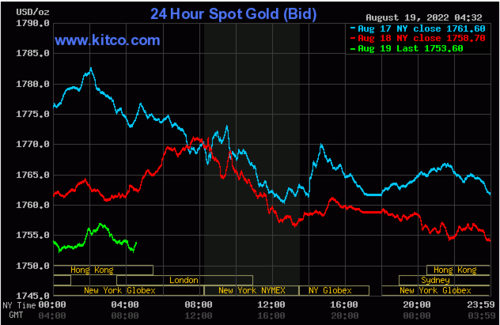
Image Source: Kitco News
September silver futures prices hit a two-week low today. The silver bears have the overall near-term technical advantage and have momentum. Silver bulls' next upside price objective is closing prices above solid technical resistance at $22.00. The next downside price objective for the bears is closing prices below solid support at $19.00. First resistance is seen at $20.00 and then at $20.25. Next support is seen at $19.47 and then at $19.25. Wyckoff's Market Rating: 3.0. Read More
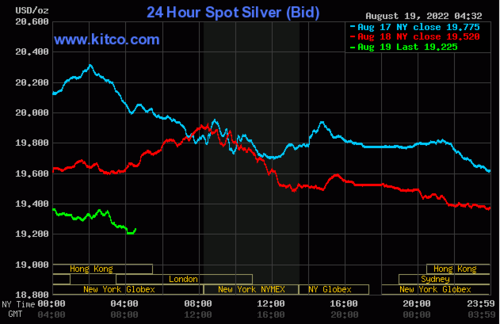
Image Source: Kitco News
This is how to play gold in a neutral price environment - VanEck's Foster and Casanova
Gold prices are again stuck under $1,800 an ounce, but one investment firm continues to see some resilient strength in the marketplace.
In their latest commentary, Joe Foster, portfolio manager and strategist, and Imaru Casanova, deputy portfolio manager for VanEck's gold strategy, said that they expect gold prices to hold around current levels even as the U.S. dollar sees renewed momentum.
The analysts added that any weakness in the U.S. dollar should provide some support for gold as investors continue to look for safe-haven assets in a world of uncertainty.
The U.S. dollar continues to be driven by rising interest rates and the Federal Reserve's aggressive monetary policy stance. However, Foster and Casanova said that the tightening cycle could be close to ending its aggressive rate hikes.
"We do believe the Fed will likely have to stop hiking rates as the economy contracts, but we also think that there is a significant risk that inflation remains at elevated levels for longer than anticipated. This would keep real rates in negative territory and be supportive of higher gold prices," the analysts said.
According to the CME FedWatch Tool, markets see a nearly 50/50 chance of the Federal Reserve raising rates by 50 basis points or 75 basis points in September. Heading into the end of the year, markets see a slower pace of rate hikes. Read More
China's Swiss gold imports soar nearly 150% in July as gold price trades below $1,800
China stepped up its gold imports from Switzerland in July, purchasing the most bullion in more than five years, according to the Swiss Federal Customs Administration.
Demand from China is starting to pick up over the summer months, with Switzerland shipping 80.1 tonnes of gold to China, worth $4.6 billion.
This is a monthly increase of 146% and the biggest cargo since December 2016, Swiss customs data showed Thursday.
Increased demand from China comes as gold continues to trade below the $1,800 an ounce level, disappointing many gold bulls but providing a cheaper entry point for long-term investors.
After hitting a peak of more than $2,000 an ounce in March, gold has been in a downtrend, with some analysts warning that a bigger selloff could be around the corner.
Analysts point to aggressive rate hikes by the Federal Reserve and a stronger U.S. dollar as some of the main obstacles holding gold back this year. Read More
Gold lost value for the last four consecutive days
While there is still one trading day left in the week gold has lost considerable value since trading began on Monday. Considering December gold futures opened at $1819 this week and are currently fixed at $1772.20 per oz. gold has given up $47 in value. This amounts to a percentage decline of 2.58%. This week’s decline in gold prices occurred as a combination of selling pressure and dollar strength.
The last time the dollar was at its current value was July 18. The dollar opened at 105.52 on Monday and is currently fixed at 107.43. Gains this week in the dollar index have added 1.77% in value-based against a basket of six foreign currencies. The dollar gained 2.09 points this week or 1.77% and December gold futures have lost 2.58%. This means that the gains in the dollar contributed 0.81% to gold’s price decline.
Market participants have been active sellers of gold as rising yields and dollar strength has made the non-interest-bearing precious yellow metal less attractive.
Market sentiment has been shaped largely by recent and future actions by the Federal Reserve as they ratchet interest rates higher. Over the last four FOMC meetings, the Fed has implemented consecutive rate hikes. Beginning in March they raise rates by 25 basis points, 50 basis points in May, 75 basis points in June, and an additional 75 basis points in July. The net result is that Fed funds rates were near zero in March of this year and are now at 225 basis points to 250 basis points.
Although four consecutive rate hikes might seem like the Federal Reserve is raising rates too quickly to combat headline inflation at 8.5%. If you think that it couldn’t get much worse simply look back in history to realize that is an incorrect assumption. Between 2004 and 2006 the Federal Reserve raised interest rates 17 times. The net result was to take Fed funds rates from 1% to 5 ¼% to curb inflation and cool down an economy that was excessively overheated. Commercial banks raised their rates to 8.25% which is the real cost of borrowing capital by corporations. Read More
Expect 'collapse' and 'unrest'; Hedge using gold, guns, livestock, and land - Tom Luongo
We are entering a time of “institutional collapse” and “institutional unrest,” said Tom Luongo, Author and Publisher of the Gold, Goats ‘n Guns newsletter, who advocates investors look into guns, livestock, land, and gold as assets for their portfolio.
“You’re buying guns as insurance against your tangible assets, against someone stealing them from you,” he said. “Well, inflation is also theft. It’s theft of purchasing power over time, so that’s why you’re supposed to buy gold.”
Luongo emphasized that although investors had experienced forty years of bull markets in bonds and equities, “nothing lasts forever.”
“The current [monetary and financial] architecture is unsustainable, but it’s also not going to go away completely,” he said. “You’re going to have to re-learn everything you learned in your life.”
Luongo spoke with David Lin, Anchor and Producer at Kitco News. Read More
.png)
Disclaimer: These articles are provided for informational purposes only. They are not offered or intended to be used as legal, tax, investment, financial, or any other advice.















