x



Image Source: Unsplash
Gold On Worst Monthly Run in 4 Years Following Powell’s Stark Reminder on Future Hikes
Gold looks set to end August on a downward trend, extending the month’s losses with the precious metal set for its fifth consecutive monthly decline, its worst run in 4 years.
The catalyst for gold’s reversal in fortunes was the switch in policy by the Federal Reserve to a more hawkish monetary policy in April that has resulted in a series of interest rate hikes in recent months as well as a reduction of the amount of the debt it holds. In some senses little has changed in the intervening months with Fed Chair Jerome Powell recently reiterating the need for more rate increases in order to bring inflation back down to its 2% target and more debt being allowed to mature.
In this environment, gold has struggled as higher interest rates make interest-paying assets such as bonds more attractive. The rally seen earlier in the month where gold climbed above $1,800 an ounce has proven illusory as it was built on the false expectation that promising US economic data would reduce the pace and severity of future interest rate hikes the Fed would need to impose. However, recent comments by a slew of Fed officials, culminating in Powell’s recent hawkish warning, have brought gold’s price crashing back down and it is now headed towards $1,700 an ounce.
How gold reacts as it approaches this key threshold will be demonstrative of the amount of support that remains for the metal. While there remain fears of a global recession as well as the ongoing war in Ukraine, there should be enough support to ensure gold doesn’t dip below the lows touched in July but on the other side, it is hard to see how gold can make significant gains when central banks across the world are intent on raising interest rates.
Source: Kinesis
Silver’s Optimism Fades as Price Sinks Towards 2-Year Lows on Reminder of Hawkish Fed
The optimism that silver investors were enjoying earlier in the month when the metal was holding above $20 an ounce has been washed away in the last few weeks with the price now flirting with the lows reached in July and threatening to sink down to the levels last seen in July 2020.
As has been the case for much of the year, the key driver for silver’s price action is the words and actions of the Federal Reserve. Hopes that the US central bank may not need to be so aggressive with its future monetary policy in the wake of economic data that showed the US was holding up surprisingly well despite high inflation have been replaced by the stark reality following comments from Fed Chair Jerome Powell that the bank will continue to raise interest rates for the foreseeable future.
Silver’s lack of yield means that the metal struggles in an environment where interest rates are rising so this reminder that plenty of action is still needed by central banks across the world to curb persistently high inflation has brought the price of silver shuddering down.
How silver reacts as it trades near the lows of last month will be instructive after the metal appeared to form a strong bottoming of its price when it sank to those levels. With a fundamental outlook that still points to healthy demand for silver due to its use in key industries such as solar energy and electric vehicles, investors may once again see these sub-$19 an ounce levels as a buying opportunity.
Source: Kinesis
This is the scenario in which gold price jumps $300 this fall – RBC Capital Markets
Even though gold is heading for its fifth monthly drop, a high price scenario of above $2,030 an ounce cannot be ruled out this fall, according to RBC Capital Markets.
After peaking above $2,000 an ounce back in March, gold is ending the month of August down more than 5% year-to-date, with December Comex futures last trading at $1,731.70 an ounce.
"The large rally that we saw at the beginning of the year, particularly as Russia invaded Ukraine, was the type of crisis performance typical of gold," Christopher Louney, commodity strategist at RBC Capital Markets, told Kitco News.
But since then, gold has fallen from its yearly highs. And that's because the particulars of this type of crisis were negative for the precious metal, Louney explained.
"It takes economic and financial fallout to get gold to perform more strongly in the long term," he said. "And even though there's certainly been financial and economic fallout, this crisis played out in a way that means higher rates and a stronger dollar, which when we think of a crisis, is not always the case. That's part of why gold is priced the way it is."
The macro drivers from aggressive rate hikes and a strong U.S. dollar have been keeping gold below $1,800 an ounce, RBC's strategists added.
"Gold has been stuck. The day-to-day has been defined by expectations versus surprises in response to macro data or Fed speak. That sort of repricing of 50 versus 75-basis-point hikes and how long they last are what drives gold daily," Louney said.
But the heightened geopolitical tensions could still support gold into the year-end, which is why a price tag above $2,000 is still possible this fall. Read More
Gold, silver down as crude oil drops, U.S. Treasury yields rise
Gold and silver prices are lower in midday U.S. trading Wednesday, with gold hitting a five-week low and silver a more-than-two-year low. Gold prices were well up from their daily lows, however.
Eroding crude oil prices and rising U.S. Treasury yields at mid-week are bearish outside market elements working against the metals markets on this day. October gold futures were last down $4.10 at $1,722.70. December Comex silver futures were last down $0.307 at $17.985 an ounce.
Today’s ADP national employment report for August showed a paltry rise of 132,000 jobs, which was well below the gain of 300,000 that the marketplace expected. The marketplace showed little reaction to the report, which has a recent history of not being a good indicator of Friday morning’s more important employment situation report from the Labor Department. That report is expected to show the key non-farm payrolls growth number at up 325,000 in August versus the July report showing a gain of 528,000 non-farm jobs.
Global stock markets were mostly lower overnight. U.S. stock indexes are weaker at midday. Traders and investors remain tentative at mid-week, following the Federal Reserve’s annual Jackson Hole symposium that saw U.S. Fed officials, including Chairman Powell, lean aggressively hawkish on U.S. monetary policy. Other major central banks of the world are also tightening their monetary policies—all in an effort to tamp down problematic price inflation, even if it slows global economic growth.
Technically, October gold futures prices hit a five-week low today. The gold futures bears have the solid overall near-term technical advantage. Prices are in a three-week-old downtrend on the daily bar chart. Bulls’ next upside price objective is to produce a close above solid resistance at $1,780.00. Bears' next near-term downside price objective is pushing futures prices below solid technical support at the July low of $1,686.30. First resistance is seen at today’s high of $1,728.70 and then at Tuesday’s high of $1,743.10. First support is seen at today’s low of $1,711.70 and then at $1,700.00. Wyckoff's Market Rating: 2.0.
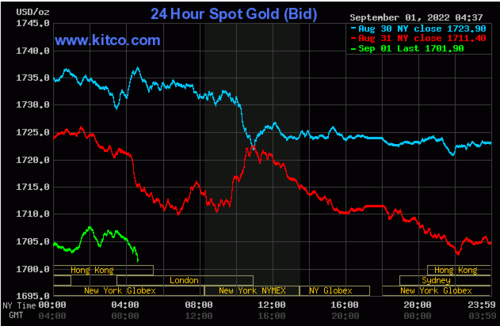
Image Source: Kitco News
December silver futures prices hit a more-than-two-year low today. The silver bears have the solid overall near-term technical advantage. Silver bulls' next upside price objective is closing prices above solid technical resistance at $19.50. The next downside price objective for the bears is closing prices below solid support at $17.00. First resistance is seen at today’s high of $18.39 and then at this week’s high of $18.83. Next support is seen at today’s low of $17.80 and then at $17.50. Wyckoff's Market Rating: 1.0. Read More
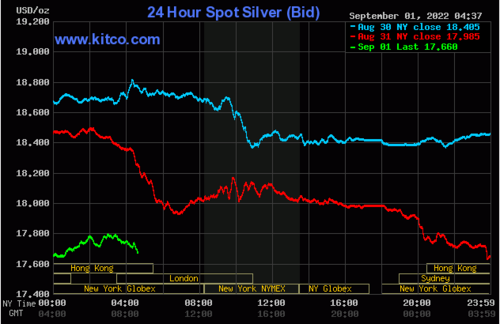
Image Source: Kitco News
The risk of gold price plunging below $1,700 is limited, says Standard Chartered
Even though gold is lacking conviction at the moment as prices trend towards $1,700 an ounce, further downside remains limited, said Standard Chartered.
The U.S. dollar has been inflicting a lot of pain on gold prices over the summer months, forcing gold to wrap up August with the fifth monthly loss. And while the U.S. dollar index traded near 20-year highs on aggressive Federal Reserve rhetoric, December gold futures dropped to below $1,800 an ounce and were last trading at $1,722.50.
However, the good news for gold is that it is not likely to fall much further because most of the downside risk has already been priced in, said Suki Cooper, precious metals analyst at Standard Chartered.
"Although the yellow metal faces significant downside risks, it also benefits from tailwinds including recession risk, a price-responsive physical market, already scaled-back positioning and elevated inflation," Cooper wrote in a report this week. "The prospect of further rate hikes has quelled investor appetite. While we expect gold to trend lower towards USD 1,700/oz in Q4-2022, these factors are likely to limit the downside."
Looking ahead, Standard Chartered sees the Federal Reserve hiking by only 50 basis points at its upcoming September meeting and then pausing at November and December meetings. This is a slightly more dovish outlook than what markets expect, with the CME FedWatch Tool pricing in a 70.5% chance of a 75-basis-point hike in September.
"Our economists believe the Fed will pause as the U.S. economy is likely to lose momentum in Q4-2022, and that U.S. inflation will start to ease, albeit remaining elevated," Cooper said. "Fears around slower growth and rising risk of a recession should buffer the downside to gold. For now, gold is largely taking its cue from the USD, with the three-month rolling correlation at -58%." Read More
Powell’s speech creates persistent pessimism in equities and precious metals
Gold prices continue to trade under pressure resulting in another double-digit price decline today. As of 5:23 PM EDT gold futures basis, the most active December 2022 Comex contract is trading down by $13.60 or 0.78% and currently fixed at $1722.70. Just as in yesterday’s trading activity current pricing is just above the daily low of $1720.60. That being said, gold continues to trade to a lower low for three out of the last four trading sessions.

Image Source: Kitco News
Powell’s Keynote speech last week has had a persistent influence which continues to drive U.S. equities and precious metals to lower pricing. His message was resolute and clear re-affirming that the Federal Reserve is intent on moving inflation lower at any cost.
According to the EveningBriefing by Bloomberg Chairman Powell has abandoned his notion that a soft landing is possible and is now aiming for something that will potentially result in much more pain for American corporations and individuals. However, many analysts are convinced that the hawkish monetary policy of the Federal Reserve will not be enough to achieve its intended goal.
According to Natasha Solo-Lyons who penned this EveningBriefing says that analysts have put a name to this economic scenario using the paradoxical name of a “growth recession”. It differs from a soft landing in that it is defined as a protracted period of meagre growth and rising unemployment. It differs in that it stops short of an outright recession. Read More
Gold and silver move lower ahead of the European open
Gold (-0.28%) has once again opened lower as it heads to the technical support level of $1681/oz. Silver (-1.00%) is also struggling and trades at $17.79/oz. In the rest of the commodities complex, copper is 1.12% lower but spot WTI has risen 0.25%.
In risk markets, the Nikkei 225 (-1.53%), ASX (-2.02%) and Shanghai Composite (-0.49%) all struggled overnight. Futures in Europe are pointing towards a weak cash open.
In FX markets, the Japanese Yen hit its lowest level against the U.S. dollar since 1998 overnight. In addition to that, GBP/USD also moved lower to hit 1.1569 a level not seen since March 2020.
News from overnight: Read More
.png)
Disclaimer: These articles are provided for informational purposes only. They are not offered or intended to be used as legal, tax, investment, financial, or any other advice.















