x




Image Source: Unsplash
Inflation will remain high until 2026; ‘You don’t need a recession to bring down inflation,’ says Ex-Reagan advisor – Arthur Laffer
Reagan’s former economic advisor, Arthur Laffer, expects inflation to continue to accelerate, and to be well outside of the preferred range of 2 percent until 2026. Laffer, who is Founder and Chairman of Laffer Associates, nevertheless believes that inflation can be tamed.
The June inflation figure was 9.1 percent, the highest since 1981.
“You don’t need a recession to bring down inflation,” said Laffer. “We need tight money, and tax cuts to increase the supply of goods and services.”
Laffer, who advised U.S. Presidents Ronald Reagan and Donald Trump, explained that when taxes are cut, this causes firms and individuals to produce more, which reduces prices.
He said, “if you have a bumper crop in apples, what happens to the price of each apple? It goes down. If you have a bumper crop in the production of goods and services, what happens to the price of each unit? It goes down, the inflation gets stuck.”
Laffer spoke with Michelle Makori, Editor-in-Chief, and Lead Anchor at Kitco News, at the FreedomFest 2022 conference in Las Vegas. Read More
Swiss imports of Russian gold see drastic drop in June after May's influx
Switzerland imported only 284 kg of Russian gold worth about $16 million in June, which is significantly lower than the 3 tonnes worth about $200 million reported in May, according to customer data released Tuesday.
Last month, it was revealed that Switzerland imported gold from Russia for the first time since Moscow invaded Ukraine at the end of February.
The global community criticized the Swiss May gold imports as helping Russia finance its war in Ukraine, which the country's government denied. The Swiss officials responded that the imported gold originated in Russia but was shipped from Britain, adding that customs is investigating whether any sanctions were violated.
It is still unclear who is the owner of the imported gold and how long the bullion was sitting in Britain before being imported into Switzerland in May.
Switzerland plays a major role in the gold industry as it is the world's largest refining center for the precious metal. And Russia is the world's second-biggest gold producer. For about a year before February, Switzerland, on average, imported about 2 tonnes of gold a month from Russia. Read More
Gold, Silver, and Platinum headed south
The weakness in gold, silver, and platinum has continued. Every rally attempt has been met by sellers. Monday, precious metals tried to rally, showing nice gains early only to fail miserably by the end of the day. There is more room to the downside and rallies should be sold.
Until further notice, rallies will be the short covering variety that is created by too many shorts. Dead cat bounces and phony rallies that look good are a part of trading in any market. The precious metals are in a downtrend, and we remain short.

Image Souirce: Kitco News
With the recent action, look for gold to find support at 1650, silver at 18, and platinum at 800. If those levels are violated, there will be new levels to watch. Consolidation for a few days would be no surprise; the speed down has been a little too fast. Unless the pattern changes, the metals will remain weak.
Forget about the news, the headlines, and anything you believe affects the price. Until the price action changes, there is no hope of a sustained rally. This can change at any time; markets never announce their intentions. Read More
Gold, silver near steady; new fundamental inputs awaited
Gold and silver prices are trading not far from unchanged in midday U.S. trading Tuesday. A big drop in the U.S. dollar index this week is limiting selling interest in the precious metals. However, rising U.S. Treasury bond yields this week and a wobbly crude oil market are squelching the bulls. A lack of fresh, markets-moving economic or geopolitical news in mid-summer has metals traders languishing and looking more at the outside markets for direction. August gold futures were last up $0.90 at $1,711.10. September Comex silver futures were last down $0.105 at $18.735 an ounce.
Global stock markets were mixed overnight. U.S. stock indexes are solidly higher at midday. Corporate earnings reports are on the front burner of the stock markets this week. Otherwise, its summertime doldrums trading amid a lack of major, fresh news this week.
Technically, August gold futures bears have the solid overall near-term technical advantage. Prices are in a four-month-old downtrend on the daily bar chart. Bulls' next upside price objective is to produce a close above solid resistance at $1,750.00. Bears' next near-term downside price objective is pushing futures prices below solid technical support at $1,650.00. First resistance is seen at this week’s high of $1,722.00 and then at $1,735.00. First support is seen at the July low of $1,695.00 and then at $1,685.00. Wyckoff's Market Rating: 1.0.
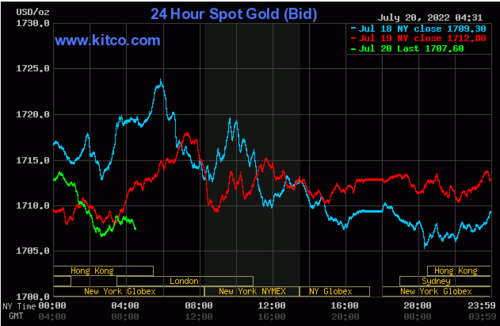
Image Source: Kitco News
September silver futures bears have the solid overall near-term technical advantage. Silver bulls' next upside price objective is closing prices above solid technical resistance at $20.00 an ounce. The next downside price objective for the bears is closing prices below solid support at $17.50. First resistance is seen at $19.00 and then at $19.36. Next support is seen at today’s low of $18.51 and then at $18.00. Wyckoff's Market Rating: 1.5. Read More
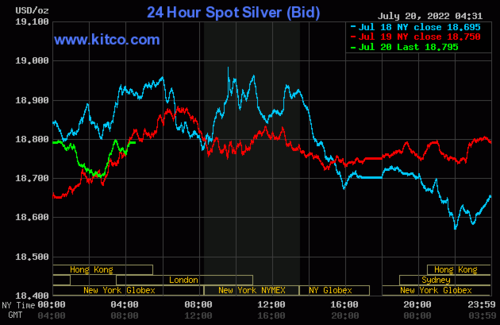
Image Source: Kitco News
Copper/gold ratio shows Fed monetary policy is too tight - MKS PAMP
As recession fears continue to rise, one market analyst said that one barometer could indicate that the Federal Reserve is close to shifting its monetary policy, which would be positive for gold.
In a recent research note, Nicky Shiels, head of metals strategy at MKS PAMP, said that she is paying close attention to the copper/gold ratio as it falls to a critical level.
"It serves as an indicator of the market's appetite for risk, and it can be a leading indicator for the direction of interest rates," she said in the note.
Analysts have noted that in recent months copper prices have slid sharply lower as investors see a growing risk of a recession as a contraction in the global economy would lead to lower copper demand.
Currently, copper prices are trading at their lowest point this year; Comex high-grade copper futures last traded at $3.288 per pound. Although gold prices have struggled, falling to $1,700 an ounce, it has outperformed copper. The industrial metal has lost more than 26% so far this year. At the same time, gold prices are down roughly 7%.
"The Copper/Gold ratio is nosediving, driven by a relatively larger copper repricing lower; that contrasts strongly with Fed funds rate which is accelerating (off a low base) in 50-75bp clips, in order to tame inflation," said Sheils. Read More
Dollar weakness did not overcome the selling pressure in gold
Over the last three trading days, market participants have been active sellers of the dollar taking the dollar index substantially lower. On Thursday, July 14 the dollar hit its highest value during this rally taking the index to an intraday high of 109.12. The dollar index has lost approximately 2.6% in value in the last four trading days when compared to the intraday high on Thursday to today’s low of 106.57.

Image Source: Kitco News
This is the highest value that the dollar has reached since July 1, 2002. Meaning it has been over 20 years since the dollar has been at this level.
Even with extreme dollar weakness gold has diminished in value from the opening price on Thursday, July 14 to the current price of gold futures which is $1710. The differential between the opening price on Thursday to current pricing results in a loss of approximately $23 or -1.32%.
While dollar weakness over the last week most certainly has limited the selling pressure in gold, higher yields from U.S. debt instruments continue to be the preferred haven asset. Since gold does not produce a yield and U.S. debt instruments have seen a substantial uptick in yields, they have become the go-to fixed asset favored by the investment community. Read More
Inflation has now peaked says economist who called 9% CPI, but markets are way off – Steve Hanke
Headline CPI in the U.S. broke another 41-year record last week, coming in at 9.1%. The “greatest inflation we’ve had in 41 years” is likely as high as it’s going to get, according to Steve Hanke, professor of Applied Economics at Johns Hopkins University.
Hanke has been calling for the CPI to reach 6% to 9% since as early as July 2021, when he and co-author John Greenwood, Chief Economist of Invesco, published an Op-Ed in the Wall Street Journal entitled “Too Much Money Portends High Inflation.”
Hanke and Greenwood argued that an expansion of the money supply will inevitably lead to a rise in consumer prices at all levels.
Now that inflation has reached the upper range of his 6% to 9% forecast, Hanke said that it has likely peaked for now. Read More
Gold moves lower ahead of the European open
Gold has moved 0.24% lower heading into the European open to trade at $1706/oz. Silver is just under flat. In the rest of the commodities complex, copper is 0.82% higher while spot WTI has fallen 4.31%.
In the risk markets, the sentiment was good overnight. The Nikkei 225 (2.67%), ASX (1.65%), and Shanghai Composite (0.76%) all closed higher. Futures are pointing towards a positive cash open in Europe.
In FX, markets were flat overnight. NZD/USD was the biggest mover rising 0.35%. BTC/USD continued its winning streak to trade at $23,675.
News from overnight: Read More
.png)
Disclaimer: These articles are provided for informational purposes only. They are not offered or intended to be used as legal, tax, investment, financial, or any other advice.















