x




The dollar edged slightly higher against the yen as investor attention turned to political shifts in Japan, where a hardline conservative is poised to become the first female prime minister. This anticipated premiership, backed by a new coalition, has raised concerns about potential fiscal expansion, which could put downward pressure on the yen despite a Bank of Japan board member advocating for a rate hike. The euro also saw a small gain against the dollar as political tensions in France eased temporarily, though markets haven't entirely dismissed the French political risk. Meanwhile, the US dollar index gained as worries about US credit risk lessened after President Donald Trump's comments on China tariffs, coupled with positive earnings from some regional banks, eased broader concerns about the US banking sector following a week of bad loan and fraud issues.
However, economists warn that the dollar’s strength faces multiple challenges, with the government shutdown potentially hurting economic activity both directly and indirectly, and escalating US-China trade tensions remaining a major drag. Tariffs already in effect continue to slow real household income growth and impact corporate margins. With no clear end in sight for the federal government shutdown, the political and economic pressures are expected to intensify into November. Separately, the Australian dollar rose, boosted by resilient economic data from China, its key trade partner, which showed better-than-expected third-quarter growth and industrial output despite the ongoing US tariffs. Source
Canada has announced tariff relief on specific steel and aluminum products imported from the US and China as a measure to support domestic businesses struggling amidst ongoing trade disputes. This move comes as Prime Minister Mark Carney’s government is engaged in negotiations with the US regarding tariffs imposed by President Donald Trump on Canadian steel and aluminum, while also working to secure relief from Chinese tariffs on Canadian agricultural exports. The tariff remissions, effective from October 15, apply to certain varieties of steel and aluminum from China not produced domestically, and specific US steel and aluminum products linked to sectors like public health, national security, manufacturing, agriculture, and food packaging.
Finance Minister François-Philippe Champagne indicated that this remission process is intended to safeguard the downstream sector and address "exceptional circumstances" where specific products are essential to maintaining Canadian supply chains. These targeted exemptions, while providing necessary relief to certain industries, are not expected to significantly impact the overall collection of counter-tariffs. The tariff rollbacks also include reversing many of the retaliatory tariffs that the previous Canadian administration had imposed on US imports, as the current government works towards a trade resolution with the Trump administration. Source
Canada’s main stock index, the S&P/TSX composite index, saw a strong rebound on Monday, closing up by 1% and recovering losses from the previous week. The market was buoyed by easing concerns over the escalating global trade war, following U.S. President Donald Trump's optimistic comments about reaching a fair trade deal with China, and Canada’s move to offer tariff relief on some US and Chinese steel and aluminum imports to support domestic businesses. The upturn was broad-based, with the heavily-weighted materials group leading the gains, climbing 2.3% as the price of gold reached a new record high, pushing up shares of mining companies like NGEx Minerals.
Financials and industrials also posted solid advances, with nine out of ten major sectors ending the day in positive territory. This positive market movement, which mirrored a rise in Wall Street indexes, was attributed by analysts to investor optimism about 2026 and robust corporate earnings results from the US. The only sector to decline was consumer staples, pulled lower by shares of Loblaw Companies Limited. Overall, the limited market pullback from recent volatility suggests that investors remain hopeful about the future despite persistent near-term challenges. Source
Despite an unprecedented run to new record highs, silver experienced a significant price correction, dropping nearly 5% from its overnight peak to trade around $51.70 an ounce, although it remained on track for a weekly gain of nearly 3%. BCA Research's Chief Strategist, Roukaya Ibrahim, warned that this correction could signal the beginning of a larger downward trend, arguing that silver's price surge was too rapid and lacked stable fundamental support. The rally was partially fuelled by limited physical liquidity in the Over-the-Counter markets due to ongoing supply chain issues, which has led to depleted London vaults while New York vaults remain full, partly due to fears of potential US tariffs on silver. However, the high spot premium over CME futures is starting to attract some metal back to London, narrowing the arbitrage opportunity.
Ibrahim cautioned investors that the history of commodity rallies driven by short squeezes suggests a rapid and significant reversal is likely, with prices often remaining below the peak for months following the surge. Technically, she noted that silver is overextended, with the price standing 43% above its 200-day moving average and its Relative Strength Index at 85, both signalling an overbought market due for a near-term pullback. She did, however, acknowledge that ongoing global trade tensions and the risk of US tariffs on silver could continue to incentivize stockpiling in New York, limiting the supply needed to ease the London shortage. Ibrahim concluded that a final determination on the US Section 232 Investigation into tariffs could be the trigger that reverses the price trend in both London and New York. Source
The gold market experienced significant profit-taking after hitting a new intraday record high near $4,400 an ounce, with spot gold falling over $165 from its peak to trade around $4,252.20 an ounce. Despite this late-week selling pressure, the precious metal is still on track for a major milestone: a ninth consecutive week of gains, a feat only achieved five times since the 1970s. During this nine-week rally, gold prices have soared over 25%, surpassing the 19% gain seen during the comparable rally in 2020. However, some analysts are urging caution, noting the market is significantly overbought and due for a technical pullback, as there has historically never been a ten-week consecutive growth period for gold.
Conversely, others argue the rally is fundamentally justified, citing growing safe-haven demand amidst weak economic activity, the risk of a regional banking crisis, and the failure of Congress to pass new funding legislation. Dovish signals from Federal Reserve members, including Chair Jerome Powell, supporting falling interest rates are also providing a tailwind for the metal. While "long gold" is one of the most crowded trades, its relatively low 2.4% allocation in total fund manager portfolios suggests the rally's fundamentals remain intact. With speculative activity on the rise and government data releases limited due to the shutdown—save for the crucial CPI data—analysts believe the path of least resistance for gold remains upward, with any dips seen as buying opportunities. Source
The gold sector shows underlying strength, with silver being the best-performing precious metal for the week, surging 12% and showing double-digit gains despite a healthy pullback driven by profit-taking. Gold itself has climbed 61% this year, a rally Goldman Sachs analyst Lina Thomas attributes to strong real demand and normalization following years of underinvestment, supported by record central bank buying and private investors catching up as the Federal Reserve cuts rates. This strong demand is evident in record global gold ETF purchases, which hit 146 tons in September 2025, more than doubling the volume from August. Furthermore, Orla Mining exceeded its third-quarter production estimates, and as the price of gold approaches $3,000 per ounce, analysts note that the mining sector has room for a re-rating toward historical mid-cycle valuation averages.
Despite the positive momentum, there are weaknesses and threats in the market, including platinum being the weakest performer for the week and trading at a premium to its net asset value in Japan amid softer fundamentals like lower PGM output from Jubilee Metals Group. Silver's dramatic 79% surge this year is flagged by Goldman Sachs as potentially shaky, fuelled by speculative inflows and Fed rate cut expectations without the central bank safety net that gold enjoys, making it much more volatile. Investment flows into silver ETFs are also starting to stall after a significant rise this year. Threats to the entire sector include potential downside risks from a Supreme Court ruling on U.S. tariffs, a possible hawkish shift by the Federal Reserve, and the outcome of the U.S. midterm elections. Additionally, the latest global fund manager survey indicated that being "long gold" is now considered the most crowded trade. Source
Gold has recently experienced extraordinary volatility, with spot prices settling around new highs of $4,250 per ounce as of Monday, October 20, following a week that saw gains exceeding 10% and single-day swings of around $200. This highly volatile period is attributed to a confluence of policy-related risks stacking up simultaneously. Key drivers include the return of major trade war concerns, sparked by President Trump's threat of a substantial tariff on Chinese imports before a partial walk-back, which produced massive safe-haven surges and subsequent relief erosions but left gold with a higher floor. Additionally, the protracted, multi-week United States government shutdown has amplified policy uncertainty, sustaining a geopolitical premium for gold as critical agencies operate on skeleton shifts. Finally, the approaching Federal Reserve meeting on October 28–29, with markets leaning toward at least a 25 basis point interest rate cut, has bolstered gold's appeal as investors price in dovish expectations.
The short-term outlook suggests that volatility is likely to remain the dominant feature until one of the core policy risks is resolved. The base case sees gold remaining elevated and choppy between $4,150 and $4,450, supported by the prolonged shutdown and expected Fed easing direction. A bull case, pushing gold past $4,500, could materialize from a new, unexpected tariff escalation or a disorderly data surprise during the shutdown. Conversely, a bear case, involving a controlled cool-off to the $4,000–$4,150 range, would require a credible Washington compromise to end the shutdown before the Fed meeting, along with upbeat US-China trade visuals. The momentum is fundamentally driven by a stack of policy risk premia—trade, governance, and interest rates—and the "shining metal" will only cool from its current boil to a simmer once clarity emerges on at least one of these critical pillars. Source
CIBC, a major Canadian bank, has significantly upgraded its gold and silver price forecasts, expecting the current bull market momentum to persist through 2027. The analysts project that gold will average $4,500 an ounce in both 2026 and 2027, substantially higher than their previous estimates, and they view $3,300 an ounce as the new normal for the metal in the long term. This bullish outlook is primarily driven by persistent economic uncertainty, including expectations for continued tariff policy uncertainty and a delayed negative impact on consumer purchasing power from existing and future tariffs. Furthermore, the bank attributes the recent "parabolic shift" in gold above $4,000 not just to earlier interest rate cuts by the Federal Reserve, but to growing, longer-term concerns about inflation and the preservation of wealth, especially as the Fed's monetary focus shifts away from longer-term inflation risks toward the job market.
The bank is also highly optimistic about silver, forecasting that prices will average $55 an ounce in 2026 and 2027, with a long-term expectation of around $38 an ounce. Additional support for gold is anticipated from continued gold accumulation by central banks as they diversify away from the US dollar, and from the digital marketplace, where gold is increasingly used as an anchor for stablecoins, notably by Tether. While CIBC is bullish on the long-term trend, they caution that the sector is currently overbought, with technical indicators suggesting a likely period of consolidation or a short-term correction, potentially down to the $3,440–$3,550 range. However, the analysts emphasize that any such correction in both gold and silver should be seen by investors as a strategic buying opportunity, as the longer-term uptrend remains solid. Source
The gold and silver markets are exhibiting signs of severe strain and being extremely overbought following a white-hot bull run, according to analysts at Heraeus. Gold's recent price surge, including a jump of over $200 per ounce in a single week, is driven by a fear of missing out rather than geopolitical concerns, which should theoretically ease with potential peace progress in Gaza. Despite the rise, record-high prices are likely to crimp gold jewellery sales in price-sensitive markets like India during the auspicious Diwali festival, where second-quarter sales were already down 17% year-over-year. However, the rally is supported by expectations that the Federal Reserve will cut interest rates at its upcoming meeting due to signs of a weakening labor market, even with official data delayed by the US government shutdown. Meanwhile, robust investor demand in India, coupled with subdued imports, has led to local gold premiums reportedly reaching $25 an ounce.
The silver market is under intense physical strain, although the squeeze eased slightly last week, reflected by a narrowing backwardation and a reduction in one-month lease rates from over 30% to 20%. The market is witnessing a tug-of-war between investors and industrial users, with India halting new ETF subscriptions and seeing imports fall 46% due to a domestic shortage, pushing local premiums well above global prices. Volatility is also high in silver ETFs, which saw huge inflows followed by the largest single-session outflows since February, indicating nervous sentiment. Heraeus maintains that the current high prices should ultimately lead to a demand destruction correction, citing the historical inverse relationship between the silver price and its content in industrial applications like solar cells. The potential for the US government to include silver in a "Section 232" review also adds uncertainty, as it could hinder much-needed outflows from US warehouses and further tighten liquidity. Source
While central bank purchases initially powered gold’s rally from late 2022, recent trade data from CME Group indicates that investment demand is now the primary driver of momentum in the precious metal market. This shift was highlighted by a record total volume of 2,829,666 contracts across CME's metals complex on a Friday, surpassing a previous record set just two weeks earlier, coinciding with gold briefly reaching near all-time highs of $4,400 an ounce before a sharp drop. The record activity was particularly notable in smaller contracts like Micro Gold, E-mini Gold, and the new one-ounce Gold futures, suggesting a surge in participation from retail investors. CME Group's Managing Director, Jin Hennig, attributed the record volumes to surging safe-haven demand as market participants navigate ongoing economic uncertainty, with both large institutions and retail traders using gold futures and options to hedge risk.
Further supporting the notion of surging investment interest, data from the World Gold Council showed a significant influx of 59.2 tonnes into global gold-backed exchange-traded funds in one week, the largest such increase since March 2020. Despite this record demand and price frenzy, industry experts suggest gold remains an underowned asset; for example, Aakash Doshi of State Street Investment Management noted that the world's largest gold-backed ETF, GLD, was still seeing outflows in January, indicating it is not overowned. Additionally, Robert Minter of abrdn cited data showing gold represents only 2.4% of total portfolio allocations, suggesting the fundamental factors supporting gold remain strong. Source
Gold and silver prices saw sharp gains in midday trading on Monday, driven by a corrective bounce as bargain hunters stepped in following heavy selling pressure and price dips on Friday. Despite the strong rebound, the article highlights a growing concern over the extreme daily price volatility in both precious metals. This volatility is viewed as a potentially negative sign, suggesting that the major bull market run could be entering a climaxing phase or, at minimum, an extended period of choppy, highly volatile trading that might deter both speculative bulls and bears in the futures markets. December gold was last up $150.00 at $4,363.90, and December silver was up $1.316 at $51.40.
Sentiment improved on Monday due to efforts by President Trump to ease trade tensions with China, yet the safe-haven demand for gold and silver remained strong, seemingly undeterred by the generally better risk appetite in the broader market. The ongoing U.S. government shutdown, specifically the resulting lack of U.S. economic data, is also cited as a bullish factor for both metals due to the created uncertainty. Technically, both December gold and silver futures bulls maintain an overall near-term technical advantage despite a bearish "key reversal" down chart pattern that occurred on Friday, suggesting a potential market top. For gold, bulls aim to close above the resistance at the record high of $4,392.00, while bears target support at $4,000.00. Similarly, silver bulls look to close above the record high of $53.765, while bears aim for support at $46.70. Source
UBS Global Wealth Management strategist Sagar Khandelwal predicts that mounting political, trade-related, and geopolitical uncertainties, coupled with falling real interest rates, a weaker dollar, and rising government debt, could propel gold prices to $4,700 per ounce, with mining stocks performing even better by the first quarter of 2026. Gold has already risen over 60 percent this year, outperforming all major asset classes, benefiting from recent events like a US government shutdown and renewed trade tensions. Khandelwal suggests that as the Federal Reserve cuts interest rates amid persistent inflation, US real interest rates may turn negative, which would diminish the dollar's appeal and boost investment in gold. He maintains that gold is a crucial component of a resilient investment strategy, advocating for a mid-single-digit allocation in a diversified portfolio due to its low correlation with equities and bonds, especially during market stress.
The analyst notes that gold exchange-traded funds saw their largest monthly inflow in September, contributing to the strongest quarter on record. UBS anticipates investment demand will strengthen further, and combined with continued high central bank purchases, global gold demand could reach around 4,850 metric tons this year, the highest since 2011. Khandelwal posits that if private investors follow central banks in diversifying US Treasury holdings into gold, spot prices could climb even higher toward his upside case of $4,700 per ounce. Additionally, he advises investors to consider select gold miners, whose cash flow could increase more rapidly than gold prices over the next six months. Source
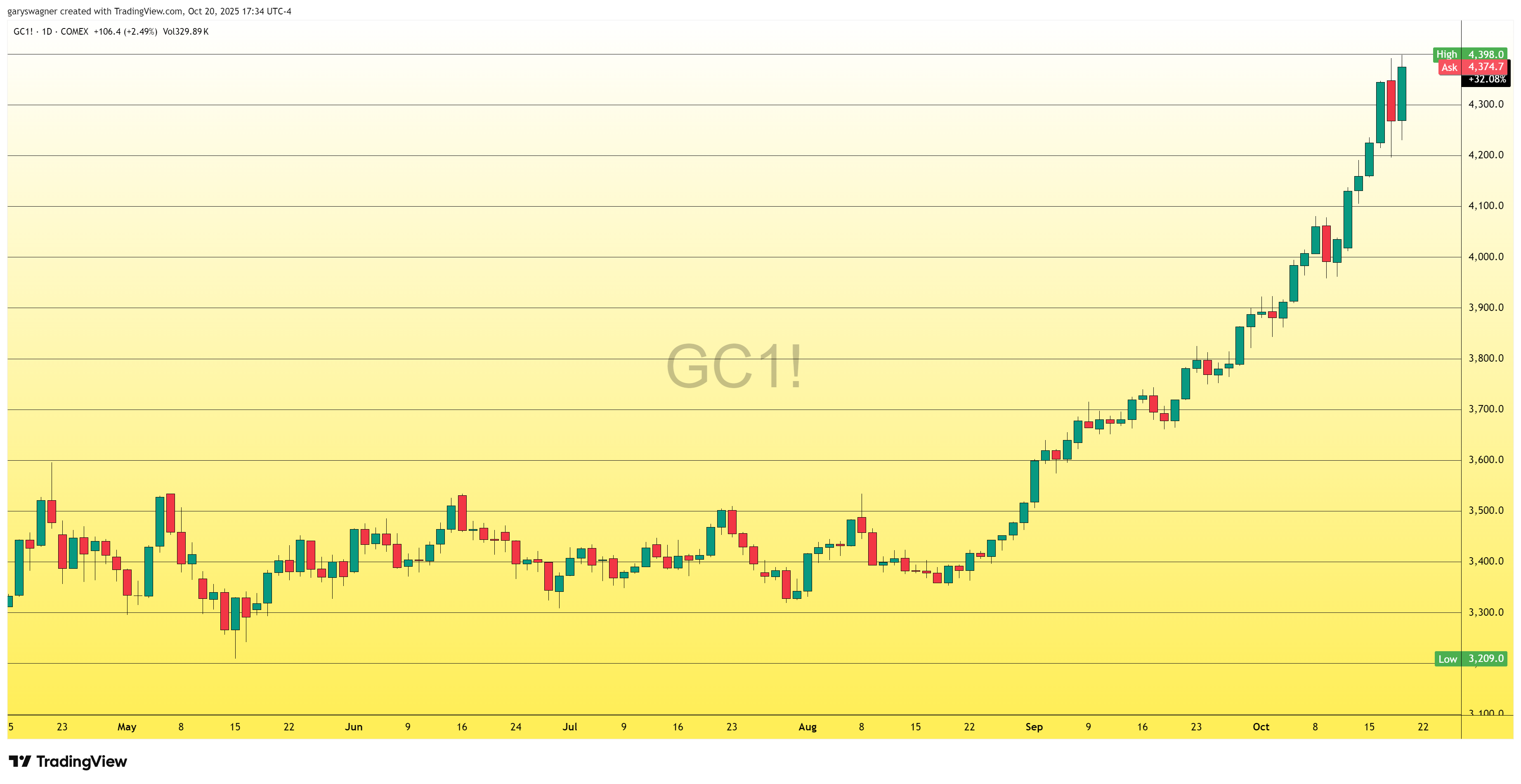
Image Source: Kitco News
Gold futures established a new record high on Monday, recovering significantly from a major $75 drop on the previous Friday. This volatile movement reflects deep investor anxiety driven by multiple risks facing the U.S. economy. The rally was initially sparked by reports of banking sector vulnerability involving two regional institutions, California Bank & Trust and Western Alliance, which disclosed their exposure to what appears to be a substantial loan fraud case. Specifically, California Bank & Trust's collateral was compromised when borrowers unauthorizedly transferred promissory notes and underlying properties, many of which were already facing foreclosure. Western Alliance faced similar issues where borrowers allegedly fabricated title insurance policies to hide senior liens, making the bank's security interest subordinate, and also systematically drained required funds from collateral accounts. These revelations have intensified concerns about the stability of the U.S. financial system, echoing the 2023 regional banking crisis, and fueling a strong flight to gold as a traditional safe-haven asset.
The banking troubles are just one part of a broader supportive environment for the precious metal. The ongoing federal government shutdown, having failed ten consecutive reopening votes, continues to generate policy uncertainty, particularly around essential functions and the debt ceiling. Furthermore, escalating trade tensions between the United States and China are dampening economic growth and corporate earnings forecasts. This combination of financial sector vulnerability, political dysfunction, and geopolitical friction has created an exceptionally bullish outlook for gold. As a result, the metal has been setting new records frequently, with analysts suggesting prices could reach $4,500 per troy ounce in the near term as long as these fundamental concerns persist. Source
In this week’s Live from the Vault, Andrew Maguire explains how London has lost its grip on the global silver market, as rising gold and silver demand in Asia, led by the Shanghai Gold Exchange, drives spot prices and exposes COMEX struggles.
The precious metals expert reveals central banks, governments and institutional investors are racing for physical delivery as China’s export restrictions tighten supply, signalling a clear shift in precious metals towards an East-driven market.
Disclaimer: These articles are provided for informational purposes only. They are not offered or intended to be used as legal, tax, investment, financial, or any other advice.
Featured Image - Source: Unsplash















