x




JP Morgan’s Aaron Hussein outlines why gold, despite its recent rally and role as a hedge in turbulent times, should not be considered a standalone diversifier in investment portfolios. He highlights that gold’s resurgence has been fuelled by rising geopolitical tensions, concerns about U.S. fiscal policy, and central bank purchases in emerging markets. While these factors make gold attractive as a safe-haven asset, Hussein urges investors to evaluate gold's long-term characteristics. Historically, gold has shown highly variable performance—outperforming over certain timeframes but significantly underperforming over others. It also lacks yield and income generation, with returns based largely on market sentiment rather than fundamentals.
Hussein further argues that gold’s reputation as a reliable inflation hedge is overstated, pointing out that over the past four decades, its correlation with inflation has often been negative. During the inflation surge of 2020–2022, for example, gold prices declined. Additionally, unlike other real assets such as real estate or infrastructure, gold generates no income, which creates a real opportunity cost in high-interest environments. While Hussein concedes that gold can serve a useful role in hedging against macroeconomic uncertainty and geopolitical risk, he emphasizes it should be only a modest part of a diversified portfolio. For stability and income, investors are better served by pairing gold with productive, income-generating assets. Source
The European Central Bank (ECB) recently acknowledged gold’s renewed prominence as a global monetary asset and a safe-haven investment amid growing economic and geopolitical uncertainty. In a detailed paper, the ECB emphasized gold's lack of counterparty risk and intrinsic value due to its limited supply, noting that it often performs well during times of market stress. However, the central bank also warned that rising exposure to gold and its derivatives—particularly through opaque, over-the-counter (OTC) contracts—could pose financial stability risks. It highlighted significant disruptions caused by past trade tensions and noted that margin calls and illiquidity in physical gold markets could lead to systemic stress, especially given the high concentration and leveraged nature of commodity markets.
Despite these concerns, several analysts and market participants argue that the ECB may be overstating the risks. Experts like Axel Merk and Ole Hansen contend that gold markets have historically remained resilient, with well-managed volatility and established regulatory safeguards such as rising margin requirements. They suggest that while stresses can emerge, they are typical of physical commodities and do not undermine gold's long-term role as a store of value. Joseph Cavatoni from the World Gold Council reinforced this view, pointing to gold’s vast liquidity and strong performance during past crises. Many analysts see the ECB’s attention as a signal of gold’s growing strategic relevance, with some even suggesting that its “remonetization” is becoming mainstream as confidence in fiat currencies wanes. Source
Silver’s investment appeal appears to be waning as its role shifts more toward industrial use, according to commodities traders interviewed by Kitco News. Kevin Grady of Phoenix Futures noted that while silver was once viewed as a leveraged play on gold, it has increasingly fallen out of favour among investors due to logistical challenges, lack of safe-haven perception, and weaker price performance relative to gold. He highlighted that silver’s increasing role in sectors like solar and electrification may have reduced its responsiveness to investment-driven price surges. Additionally, higher trading costs, less favourable spread structures, and fewer speculative opportunities compared to gold have made it a less attractive asset for traders.
Sean Lusk of Walsh Trading echoed these sentiments, emphasizing the divergence between silver and gold. He pointed out that while silver has shown resilience and hasn't collapsed, it hasn’t followed gold’s upward trajectory either. With no central bank buying and limited safe-haven demand, silver appears vulnerable, especially if gold prices correct downward. Lusk also noted that silver, platinum, and copper are all trading within narrowing price wedges, suggesting a lack of clear momentum or investor conviction. He warned that if gold fails to sustain its highs, silver’s current price levels may not hold, as it continues to move in tandem with gold without establishing its own market leadership. Source
Gold demand has surged in early 2025, driven by a combination of central bank purchases and renewed investor interest, according to Joseph Cavatoni of the World Gold Council. Concerns over U.S. debt sustainability, inflation risks, and broader instability in traditional financial markets have pushed both institutional and retail investors toward gold as a hedge. Cavatoni highlighted that central banks—especially in emerging markets—are actively increasing their gold reserves as part of a long-term diversification strategy, given the underweight gold allocations in their portfolios compared to developed economies. Meanwhile, ETF inflows, particularly in the U.S. and China, have seen a notable uptick, signalling stronger investor conviction in gold’s long-term value amid market uncertainty.
Cavatoni also emphasized the strategic role of gold in portfolios as correlations between equities and bonds rise, making diversification through gold more attractive. Despite a price-sensitive dip in jewelry demand, investment channels such as ETFs, coins, and bars remain robust, especially in Asia. Gold has proven historically resilient during systemic financial crises, reinforcing its appeal during turbulent times. Supply dynamics remain favourable with strong mining output and cautious recycling activity. Cavatoni also pointed to legislative efforts in the U.S. aimed at making gold more accessible for mutual funds, suggesting policy momentum that could further support gold investment. Price forecasts as high as $4,000 per ounce are being taken seriously, backed by gold’s nearly 25% year-to-date return and ongoing macroeconomic stressors. Watch the podcast
Gold prices surged above $3,300 an ounce following Moody’s downgrade of U.S. sovereign debt, as investors turned to the precious metal amid renewed concerns over fiscal instability. The downgrade from Aaa to Aa1, along with a shift in outlook to “stable,” triggered a broad market reaction: U.S. equities fell, the dollar weakened, and Treasury yields rose. Analysts noted that gold has become the key beneficiary as a safe-haven asset, buoyed by growing scepticism around the U.S. government’s spending and debt trajectory. The Congressional Budget Office’s projection that proposed tax and budget policies could add $3.8 trillion to the national debt has further intensified investor anxiety.
Market analysts suggest that unless bond yields reverse or the dollar recovers unexpectedly, gold’s bullish momentum could continue, with technical resistance now eyeing the $3,500 level. Some, like Rick Kanda, see potential for gold to hit $4,000 amid deepening fiscal uncertainty and rising demand for tangible assets. Central banks’ continued gold purchases and investor preference for physical bullion over cash-based investments underscore this trend. Still, others urge caution, noting the need for $3,250 to hold as a support level to confirm another leg higher. While the market echoes past crisis behaviour, many believe this could mark the start of a larger structural shift in gold’s role as a financial anchor. Source
Gold and silver prices climbed midweek as safe-haven buying intensified, driven by rising geopolitical tensions and strong demand from China. June gold rose to $3,310.70, and July silver hit $33.615, bolstered in part by reports suggesting Israel may be preparing to strike Iran’s nuclear facilities. Although the market’s reaction to this intelligence has been measured, it contributed to renewed interest in precious metals. Chinese demand, particularly, has surged—with April gold imports up 73% month-over-month—as commercial banks and insurance firms are encouraged to increase their gold holdings amid concerns about the yuan and the property sector.
In addition to gold and silver, platinum and palladium also saw gains, with platinum becoming more attractive to Chinese buyers due to its relative price stability. Market dynamics were further influenced by a weaker U.S. dollar and soft crude oil prices, while U.S. Treasury yields hovered around 4.57%. Technically, both gold and silver bulls hold near-term advantages, with gold aiming to break resistance at $3,400 and silver eyeing $34.015. However, key support levels remain critical for both metals, with traders closely watching price action for signs of sustained momentum or potential reversals. Source

Image Source: Kitco News
Gold prices continued their strong rally for a third straight day, driven by escalating geopolitical tensions in the Middle East. The June 2025 gold futures contract rose $34.50 to close at $3,319.10, adding to nearly $98 in gains since Monday. While earlier price movements this week were influenced by trade policy concerns, today’s surge is more directly linked to reports suggesting that Israel may be preparing military strikes against Iranian nuclear facilities. This comes at a sensitive diplomatic moment, with the Trump administration still engaged in negotiations with Tehran. Intelligence sources emphasize that while no final decision has been made by Israel, the likelihood of such an action has increased amid doubts over the U.S.-Iran nuclear talks.
The potential for military conflict has amplified demand for gold as a safe-haven asset, a trend that traditionally strengthens during periods of global instability. Analysts note that gold’s role as a hedge against uncertainty is becoming more prominent as geopolitical risks escalate, especially if tensions between Israel and Iran continue to rise or if diplomatic efforts falter. The market is responding not only to actual events but also to the broader fear of instability in a strategically vital region. Should conflict erupt or diplomatic negotiations collapse, it could send gold prices even higher, reinforcing the metal's historical role in times of crisis. Source
The global treasury market is facing renewed instability as the long-standing yen carry trade begins to unravel, creating ripple effects that could drive U.S. Treasury yields higher and gold prices to new record levels. Japanese 30-year bond yields spiked to a record 3.2% following a historically weak bond auction, signaling a shift in global capital flows. Analysts warn that the end of the yen carry trade — a decades-old strategy where investors borrowed yen at low rates to invest in higher-yielding assets abroad — could lead to massive capital reallocation. With an estimated $1 trillion in exposure, this unwind may cause severe currency volatility, liquidity challenges, and asset price declines, particularly in markets reliant on Japanese investment. These developments are coinciding with inflation pressures and the Bank of Japan’s gradual exit from ultra-loose monetary policy.
For gold, the implications are bullish. Market analysts note that despite traditionally rising yields being negative for gold, the threat of financial instability and a weakening global debt structure is enhancing gold’s safe-haven appeal. The yen and gold often move in tandem, and as Japan potentially sells off U.S. Treasuries to stabilize its domestic market, U.S. yields could spike further, particularly at a time when America’s credit rating is under scrutiny. This confluence of factors mirrors gold’s rally in 2024, when prices jumped from $2,400 to $2,600 amid similar turmoil. Technical indicators show gold has key support between $3,245 and $3,275, with resistance at $3,360, and a possible path to new highs at $3,500 if conditions worsen. Source
Chinese demand for gold has surged dramatically, playing a pivotal role in supporting bullion prices near record highs and reinforcing the country's broader de-dollarization strategy. In April, China imported 127.5 metric tonnes of gold—the most in nearly a year—despite prices reaching historic highs. This surge was fueled by the People’s Bank of China issuing new import quotas to meet overwhelming institutional and retail demand. Analysts observe that Chinese traders are demonstrating strong conviction, buying consistently even during price drawdowns. This sustained physical demand has created a significant premium on the Shanghai Gold Exchange and reignited global buying interest, further reinforcing gold’s role as a safe-haven asset.
Beyond short-term market movements, China’s gold accumulation is part of a strategic effort to reduce reliance on the U.S. dollar and reshape the global financial system. By accumulating reserves and promoting the yuan through trade and monetary mechanisms, China is building a dual foundation of gold and national currency to enhance its financial sovereignty. This “quiet, cumulative” strategy avoids triggering market disruptions while subtly weakening global dependence on the dollar. Analysts suggest China’s actual gold holdings could be far greater than reported, highlighting a deliberate and long-term approach. In doing so, China is positioning itself not to abruptly overthrow the dollar, but to offer a credible alternative for the future of international finance. Source
Canada’s Finance Department has confirmed that the 25% retaliatory tariffs on U.S. precious metals imports—including gold, silver, platinum, and palladium—remain firmly in place, contrary to recent reports suggesting otherwise. These tariffs are part of Canada's broader $60 billion countermeasure against U.S. trade actions, designed to target end-use goods while limiting harm to Canadian businesses. While temporary relief was granted in April for select imports related to public safety, health, and national security, this exemption does not apply to most precious metals, which continue to face full tariff rates. The scope of products covered has not changed, and as of March 2025, a wide range of jewelry and non-jewelry precious metals items are affected.
The impact of these tariffs on Canada–U.S. trade has been significant. According to Statistics Canada, Canadian exports of unwrought precious metals declined 8.9% in March, while imports of similar U.S. products plummeted nearly 70%, making them the largest contributor to an overall 15.8% drop in mineral product imports. Although transshipments—precious metals temporarily imported into Canada en route to other destinations—are exempt from the surtax, the majority of affected goods face steep tariff costs. The Canadian government emphasized that these measures were strategically selected after months of consultations to apply pressure on the U.S. while safeguarding domestic industries as much as possible. Source
Disclaimer: These articles are provided for informational purposes only. They are not offered or intended to be used as legal, tax, investment, financial, or any other advice.
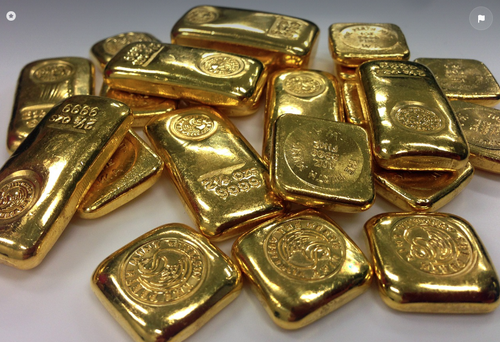
Featured Image - Source: Pixabay















