x




The Canadian dollar, known as the loonie, fell to a one-week low against the U.S. dollar, losing a lot of the value it gained the previous week. This drop occurred before a scheduled speech by Bank of Canada Governor Tiff Macklem on global trade. The loonie was trading 0.3% lower at 1.3820 per U.S. dollar. The previous week, the Canadian dollar was the strongest among the G10 currencies. The U.S. dollar also had a better start to the week, which contributed to the loonie's decline.
The Bank of Canada recently lowered its benchmark interest rate by 25 basis points to 2.50%, its first cut since March. Following this, markets are anticipating another potential rate cut in the fourth quarter. The U.S. Federal Reserve also made an interest rate cut, but the U.S. central bank appeared less eager for future rate reductions. Additionally, the price of oil, a key Canadian export, settled slightly down, and Canadian bond yields edged lower. Canadian producer prices also saw an increase of 0.5% in August from July. Source
According to analysts at Metals Focus, the gold market is experiencing profit-taking after the U.S. Federal Reserve's recent interest rate cut of 25 basis points. This move, which was seen as a cautious easing cycle, fell short of market expectations for more aggressive action, leading to a temporary pullback in gold prices. However, Metals Focus emphasizes that the rally in gold is not just driven by short-term rate policy and that the metal remains in a long-term uptrend. The research firm believes that the macroeconomic and geopolitical environment will continue to be supportive of gold investment, suggesting that buying on dips will persist and drive the metal to new all-time highs well into 2026.
A key factor supporting gold's long-term outlook is the political uncertainty surrounding the Federal Reserve's independence. Metals Focus managing director Philip Newman points out that political pressure to slash rates could undermine the dollar's status as a global reserve currency, a scenario not yet priced into the market. If the Fed were to yield to this pressure, it could lead to rising inflation, which is a bullish scenario for gold as it would drive down real interest rates and reduce the opportunity cost of holding a non-yielding asset. Furthermore, despite a summer slowdown, Newman expects central banks to continue increasing their gold reserves as they diversify away from the U.S. dollar. Source
The Federal Reserve recently cut its benchmark interest rate to address a slowing economy. This move, however, has drawn a sharp warning from Kenneth Rogoff, former IMF Chief Economist, who believes it is a dangerous step toward inevitable inflation. Rogoff argues that the Fed's independence is under assault from political pressure, which is a structural problem rooted in the nation's spiralling debt. This pressure will ultimately force the central bank to accommodate government spending, leading to higher inflation over the long term.
Rogoff also predicts a significant decline in the U.S. dollar's global dominance, forecasting its share of global reserves could fall to 35-40% within a decade. This shift is being driven by what he calls American "unforced errors," particularly the aggressive use of financial sanctions, which incentivizes other nations to seek alternatives. In response to this, global central banks have been on a historic gold-buying spree, purchasing over 2,000 tons in the last two years. While the dollar faces these long-term challenges, Rogoff bluntly stated that China's economic crisis has already begun, describing it as a "Japan-like" crisis. Source
Swiss gold exports to the U.S. fell by over 99% in August, nearly coming to a halt after a customs ruling temporarily imposed tariffs on Swiss gold bars. A U.S. Customs and Border Protection letter had classified one-kilogram and 100-ounce gold bars under a customs code that subjected them to a 39% tariff. This decision, which came as a shock to the global gold market, was a significant blow to Switzerland, as gold exports made up a large portion of its trade surplus with the U.S. Shipments to the U.S. did not normalize until early September when President Trump's administration formalized the tariff exemption.
In contrast to the sharp decline in exports to the U.S., Swiss gold shipments to China more than tripled in August, reaching their highest level since May 2024. Exports to India also saw an increase during the same period. The data shows that Switzerland shipped 35 tonnes of gold to China, up from 9.9 tonnes in July, and 15.2 tonnes to India. Overall, total gold exports from Switzerland fell by 19% to just under 105 tonnes last month. Source
Despite gold prices being near record highs and having risen significantly this year, analysts and investors are not yet calling a top to the rally. Major financial institutions and prominent investors are increasing their exposure to gold, viewing it as a long-term hedge against economic instability. For example, French bank Société Générale has taken a maximum 10% position in gold, and billionaire Ray Dalio recommends investors hold at least 10% of their portfolios in the metal. The article notes that despite this growing demand, gold holdings still represent a small fraction of total global financial assets, and holdings in gold-backed exchange-traded funds are below their 2020 record levels, indicating there is still room for growth.
The demand for gold is being driven by several macro-level factors, including rising government debt and concerns over central bank independence. The U.S. deficit and total national debt are at unprecedented levels, a trend mirrored by rising debt globally. This has led gold to reach new record highs against all major currencies, including the Canadian dollar, British pound, and euro. Additionally, with the Federal Reserve's monetary policy being questioned and the potential for more aggressive rate cuts in the future, investors are seeking alternatives to the U.S. dollar, further solidifying gold's appeal as a safe-haven asset. Source
While gold has seen some profit-taking and was unable to hold its recent gains above $3,700 an ounce, analysts believe that the precious metal remains well-supported, as it recorded a new record weekly close at $3,683.10. According to strategists, any near-term pullbacks are expected to be met with aggressive buying from investors, as the Federal Reserve has restarted its easing cycle amidst ongoing economic uncertainty. The rally is seen as being in its early stages, with significant buying potential remaining and some forecasts targeting a price of $4,000 per ounce by year-end or early 2026.
Beyond the Fed's monetary policy, the long-term bullish sentiment for gold is also being driven by eroding faith in the U.S. dollar, which analysts attribute to rising national debt and political pressure on the central bank's independence. Central banks are expected to continue diversifying their reserves away from the dollar by purchasing more gold. While the Fed has outlined a mild easing path, some analysts see the potential for more aggressive rate cuts, particularly with a new Trump appointee on the board who has already dissented in favour of a larger rate cut. All of these factors are contributing to a solid long-term uptrend for gold, despite the potential for short-term volatility. Source
Equinox Gold Corp. has achieved a significant milestone with the first gold pour at its Valentine Gold Project in Newfoundland and Labrador, Canada. This accomplishment occurred ahead of the anticipated schedule, with the mine's process plant already operating at a mill throughput averaging 47% of its nameplate capacity during the initial 15 days of operation. The company expects the project to ramp up to its full capacity of 2.5 million tonnes per year, solidifying its position to become the second-largest gold producer in Canada, with Valentine slated to be the largest gold mine in Atlantic Canada.
This development at the Valentine Gold Project is a key component of Equinox Gold’s growth strategy, with the mine projected to produce between 175,000 and 200,000 ounces of gold annually for the first 12 years of its 14-year reserve life. The successful commissioning and early gold pour reflect efficient execution and positions the company for a new chapter of meaningful production growth. With the Valentine and Greenstone mines now both in the ramp-up phase, Equinox Gold is poised to significantly increase its overall output. Source
Central bank purchases of gold, which were a key driver of the metal's price rally earlier in the year, stalled in July. The net change in central bank gold holdings was near zero for the month, as a sale by the Indonesian central bank offset purchases from countries like China, Kazakhstan, and Turkey. While this represents a significant slowdown from the first half of the year, when central banks added 415 tonnes to their reserves, the overall trend of gold accumulation over the last three years has been substantial, with over 1,000 tonnes added annually.
Meanwhile, the outlook for silver demand from the U.S. solar industry is becoming less certain. While the EIA had previously forecast record installations for the year, a new prediction from the Solar Energy Industries Association suggests that U.S. solar capacity could drop by 18% between 2026 and 2030, based on potential rollbacks of subsidies. Despite this, Heraeus notes that at present, fiscal and monetary policies are having a greater impact on silver prices than industrial demand. Source
Gold and silver prices have surged, with gold reaching another record high and silver hitting a new 14-year high. This upward momentum is being fueled by expectations of lower global interest rates, which are seen as a catalyst for increased consumer and commercial demand. Additionally, a bullish sentiment in technical charts and continued safe-haven demand amidst geopolitical tensions are contributing to the rally. The market shows no signs of a top forming, suggesting that the prices for both precious metals are likely to continue their upward trajectory.
Reports indicate that investment flows into gold exchange-traded funds (ETFs) have hit a three-year high, reflecting strong investor confidence. The market is also anticipating further interest rate cuts from the Federal Reserve, which historically supports precious metals. The People's Bank of China's decision to maintain its key lending rates at record lows is also seen as a bullish factor for demand. From a technical standpoint, both gold and silver are in a strong position, with Wyckoff's Market Rating at a bullish 9.0, indicating a high probability of continued upward movement. Source
Deutsche Bank has raised its gold price forecast, now expecting the precious metal to average $4,000 per ounce in 2026. This updated prediction comes after gold has already surpassed the bank's previous 2025 target of $3,700 an ounce. According to Deutsche Bank's research analyst, Michael Hsueh, gold's strong rally this year—up over 40%—is largely attributable to a significant increase in official demand from central banks, a trend he anticipates will persist. Hsueh suggests that applying the average 13% outperformance of gold against a standard model, which has been seen since central bank demand surged in 2022, leads to the new $4,000 average forecast.
In addition to strong central bank buying, particularly from China, Deutsche Bank also expects investment demand to remain a key driver. The report notes that developed market ETFs and speculative futures positioning are not overextended, suggesting there is still room for growth. While bullish on gold's prospects, Deutsche Bank also acknowledges potential risks, such as the Federal Reserve not being as aggressive with rate cuts as the market expects due to elevated inflation. However, uncertainty surrounding the Fed's monetary policy independence, a potential outcome of growing political pressure, is seen as a major factor that would ultimately be bullish for gold. Source
China's central bank has been a major buyer of gold over the past three years, yet its gold reserves remain relatively low as a percentage of its total holdings compared to developed nations. According to Société Générale, if China were to increase its gold reserves to a more typical level of 20%, it would need to acquire an additional 3,036 tonnes. This sustained, long-term purchasing goal, which could take nearly a decade to achieve, is a significant factor in supporting higher gold prices for the foreseeable future, as this strategic accumulation is driven by geopolitical rather than just economic considerations.
Société Générale also suggests that China’s official gold purchases may be higher than publicly reported. The bank's analysis of customs data indicates that the People's Bank of China's monthly acquisitions are likely much greater than the figures reported to the IMF. Even with this conservative estimate, the consistent demand from the world’s second-largest economy is a powerful force. Given this ongoing trend, Société Générale has reiterated its bullish forecast, expecting gold prices to surpass $4,000 an ounce next year, with an average price of $4,065 in the second quarter of 2026. Source
Disclaimer: These articles are provided for informational purposes only. They are not offered or intended to be used as legal, tax, investment, financial, or any other advice.
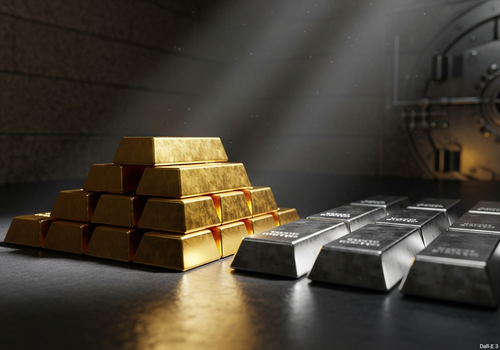
Featured Image generated with Google AI Studio















