x




Image Source: Unsplash
Strong Dollar is Generating a Challenging Scenario for Silver
The U.S. Dollar finished last week strengthening against a large majority of currencies.
The recent macroeconomic data released in the United States are increasing the pressure on the Federal Reserve for further hawkish decisions. Markets are now pricing the interest rates to be in the region of 3.5 – 3.75% by the end of this year. Therefore, it is not a surprise that in the last few trading days we have seen a challenging scenario for precious metals.
Both gold and silver posted losses. The yellow metal declined by around 40 dollars, slowing down from $1,800 to $1,760, while silver lost over 8%, falling from $20.7 to $18,9, posting five negative trading sessions in a row. Also, in early trading today we have not seen any rebound signal, with silver traded below the key level of $19 per ounce.
The ratio between gold and silver jumped above 91, around 2% less than the peak reached 6 weeks ago at 92.5-93.
Overall, the short-term technical scenario remains weak, with space for further declines. There are some important support zones around $18.5 and particularly between $18 and $18.2 per ounce, where the low was reached in July. Read More
Gold Price Remains Above $1,750 Despite Dollar Strength
Gold started the new week declining to $1,752 per ounce, in line with the weakness shown last week.
Overall, the scenario remains complex as investors try to predict and anticipate the Federal Reserve’s next moves. The solid data released last week, with numbers highlighting the strength of the U.S. job market, generated a new rebound of the greenback and the pair EUR/USD is now trading close to parity.
Moreover, the yields of the U.S. 10-year treasuries recovered, increasing the bearish pressure on the precious metal. Gold lost around 2%, falling from $1,800 to $1,760, while silver and platinum lost respectively 8% and 7%.
Looking at fundamentals, investor interest in the physical metal is still strong, particularly in Asia, while we have seen an outflow from the ETFs.
From a technical point of view, gold is now close to the important support zone of $1,750, while the next key levels to monitor are placed at $1,720 and $1,680. On the other hand, we could see a trigger to the upside if the price rises above $1,790 and if it breaks above the resistance placed at $1,820. Read More
Hedge funds cautious on gold and silver as Fed pivot could prove to be premature
After increasing their bullish bets in gold for the last two weeks, hedge funds took a break in the precious metals as Federal Reserve interest rate hike expectations remain highly fluid, supporting the U.S. dollar.
Analysts have noted that gold has struggled to hold the $1,800 level as early expectations that the Federal Reserve could start to pivot on its aggressive monetary policy tightening by September proved premature.
Markets are split roughly 50/50 and the Federal Reserve will raise the Fed Funds rate by 50 or 75 basis points next month. Analysts note that shifting interest rate expectations is driving bond yields higher. At the same time, they are also driving the U.S. dollar higher, with the dollar index holding solid support well above 104 points.
Gold has been susceptible to U.S. dollar strength through most of 2022 compared to other commodities. Ole Hansen, head of commodity strategy at Saxo Bank, noted that out of 24 commodities, only oil and gold did not benefit from broad-based buying last week.
"Hedge funds were net buyers for a third week with the total net long across the 24 major commodity futures tracked in this update rising by 14% to reach a seven-week high at 988k lots," he said. "The 123k lot increase was split equally between new longs being added and short positions being scaled back, and overall, the net increase was broad, led by natural gas, sugar, cattle and grains, with most of the selling being concentrated in crude oil and gold." Read More
Strong greenback keeping metals bulls on the sidelines
Gold and silver prices are down in midday U.S. trading Monday and hit three-week lows early on. A strong U.S. dollar index that hit a five-week high overnight and is very close to its 20-year high scored in July is keeping the precious metals market buyers scarce at present. October gold futures were last down $14.40 at $1,738.80. September Comex silver futures were last down $0.139 at $18.93 an ounce.
U.S. stock indexes are solidly lower at midday. Traders and investors are concerned and more risk averse to start the trading week, amid what is perceived to be a still-aggressive Federal Reserve that is hell-bent on lowering inflation even if it causes a U.S. economic recession. The marketplace is eagerly awaiting the late-week Jackson Hole, Wyoming Federal Reserve annual symposium, including a speech from Fed Chairman Jerome Powell Friday morning. Past Jackson Hole Fed confabs have produced significant monetary policy statements from the U.S. central bank.
Technically, October gold futures prices hit a three-week low today. The gold futures bears have the firm overall near-term technical advantage and have momentum on their side. Bulls’ next upside price objective is to produce a close above solid resistance at $1,800.00. Bears' next near-term downside price objective is pushing futures prices below solid technical support at the July low of $1,686.30. First resistance is seen at today’s high of $1,752.30 and then at Friday’s high of 1,762.70. First support is seen at today’s low of $1,730.40 and then at $1,717.00. Wyckoff's Market Rating: 2.5.
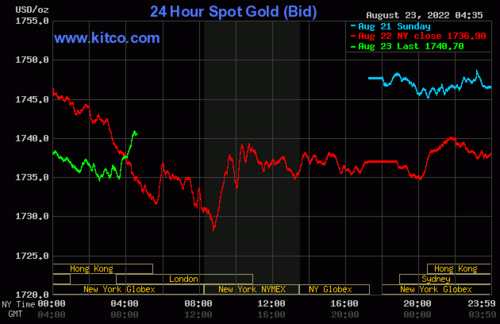
Image Source: Kitco News
September silver futures prices hit a three-week low early on today. The silver bears have the solid overall near-term technical advantage. Silver bulls' next upside price objective is closing prices above solid technical resistance at the August high of $20.87. The next downside price objective for the bears is closing prices below solid support at the July low of $18.01. First resistance is seen at last Friday’s high of $19.48 and then at $20.00. Next support is seen at today’s low of $18.605 and then at $18.25. Wyckoff's Market Rating: 2.0. Read More
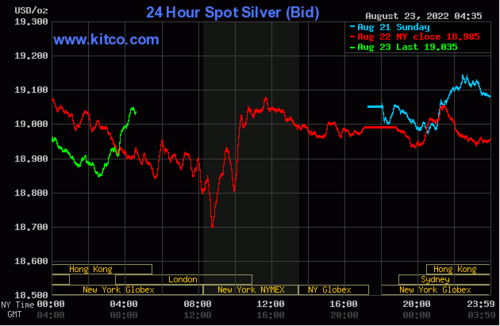
Image Source: Kitco News
Markets are wrong about Fed pivot; Powell will keep raising rates, and a year-long recession will ensue - Danielle DiMartino Booth
Despite a poor performance over the year, stock markets have rallied recently, with the S&P 500 up by 8.8 percent over the last month. This is partly due to expectations that the Fed will pause with its tightening cycle, or pivot and start reducing rates early next year.
Danielle DiMartino Booth, Founder and CEO of Quill Intelligence, said that the markets are wrong, and that Jerome Powell has no intention of easing up on tightening. She also forecasts a prolonged recession.
“Even if the Fed does pause its rate hiking campaign, it will want to continue with quantitative tightening, and not ease anytime soon,” she said. “We’re going to remain in a recession… for at least four quarters.”
She was confident that the Fed would not pivot, adding “I will be the first to say I am wrong if we see a major Powell pivot. And it would be mea culpa and I will be slaughtered on Twitter. And I’m fine with that too.”
DiMartino Booth spoke with Michelle Makori, Editor-in-Chief and Lead Anchor at Kitco News. Read More
Commerzbank lowers gold price target to $1,800 and sees potential for higher prices by 2023
The third quarter has been disappointing for many gold investors as the precious metal has been in a sharp downtrend and recently has been unable to hold any gains above $1,800 an ounce.
Although gold has struggled in the face of rising interest rates and surging momentum in the U.S. dollar, Carsten Fritsch, precious metals analyst at Commerzbank, said in a report Monday that the price action is doing a lot better than one would expect given the current environment.
Although gold prices have dropped, prices have held initial support at around $1,700 an ounce as the Federal Reserve embarked on an extraordinary tightening cycle. So far this year, the U.S. central bank has raised interest rates by 2.25%, driving real yields higher and boosting the U.S. dollar to a 20-year high.
"Despite all the complaining about the disappointing gold price development in recent months from an investor's point of view, it should not be forgotten that gold is still the best performer this year compared to other asset classes," Fritsch said in the report.
"Gold is currently trading 4.5% below the level at the beginning of the year. In the case of U.S. bonds, the corresponding loss amounts to 9.5% due to the sharp rise in yields, if the T-Note future is used as a reference. The equity markets have lost around 14% since the beginning of the year as measured by the MSCI World, the bitcoin price even more than 50%," Fritsch added. Read More
Is 'something worse' than a recession coming? Jamie Dimon issues warning as JPMorgan sees Fed's last big rate hike in September
With all eyes set on Federal Reserve Chair Jerome Powell's speech at the Jackson Hole symposium on Friday, JPMorgan expects the next rate increase to be the last big hike of the tightening cycle. JPMorgan CEO Jamie Dimon also warns that "something worse" than a recession could be coming.
The last time the Fed could surprise markets with an oversized rate hike would be at its upcoming September meeting, JPMorgan Chase & Co. strategists said in a note Monday.
"We expect another outsized Fed hike in September, but post that, we would look for the Fed not to surprise the markets on the hawkish side again," they wrote strategists.
The end of the aggressive tightening pace could help risk-on assets recover during the second half of the year.
In the meantime, Dimon shared his outlook on the economy in a client call earlier in August. And it was quite uncertain.
"What is out there? There are storm clouds. Rates, QT, oil, Ukraine, war, China. If I had to put odds: soft landing 10%. Harder landing, mild recession, 20%, 30%. Harder recession, 20%, 30%. And maybe something worse at 20% to 30%," Dimon explained. "It is a bad mistake to say 'here is my single point forecast.'"
Goldman Sachs also shared its take on the impact of global monetary policy tightening in a note Monday, stating that major economies won't experience recessions over the next 12 months.
"Their resilience supports our forecast that no major economy will enter a monetary policy-driven recession over the next year," economists led by Jan Hatzius wrote in the note. "Coupled with the persistence in inflation and its drivers, this resilience suggests some upside risk to terminal rates among the later hikers relative to current market pricing." Read More
A strong dollar causes gold to drop and fill a gap in the continuous futures chart
A lot has changed in how gold trades on the futures market. Gold futures used to open and close daily leaving a time when you could not place trades at the market, similar to the way stocks trade today.
Gold now trades around-the-clock 24 hours a day, five days a week. Gold futures only close one time a week. It closes on Friday at 6 o’clock in New York and reopens on Monday morning at 9 o’clock in Australia. This means that there can be a price gap or void between Friday’s close and the opening on Monday in Australia. Gaps can also occur when trading closes on a holiday.
Lastly, another way a price gap or void can be created in gold futures is in a continuous futures contract. This can occur when the most active contract month expires and a new month becomes the most active. Many market technicians believe that typically a gap will be filled, and although this does not always occur it is something that market technicians look for when a gap appears.

Image Source: Kitco News
The chart above is a continuous futures contract of gold. On July 29 the most active August 2022 contract expired and the new most active contract month became December 2022. This created a price gap as gold futures closed at $1750 on July 28 and opened at $1773 the following day. Read More
Gold's disappointing price action is a sign that metal is anticipating enduring deflation - Bloomberg Intelligence
After falling 3% last week, gold was trading near three-week lows Monday as the strong U.S. dollar continued to pressure the metal. But there could also be another reason for gold's poor price performance, according to Bloomberg Intelligence.
Year-to-date, gold is down 4.3% despite massive inflation concerns, which are still top of mind for central banks worldwide. And one potential explanation could be that the gold market has been looking for deflationary forces to win out in the long term.
"Gold's poor performance despite the greatest inflation in 40 years may show that the metal, considered a store of value, has been anticipating enduring deflation and is resuming its propensity to outperform most commodities," Bloomberg Intelligence senior commodity strategist Mike McGlone said in a note Monday.
McGlone added that gold is still early in its recovery against copper and crude oil, with the outlook for the precious metal looking promising.
"Our analysis with wheat shows the metal's tendency to surpass other commodities," he noted. "The juxtaposition between the ephemeral wheat-price spike in 1H and the store of value, gold, may play out in the metal's favor in 2H, with enduring implications. A key economic gauge for 2H may come from whether the gold vs. Bloomberg Commodity Spot Index ratio will recover from a support zone that has held since 2008."
Gold's two biggest obstacles in the first half of 2022 have been a strong U.S. dollar and an aggressive Federal Reserve. Yet, the result for gold could be a firm price foundation.
"Gold has appreciated vs. crude oil since the financial crisis, and the trend could be drawing fuel from the relatively discounted levels reached in 1H. The gold-to-crude ratio appears similar to the bottom in 2018, and a primary reason: the paradigm shift of North American oil supply exceeding demand," McGlone noted. Read More
.png)
Disclaimer: These articles are provided for informational purposes only. They are not offered or intended to be used as legal, tax, investment, financial, or any other advice.















