x



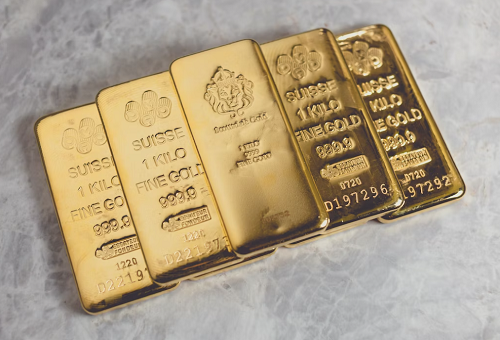
Image Source: Unsplash
Gold Price News: Gold Holds Near $2,000 Even On Good Day for Equities
The strength of underlying support for gold is clearly on show today with the price of the precious metal holding near $2,000 an ounce even on a more positive day for equities markets.
Market confidence remains very fragile as investors try to assess the true health of the banking sector following last month’s collapse of three US banks and UBS’ forced buyout of Credit Suisse. And while the initial contagion was contained, renewed concerns over the long-term future of First Republic Bank have kept gold, with its lack of counterparty risk, in strong demand.
The latest round of earnings sees Meta reporting later today with Amazon and Barclays among those releasing their figures tomorrow and these will help investors determine the current state of the global economy. Read More
Silver Price News: Silver Trades Near $25 as Market Confidence Remains Fragile
Silver is trading just below $25 an ounce as investors assess the latest round of earnings and try to determine the true health of the global economy.
In this environment, silver is working out which of its different hats is most applicable. Its safe haven appeal and lack of counterparty risk can bolster demand at times when market confidence is low, as was certainly the case during last month’s US banking crisis. Yet the metal also has considerable industrial exposure so a healthy global economy is important for physical demand.
Finally, investors need to weigh up how much further the Federal Reserve and other central banks are likely to keep hiking interest rates with the metal’s lack of yield reducing its appeal during times of rising rates. Read More
Gold consolidates but remains on a 'golden cross path' higher - NDR's Tim Hayes
The gold market could continue to consolidate around $2,000 an ounce as the Federal Reserve prepares to raise interest rates one last time and then hold the line until inflation is under control, according to one analyst.
However, even this new holding pattern doesn't dimmish gold's potential. In a recent interview with Kitco News, Tim Hayes, chief global investment strategist at Ned Davis Research, said the trend in gold is clearly higher. He noted that in his Gold Watch report, nine of the 16 indicators he watches are flashing bullish signals.
Hayes' bullish outlook for gold comes as prices continue to trade on either side of $2,000. June gold futures last traded at $2008.20 an ounce, up 0.42% on the day. Hayes explained that the gold market benefits from solid tailwinds as commodity prices remain elevated and bond yields and the U.S. dollar continue to struggle.
"If we see continuing signs of the economy slowing, and the bond market continues to anticipate that the Federal is going to hold interest rates, then yields are going come down and that would help gold break out and regain its momentum," he said. Read More
Gold prices maintained gains around $2,000 an ounce as U.S. durable goods increased 3.2% in March
The gold market continues to hold its ground at around $2,000 an ounce even as economists expect recession fears to start to ease following strong-than-expected manufacturing data.
Wednesday the Commerce Department said that U.S. durable goods orders rose 3.2% last month, following February’s 1.2% decline. The data was stronger than expected; consensus expectations compiled by various news organizations called for durables to increase by 0.7%.
Capital goods orders, the transportation sector, increased by 0.3% in March. The data also beat expectations, as economists were looking for a 0.2% drop.
The gold market is maintaining modest gains in its initial reaction to the latest economic data. June gold futures last traded at $2,008.70 an ounce, up 0.21% on the day. Read More
QE isn't over and will drive gold to $3,000 and Bitcoin to $100,000 in the next decade - Crossborder Capital
Persistently elevated inflation has forced central banks worldwide to tighten their monetary policies by aggressively raising interest rates and reducing the amount of liquidity sloshing around in the marketplace.
Analysts have noted that central bank quantitative tightening has drastically reduced the global money supply, with some economists sounding the alarm that this will lead to a recession and deflation. Some economists note that the global money supply has dropped 6.6% in the last 12 months as of February. This is the most significant contraction in more than 50 years, according to some reports.
Despite the current environment, one research firm said that monetary inflation hasn't disappeared, which will be good for gold, bitcoin and other inflation hedges.
Last week Crossborder Capital said that gold prices could push past $3,000 an ounce and Bitcoin could hit $100,000 in the next decade as central banks will be forced to cover increased government spending.
"We believe that a major upswing in the Global Liquidity cycle is underway," the analysts said in the report. "This will mean a potentially sizeable monetary inflation that will be further fuelled by the need for Central Banks to plug fast-widening holes in government finances. The whopping size of the US (and others') debt burden will force a rapid and permanent return to QE-type policies. As monetary inflation rages, asset prices will be lifted higher, but traditional monetary hedges, like gold, and new ones, such as Bitcoin, may prove the major winners." Read More
Gold weaker as U.S. Treasury yields up-tick
Gold prices are modestly down and silver near steady in midday U.S. dealings Wednesday. The precious metals markets are seeing buying interest limited by a rise in U.S. Treasury yields at mid-week. However, losses in metals are being limited by a weaker U.S. dollar index today. June gold was last down $7.20 at $1,997.30 and May silver was up $0.003 at $24.89.
Traders at mid-week are buzzing about First Republic Bank's quarterly earnings report on Tuesday that was worse than expected, including a huge outflow of deposits. Reports said the bank's conference call on its earnings was very brief, with no questions taken from reporters. That prompted a nearly 50% drop in the bank's share price Tuesday, including trading in the stock being halted for a while. Reports today said the U.S. government is not going to step in and assist the ailing bank.
Technically, June gold futures bulls still have the firm overall near-term technical advantage. However, a six-week-old uptrend on the daily bar chart has stalled out. Bulls' next upside price objective is to produce a close above solid resistance at the April high of $2,063.40. Bears' next near-term downside price objective is pushing futures prices below solid technical support at the April low of $1,965.90. First resistance is seen at today's high of $2,020.20 and then at $2,028.00. First support is seen at last week's low of $1,980.90 and then at $1,965.90. Wyckoff's Market Rating: 7.0.
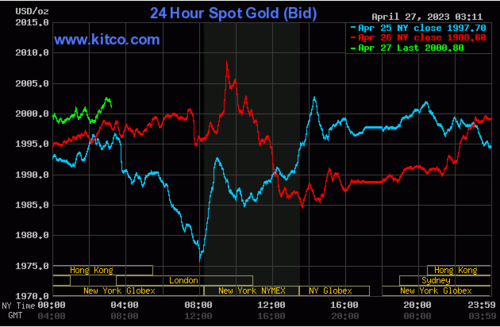
Image Source: Kitco News
May silver futures bulls have the overall near-term technical advantage. However, a six-week-old uptrend on the daily bar chart has been negated, which is one early clue that a market top is in place. Silver bulls' next upside price objective is closing prices above solid technical resistance at the April high of $26.235. The next downside price objective for the bears is closing prices below solid support at $23.00. First resistance is seen at this week's high of $25.435 and then at $25.71. Next support is seen at this week's low of $24.53 and then at $24.25. Wyckoff's Market Rating: 7.0. Read More
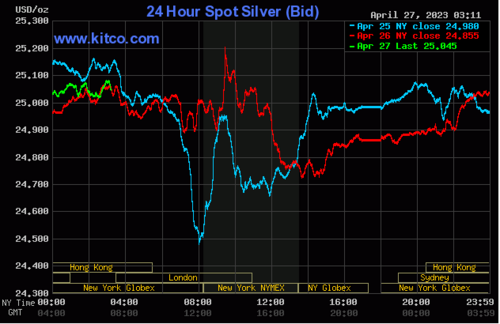
Image Source: Kitco News
Gold needs only a slight increase in investor purchases to justify $2,500 price tag, says BofA
With central banks continuing to buy gold, the de-dollarization trend accelerating, and the Federal Reserve stopping rate hikes, gold doesn't require a lot of new investor buying to justify a run to $2,500 this year, according to BofA.
"Bottom line: non-commercial purchases do not need to increase materially to justify gold hitting $2,500/oz this year. Inflows into ETFs will be critical and dynamics in assets under management will be a crucial indicator confirming whether price gains can be sustained," BofA commodity strategist said in a note Tuesday.
BofA sees the Fed's hiking cycle ending soon despite elevated inflation, which suggests that real rates may become less of a headwind for gold, the note described.
"Influenced by the recent banking turmoil, markets are pricing imminent rate cuts. At the same time, core inflation has been sticky and elevated price pressures, for example in shelter, highlight the risk of second round effects," the note said. "This confirms our long-held view: central banks have no silver bullet for fighting inflation and this should ultimately bring investors back to the market. The end of the hiking cycle will be critical for the yellow metal."
In the meantime, central bank gold buying has remained persistent. And on top of last year's record amounts of gold bought, the de-dollarization trend accelerates gold price growth. Read More
The next two days will reveal the latest data on inflation and the economy
Over the next two days market participants, analysts, and members of the Federal Reserve will get the latest information on the state of our economy and the current level of inflation. At 8:30 AM EST, the BEA (U.S. Bureau of Economic Analysis) will release the advanced estimate for the 1st Quarter Gross Domestic Product (GDP). The second estimate which will include preliminary data on corporate profits will not be released until May 25.
The Federal Reserve Bank of Philadelphia released the “First Quarter 2023 Survey of Professional Forecasters” on February 10. The forecasters anticipate higher growth and a stronger labor market in 2023 concluding that, “On an annual-average over annual-average basis, the forecasters expect real GDP to increase 1.3 percent in 2023, up from the projection of 0.7 percent in the survey of three months ago.”
Predictions for tomorrow’s GDP report vary but the latest model provided by the Federal Reserve Bank of Atlanta says that “The GDPNow model estimate for real GDP growth (seasonally adjusted annual rate) in the first quarter of 2023 is 1.1 percent on April 26, down from 2.5 percent on April 18.” This forecast clearly shows a contraction in the estimates from approximately one week ago.
On Friday the BEA will release the latest data on inflation vis-à-vis the PCE price index. Early forecasts expect to see the core PCE increase by 0.3% month over month and An increase of 4.5% year-over-year. Read More
.png)
Disclaimer: These articles are provided for informational purposes only. They are not offered or intended to be used as legal, tax, investment, financial, or any other advice.















