x




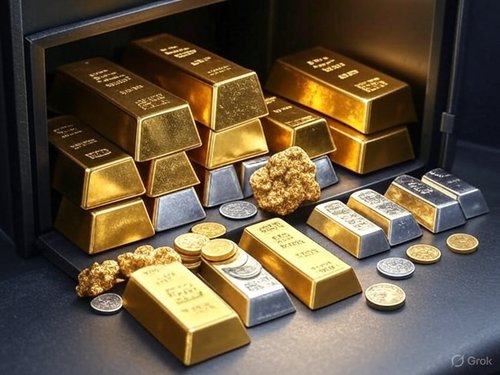
The global gold market is currently experiencing a historic shift, moving away from London as its traditional hub and decentralising into competing geopolitical blocs. According to Josh Phair, the founder and CEO of Scottsdale Mint, the world is "bifurcating," and the free flow of precious metals can no longer be guaranteed. This is leading to a growing belief that London is no longer the top jurisdiction for storing physical bullion. This change is being driven by various factors, including regulatory uncertainty, such as a recent U.S. customs ruling that temporarily threatened a high tariff on Swiss gold bars.
Phair also highlighted the increasing pressure on physical supply, citing new large-scale buyers like India, which is considering allowing its pension system to buy gold ETFs. This Eastern demand for one-kilo bars creates a structural mismatch with the Western market's infrastructure, which primarily uses larger 400-ounce bars. The silver market is facing similar pressures, with a forecasted supply deficit driven by its role as a critical mineral in military, AI, and green energy applications. Phair believes the ultimate crisis for investors may not be a drop in price, but a struggle to secure access to physical metal as the market becomes more controlled and politicised. Source
Macro strategist Stephanie Pomboy believes the market's positive reaction to a potential Federal Reserve rate cut is misguided, calling it a "trap." She argues that the Fed's traditional tools are no longer effective due to high government debt and that a deeper economic slowdown is underway. Pomboy points to corporate tax receipts, which show zero year-on-year growth, as a key indicator that the corporate sector is struggling. She describes the current situation as a "K-shaped" economy where the earnings of a few large companies, like the "Magnificent Seven," mask widespread weakness in the broader market.
Pomboy contends that the average U.S. consumer has been in a recession since the COVID-19 pandemic, citing record-high credit card delinquencies as evidence of their inability to cope with rising prices. She also warns that the nation's massive $37 trillion debt load is pushing the U.S. toward a "Fiscal Dominance" regime, where the central bank's independence is secondary to the Treasury's borrowing needs. Despite her bearish outlook on the broader economy, she remains bullish on precious metals and sees a major opportunity in the energy sector to power the growth of artificial intelligence. Source
President Donald Trump's announcement that he intends to fire Federal Reserve Governor Lisa Cook is a significant escalation of his efforts to influence the central bank's independence. Trump's action, citing allegations of false statements on mortgage applications, has been met with strong condemnation from Democrats. Cook is the first Black woman to serve on the Federal Reserve's Board of Governors, which has seven members who serve 14-year terms. The Federal Reserve Act of 1913 stipulates that a president can only remove a governor "for cause," a provision that is now at the heart of a likely legal battle.
If Trump's removal of Cook is successful, and his nominee Stephen Miran is confirmed to fill a separate vacancy, it would give his appointees a 4-3 majority on the Fed’s Board of Governors. This shift in the board's composition could potentially allow Trump to accelerate changes to monetary policy. The news of Trump's action has been viewed by markets as a move toward lower interest rates, causing gold prices to jump from $3,351 to $3,385 per ounce. Source
Precious metals, including gold, platinum, palladium, and silver, have significantly outperformed major stock market indices this year due to a weaker US dollar and heightened geopolitical tensions. Platinum, in particular, has seen a three-year supply deficit driven by strong demand from China and the US, as well as production shortfalls and sanctions on Russian exports. The future of the rally for these metals depends on the geopolitical climate and the US dollar's performance. While recent diplomatic efforts to reduce global conflicts have not made significant progress, a sudden de-escalation could lead to a correction in safe-haven assets.
The weakening of the US dollar is also a key factor supporting precious metals. This is being influenced by political pressure on the Federal Reserve and the nation's rising debt, which has exceeded $37 trillion. The recently passed "big, beautiful bill" could add trillions more to the national debt, making a stronger dollar unlikely. However, precious metals are not immune to a market-wide sell-off in times of panic, and a slowdown in global business could reduce industrial demand for metals like platinum and palladium. The upcoming July PCE report is a critical event that could either extend the metals' gains or trigger a correction if the data exceeds expectations. Source
Financial analyst Lynette Zang warns that the recently signed "Genius Act" is a deliberate plan to trigger hyperinflation as part of a global financial reset. She argues that the act, which regulates stablecoins, will cause a deflationary shock by draining money from the commercial banking system as people exchange bank deposits for stablecoins. The government would then be forced to print money to fight this deflation, leading to hyperinflation. Zang also suggests that official economic data, such as U.S. jobs numbers and rising consumer delinquencies, is being intentionally obscured to mislead the public.
Zang's concerns extend to the U.S. Treasury market, which she claims is weakening as foreign buyers of U.S. debt are "evaporating." She also points to the banking system's massive exposure to derivatives, which she believes could trigger a financial crisis that would make 2008 seem insignificant. In this environment, Zang states that the only safe haven is physical precious metals, dismissing the official "paper price" of gold as a "joke." She is "a hundred percent" certain that governments will attempt a "globally coordinated" confiscation of gold during the next major crisis. Source
India's Pension Fund Regulatory and Development Authority is considering a proposal to remove the 5% cap on pension funds investing in alternative assets, including gold-backed exchange-traded funds, real estate investment trusts, and infrastructure trusts. This move comes after retirement fund managers, who collectively oversee around $177 billion, requested the change to boost returns on the nation's growing pool of retirement savings. The regulator is currently reviewing the proposal and has even sent a draft of the new language to the funds for their feedback.
The potential removal of the investment limit could significantly impact India's gold investment sector. In 2025, some of the country's largest gold ETFs have already seen price increases of nearly 30%, which has made gold an attractive option for pension investments. Indian gold ETFs recorded net inflows for the third consecutive month in July, and their cumulative assets under management saw a 96% year-over-year increase. The steady growth in new investor accounts also highlights a rising interest in gold ETFs. Source
Gold prices have slightly increased, reversing earlier losses due to mild safe-haven demand. This comes amid concerns over the Federal Reserve’s independence following criticism from the President towards the Fed Chairman and the firing of a Fed governor. The gold market is also anticipating potential volatility from a number of upcoming events, including the quarterly earnings report from Nvidia, the world's most valuable company.
In addition to Nvidia's report, market watchers are also awaiting the release of U.S. personal income and expenditures data, which includes key inflation readings closely monitored by the Federal Reserve. Technically, both gold and silver futures are showing a near-term advantage for bulls. The price objectives for December gold futures are a close above $3,500.00 for bulls and a push below $3,319.20 for bears, while for September silver futures, the objectives are a close above $39.91 for bulls and a close below $36.28 for bears. Source
A report from CME Group highlights that China and India were responsible for over half of the world's consumer gold demand in the previous year, with their significant appetite for physical gold now driving rapid growth in Asia's derivatives markets. Gold has experienced a strong bull run recently, with prices increasing considerably in 2023 and 2024 and continuing to perform well in 2025 due to its safe-haven appeal. This strong cultural and investment demand for physical gold in Asian nations is increasingly reflected in the region's derivatives trading activity.
The report notes a significant surge in liquidity for COMEX Gold futures during Asian trading hours, which now accounts for over a third of the total trading volume. This trend is even more pronounced in Micro Gold futures, a smaller contract size that has seen a dramatic increase in daily volume, with Asian hours activity making up a larger share of global trading. The increased trading activity indicates a growing interest in derivatives for price risk management. The article concludes that gold prices are expected to remain a key focus for investors due to ongoing economic, geopolitical, and monetary policy uncertainties. Source

Image Source: Kitco News
Gold prices strengthened on Wednesday, hitting a two-week high as investors adopted a cautious stance ahead of important inflation data and amid political tensions. The article notes that President Trump's attempt to remove a Federal Reserve governor has raised questions about central bank independence, which could prompt investors to seek out assets like gold that are insulated from political interference. This political uncertainty, combined with upcoming economic reports, is creating a favorable environment for gold.
Schroders Investment Management has reaffirmed its bullish outlook on gold, shifting to a neutral position on equities due to concerns that investors are underestimating risks. The firm's analysis points to rising inflation and a diminishing confidence in the U.S. dollar as key drivers for gold's appeal. The ability of gold to break through the $3,400 resistance level could signal the start of a more significant rally, especially if the upcoming PCE inflation report confirms persistent price pressures. Source
Despite silver's difficulty in maintaining a price above $40 an ounce, Amplify ETFs' Nate Miller believes the precious metal has significant momentum that could push it back to its 2011 record highs. Miller attributes this to strong investment demand and silver's dual role as both an industrial and monetary metal. The global green energy transition is a key driver, as silver is a critical component in solar panels, with the solar sector's demand for the metal projected to reach a record 140 million ounces this year.
Miller also points to growing economic uncertainty and global trade conflicts, which are increasing inflationary pressures and renewing investor interest in silver as a way to preserve purchasing power. He highlights a key technical factor, the gold-to-silver ratio, which remains elevated compared to its historical average. Miller suggests that if the ratio were to normalize, silver would need to be priced at around $50 to $52 an ounce to match the current price of gold. Amplify has also launched a new covered call ETF for junior silver miners to provide investors with a yield on a traditionally non-yielding asset. Source
A new report from Metals Focus, commissioned by the Silver Institute, examines the volatile nature of physical silver investment, which is a key and dynamic part of global silver demand. The report, "Key Physical Silver Investment Markets," focuses on the four leading markets: the United States, India, Germany, and Australia, which collectively account for nearly 80% of the world's demand for silver bars and coins. Rising geopolitical tensions, increasing government debt, and a perception that silver is undervalued compared to gold have contributed to a significant price increase this year, with silver outperforming both gold and Bitcoin.
The analysis provides insights into each of the four major markets. The United States is currently the largest market, though India is projected to take the top spot in 2025. U.S. investors have purchased a combined 1.5 billion ounces since 2010 and tend to hold on to their investments for the long term. In India, silver ownership is a cultural tradition, and demand, primarily for bars, has been consistently high, with a surprising reluctance to liquidate holdings despite higher prices. Germany has been the third-largest market, but demand has been volatile, peaking during the COVID-19 pandemic and Russia's invasion of Ukraine before a decline following a change in tax law. Australia has emerged as the fourth-largest market, driven by its favorable tax structure and the growing popularity of investing in silver through retirement accounts. Source
According to a monthly market report from Schroders, the investment firm holds a bullish outlook on gold, seeing it as an important diversifier in the current economic landscape. The firm notes that while gold is already up significantly this year, it still has room to run as investors lose confidence in the U.S. dollar and as inflation risks increase. Schroders analysts have shifted to a neutral stance on equities, believing that market participants are underpricing risks related to inflation and economic growth. They consider gold a form of portfolio insurance amidst policy volatility, fiscal fragility, and uncertainty about the long-term role of U.S. government bonds and the dollar.
Jim Luke, a metals fund manager at Schroders, points out that despite gold's impressive year-to-date performance, investment demand still has room to grow, particularly in Western markets like North America and Europe. He highlights a significant contrast between Eastern and Western buying, with ETF flows in the U.S. and Europe being muted compared to past cycles, while a large portion of global ETF growth has come from Asia, particularly China. Luke believes that a truly global bid for gold, which he expects to emerge, is not yet present, suggesting that there is still considerable upside potential for gold prices. Source
Disclaimer: These articles are provided for informational purposes only. They are not offered or intended to be used as legal, tax, investment, financial, or any other advice.
Featured Image generated with Grok















