x




Goldman Sachs Research suggests that investors should use commodities, particularly gold, to diversify and protect their stock and bond portfolios against unpredictable financial market risks like stagnant growth and elevated inflation. These risks are especially potent when global policy uncertainty is high or when the economy is hit by a supply shock, such as a sudden interruption in energy supplies. For instance, gold prices historically surged in the 1970s due to increased US government spending and a loss of central bank credibility, stoking inflation. Furthermore, commodities were one of the few assets that achieved positive real returns when both stocks and bonds delivered negative real returns over any 12-month period.
Commodities are also seen as a crucial hedge against trade volatility because their supplies are becoming increasingly concentrated, allowing countries to use control over resources as geopolitical leverage. The report outlines a four-step cycle where governments initially insulate supply chains and stockpile commodities, eventually leading to surplus and export, followed by price drops, supply concentration, and finally, dominant producers using supply as leverage, which increases disruption risk and restarts the cycle. Examples of this concentration include the US being a major supplier of LNG and China controlling over 90% of rare earth mineral refining capacity. However, the report cautions that not all commodities are equally effective as hedges; investors must consider the commodity's weight in the inflation basket and the share of supply being disrupted to determine its hedging effectiveness, with energy and highly concentrated industrial metals and rare earths being notable examples. Source
Gold prices are nearing a new resistance level of $3,800 an ounce, driven by a strong bullish rally and solid underlying fundamentals, despite the market appearing technically overstretched. Analysts largely agree that the metal has the momentum to surpass this level, fuelled by the expectation that the Federal Reserve will continue its path of easing monetary policy, given that core inflation, as measured by the preferred PCE index, remains manageable despite being above the Fed's target. Key drivers supporting gold include consistent central bank purchases, which are expected to continue due to concerns over US debt and persistent inflation, as well as speculative buying and geopolitical uncertainty. The market is pricing in a high probability of further interest rate cuts by the end of the year, which lowers the opportunity cost of holding non-yielding gold, with some analysts projecting end-of-2025 targets at $3,800.
While the fundamental outlook remains strong for gold to cross the $3,800 threshold, some analysts suggest the market may need a new catalyst, specifically weaker-than-expected US labor market data, to provide the necessary spark for a quick surge. A disappointing US labor report would solidify expectations for faster Federal Reserve rate cuts, which would directly support higher gold prices and outweigh potential short-term headwinds. However, other analysts caution that despite the strong bullish sentiment, the metal's overbought status could lead to a period of consolidation or a moderate correction before it can build enough momentum for a decisive breakout to new record highs, particularly if the Federal Reserve is perceived as being in a tough spot regarding its independence and the strength of the US economy. Source
Gold concluded another strong week, trading at approximately $3,765 per ounce for a weekly gain of over 3%, despite facing numerous headwinds and generally positive economic data, which typically work against the precious metal. The metal’s resilience and ability to rally even when the news flow was unfavourable have led many analysts to view its momentum as nearly unstoppable, suggesting that factors beyond immediate US economic data—such as central bank buying, geopolitical tensions, a weaker US dollar, and the ongoing shift away from the dollar as the prime global reserve asset—are the primary drivers. The latest Kitco News Weekly Gold Survey reflects this extreme optimism, with 84% of Wall Street analysts predicting higher prices for the week ahead, while retail investors, though more cautiously, also grew more bullish with 63% expecting a price rise.
With gold’s price action demonstrating that even hot US economic data cannot halt its rally, the market’s focus next week will shift heavily to employment figures, culminating in the critical Nonfarm Payrolls report on Friday. Analysts suggest that a continuation of recent labor market weakness would further solidify expectations for lower US interest rates and provide a fresh catalyst to propel gold past the $3,800 resistance level. The overall sentiment is firmly bullish, with some analysts seeing a clear path to $4,000, as the market is considered to be in "strong hands" (central banks and long-term investors) who are not looking to sell. However, the metal is technically overbought, leading some to suggest a period of consolidation or a slight correction may be necessary before it can make a sustained break to new highs. Source
Gold is approaching the $3,800 per ounce resistance level, with $4,000 remaining the major long-term target, as investor confidence in the US dollar and other fiat currencies continues to erode. This persistent rally is fuelled by global concerns over rising US debt, which is expected to be further exacerbated by the government continuing to flood the market with Treasuries regardless of the outcome of ongoing funding debates. This dynamic is causing long-term Treasury yields to rise, not as a negative for gold, but as a sign of decreasing faith in the dollar, positioning gold as the last remaining global monetary asset and a critical insurance policy for wealth protection. Evidence of this growing demand includes the world’s largest gold-backed ETF, recording its biggest single-day inflow on record last Friday.
The gold market may be technically overbought, but analysts argue it is not fundamentally overvalued due to relentless central bank demand, particularly from China, which is estimated to be buying significantly more gold than it officially reports. Furthermore, investors who find gold expensive are increasingly diversifying into other precious metals like silver, which has reached consecutive 14-year highs for the past six weeks, trading above $46 an ounce. Analysts suggest that silver’s rally is still in its early stages and could be set for a trajectory similar to palladium’s massive surge between 2016 and 2021, driven by growing industrial demand coupled with dwindling supplies. Source
Gold's recent strength, despite being the worst-performing precious metal this week, is evidenced by its sixth consecutive weekly gain, driven by safe-haven demand amid ongoing geopolitical tensions and steady inflows into bullion-backed ETFs. The metal's appeal is further reinforced by a structural shift among investors who view gold as a refuge as confidence in sovereign bond markets wanes, breaking the traditional inverse relationship with real yields. This rally has been emboldened by global fiscal turmoil and tensions, sparking interest from both retail investors and hedge funds. On a corporate level, Barrick Mining Corp. shares are experiencing their biggest rally in five years due to optimistic projections for its U.S. Fourmile project in Nevada, which could potentially yield up to 750,000 ounces of gold annually. Furthermore, gold producers are currently generating strong free cash flow, which is expected to fuel a new wave of growth-focused mergers and acquisitions, potentially targeting developers next.
However, the article notes several weaknesses and threats to the gold market. Gold withdrawals from the Shanghai Gold Exchange declined in August as weak investment demand, including outflows from Chinese gold ETFs, masked a rebound in jewelry sales. A more significant risk is the potential for a sharp near-term pullback, as parabolic price changes are historically unsustainable; since 1980, when gold's trailing one-month gain exceeded 10%, the average one-week and one-month forward returns have been negative. Additionally, a resolution to major geopolitical conflicts like the Russia-Ukraine war and U.S.-China trade dispute could significantly reduce safe-haven demand. Another bearish factor could be a bubble-driven rally in the U.S. dollar, which could push real interest rates higher and draw capital away from gold. Source
The precious metals market is exhibiting strong bullish trends across gold, silver, and platinum, according to analysts at Heraeus. Gold continues to be imported in significant quantities by China and India, even as prices reach new all-time highs, driven by stocking ahead of the festival and wedding season. Non-monetary gold imports to China exceeded 100 tonnes in August, with substantial inflows from Switzerland. Investor engagement is also high, with COMEX non-commercial net gold futures reaching their highest level since February. Following a recent Federal Reserve rate cut, and with further cuts projected, falling real interest rates due to sticky inflation are expected to continue supporting the gold price rally. The precious metal set a new all-time high of $3,831.45 and was last trading around $3,827.71 per ounce.
The price rallies for silver and platinum are also being fueled by tight supply dynamics. Silver futures surpassed $46, reaching a near 14-year high, supported by the Fed's rate cut and strong industrial demand that has depleted above-ground stocks. LBMA silver inventories have fallen 7.5% year-on-year to multi-year lows, limiting the freely available pool of metal despite significant COMEX stocks. Similarly, the platinum market remains tight, with the price exceeding $1,500/oz to reach a new annual high, despite South African production returning to normal levels. Elevated lease rates and strong price momentum suggest that the price of platinum could push higher in the short term, with spot platinum last trading around $1,593.40 per ounce. Source
Gold is significantly reestablishing its dominance as a protector of purchasing power against major fiat currencies like the U.S. dollar and the euro, with its annual gains against the greenback being its best in nearly 50 years. This purchasing power is starkly illustrated by Incrementum AG's annual gold/beer ratio, which measures the amount of beer one ounce of gold can buy at Munich's Oktoberfest. Despite the cost of a one-liter mug of beer climbing to a record €15.80, one ounce of gold now purchases 186 Maß beer, the third-highest level since 1950, and nearly 26% more than in 2024. The analysts attribute this to strong gold price appreciation, noting that while German food inflation has been high, gold's average annual price increase since 2007 (9.7%) has significantly outpaced the average annual rise in Oktoberfest beer prices (4.0%).
This theme is further underscored by the firm's gold/iPhone ratio, which shows that gold has risen against Apple’s flagship smartphone for the third consecutive year. With the price of gold above $3,800 an ounce, the iPhone 17 Pro Max with 1 TB of storage—priced at $1,599—now costs only 0.46 ounces of gold, making it the cheapest iPhone ever in gold terms. Since 2018, when the iPhone XS cost a hefty 1.13 ounces of gold, the gold cost of the smartphone has dropped by nearly 60% due to the nearly tripling of the gold price. Over the entire history of the iPhone since 2007, gold prices have risen by an average of 9.7% annually, while the iPhone's price has risen by 5.6%, leading to a 50% overall decline in the iPhone's price when measured in gold. Source
The U.S. housing market showed unexpected strength in August as pending home sales—a leading indicator of existing home sales—surprised economists with a 4% rise, significantly surpassing the forecasted 0.3% increase. This positive momentum was largely attributed to lower mortgage rates, which encouraged more buyers to sign contracts, particularly in the Midwest where high affordability boosted interest. Year-over-year, pending home sales were also strong, rising 3.8% against expectations for a 1.9% rise, with increases recorded across all four U.S. regions. This better-than-expected data suggests a potential stabilization for the housing market, which has struggled over the past two years with rising prices and high mortgage rates pricing out many buyers.
Despite the positive economic data from the housing sector, spot gold prices continued to challenge their record high, trading at $3,828.33 per ounce, representing a gain of 1.82% for the day. This reaction suggests that the gold market's underlying drivers—such as geopolitical tensions and expectations of future interest rate cuts—are currently outweighing positive domestic economic indicators. The surge in pending home sales is a crucial data point that economists monitor, as contracts are signed a few months before the actual sale closes. The latest Realtors Confidence Index survey showed a modest increase in the percentage of NAR members expecting higher buyer traffic over the next three months, indicating some optimism for continued recovery in the housing sector. Source
The global gold mining sector was rocked by a major, coincident shakeup as the CEOs of the world’s two largest gold producers, Barrick Mining and Newmont, announced their departures on the same day. Mark Bristow, President and CEO of Barrick, resigned abruptly and effective immediately, with the company giving no reason for the departure. Bristow had led Barrick since its 2019 merger with Randgold, during which time the company returned $6.7 billion to shareholders and significantly reduced its net debt. However, his departure comes amidst a significant and escalating dispute with the Malian government over new mining policies that resulted in a $1 billion impairment charge for Barrick’s stake in its Loulo-Gounkoto mine, a historically important operation that was recently placed under state control. Mark Hill has been appointed as Group COO and Interim President and CEO.
In contrast, the departure of Tom Palmer, Newmont’s CEO since 2019, was announced as a more orderly transition, with his resignation from the Board and as CEO set for December 31, 2025. Palmer will be succeeded by Natascha Viljoen, who will become Newmont’s first female chief executive. Viljoen joined Newmont in 2023 as EVP and COO, bringing extensive global experience, including having previously served as CEO of Anglo American Platinum. This simultaneous change in leadership at the two industry giants is generating significant speculation across the marketplace regarding the future direction of the gold sector. Source
Gold and silver prices experienced solid gains near midday on Monday, driven primarily by safe-haven demand amidst the looming possibility of a U.S. federal government shutdown later in the week. Gold reached a new record high, with December futures up $47.00 to $3,855.80, while December silver hit a 14-year high, up $0.434 to $47.09. The uncertainty surrounding the government funding deadline, where top congressional leaders and President Trump were set to discuss a short-term spending bill, put pressure on the U.S. dollar, further contributing to the appeal of precious metals. The potential shutdown was complicated by disputes over healthcare subsidies and budget cuts, with the President threatening unprecedented permanent dismissals of unfunded federal workers if a shutdown occurred.
Technically, both December gold and silver futures bulls hold a strong near-term advantage, with Wyckoff's Market Rating at $9.5 for both. Gold bulls are targeting a close above $4,000.00 resistance, with initial resistance seen at $3,875.00, while bears aim for a close below $3,700.00 support. Similarly, silver bulls are focused on closing prices above the key technical resistance level of $50.00, with initial resistance at $47.50, and bears looking to push prices below the solid support at $44.00. These technical indicators underscore the current strong momentum in the precious metals market. Source
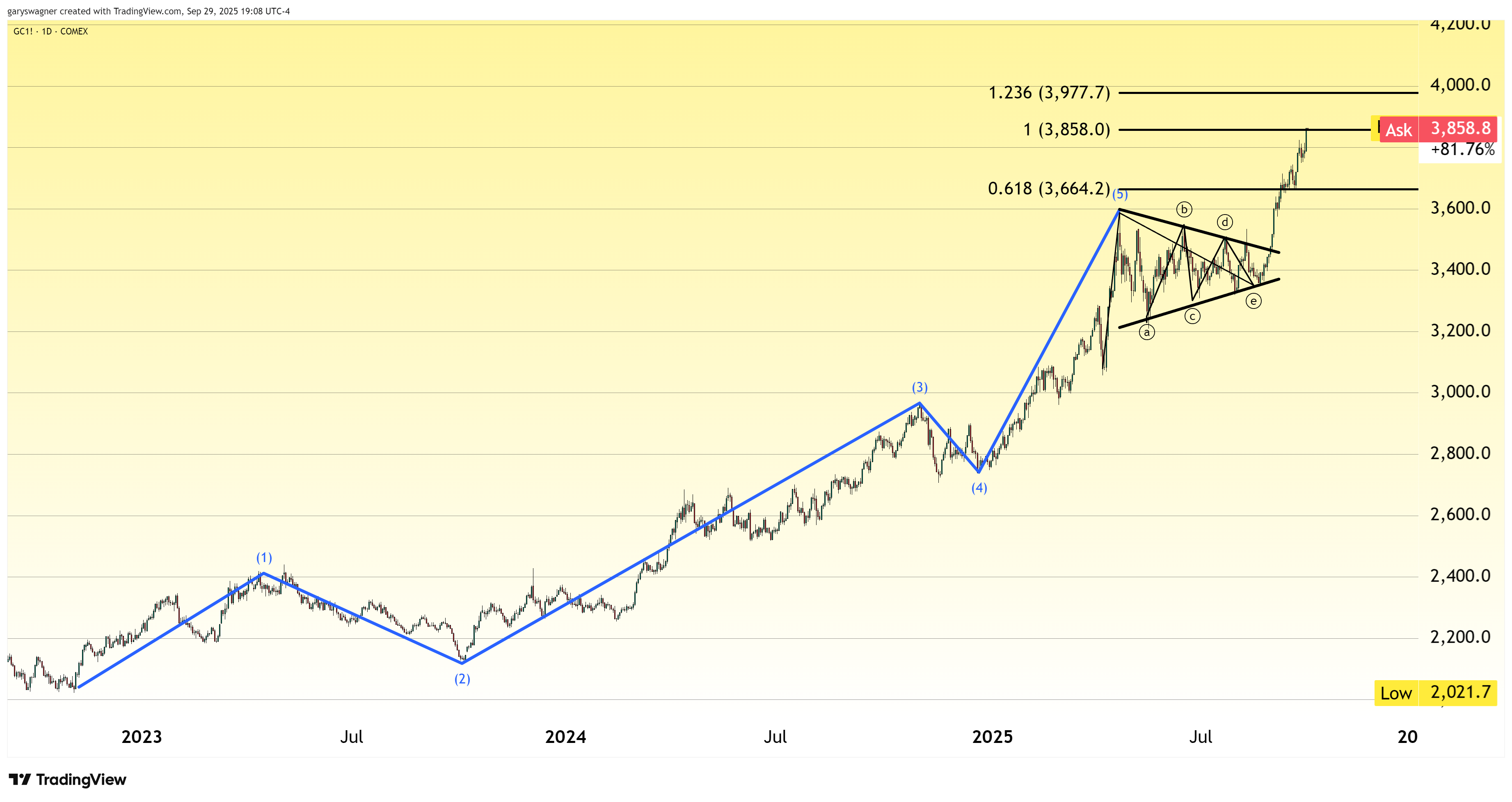
Image Source: Kitco News
Gold achieved a significant milestone today, reaching a fresh intraday and closing all-time high, driven by a combination of strong market factors. The price surge, which saw the December 2025 futures contract climb over seventy dollars to settle above the $3,800 mark at $3,862.90 per troy ounce, extends an extraordinary year-to-date rally with gains exceeding 45%. This impressive performance is the strongest annual showing for the precious metal since 1979, when high inflation fueled a similar ascent. Investors are flocking to gold's traditional safe-haven status due to immediate concerns over a potential U.S. government shutdown, which is scheduled for October 1 without budget legislation, prompting a hedge against possible economic instability.
A substantial contributor to the rally is the pronounced weakness in the U.S. dollar, which has depreciated approximately 11% since January, making dollar-denominated gold more affordable for international purchasers. Furthermore, market expectations of additional interest rate cuts from the Federal Reserve before the year's end are boosting gold's appeal, as lower rates decrease the opportunity cost associated with holding non-yielding assets. Underlying support for the sustained high price is also provided by persistent geopolitical uncertainty and the continuous, robust gold purchasing programs maintained by central banks globally. Source
In this week’s Live from the Vault, Andrew Maguire and Robert Kientz examine structural pressures within a financial system and the move from Western paper markets to Eastern physical demand, signalling a generational shift in wealth preservation.
The two precious metals experts also discuss the awakening of US retail investors and the rise of grassroots sound money initiatives, demonstrating that personal investment is key to safeguarding financial sovereignty in an era of systemic fragility.
Disclaimer: These articles are provided for informational purposes only. They are not offered or intended to be used as legal, tax, investment, financial, or any other advice.
Featured Image - Source: Unsplash















