x



Citigroup and Morgan Stanley are preparing to establish their own gold vaults in London, aiming to compete with JPMorgan’s dominant role in the city’s precious metals market. With gold prices soaring and investor demand increasing, the two U.S. banks are positioning themselves to offer vaulting and clearing services in what remains the world’s largest gold trading hub. Citigroup is already advanced in setting up a UK-based business that would make it a clearing member of the London market, while Morgan Stanley’s plans are still in early development. Currently, only four banks—JPMorgan, HSBC, UBS, and ICBC Standard Bank—hold clearing member status, alongside the Bank of England, which stores central banks’ bullion.
JPMorgan has long held a commanding share of the market, acting as custodian for the majority of exchange-traded fund gold stored in London. The London Bullion Market Association (LBMA) has welcomed new entrants, signalling that greater participation would make the market stronger and more open. LBMA officials emphasized that expanding the number of clearing members benefits the entire industry, especially as vaulting fees have risen sharply in line with gold’s more than 50 percent price increase since early 2025. Although operating vaults is costly, expectations are high that more clearing members will join the market within the next year. Source
Central banks in South Korea and Madagascar are signalling plans to expand their gold holdings amid expectations that the metal will remain a key part of global reserves despite recent price volatility. At the London Bullion Market Association’s Global Precious Metals Conference, the Bank of Korea revealed it is considering fresh gold purchases for the first time since 2013, citing gold’s importance as an inflation hedge and a long-term alternative to the U.S. dollar. Madagascar’s central bank also announced its goal to increase reserves from one tonne to four tonnes, reflecting a broader trend among developing economies seeking to diversify away from dollar dependence.
Although central bank demand for gold has eased slightly in 2025 following a record run in prices above $4,000 an ounce, total purchases remain historically strong. In the first half of the year, central banks bought around 415 tonnes of gold, compared with nearly 525 tonnes in the same period last year. The World Gold Council’s latest survey shows growing optimism, with nearly half of the world’s central banks planning to add to their holdings and 95% expecting global reserves to rise further. Analysts forecast that official reserves could increase by roughly 900 tonnes this year, helping to support gold prices over the long term even as they fluctuate below recent peaks. Source
Tether Gold (XAU₮), the world’s largest tokenized gold product, has seen explosive growth in 2025 as investors flock to digital assets backed by physical gold. The company reported its market capitalization exceeded $1.44 billion by the end of the third quarter and nearly doubled to $2.1 billion as gold prices surged to record highs above $4,360 an ounce. Tether said the rally was driven by ongoing inflation, geopolitical uncertainty, and rising institutional and central bank demand. Each XAU₮ token is backed by at least one troy ounce of gold, with reserves totalling over 375,000 ounces, illustrating growing investor confidence in blockchain-based representations of tangible assets.
Tether highlighted that its gold-backed tokens offer a bridge between traditional value and digital convenience, reflecting the broader appeal of tokenized real-world assets. CEO Paolo Ardoino emphasized that XAU₮’s success demonstrates how secure, fully backed commodities can thrive on-chain. The surge in Tether Gold’s market cap coincides with record activity in traditional gold investments, as global exchange-traded funds saw inflows of more than 145 tonnes this month and retail participation in gold futures reached record levels. Despite a brief correction in ETF flows, analysts note that demand across both digital and physical gold markets remains robust amid a search for stability in an uncertain economic environment. Source
The Bank of Canada lowered its key overnight interest rate by 25 basis points to 2.25%, marking its second consecutive reduction and the lowest level since mid-2022. Governor Tiff Macklem said the move was aimed at supporting the economy through the challenges created by new U.S. tariffs, while keeping inflation near the 2% target. The bank revised its economic forecasts downward, now expecting growth of 1.2% in 2025 and 1.1% in 2026 before a recovery in 2027. Policymakers indicated that further cuts are unlikely unless the inflation or growth outlook changes significantly, signalling a pause in the easing cycle.
Macklem acknowledged that Canada’s economic weakness reflects not just a cyclical slowdown, but a deeper structural adjustment that limits how much monetary policy can stimulate demand without risking inflation. The economy contracted by 1.6% in the second quarter, with only modest growth expected in the latter half of the year. The bank expects inflation to average around 2% this year and 2.1% in 2026, maintaining its target range of 1% to 3%. Following the announcement, the Canadian dollar strengthened slightly, while financial markets priced out the likelihood of further cuts until at least March next year. Source
Market participants at the 2025 London Bullion Market Association Global Precious Metals Conference expect gold prices to climb close to $5,000 an ounce within the next year, reflecting renewed optimism after the metal’s recent pullback below $4,000. The LBMA survey showed delegates forecasting an average price of $4,980.30, representing a 25% gain from current levels. This outlook marks a major shift from last year’s conservative forecast of around $2,941, as gold prices have risen more than 50% in 2025 — their strongest annual performance since 1979. While gold has been a standout, silver and platinum have posted even larger year-to-date gains of 61% and 93%, respectively, reflecting widespread investor enthusiasm for precious metals amid inflation and geopolitical uncertainty.
The survey also revealed shifting expectations across the metals sector, with 40% of delegates predicting gold will be the top performer through 2026, while 30% see platinum leading and 21% favour silver. Platinum is expected to rise to $1,815.50 an ounce, and silver to $59.10 an ounce, both showing double-digit percentage increases. Analysts attribute gold’s resilience to surging investment demand, particularly from institutional investors and wealth managers. UBS executive Wayne Gordon noted that client gold holdings have doubled this year, with the number of investors tripling as financial institutions repeatedly upgraded their forecasts in response to gold’s relentless rally. Source
The latest report from the National Association of Realtors showed that U.S. pending home sales were unchanged in September, signalling continued weakness in the housing market despite lower mortgage rates and a strong stock market. Economists had expected a 1.6% increase, but contract signings remained flat, down 0.9% compared to last year. The NAR noted that while signings were among the strongest of the year, they still fell short of levels consistent with a healthy market, reflecting the ongoing challenges of high home prices and a softening job environment.
Gold prices showed little reaction to the disappointing data, instead rebounding modestly after falling below $4,000 earlier in the week. Spot gold rose 1.5% to $4,012.10 an ounce, supported by bargain-hunting and investor positioning amid expectations of further monetary easing from the Federal Reserve. Economists continue to watch the housing market as a key signal for broader economic trends, with many anticipating that lower bond yields in the coming months could help ease mortgage costs and stabilize demand. Source
Rising consumer financial stress in the U.S. is adding to concerns about the sustainability of household spending, even as broader economic growth remains positive. The LegalShield Consumer Stress Legal Index climbed to 71.2 in September, its highest level in five years and up more than 26% from post-pandemic lows. The report highlighted a surge in bankruptcy inquiries, which jumped 17.4% in the third quarter alone, suggesting growing strain on household finances. LegalShield’s data shows a widening gap between Wall Street optimism and Main Street hardship, as consumers face mounting debt, persistent inflation, and high borrowing costs despite the Federal Reserve’s recent rate cut.
Analysts warn that if consumer stress continues to rise, it could slow economic activity and weigh on spending heading into the holiday season. LegalShield’s senior vice president Matt Layton described the current environment as a reflection of a “K-shaped” economy, where wealthier households benefit from asset growth while financially vulnerable families struggle with rising costs and limited wage growth. Although the labour market remains relatively stable, recent private-sector job losses and limited credit relief point to potential risks ahead. The growing disconnect between strong financial markets and household distress has supported safe-haven demand for gold, as investors hedge against economic and consumer weakness likely to persist into 2026. Source
Gold and silver prices rebounded in U.S. trading on Wednesday following recent heavy selling that caused significant short-term technical damage. December gold rose $47.70 to $4,030.50 an ounce, while December silver gained $0.87 to $48.20. The recovery was largely attributed to a routine correction and support from expectations of a U.S. interest rate cut. Traders are watching the Federal Reserve’s policy statement and Chair Jerome Powell’s comments for clues on the future direction of monetary policy. The Fed is expected to announce its second consecutive 0.25% rate reduction, as a softening labor market strengthens the case for easing even though inflation remains elevated.
Outside markets showed the U.S. dollar index trading higher, crude oil near $60.50 per barrel, and the 10-year Treasury yield at 3.99%. Analysts noted that the gold and silver markets are also responding to technical factors, with gold facing resistance at $4,100 and support at $3,800, while silver’s key resistance and support levels stand at $50.00 and $45.00, respectively. Despite recent volatility, the broader outlook for both metals remains balanced, with traders awaiting clearer signals from the Fed before establishing new positions. Source
Gold prices have rebounded after an 11% drop in less than two weeks, but Natixis analyst Bernard Dahdah warns that further downside remains possible. In his latest outlook, Dahdah outlined three potential scenarios: gold could fall toward $3,450 if central bank demand cools, to $2,800 if investment demand weakens, or in an extreme case to around $2,000—just above production costs. However, he considers these outcomes unlikely, citing strong long-term demand, particularly from Chinese and jewelry buyers who would likely step in if prices fell below $3,400. Dahdah’s base case sees gold stabilizing around current levels, averaging about $3,800 an ounce through 2026.
Dahdah said the recent rally above $4,000 was likely driven by short covering rather than fundamental strength, and he expects prices to consolidate rather than surge higher. While central bank buying is expected to remain robust, it may slow from the record levels of recent years, with around 900 tonnes of purchases projected in 2025. Despite his neutral outlook, Dahdah sees more upside risk than downside, noting that volatility in bond markets could push investors toward gold, potentially lifting prices by another 10%. With elevated inflation, persistent geopolitical uncertainty, and growing U.S. debt, Natixis expects investment demand to remain the primary force supporting the gold market in the years ahead. Source

Image Source: Kitco News
Gold prices fell after the Federal Reserve’s latest 25 basis point rate cut, as Chairman Jerome Powell’s cautious tone on future policy tempered market optimism for further easing. Although the rate reduction was widely anticipated, Powell indicated that another cut in December was uncertain, sparking a brief selloff in equities and a surprising rally in the U.S. dollar. The dollar’s 0.41% advance, with intraday gains peaking at 0.6%, defied typical market behavior following a rate cut, as traders reassessed the Fed’s commitment to continued accommodation. This unexpected dollar strength weighed on gold, which reversed early gains and closed down 0.67% at $3,941.70 for front-month futures after a volatile session.
Silver, in contrast, displayed resilience amid the broader commodity pullback, rising $0.50 to $47.54 in spot trading. Analysts suggested the white metal benefited from optimism surrounding an upcoming U.S.-China meeting that could boost industrial demand. Silver’s outperformance also points to a potential rebalancing in the gold-silver ratio, as investors reposition for possible convergence between the two metals. While Powell’s remarks have dampened near-term enthusiasm for gold, market participants remain attentive to global diplomatic developments and economic data that could influence the Fed’s policy path and precious metals demand through the end of the year. Source
Gold prices are holding just below $4,000 an ounce following the Federal Reserve’s expected interest rate cut to a range of 3.75% to 4.00%. The Fed maintained its assessment that the U.S. economy is growing at a moderate pace and that inflation remains elevated, while emphasizing a renewed focus on labor market conditions. Despite some initial volatility in response to the Fed’s decision, spot gold stabilized at around $3,987 an ounce, reflecting a modest gain on the day. The Fed also confirmed it has paused reductions to its balance sheet, a move previously signaled by Chair Jerome Powell.
Analysts noted the composition of the Fed’s vote and its relatively dovish tone, with some members advocating for larger cuts while others preferred to hold rates steady. The guidance suggests further rate reductions may occur in December and into early 2026, maintaining a cautious approach toward inflation and employment risks. Market observers highlighted that the Fed’s decision met expectations and underscored a focus on supporting payrolls, signaling a steady approach for financial markets and sustaining positive conditions for risk assets. Source
Gold prices are facing uncertainty as Federal Reserve Chair Jerome Powell signaled that a rate cut in December is not guaranteed, despite a recent 25-basis-point reduction. Markets had been heavily pricing in another cut, but Powell emphasized that policy is not on a predetermined path and that committee members hold differing views on the next steps. Spot gold briefly rose ahead of the press conference but later slipped to $3,941 an ounce, reflecting cautious investor sentiment following the Fed’s guidance. Powell highlighted the limited economic data due to the government shutdown and suggested that slowing the pace of rate cuts could be prudent in such conditions.
Despite the more cautious tone, many analysts continue to anticipate further rate reductions to support the labor market. Falling interest rates combined with elevated inflation may continue to reduce the real cost of holding gold, maintaining its appeal as a non-yielding asset. The market now faces a more nuanced outlook, balancing expectations for potential easing against the Fed’s emphasis on careful, data-dependent policy decisions. Source
Disclaimer: These articles are provided for informational purposes only. They are not offered or intended to be used as legal, tax, investment, financial, or any other advice.
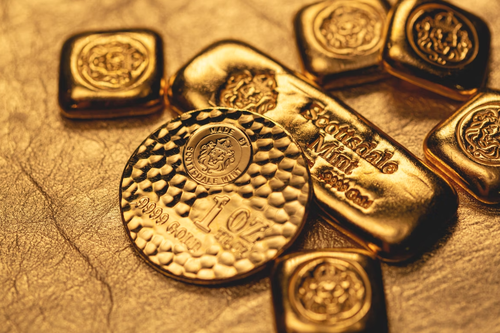
Featured Image - Source: Unsplash















