x




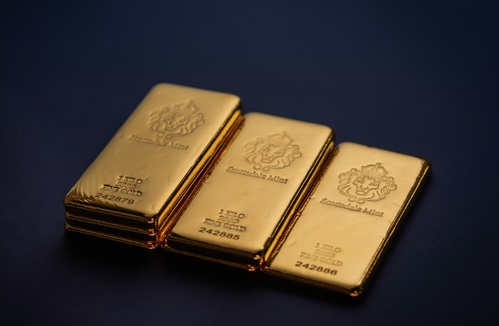
Gold and silver saw sharp declines near midday Monday as traders engaged in heavy profit taking and weak long liquidation after both metals hit new record highs. February gold futures fell from Friday’s peak of 4,584.00 to 4,482.60, down 70.40, while March silver dropped from a record 82.67 to 74.80, down 2.331. These moves are viewed as corrective pullbacks within ongoing uptrends, though continued selling over the next two days could signal more serious chart damage and potential short-term tops. A strong rebound, however, could confirm today’s lows as reaction points within the broader upward trend.
Outside markets showed a slightly stronger US dollar index, crude oil trading around 59.25 per barrel, and a 10-year US Treasury yield at 4.118 percent. Technical levels remain key, with gold bulls aiming to close above 4,584.00 and bears targeting support near 4,200.00, while silver traders watch resistance at 82.67 and downside support at 67.50. Both metals hold a Wyckoff Market Rating of 7.5, indicating bulls still have a firm technical advantage despite the sharp drop. Source
JP Morgan expects gold prices to climb to 5,055 per ounce by the final quarter of 2026, driven by strong demand from ETFs, central banks, Chinese insurers and the crypto sector, following record highs above 4,000 in 2025. The bank highlights that weakening US interest rates, a softer dollar and geopolitical uncertainty are sustaining gold’s appeal as both a hedge and a competitor to Treasuries. Investor and central bank demand reached around 980 tonnes in the third quarter of 2025, translating to approximately 109 billion dollars at average prices, and JP Morgan forecasts an average of 585 tonnes of quarterly demand in 2026. They note that every 100 tonnes above 350 tonnes per quarter could drive a 2 percent quarter-over-quarter price increase, reinforcing their bullish outlook.
Central banks remain a key pillar of the market, with 2026 purchases expected to stay strong at around 755 tonnes, despite being lower than recent peaks. IMF data shows central banks now hold nearly 20 percent of reserves in gold, up from 15 percent a year earlier, and further diversification could add hundreds of billions of dollars in buying even at higher price levels. Investor allocations are also rising, projected to include 250 tonnes of ETF inflows and more than 1,200 tonnes in bar and coin demand in 2026, with gold holdings currently representing 2.8 percent of global assets under management and seen potentially rising to 4–5 percent. With mine supply struggling to keep up and new demand possibly emerging from Chinese insurance companies and crypto participants, JP Morgan sees risk skewed toward faster price gains and believes a move toward 6,000 is possible under stronger diversification flows. Source
China bought a record 961 million dollars in Russian gold in November 2025, following 930 million dollars in October, marking the largest bilateral gold trade on record and driving total imports to 1.9 billion dollars for the year so far, almost nine times last year’s level. This surge reflects Beijing’s push to boost gold reserves and reduce dollar reliance, with analysts suggesting the true scale may be far higher; Société Générale estimates China’s actual acquisition since mid-2022 could exceed 1,080 tonnes based on discrepancies in global bullion flows. Officials continue reporting purchases despite high prices, a move seen as a signal to citizens that buying gold is prudent amid rising geopolitical tension and a climate of fear and mistrust.
Russia, meanwhile, is being forced to sell sovereign gold domestically for the first time to support the ruble and plug financial gaps as reserves shrink due to sanctions and falling liquid assets, with up to 230 tonnes expected to be sold in 2025 and 115 tonnes in 2026. This strategy offers short-term budget relief but risks deepening reserve depletion and increasing financial vulnerability, highlighting how sanctions have squeezed Moscow’s fiscal options. Broader central bank activity reflects the shifting global landscape, with emerging markets buying gold to diversify as the G7 debates seizing frozen Russian assets, underscoring gold’s renewed importance as a strategic financial asset amid instability. Source
Charlie Morris of ByteTree expects gold’s bull run to extend into 2026, supported by long-term inflation risks and declining momentum in overheated sectors like AI, tech and crypto. He argues that persistent deficits and money entering the real economy will eventually trigger sustained inflation, reinforcing demand for gold. Morris maintains that gold and Bitcoin are uncorrelated reserve assets in different domains, with gold tied to real-world financial dynamics and Bitcoin tied to the digital economy. He believes they will continue to alternate leadership in performance, but both remain underowned by mainstream investors and large wealth managers, which leaves room for substantial growth as allocations rise.
Silver could also outperform in the near term as capital rotates out of crypto, with Morris suggesting that if gold reached 7,000 and the gold-silver ratio narrowed to 40, silver could climb toward 175. However, he views silver more as a tactical trade compared to long-term holdings in gold and Bitcoin. Despite record prices, Morris sees little evidence of mania in precious metals, citing muted ETF inflows and scepticism among the public and institutions. He believes broader recognition of gold’s role has yet to arrive, and that without major improvements in global fiscal discipline and governance, both gold and Bitcoin retain strong long-term cases rooted in economic instability and distrust in financial systems. Source
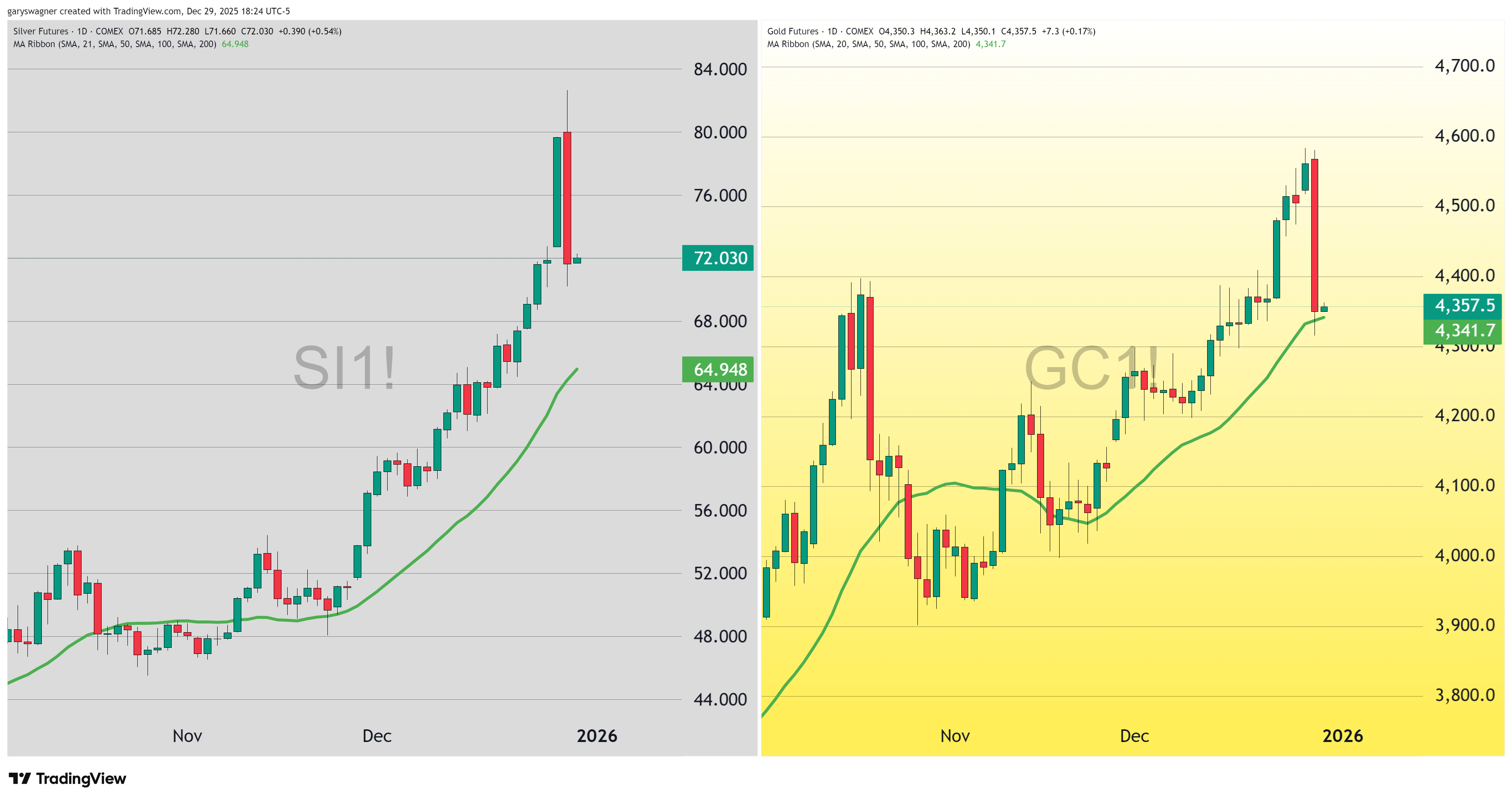
Image Source: Kitco News
Gold and silver pulled back sharply after reaching record highs, with investors locking in profits following their strongest annual run in decades. Gold peaked at $4,550, up more than 70% year-to-date, before closing with a 65% annual gain after dropping about $200 or 4.43%. Silver saw a steeper correction, falling 9% in spot trading and 8.7% in futures, a move intensified by the Chicago Mercantile Exchange raising overnight margin requirements to $25,000 for the second time this month, which forced leveraged traders to liquidate positions.
Other precious metals followed the trend, as platinum and palladium plunged 14.92% and 17.71% respectively after earlier multi-year highs. Despite the sell-off, silver remains 2025’s top performer with nearly 150% gains, just ahead of platinum’s 135%. Geopolitical signals also influenced the downturn, with tentative optimism around U.S.-Ukraine peace discussions offset by renewed tensions after Russia’s response to a drone incident. These crosscurrents, combined with technical pressures and elevated valuations, contributed to a volatile session and broad pullback across the metals complex. Source
The US economy is expected to remain resilient in 2026 thanks to AI-driven productivity, but falling interest rates, fiscal imbalances, political risks at the Federal Reserve and accelerating global de-dollarization are projected to limit dollar strength. Forecasts see the dollar index ranging between 98 and 102, with rate cuts already pressuring the currency after a 9 percent decline this year. Analysts argue that even with solid growth, deficits prevent higher rates, inflation risks could push real yields lower and uncertainty around Fed leadership under a potential Trump appointment could further undermine credibility. These factors have boosted gold and silver, with both posting huge gains as investors seek alternatives to the dollar.
De-dollarization trends and geopolitical shifts are adding to the headwinds, with central banks diversifying into gold at a pace of 750 to 900 tonnes annually and investors raising hedge ratios against US assets. A global push away from the dollar has accelerated since sanctions on Russia, expansion of trade tariffs and concerns about US political polarization and fiscal excess. Major institutions like TD Securities and RBC see the dollar losing clout as a safe haven even if the US retains economic momentum, while analysts warn the dollar’s premium may fade as other countries seek alternatives. Precious metals continue to benefit from this shift, reinforcing expectations that gold demand will stay elevated as central banks and private investors reduce reliance on the greenback. Source
Goldman Sachs positions gold as the strongest commodity for 2026, driven by steady global GDP growth, expected Federal Reserve rate cuts, and intensifying geopolitical dynamics between the US and China. They argue commodities will stay central to geopolitical and AI competition, while two ongoing energy supply waves shape the broader market. Central banks are expected to continue buying around 70 tonnes monthly, four times higher than pre-2022 averages, due to heightened geopolitical risk awareness, low existing reserve allocations in major emerging markets, and strong survey signals of future buying. This sustained demand is seen as a major contributor to price appreciation.
They also see potential for private investors to amplify gains if even a small share of US portfolios shifts into gold, estimating that each 1 basis point increase could lift prices by 1.4 percent. With gold ETFs currently underrepresented in US portfolios, this could fuel competition for bullion between investors and central banks. Goldman Sachs stresses that commodities offer portfolio insurance in a world of concentrated supply chains and geopolitical risk, making equity-bond portfolios less resilient. Their price path projections suggest a dip to the low $4,200 range in early 2026 before climbing to a record near $4,630 in Q3 and hitting $4,900 by year-end. Source
Silver surged roughly 170% in 2025, climbing from around $29.50 to nearly $80 per ounce after a volatile year marked by trade tariff shocks, supply disruptions, and accelerating investment demand. Retail sentiment now leans bullish, with 57% of surveyed investors expecting prices to exceed $100 in 2026 and another 27% forecasting between $80 and $100. Supporters point to ongoing supply shortages, especially in China where industrial consumption for solar manufacturing is heavy, and investment flows into ETFs that have absorbed over 100 million ounces. Some experts argue that silver remains undervalued relative to gold, with potential for the gold/silver ratio to fall toward historical lows, implying room for higher prices as industrial demand from sectors like AI infrastructure and renewable energy continues to grow.
However, major banks and analysts urge caution. Heraeus and TD Securities warn that price momentum may fade as the market digests an oversupply in LBMA inventories and demand softens at elevated price levels, potentially pulling silver into a consolidation phase or back toward the mid $40 range. BMO Capital Markets expects an average around $56 for 2026, peaking near $60 in Q4, while some technical analysts foresee the end of the current long-term cycle with the risk of a multi-year correction beginning in 2026. Even bullish forecasters acknowledge the bull run is mature and vulnerable to a bust before another boom phase eventually emerges. Source
Pending home sales in the U.S. surged 3.3% in November, beating expectations for a 1% gain and marking the strongest performance since early 2023. All four regions saw month-over-month growth, and sales rose 2.6% for the year after economists had predicted a decline. The National Association of Realtors attributed the improvement to easing mortgage rates, wage growth outpacing home prices, and greater inventory availability, which is encouraging more buyers back into the market. Confidence surveys also showed rising expectations for both buyer and seller traffic over the next three months compared to October.
The stronger housing data pressured gold prices intraday, with spot gold trading near session lows at $4,335.14 per ounce, down 4.37% on the day. The surprisingly positive housing momentum has economists watching to see if improving affordability and stabilizing demand can sustain a broader recovery in existing home sales, as pending sales typically lead finalized transactions by several months. The housing market is still emerging from two years of weakness driven by high borrowing costs and elevated home prices, but November’s data suggests that conditions may be turning a corner. Source
UBS has raised its gold price forecast to $5,000 per ounce by September 2026, citing rising demand fueled by low real yields, global economic uncertainty, and mounting political and fiscal risks in the United States. The bank believes U.S. midterm election volatility and deteriorating fiscal conditions could lift prices even higher to $5,400 under an upside scenario, while their base case projects a retreat to $4,800 by year-end 2026, still well above previous estimates. UBS attributes the bullish outlook to expected Federal Reserve rate cuts, lower bond yields, and renewed central bank and investor interest through ETFs, coins, bars, and jewelry.
The bank notes that central banks have already purchased 634 metric tons of gold this year, with full-year 2025 demand forecasted between 900 and 950 metric tons, and ETF inflows of 222 metric tons signal improving investor appetite. However, they caution that potential Federal Reserve hawkishness and renewed central bank selling could challenge the rally. UBS maintains a buy-the-dip stance and recommends a mid-single-digit allocation to gold as prices soften short-term, with spot last seen around $4,322.40 per ounce after a 4.65% daily drop. Source
Gold and silver are entering a structurally transformative phase, according to Robert Gottlieb, as both metals have shifted from speculative plays to essential components of global portfolios. Gold’s defining moment came in 2022 when emerging-market central banks, responding to U.S. dollar weaponization amid geopolitical tensions, began diversifying reserves into gold regardless of price. This persistent central bank demand provides a durable foundation for gold prices, insulating the market from short-term speculative swings. Silver, on the other hand, reached its defining moment in 2025 as industrial demand depleted above-ground stockpiles and supply chains became increasingly constrained, creating structural tightness that underpins long-term value even amid volatility.
Looking ahead to 2026, Gottlieb expects more moderate but meaningful gains rather than the explosive 60–70% annual returns seen in 2025. Gold may rise 10–15% based on structural support from central bank buying, while silver remains volatile, with sharp pullbacks reflecting temporary market resets rather than reversals. Both metals are now seen as integral to portfolio diversification, signaling a re-rating of hard assets rather than a speculative bubble. Investors can anticipate continued volatility, particularly in silver, but the underlying support from central banks and industrial demand suggests that the long-term bull market remains intact. Source
In this week’s Live from the Vault, Andrew Maguire sits down with Kinesis CEO Thomas Coughlin to discuss the evolution of Kinesis beyond gold and silver, integrating hybrid banking, stablecoins, and real-world asset tokenisation.
Thomas reveals transformative opportunities for 2026, with Kinesis’ expansion beyond the platform uniquely positioned to provide a seamless pathway into precious metals, decentralised finance, and the next generation of financial solutions.
Disclaimer: These articles are provided for informational purposes only. They are not offered or intended to be used as legal, tax, investment, financial, or any other advice.
Featured Image - Source: Unsplash















