x



Image Source: Unsplash
Geopolitical uncertainty has quietly supported gold prices, but now the volume has been turned up
The gold market is retesting significant resistance at $1,800 an ounce as renewed geopolitical uncertainty has increased safe-haven demand for the precious metal.
Analysts note that geopolitical risks have picked up after U.S. Speaker of the House of Representatives Nancy Pelosi visited Taiwan, raising the ire of China. In response to Pelosi's visit, as part of a tour of Asia, China has kicked off the biggest-ever military exercises in the Taiwan Strait. The military exercises include live-fire drills just 12 miles from the island. Read More
Gold, silver see safe-haven and chart-based buying
Gold and silver prices are higher in midday U.S. trading Thursday, with gold sharply up and hitting a four-week high--now within easy striking distance of $1,800.00. Safe-haven demand is featured today as China-Taiwan-U.S. tensions have escalated this week. Short covering in the futures markets and some fresh chart-based buying are also featured today, as the near-term technical postures for both metals have improved this week. October gold futures were last up $29.80 at $1,796.00. September Comex silver futures were last up $0.226 at $20.12 an ounce.
The marketplace was a bit more nervous today after China fired several ballistic missiles around Taiwan, in apparent retaliation for U.S. House Speaker Nancy Pelosi’s visit to Taiwan on Tuesday. China is conducting aggressive military manoeuvres around Taiwan.
The Bank of England’s monetary policy meeting conclusion Thursday saw the BOE raise its key interest rate by 0.5%, the largest since 1995. The BOE also warned of a long economic recession for the U.K. The dire economic outlook for the U.K. may also be prompting some safe-haven buying in gold and silver. Some are arguing the BOE is probably more on track in forecasting a longer recession, whereas the Federal Reserve does not like to look that far out—especially if the outlook is not rosy.
Technically, October gold futures prices hit a four-week high today. The gold futures bears still have the overall near-term technical advantage. However, a fledgling price uptrend is still in place on the daily bar chart to suggest a market bottom is in place. Bulls have momentum and their next upside price objective is to produce a close above solid resistance at $1,850.00. Bears' next near-term downside price objective is pushing futures prices below solid technical support at $1,720.00. First resistance is seen at $1,800.00 and then at 1,825.00. First support is seen at $1,775.00 and then at today’s low of $1,769.50. Wyckoff's Market Rating: 4.0.
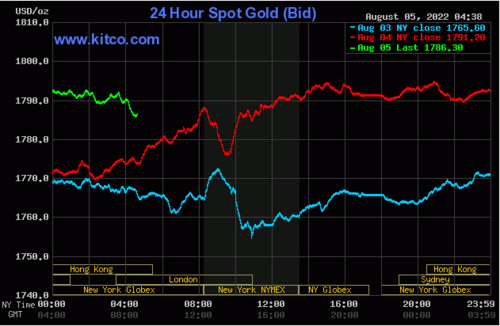
Image Source: Kitco News
September silver futures bears have the overall near-term technical advantage. However, a price downtrend has been negated to suggest a market bottom is in place. Silver bulls' next upside price objective is closing prices above solid technical resistance at $21.50. The next downside price objective for the bears is closing prices below solid support at $19.00. First resistance is seen at this week’s high of $20.51 and then at $20.75. Next support is seen at this week’s low of $17.75 and then at $19.40. Wyckoff's Market Rating: 3.0. Read More
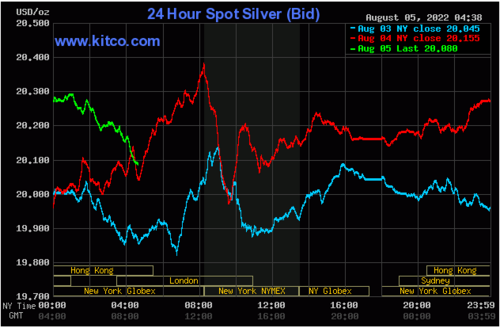
Image Source: Kitco News
UPDATE: Metals exhaling before the next move
With jobs numbers out tomorrow morning at 8.30 am ET, traders should be ready to face volatility. The below hourly charts are a zoomed-in version of what we presented yesterday, updated with price action.
We can see the highlighted support zone held for gold, which has threatened to break out higher again as of this writing.

Image Source: Kitco News
Silver has not gone on to make a higher high, and is forming a bearish rising channel, within a wedge, and it looks like it can break either way. However, it is not uncommon for gold to need to "drag" silver higher in the beginnings of a trending move up. Read More
Gold futures break above $1800 reacting to both foreign and domestic risks
This week gold futures have traded above $1800 twice, on Tuesday and today. But today’s break above $1800 differs because gold closed above this key psychological price point. Today’s solid gains were based upon two major fundamental concerns, these fears were both foreign and domestic in origin.
Domestic fears of a recession:
On July 28 the government released the advance estimate of the second quarter GDP. The report revealed that the GDP had decreased at an annual rate of 0.9% during the second quarter of 2022. Earlier this year the BEA reported a decrease in the first quarter GDP of 1.6%. The widely accepted definition of a recession is an economic contraction over two consecutive quarters.
This means that it is likely that we are currently in or about to enter a recession which is why tomorrow’s jobs report is so important. Friday’s employment report will provide data needed to measure whether the American economy is in a recession. The fear of a disappointing jobs report pressured yields on US treasuries and the dollar lower today.
Dollar weakness was certainly a component moving gold sharply higher. Dollar weakness accounted for $10.25 of today’s $25.60 gain in spot gold prices. Spot gold is currently fixed at $1791.20 after factoring in an additional $15.35 that resulted from market participants actively buying spot gold. Read More
Gold price in rally mode on latest geopolitical tensions but Friday's jobs report could disrupt momentum – analysts
Gold breached the coveted $1,800 an ounce level Thursday on increased geopolitical tensions between the U.S. and China. But the upcoming Friday's employment report could disrupt momentum, according to analysts.
December gold futures rose $33 on Thursday, touching a daily high of $1,812. At the time of writing, prices were at $1,808.20 an ounce.
Taiwan is at the centre of the latest round of geopolitical tensions between the U.S. and China. On Thursday, markets were spooked by China firing several ballistic missiles around Taiwan in retaliation for U.S. House Speaker Nancy Pelosi's visit. China is also conducting aggressive military manoeuvres.
"The aggressive tone emanating out of Beijing in response to Pelosi's visit to Taiwan has made for a classic safe haven play in recent sessions, with gold and Treasuries rising in tandem with the U.S. dollar and the Japanese Yen," said Han Tan, chief market analyst at Exinity Group.
This situation will continue to develop into the weekend, according to Marc Chandler, chief market strategist at Bannockburn Global Forex.
"China continues its military harassment of Taiwan, while U.S. President Biden pushes against a Senate bill that would recognize Taiwan as a 'major non-NATO ally' and boost its representation in international forums," Chandler said. Read More
The stock market will correct by 30% more; Expect ‘bad earnings’ to dampen the rally – Ted Oakley
Despite a bad year overall, stock markets rallied recently, with the S&P 500 up 8 percent over the past month, and the NASDAQ up 11 percent over the same period.
Ted Oakley, Founder and Managing Partner at Oxbow Advisors, said that this is temporary, and that stocks have much further to fall.
“For [stocks] to go down another 20 or 30 percent would not be hard at all, when you look at what earnings are going to look like in the next two quarters,” he stated.
He explained that due to “high cost of capital” and a 38-year high level of inventories, companies can expect poor earnings results in Q3 and Q4.
Oakley spoke with David Lin, Anchor and Producer at Kitco News. Read More
US, Perth mints see renewed demand for gold bullion; Aussie silver shines bright
Recession fears and the ongoing inflation threat prompted retail investors to jump back into the gold market as two major global mints reported increases in their gold and silver bullion sales.
Sales data from the U.S. Mint showed that it sold 64,500 ounces of gold in various denominations of its American Eagle gold bullion coins. Sales are up 24% from June's sharp drop. Last month's sales are up 10% from July 2021.
While gold demand picked up in July, investors are still reluctant to buy physical silver. The data from the U.S. Mint shows that it sold 850,000 ounces of silver last month, down 8% from June. Sales are down sharply, falling nearly 73% from July 2021.
Analysts have said that retail investment demand for silver has struggled as recession fears continue to grow. A global recession would reduce industrial demand for silver, representing about 60% of the global market. Analysts have said that gold is seen as a more sturdy, safe-haven asset in the current environment.
Meanwhile, on the other side of the globe, the Perth Mint said it sold 79,305 ounces of gold in July, an increase of 21% from July. At the same time sales are up 12% from last year.
The Perth Mint also said it sold 2.47 million ounces of silver last month, up 62% from June and 89% from July 2021.
"We continued to experience extremely strong demand for physical silver," said Neil Vance, general manager of minted products at the Perth Mint. "Even with a strong month for output, silver coins remain subject to allocation." Read More
July was worst month for gold ETFs since March 2021
July was the worst month for outflows in global gold-backed exchange-traded funds since March of 2021, as 81 tonnes of the precious metal left the market, according to the latest report from the World Gold Council.
“Significant outflows from global gold ETFs and a decline in gold futures positioning, which reached net short for only the fifth time since 2006, weighed on gold’s performance throughout July. Gold also faced headwinds in the form of a stronger US dollar, weaker Brent crude prices following softer growth data and lower implied volatility,” said Adam Perlaky, senior analyst at the WGC, in the report.
However, the WGC also noted that the market could be on the cusp of turning around as sentiment was significantly bearish by the end of the month.
In its monthly ETF update, the WGC said the gold market saw broad-based outflows in North American and European markets. North America-listed funds saw 50.3 tonnes of gold flee the marketplace.
However, one trend in North America remains strong. The WGC noted that demand for low-cost ETFs saw inflows.
Meanwhile, European funds saw outflows of 38.1 tonnes.
“This came on the back of the EU raising rates for the first time in 11 years and by a larger-than-expected amount of 50 [basis points],” the analysts said.
Bucking the current trend, Asian-listed funds saw inflows of 8.1 tonnes.
“All the inflows came from China, which had the worst absolute outflows during the first half of the year, primarily due to profit taking amid a strong local gold price in Q1. Inflows in July were mainly driven by safe-haven buying,” the analysts said. Read More
.png)
Disclaimer: These articles are provided for informational purposes only. They are not offered or intended to be used as legal, tax, investment, financial, or any other advice.















