x




Image Source: Unsplash
Aussie gold miners produced 83 tonnes of gold in Q2
Australian gold production was firing on all cylinders between April and June, rising by 9% compared to the first three months of the year, according to Melbourne-based gold mining consultants Surbiton Associates.
According to the firm's quarterly report, Australian gold companies produced 83 tonnes of gold in the final quarter of the 2021-2022 financial year.
"This brings Australian total gold mine production to 317 tonnes for the financial year ended 30 June 2022, worth around A$26 billion," the report said.
Dr. Sandra Close, a Surbiton director, said that producers were able to end the financial year on a high note by pushing their treatment plants and treating higher-grade ore.
She added that although gold prices have struggled since March, Aussie producers still had a strong incentive to push production higher.
"In the second quarter of 2022, the US dollar price of gold fell by US$125 per ounce, but the Australian dollar gold price actually rose by almost A$42 an ounce due to a US 6 cent movement in the exchange rate," Close said.
Although the June quarter saw strong production, Close noted that the industry faces some challenges, including rising input costs due to inflation and a shortage of skilled workers. Read More
$50,000 gold is likely once the monetary system returns to a gold standard - John Butler
As the world transitions to a gold standard monetary system, the price of gold will skyrocket to $50,000 per ounce, said John Butler, Head of Treasury at TallyMoney and author of The Golden Revolution, Revisited.
“Today, the gold price is too low to allow markets to clear, because assets are over-valued vis-à-vis gold,” he said. “According to my calculations, you’re talking about something in the region of $50,000 per ounce being [reasonable] if you go back to a gold-backed international monetary system.”
Butler claimed that the process of transitioning to a gold standard is inevitable as the U.S. loses its economic dominance and the world becomes multipolar.
“Gold solves for the game-theoretic monetary equilibrium for a multipolar world that is, nevertheless, hugely dependent on international trade,” he explained. “At the end of the Second World War, the U.S. economy was roughly half the entire global economy. By activity today, it’s only 20 percent… If you just extrapolate this trend, ultimately, it’s going to tip the balance regardless of whether the U.S. retains military superiority or not.”
Butler spoke with David Lin, Anchor and Producer at Kitco News. Read More
Gold prices drop to session lows after ISM Service PMI rises to 56.9
Gold prices have dropped to session lows following better-than-expected activity in the U.S. service sector, according to the latest report from the Institute for Supply Management (ISM).
Tuesday, ISM said that its service-sector index showed a reading of 56.9% for August, up from July’s reading of 56.7%. The data beat expectations, as consensus forecasts called for a drop to 55.4%
Readings above 50% in such diffusion indexes are seen as a sign of economic growth and vice-versa. The farther an indicator is above or below 50%, the greater or smaller the rate of change.
The gold market is seeing some renewed selling following the latest economic data. December gold futures last traded at $1,713.90 an ounce, down 0.50% on the day.
Some economists note that the ISM report will help to further ease fears that the U.S. is headed towards a recession. They also note that it also gives the Federal Reserve more room to aggressively raise interest rates to cool inflation pressures.
“Overall, while our tracking models suggest that the risks of recession over the next year or so are rising, we still think the economy is more likely to see a period of below-trend growth rather than an outright contraction,” said Andrew Hunter, senior U.S. economist at Capital Economics.
Following the data, markets are pricing in a 72% chance of a 75-basis point hike later this month. Read More
Gold bears remain in control as short squeeze runs out of momentum
Gold bears remain firmly in control of the market as prices have been unable to hold gains above $1,750 and a short squeeze on hedge funds has proved to be short-lived.
According to market analysts, hedge funds remain pessimistic about gold as markets shift expectations that the Federal Reserve will quickly pivot from its current aggressive monetary policy strategy.
Further rate hikes through the rest of the year and in the first quarter of 2023 continue to support the U.S. dollar at a 20-year high and bond yields above 3%, two significant headwinds for the precious metal.
According to the CME FedWatch Tool, markets see a 74% chance that the Federal Reserve will raise interest rates by another 75 basis points later this month.
Commodity analysts at TD Securities noted that gold's dismal performance through the summer indicates that the market has priced in higher interest rates; however, they added that the next wave of selling will be driven by expectations that a much-anticipated pivot is further away than initially thought.
"While gold prices may now have accurately captured the expected level of interest rates, they are not reflecting the implications of a sustained period of restrictive policy. Further, we see odds of a major capitulation event growing with every tick lower in gold prices," the analysts said in a note. "Gold markets still feature an extremely concentrated and bloated position held by a small number of family offices and proprietary trading shops, which are increasingly at risk as prices approach their pandemic-era entry levels." Read More
Gold weaker on surging U.S. dollar, rising U.S. Treasury yields
Gold prices are moderately down in midday U.S. trading Tuesday, while silver prices are just a bit firmer. A strong U.S. dollar index that hit a 20-year high today and a sharp rise in U.S. Treasury yields to start the U.S. trading week are bearish outside market forces working against the metals markets. October gold was last down $7.60 at $1,705.40 and December silver was up $0.079 at $17.96.
The greenback rose sharply as the Euro currency slumped after Russia said it won't reopen its main natural gas pipeline from Russia into Europe. In other news, OPEC-plus decided to cut its collective crude oil production by 100,000 barrels per day starting in October, in an effort to boost prices.
Technically, October gold futures bears have the solid overall near-term technical advantage. Prices are in a four-week-old downtrend on the daily bar chart. Bulls' next upside price objective is to produce a close above solid resistance at $1,750.00. Bears' next near-term downside price objective is pushing futures prices below solid technical support at the July low of $1,686.30. First resistance is seen at today's high of $1,727.00 and then at $1,740.00. First support is seen at $1,700.00 and then at last week's low of $1,689.80. Wyckoff's Market Rating: 1.5.
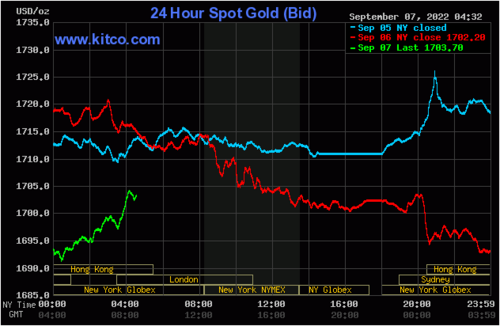
Image Source: Kitco News
December silver futures bears have the solid overall near-term technical advantage. Silver bulls' next upside price objective is closing prices above solid technical resistance at $19.50. The next downside price objective for the bears is closing prices below solid support at $17.00. First resistance is seen at today's high of $18.465 and then at $18.80. Next support is seen at today's low of $17.815 and then at last week's low of $17.40. Wyckoff's Market Rating: 1.5. Read More
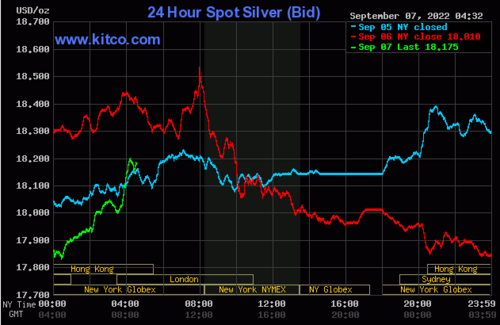
Image Source: Kitco News
Brace for a possible U.S. debt crisis if inflation stays elevated, democracy itself is at risk - Michael Gayed
The U.S. could have a sovereign debt crisis as Treasury yields rise and other countries fail to pay back their dollar-denominated loans, said Michael Gayed, portfolio manager and Publisher of the Lead-Lag Report. These trends, in turn, could pose risks to U.S. democracy.
Gayed's research shows that Treasury yields, on a weekly basis, have been rising 68.6 percent of the time in 2022, a level that is unprecedented. Rising yields could weaken a government's ability to fulfil its debt obligations.
"My hope is that this anomaly ends, and that we're not headed for a sovereign debt crisis," said Gayed. "We want to be really careful about how despotism happens. Conditions create the monster. What I'm really referring to is how the Weimar Republic created conditions for Hitler's rise to power."
Although Gayed said that another Hitler-like despot is not necessarily going to arise, he stressed that conditions in the German Weimar Republic of the 1920s, with its high inflation and debt troubles, are analogous to the U.S.'s similar problems today.
Gayed spoke with David Lin, Anchor and Producer at Kitco News. Read More
Treasury yields rise, dollar index closes above 110 pressuring gold lower
Well before the Federal Reserve enacted its first interest rate hike in March the dollar has been on a dynamic upside surge. In July 2021 the dollar index traded to a low of 89.45 and in just over a year moved to a 20-year high with the dollar index currently trading above 110. When analysts talk about dollar strength it is a little misleading on the surface.
The dollar has lost value and continues to lose value in terms of its buying power. With inflation running over 8% the cost of goods and services continues to mean that the United States dollar has less buying power than it did a year ago, five years ago, or 20 years ago.
The dollar index's strength represents the dollar as it relates to the basket of six currencies it is paired against. Within this foreign currency basket, certain ones carry more weight. The Eurodollar for example accounts for 56.7% by far the largest component of the index. The Japanese yen is weighted at 13.6%, the British pound at 11.9%, the Canadian dollar at 9.1%, the Swedish krona at 4.2%, and the Swiss franc is weighted at 3.6%.

Image Source: Kitco News
Because the vast majority of countries have been devaluing their fiat currency by creating excessive monetary supplies, the dollar has been depreciating less than the other currencies it is paired against. So, the term "dollar strength" is simply a measurement of foreign-exchange values of the U.S. dollar when compared against the foreign currencies contained in the dollar index. Read More
Silver moves slightly higher ahead of the European open
Gold has moved 0.26% lower overnight while silver has pushed 0.20% into the black. Elsewhere in the rest of the commodities complex, copper (-1.19%) and spot WTI (-1.69%) both struggled overnight.
In the indices, the Nikkei 225 (0.03%) managed to keep its head just above water but the ASX (-1.42%) and Shanghai Composite (-0.07%) underperformed.
In FX markets, the biggest mover was USD/JPY which rose 0.86% compounding on the yen's recent woes. In the crypto space, BTC/USD trades at $18,771.
News from overnight: Read More
The Yield Curve Signals More QE Is Coming
In spite of the common narrative that the Fed’s monetary policy is “tight” or “hawkish,” it has not yet removed any liquidity from the banking system.
The Fed’s balance sheet has been reduced to an immaterial amount since June when Quantitative Tightening was set to commence.
Meanwhile, the U.S. Treasury Bond Yield Curve now sports a 40 basis point inversion between the 2-year and 10-year Treasuries. The last two times the 2/10 inverted by this much occurred in March 2000 and the spring of 2007 and the Fed followed suit by cutting the Fed funds rate and injecting liquidity into the banking system.
The point here is that, in addition to signalling that the economy is (globally) sinking quickly into a deep recession, the extreme yield curve inversion is telling the market that the banking system is starved for liquidity – liquidity that the Fed and other Central Banks will soon have to provide by resuming a large scale money printing operation.
Yes, there may be $2 trillion sitting in “suspended animation” in the Fed’s overnight reverse report facility. However, this is the spot most devoid of risk to park that liquidity and earn over 2% annualized on it.
The big “too big to fail” banks ultimately need that capital to offset their increasingly illiquid, off-balance-sheet OTC derivatives and their exposure to an escalating amount of “on balance sheet” subprime and distressed loans (mortgages, auto loans, business loans).
In other words, the banks and money market funds parking cash at the Fed are doing so because they do not like the risk involved with lending money even on a short-term basis to entities that need the cash. As such, at some point, the Central Banks will have to create new liquidity in order to keep the financial system from imploding.
The market’s realization that the Central Banks – especially the Fed – are faced with the choice of “print or collapse” is the reason the precious metals sector is bottoming and is headed higher.
On days when “risk-on” capital floods into the most speculative stocks, capital is also flowing briskly into silver and mining stocks. In those days, the broad mining stock indices outperform the major stock indices like the Dow, S&P 500 and Nasdaq.
Source: Kinesis
.png)
Disclaimer: These articles are provided for informational purposes only. They are not offered or intended to be used as legal, tax, investment, financial, or any other advice.















