x




Image Source: Unsplash
Silver Continues to Fall in Short-Term But Fundamental Outlook Provides Hope
Silver finds itself under pressure again as investors continue to see the Federal Reserve’s expected series of interest rate hikes as the key macroeconomic driver.
In this environment, silver keeps being punished even though the US central bank’s comments on its short-term economic policy were announced last week.
As such, silver has quickly gone from trying to hold on to the key recent level of $25 an ounce just a week ago, the metal now finds itself only a little above $23 an ounce at its lowest level since mid-February. Read More
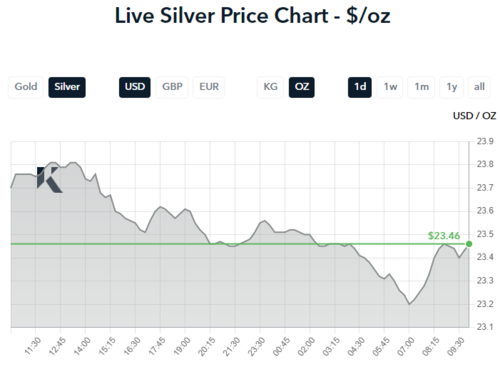
Image Source: Kitco News
Gold Tests $1,900 as Dollar Strength, Prospect of Fed Hikes Outweigh Geopolitical Fears
Gold finds itself flirting with $1,900 an ounce as the strength of the US dollar and the expected upward trajectory of Federal Reserve interest rate hikes outweighs the latest escalation in the Ukrainian conflict with Russia cutting off gas supplies to Poland and Bulgaria.
Yet despite this bearish sentiment on equity markets, gold finds itself looking downward and is now testing the key psychological level of $1,900 an ounce. A failure to hold above this level, even with the Ukrainian-Russian war providing a clear investment reason for the ultimate haven asset, would illustrate how much the action of the Federal Reserve drives markets.
With interest rate hikes all but guaranteed by the US central bank in May and June and highly likely in July too, gold’s lack of yield has seen it fall out of favor with investors.
Considering gold was above $2,000 barely a month ago, the precious metal’s fall from grace has been pretty sharp. That said, $1,900 remains a very high level for gold historically, and given the fragile state of markets currently, it wouldn’t take much for renewed fear trading to push its price upward once again. Read More
Saylor says Bitcoin is 'perfect asset for retirement,' less risky than bonds and gold as Fidelity offers Bitcoin option with 401(k) plans
As Fidelity Investments becomes the first retirement plan provider in the U.S. to offer Bitcoin as an option in 401(k) accounts, MicroStrategy CEO Michael Saylor said the world's largest cryptocurrency is a perfect retirement asset.
Fidelity Investments, the largest 401(k) plan provider in the U.S., announced Tuesday its plan to offer Bitcoin as an option for its 401(k) accounts by the middle of this year. Fidelity, which has $2.7 trillion in assets under management, is the first 401(k) provider to do so.
Saylor said he is "delighted" with the ability to offer his own employees such an option, adding that Bitcoin is a safer investment choice than many other assets, including bonds, stocks, and even gold.
"Bitcoin's digital property, and that makes it the perfect asset for a retirement plan," Saylor told CNBC Tuesday. "It's less risky than bonds, than stocks, than commercial real estate, than gold. It was kind of built for this." Read More
Swiss gold exports to America rose sharply in March
Swiss gold exports to the U.S. rose in March. Swiss shipments of gold to America to their highest since May 2020, Swiss customs data showed. Exports to Britain, which like the United States is a center for gold investment and trading, also rose, but shipments of gold to China and India, the biggest consumer markets, fell sharply.
On the Exchange-traded funds (ETFs) side, storing gold for investors added 185 tonnes worth around $15 billion to their stockpile in March, the most since July 2020, according to the World Gold Council.
Swiss exports to mainland China and Hong Kong fell in March to their lowest in a year and shipments to India were the smallest since May 2021. Exports to Britain were the highest since June 2021. Read More
Major Russian gold miner opts for exports versus imports as local banks buy gold at discount
Russia's second-largest gold producer Polymetal prefers to sell its gold abroad since Russian local banks buy the precious metal at a discount.
In light of Western sanctions imposed on Russia after its invasion of Ukraine in February, Polymetal's options of selling its gold are limited. The miner has been targeting non-sanctioned banks, Bloomberg reported, citing the company's CEO Vitaly Nesis as saying during an investor call Monday.
However, those local banks purchase the yellow metal at a discount price compared to the international pricing. The local banks that Polymetal usually sold to in the past were state-run banks, including Sberbank PJS, VTB Bank PJSC, and Bank Otkritie.
Due to sanctions, the miner cannot sell its gold to those institutions anymore. And Russia's central bank, which has re-started its official purchases of locally-produced gold, is not projected to buy as much as before, Bloomberg reported. Read More
Gold prices remain below $1,900 finding no bullish momentum from disappointing U.S. pending home sales data
Disappointing US. housing sales data is unable to provide the gold market any bullish traction as prices remain under pressure, falling below $1,900 an ounce.
Tuesday, the National Association of Realtors (NAR) said its Pending Home Sales Index fell 1.2% in March to 103.7, following a more than 4% decline in February. The data was weaker than expected as economists were looking for a 1.0% decline.
For the year, pending home sales are down more than 8% and have declined in the last ten consecutive months.
The gold market is not seeing much reaction to the latest home sales numbers as it is hit with some renewed selling pressure. June gold futures last traded at $1,886.70 an ounce, down nearly 1% on the day. Read More
Gold, silver slump on strong U.S. dollar, rising bond yields
Gold and silver prices are lower in midday U.S. Trading Wednesday and hit two-month lows. The safe-haven metals are being hit hard by a surging U.S. dollar and rising government bond yields. The bulls also continue to get punished by the chart-based bears who continue to press their case amid weakening near-term technicals. June gold futures were last down $15.40 at $1,888.70 and May Comex silver was last down $0.049 at $23.485 an ounce.
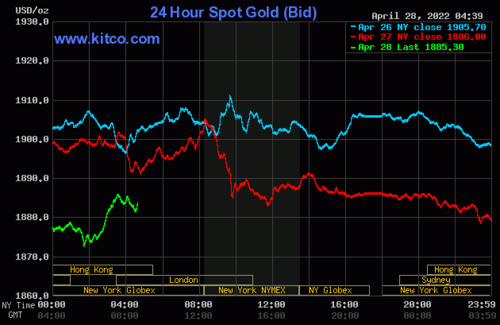
Image Source: Kitco News
Technically, June gold futures prices hit another two-month low today. A price downtrend line is in place on the daily bar chart. Bears have gained the slight overall near-term technical advantage and have momentum on their side. Bulls' next upside price objective is to produce a close above solid resistance at $1,950.00. Bears' next near-term downside price objective is pushing futures prices below solid technical support at $1,850.00. First resistance is seen at $1,900.00 and then at today’s high of $1,908.10. First support is seen at today’s low of $1,881.60 and then at $1,875.00. Wyckoff's Market Rating: 4.5.
May silver futures prices hit a nine-week low today. A price downtrend line is in place on the daily bar chart. The silver bears have the overall near-term technical advantage. Silver bulls' next upside price objective is closing prices above solid technical resistance at $25.00 an ounce. The next downside price objective for the bears is closing prices below solid support at $23.00. First resistance is seen at today’s high of $23.765 and then at $24.00. Next support is seen at today’s low of $23.275 and then at $23.00. Wyckoff's Market Rating: 3.5. Read More
Inflation will keep gold prices above $1,900 even as the Fed raises rates - Scotiabank
The gold market continues to struggle as prices trade below $1,900 an ounce, and the Federal Reserve's monetary policy decision next week will continue to weigh on the precious metal; however, one market strategist still sees solid support for the precious metal through the rest of the year.
In a report published Monday, Marc Desormeaux, senior economist at Scotiabank, said that despite gold's recent more than 5% drop from $2,000, he is increasing his forecast for the precious metal.
The Canadian bank now sees gold prices averaging the year around $1,900, up from the previous forecast of $1,800.
Although Desormeaux is relatively bullish on gold, he added that the precious metal could struggle in the near term ahead of the Federal Reserve's monetary policy decision. Read More
Unintended consequences of U.S. dollar 'weaponization': here's how gold and Bitcoin utilize the moment
Are we witnessing a reversal in globalization? What are some unintended consequences of sanctions against Russia and the weaponization of the world's reserve currency — the U.S. dollar?
With uncertainty still the dominant theme going into the second quarter of 2022, the main beneficiaries in this environment are safe-haven assets like gold and Bitcoin as the search for diversification becomes a priority for countries, institutions, and individual investors, according to analysts.
Existing trade deals and supply chains that took decades to build have been seriously disrupted — first by the COVID-19 pandemic and now by the war in Ukraine and sanctions against Russia.
Following Russia's invasion of Ukraine on February 24, the U.S dollar has been "weaponized" to put pressure on Russia via numerous financial sanctions, analysts told Kitco News. For example, around $300 billion of Russia's approximately $640 billion worth of foreign exchange reserves have been frozen, while Moscow has been banned from the SWIFT international payments system (aside from some energy payments).
"It's a very delicate matter. The Federal Reserve doesn't want to harm its reputation and trust in the U.S. dollar, which has not been backed by gold since 1974. At the same time, they are confiscating other central banks' money using the SWIFT system because their foreign policies are not aligned with the U.S.," Frank Holmes, CEO and CIO of U.S. Global Investors & Executive Chairman of HIVE Blockchain, told Kitco News. Read More
Gold demand rises 34% in Q1, driven by strong ETF demand – World Gold Council
The gold market saw a strong start to 2022, and conditions are in place for investment demand to remain solid for the rest of the year as investors look to protect themselves from inflation and look for diversification, according to the latest research from the World Gold Council (WGC).
On Wednesday the WGC released its quarterly trends report for the first quarter, noting that physical gold demand increased to 1,234 tonnes, a 34% increase compared to the first quarter of 2021.
The report said that gold demand saw its biggest quarterly jump since the fourth quarter of 2018; at the same time, demand was 19% above the five-year average.
"An uneasy environment of persistently high inflation and elevated geopolitical risks drove investors to gold, helping to propel prices higher," the analysts said in the report. Read More
.png)
Disclaimer: These articles are provided for informational purposes only. They are not offered or intended to be used as legal, tax, investment, financial, or any other advice.















