x




Image Source: Unsplash
Gold & Silver April Outlook - Monthly Review - 2022
A key development to look out for in April is signs of gold and silver breaking out of their close correlation. While gold looks to have more headwinds than tailwinds to push its price, silver’s more industrial appeal provides it with strong fundamental support, outside of purely geopolitical and macroeconomic factors.
Indeed the Silver Institute is forecasting demand for the metal to reach a new record high this year at 1.112 billion ounces. A major source of this burgeoning demand comes from the solar sector, something that is only likely to gain pace as European countries seek to reduce their exposure to Russian fossil fuels.
“The outlook for silver’s use in the photovoltaic (PV) industry remains bright,” the Silver Institute said. “Government commitments to carbon neutrality have resulted in a rapid expansion of green energy projects. As a result, even with ongoing efforts to reduce silver loadings, record PV installations are expected to lift silver demand in this segment to an all-time high in 2022.” Read More
ISM Manufacturing Index disappoints, but gold price focused on bond yields
Gold edged down as the headline manufacturing index from the Institute for Supply Management disappointed in March. The precious metal remained focused on rising bond yields.
The ISM manufacturing index was at 57.1% last month versus the consensus forecast of 59%. The monthly figure also marked a 1.5 percentage-point increase from February’s reading of 58.6%.
“This figure indicates expansion in the overall economy for the 22nd month in a row after a contraction in April and May 2020. This is the lowest reading since September 2020 (55.4 percent),” the report said.
Readings above 50% in such diffusion indexes are seen as a sign of economic growth and vice-versa. The farther an indicator is above or below 50%, the greater or smaller the rate of change. Read More
Gold prices down but see little reaction to mixed U.S. nonfarm payrolls
The gold market has been hit with some strong selling pressure but is seeing little reaction to mixed U.S. labor market data.
Friday, the Bureau of Labor Statistics said 431,000 jobs were created in March. The data missed expectations economists were forecasting job gains of around 492,000.
Meanwhile, the unemployment rate continued to fall, dropping to 3.6%, down from February's reading of 3.8%. Economists were looking for the rate to fall to 3.7%.
The gold market was down 1% on the day ahead of the jobs report and has remained under pressure in initial reaction. June gold futures last traded at $1,927.70 an ounce, down 1.10% on the day.
Positive for gold, wage pressures continue to rise, adding to the growing inflationary environment. The report said that the average hourly wage increased by 13 cents or 0.4% in March to $31.73. The report said that in the past year wages have increased 5.6%. Read More
The Metals, Money, and Markets Weekly: Inflation, Shrinkflation, Stagflation Nation
Wall Street turns bearish on gold; sees support at $1,900 as markets focus on ceasefire talks, hawkish Fed
Potential progress in ceasefire talks between Russia and Ukraine could reduce gold's safe-haven premium next week, according to some market analysts who see new bearish momentum in the marketplace.
The latest results from the weekly Kitco News Gold Survey show a majority of Wall Street analysts are now bearish on the precious metal. Meanwhile, although retail investors remain bullish on gold in the near-term, sentiment has dropped sharply from the previous week.
While analysts are looking for gold prices to fall next week, many note that the market is caught in a new consolidation pattern with initial support to hold between $1,880 and $1,900.
Sean Lusk, co-director of commercial hedging with Walsh Trading, said that although gold struggles to find new bullish momentum, he still sees lower prices as a long-term buying opportunity. Read More
Nothing beats gold as real money
The devastation created by Russia's invasion of Ukraine continues unabated and it is now starting to have significant implications for the global economy. According to some economists, we are witnessing the end of globalization.
Lines are being drawn between allies and opponents that won't easily be undone, even if the conflict in Eastern Europe were to end. Gold, it appears, is playing an essential role in this new environment, where currencies and commodities are being weaponized.
Global commodity markets remain in chaos as nations look to establish their own domestic supply chains. The biggest impact is being felt in the energy sector as Russia's nat gas represents 40% of European demand.
There is a growing threat that Russia could weaponize its commodity markets as it demands 'unfriendly nations' pay for their energy in rubles. Russia is also looking to accept gold and even bitcoin for its oil and gas. According to some economists, Europe, already teetering on edge, could fall into a full-blown recession if Russia decides to withhold supply. Read More
Jobs Reports supports aggressive Fed rate hikes, to reduce inflation, but other factors need to be resolved to solve the big global picture
The Bureau of Labor Statistics released some welcome news today. 431,000 Americans became gainfully employed in March and the jobless rate was within 0.1% of 3.5%, coming in at 3.6%. Economists polled had forecasted that over 500,000 jobs would be added, however, that has little relevance with today’s report indicating that the labor market in the United States is vibrant and strong. The strength of today’s report shows that America’s workforce is now only 1.6 million jobs or 1% of the levels that existed before the pandemic. It must be noted that higher employment is a byproduct of a tight labor market that has had to offer higher wages to attract new workers.
This solid report will give the Federal Reserve the necessary data to continue to raise rates, most likely at a much more aggressive rate. However, the Federal Reserve will have a near-impossible mission to have a soft landing as they reduce the current inflation rate to an acceptable target rate which is been 2%.
Today’s report had resulted in a strong decline in gold pricing with the most active June 2022 futures contract declining by $25.50 or 1.31% and is currently fixed at $1928.50. The vast majority of today’s decline was a direct result of selling pressure with 0.2% of today’s 1.31% decline the result of dollar strength. Read More
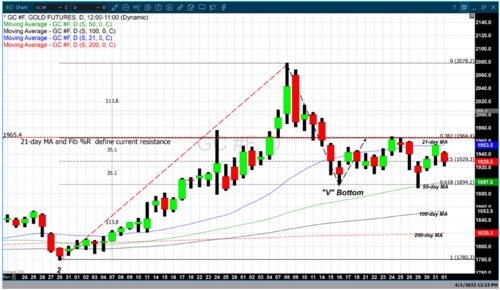
Image Source: Kitco News
Why did Russia just set a fixed gold price on bullion purchases?
Gold ended the week under significant pressure despite the 2-year and the 10-year Treasury yields inverting for the first time since 2019. Many market participants view this as a possible red flag that recession could be around the corner. Read More
Gold price kicks off Q2 with $30 losses, but $2k mark expected to be hit soon - analysts
After a stellar first quarter, gold's April trading started on a sour note as prices dropped $30 on the day amid rising yields. But analysts are keeping a close eye on the 2-year and the 10-year Treasury yields and what the inversion means for gold.
The main event Friday was not the highly-anticipated employment report but an inversion of the 2-year and the 10-year Treasury yield spread. Many market participants view this as a possible warning sign that recession could be around the corner.
"The inversion of the 10y-2y Treasury yield spread this week led to predictable speculation that the Fed's interest rate hikes would quickly push the U.S. economy into recession," said Capital Economics chief North America economist Paul Ashworth. "Given its impressive track record in predicting U.S. recessions – it's been almost 50 years since the last false positive – it would seem foolish to doubt that bearish recession speculation."
The inversion of the yield curve is a red flag, but it is not a timing tool, explained DailyFX strategist Michael Boutros. "It doesn't mean that we are heading into recession for sure. But it does highlight the threat that the environment is right for such a move. You will see that spread wobbling in the near term," Boutros said. Read More
Gold and silver trade higher heading into the European open
Gold (0.22%) and silver (0.87%) have moved marginally higher leading into the European open. Elsewhere in the commodities complex, copper is flat while spot WTI has risen 0.80% after a touch close last week.
There were some reports that talks between Russia and Ukraine progressed this weekend and sentiment has picked up overnight. The Nikkei 225 (0.25%) and ASX (0.27%) pushed higher. Futures in Europe are indicating a positive cash open.
FX markets were quiet overnight but AUD and NZD gained against the greenback. In the crypto space, BTC/USD trades half a percent lower at $46,192.
News from overnight: Read More
Disclaimer: These articles are provided for informational purposes only. They are not offered or intended to be used as legal, tax, investment, financial, or any other advice.















