x




Image Source: Unsplash
Gold price holding steady below $1,950 as U.S. weekly jobless claims fall to new 53-year low
The gold market is holding on to solid gains just below critical resistance at $1,950 an ounce and new momentum in the U.S. labor market has not impacted the precious metal’s bullish sentiment.
U.S. weekly jobless claims have once again dropped below 200,000, falling to its lowest level in 53 years.
Thursday, the U.S. Labor Department said that weekly jobless claims fell by 28,000 to 187,000, down from the previous week's revised estimate of 215,000 claims.
“This is the lowest level for initial claims since September 6, 1969 when it was 182,000,” the report said. Read More
U.S. durable goods disappoint in February, gold price trades above $1,940
Gold was trading above $1,940 an ounce after the newly released data showed that orders for long-lasting U.S. factory goods were down 2.2% in February versus the expected decline of 0.5%.
Meanwhile, January’s data was revised to an increase of 1.6%.
Following the release, gold edged up, with April Comex gold futures last trading at $1,947.80, up 0.54% on the day.
The monthly decrease in durable goods orders was $6 billion and was largely driven by transportation equipment.
The core durable goods section, which excludes the volatile transportation sector, also disappointed expectations, falling 0.6% versus the expected increase of 0.6%. Excluding defense, new orders dropped 2.7%. Read More
Gold price posts double-digit gains as markets worry about the yield curve inverting
As the Federal Reserve kicks off its aggressive tightening cycle to get inflation under control, investors worry about the state of the U.S. economy and what the bond market is saying. And the gold price is reacting.
One of the most popular gauges into the state of the U.S. economy is the yield curve, which looks to be moving closer to inverting following a volatile week in the bond market, which is repricing Fed expectations, including a 50-basis-point hike in May.
The relationship analysts pay close attention to is the 2-year and 10-year Treasury yields.
"Shorter-dated debt is especially bearing the brunt of the Fed's more hawkish stance, with the year-to-date surge on 2-year Treasury yields now rising to 145 basis points. This would make for the worst quarter since 1984. Yields on 10-year Treasuries have also hit the psychologically important 2.40% level for the first time since 2019, as the spread between the 2-year and 10-year has whittled down to a mere 20 basis points or so, its flattest since the onset of the pandemic in 2020," Exinity Group chief market analyst Han Tan said on Wednesday. Read More
A weaponized U.S. dollar could prompt central banks to diversify with more gold - MKS' Shiels
A weaponized U.S. dollar as Russia's war with Ukraine enters its fifth week could create more opportunities for gold, according to one precious metals firm.
In reports published Wednesday and Thursday, Nicky Shiels, head of metals strategy at MKS PAMP Group, highlighted the impact that ongoing Western sanctions imposed on Russia could have on the global economy and how it could impact the dollar's role as a reserve currency.
"Depending on whether the West is successful or not, the more they are used or, the longer sanctions are imposed, the more other countries will try to avoid relying on Western finance," she said in the report.
Looking at the U.S. dollar's role within the global economy, Shiels said that it remains the largest currency held by central banks, representing about 60% of global reserves. She also noted 90% of daily trades in the $6.6 trillion foreign exchange market involve the U.S. dollar.
"There are current alternatives, but none currently match the US$ in size, depth and respect," she said. Although the gold market is still too small to completely replace the dollar, Shiels said central banks can still use it to diversify away from the U.S. dollar. Read More
Gold will continue to shine as Russia's war with Ukraine changes the geopolitical, financial market landscapes
Gold investors should not expect the precious metal to give up on $2,000 an ounce without a fight, according to one market analyst.
In a telephone interview with Kitco News, Chantelle Schieven, head of research at Murenbeeld & Co., said that gold has found a new range and that the precious metal is building a solid base between $1,900 an ounce and $2,000 an ounce.
The gold market has benefited from significant safe-haven demand as Russia's invasion of Ukraine enters its fifth week. Even if the war in Eastern Europe is resolved, Schieven said she doesn't expect safe-haven demand to dry up completely. She added that the conflict has become a critical pivot point that is changing the global geopolitical landscape and financial markets.
"The overall fear in the market is not going away anytime soon and that will continue to support gold," she said. "Gold has established solid support around $1,900 and a strong trend is emerging even if geopolitical tensions start to ease." Read More
Gold, silver sharply up on safe-haven buying, inflation worries
Gold and silver prices are sharply higher in midday U.S. trading Thursday, as safe-haven demand is featured amid marketplace risk aversion that remains elevated amid the Russia-Ukraine war. Sharp gains in crude oil prices this week are also bullish for the metals markets, even though oil prices backed off today. April gold futures were last up $26.70 at $1,964.00 and May Comex silver was last up $0.736 at $25.925 an ounce.
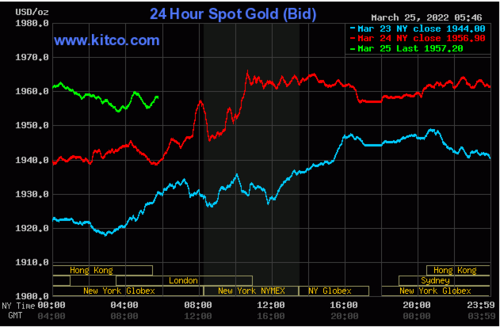
Image Source: Kitco News
Technically, April gold futures prices hit a two-week high today and saw a bullish upside breakout from the recent sideways trading range. Bulls have the firm overall near-term technical advantage. Bulls' next upside price objective is to produce a close above solid resistance at $2,000.00. Bears' next near-term downside price objective is pushing futures prices below solid technical support at the March low of $1,895.20. First resistance is seen at $1,976.50 and then at $1,985.00. First support is seen at today’s low of $1,937.40 and then at $1,925.00. Wyckoff's Market Rating: 7.0. Read More
This twist could cause inflation to challenge 13.3%, a level not seen since 1979
Inflation is currently running at 7.9% and new forces emerging over the last month that will exponentially magnify the pace at which inflation continues to grow. It could in fact challenge the highest level we have seen in since 1979. If this unfolds, we would see gold move exponentially higher.
The primary factor that is taking gold well above $1900 over the last three trading days is inflation with a twist. The twist magnifies the current level of inflation and accelerates the level at which it is growing, and quickens the timeline to achieve that. Inflation began to spike long before Russia invaded Ukraine. It has been running rampant this year well above levels seen over the last 40 years. Read More
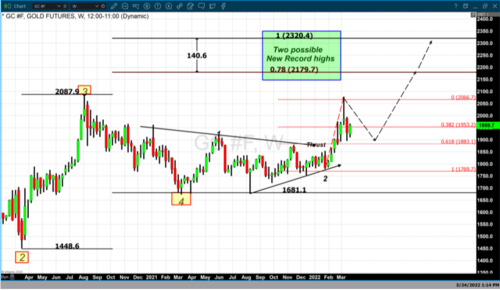
Image Source: Kitco News
'Nothing but a series of black swan events' since mid-2019, what shock is next? Goehring & Rozencwajg weighs in
Markets have been busy digesting a series of black swan events since mid-2019, but the shock streak might not be over, according to Goehring & Rozencwajg Associates managing partner Leigh Goehring.
Investors have seen everything from the COVID-19 pandemic to massive money-printing, very loose global monetary policies, post-COVID waves, economic shocks, supply shortages, high inflation, and Russia's invasion of Ukraine.
And with inflation still accelerating, commodities surging, and global central banks hiking rates, there are many red flags out there, including a possible inversion of the yield curve, Goehring told Kitco News.
At its March meeting, the Federal Reserve raised rates for the first time since 2018 and signaled that it could hike by 50 basis points at a time if needed. The big worry with such an aggressive tightening schedule is slower economic growth and unintended consequences from the war in Ukraine.
The three areas that Goehring is watching for a potential black swan event are the agriculture, oil, and finance sectors, with the latter looking like the most probable dangerous scenario. Read More
Gold and silver are marginally lower ahead of the European open
Gold is heading into the European session 0.09% lower trading at $1955/oz. Silver is also marginally lower trading at 25.51/oz. In the rest of the commodities complex, copper has risen half a percent and spot WTI is 0.77% higher.
Risk sentiment overnight was once again mixed. The Nikkei 225 (0.14%) and ASX (0.26%) pushed higher while the Shanghai Composite fell 1.17%. Futures in Europe are pointing towards a moderately lower cash open.
In FX markets, the greenback suffered overnight. The high-flying USD/JPY retraced half a percent and EURUSD rose 0.27%. In the crypto space, BTC/USD rose 0.37% to trade at $44,283. Read More
Disclaimer: These articles are provided for informational purposes only. They are not offered or intended to be used as legal, tax, investment, financial, or any other advice.















