x



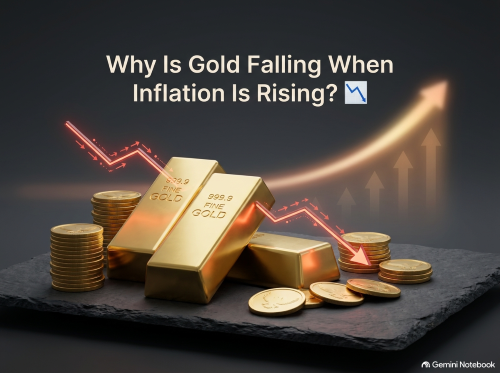
You pull up to the petrol pump, fill your tank, and wince at the receipt. Inflation is clearly creeping up again—with recent UK figures showing annual CPI rising from 3.1% to 3.5%, largely driven by surging transport and fuel costs. Naturally, your instinct might be to expect gold, traditionally viewed as the ultimate inflation hedge, to rally.
Yet when you check the market headlines, an ounce of gold is trading around £2,920, dropping lower on the day.
If you hold gold to protect your purchasing power, it is entirely reasonable to ask why the cost of living can go up while the price of gold goes down. The answer lies in how financial markets interpret inflation, how central banks react, and what happens to real interest rates behind the scenes.
Gold possesses many unique qualities as a monetary asset, but it has one defining financial characteristic: it pays no interest or yield. When you hold physical gold, there is no dividend or coupon arriving in your bank account every quarter.
Because gold yields zero percent, its price is heavily influenced by the opportunity cost of holding it instead of cash or government bonds.
When inflation surges, investors immediately look at how central banks like the Federal Reserve or the Bank of England will respond. If markets expect central banks to raise interest rates aggressively to combat rising prices, bond yields tend to climb. What matters most to investors is not just inflation itself, but the real rate of return—the bond yield minus expected inflation.
As explored in a recent analysis on Kitco News, this creates a fascinating paradox:
In that scenario, holding interest-bearing cash or government bonds suddenly becomes far more attractive than holding non-yielding gold. Consequently, an inflation headline can trigger an immediate sell-off in gold as capital rotates into rising bond yields.
Central bankers face a notorious dilemma when inflation is driven by energy costs. A rate hike can cool consumer borrowing and slow business spending, but it cannot produce a single extra barrel of crude oil or lower the cost of fuel arriving at UK petrol stations.
If a price spike is confined to the petrol pump, raising borrowing costs risks double-squeezing household budgets after energy pressures have already peaked. However, if higher fuel costs begin bleeding into delivery charges, supermarket shelf prices, and worker wage demands, inflation spreads across the wider service economy.
When markets expect central banks to stand firm and hike rates to head off broad inflation, gold often experiences downward pressure. But if high interest rates eventually weaken the broader economy, investors will begin asking how long borrowing costs can remain elevated. If rate expectations start to fall, the pressure on gold tends to ease—even while consumer prices remain high.
Because international gold is priced in US dollars, currency fluctuations add another layer of complexity for UK investors.
If international gold drops by 3% in US dollar terms, but the pound sterling simultaneously weakens by 2% against the dollar, the actual decline on a UK screen is only around 1%. Conversely, if sterling strengthens alongside rising UK rate expectations, it can deepen the price fall that a UK buyer sees.
A dramatic headline about global gold market movements might sound alarming, but the move in your local currency can look quite different once exchange rates are factored in.
What does a temporary price dip mean if you own physical gold coins or bars?
If you need to liquidate your holdings today, a lower market price obviously matters. But for investors holding precious metals over years or decades, gold is primarily a tool for long-term purchasing power preservation rather than short-term trading. Gold’s job is not to move in a straight line alongside every monthly consumer price index release, but to protect capital against monetary depreciation over entire economic cycles.
It is also worth keeping daily inflation headlines in perspective. When headline inflation drops from 3.5% down to 3%, prices are not falling—they are simply rising at a slightly slower pace. The weekly shop still gets progressively dearer. For long-term savers, the fundamental challenge remains whether cash returns can genuinely outpace the real loss of purchasing power over time.
While interest rate expectations can temporarily overshadow gold during an inflation scare, physical gold continues to serve its core purpose: acting as unencumbered money when economic uncertainties mount.
Disclaimer: This article is provided for informational purposes only, mistakes may be made, and it's not offered or intended to be used as legal, tax, investment, financial, or any other advice.