x



The global financial landscape is undergoing a profound structural shift, yet the institution tasked with maintaining monetary stability appears to be looking through the wrong telescope. In a compelling discussion on Live from the Vault, CEO of Qi Research and former Federal Reserve insider Danielle DiMartino Booth joined host Andrew Maguire to break down why official macroeconomic indicators are severely distorting the true state of the economy—and what this means for investors seeking capital preservation.
From the illusion of robust economic aggregates to underlying credit market stress and the fundamental repricing of physical gold, the macroeconomic landscape is far more precarious than mainstream narratives suggest.
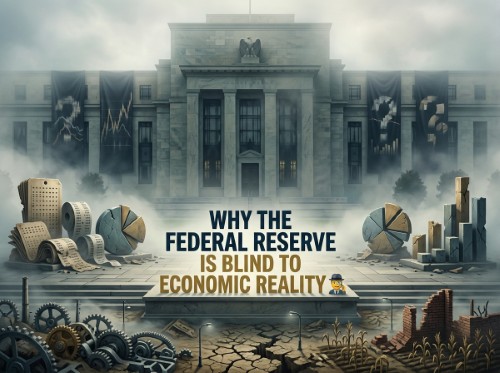
The central flaw in current Federal Reserve policy stems from an over-reliance on top-level macroeconomic aggregates. Headline metrics—such as an unemployment rate hovering around four per cent or aggregate gross domestic product (GDP) growth—create a facade of economic resilience. However, evaluating the economy purely through broad averages distorts reality because these numbers are heavily weighted by the wealthiest segment of society.
For instance, whilst there is approximately eight trillion dollars parked in money market funds yielding lucrative returns, these cash reserves are overwhelmingly concentrated in the hands of the top wealth brackets. On the opposite side of the spectrum, the average household saving rate has collapsed to roughly three per cent.
Underneath the headline figures, everyday households are facing severe financial strain caused by persistent inflation in essential goods, utility bills, fuel, and food. To manage basic living costs, an unprecedented number of individuals are turning to 'buy now, pay later' schemes for everyday items or taking on secondary employment, as evidenced by a marked spike in online searches for gig-economy work such as driving for Uber. Furthermore, credit card delinquency rates have surpassed levels witnessed in the aftermath of the 2008 Great Recession, revealing that the average household is rapidly exhausting its financial buffers.
By relying solely on lagging, backward-looking macroeconomic data, central bankers risk mistaking the prosperity of the wealthy elite for general economic health, delaying necessary policy adjustments until a broader contraction is already underway.
While official policy figures remain focused on broad averages, real-time stress is accumulating across credit markets. The most visible manifestation of this tension is found in borrowing costs for high-yield corporate debt, where major entities are contemplating double-digit coupons on junk bonds—a phenomenon not seen in generations.
Simultaneously, the commercial real estate sector is entering a dangerous second phase. Following years of low interest rates, financial institutions previously managed troubled commercial loans through a process known as 'extend and pretend'—continually rolling over debt in the hope that property values would recover. That era has abruptly ended. Banks are increasingly unwilling or unable to absorb ongoing risk, forcing properties to clear at steep discounts.
Crucially, this distress is no longer confined to office buildings. It is actively spilling over into the multi-family residential sector, where substantial leverage was deployed during the previous cycle. As commercial mortgage-backed securities (CMBS) face heightened default rates, losses are beginning to impact even senior investment-grade tranches. Because regional banks carry a disproportionate share of commercial real estate debt on their balance sheets, this unravelling poses a direct threat to community-level lending and broader credit availability.
Economic policy cannot be separated from the global geopolitical backdrop. As international tensions mount, the global economy is witnessing a shift toward defence manufacturing—a classic 'guns versus butter' economic reallocation. While consumer demand for big-ticket items like automobiles and housing stalls under high financing costs, state-sponsored defence spending is propping up industrial output in major economies.
At the same time, mounting national debt—with the United States national debt approaching forty trillion dollars—presents a severe long-term challenge. Servicing such immense debt burdens under elevated interest rates creates significant friction with sovereign creditors, who harbour growing concerns over long-term debt sustainability and currency debasement.
Domestically, this environment fuels intense political polarisation. As public trust in traditional institutions wanes and wealth disparities widen, a growing 'silent majority' finds itself unrepresented by partisan extremes, longing for fiscal conservatism, monetary discipline, and responsible governance rather than perpetual debt expansion.
Amid monetary debasement and geopolitical uncertainty, gold is undergoing a structural transformation. Historically, gold prices moved inversely to real interest rates and US dollar yields. Recently, however, gold has decisively broken this traditional correlation, continuing to climb even in the presence of higher paper yields.
This breakdown occurs because sovereign states and central banks are fundamentally repricing physical gold as an essential tier-one strategic reserve. In an increasingly fragmented global order, holding unencumbered physical bullion represents national sovereignty and protection against sanctions or asset freezes.
There is also a widening divergence between physical bullion markets in the East and paper derivative markets in the West:
For individual investors, navigating this environment requires distinguishing between paper speculation and physical ownership. While short-term 'investing tourists' and leveraged hedge funds can induce temporary market volatility during margin calls, long-term wealth preservation rests on holding allocated physical bullion. Systematically accumulating physical assets remains one of the most effective strategies for securing individual financial sovereignty against persistent fiat currency debasement.
In times of economic uncertainty, surviving financial market volatility requires a dual perspective: understanding the superficial narrative that drives short-term market pricing while remaining anchored to the underlying structural realities of the business cycle.
As central banks continue to rely on flawed aggregate data, credit market friction builds, and sovereign states quietly secure physical reserves, individuals must take personal responsibility for their financial independence. By focusing on fundamental solvency, reducing unhedged risk, and allocating toward tangible assets, investors can protect their wealth through the turbulent macroeconomic transitions ahead.
Live From The Vault - Episode: 292. The Fed Is Looking at the Wrong Numbers Ft. Danielle DiMartino Booth
"In this week’s Live from the Vault, Andrew Maguire is joined by Danielle DiMartino Booth of QI Research to examine what lies beneath an economy the Fed calls stable — from small business bankruptcies to credit markets pricing risk not seen in decades.
The two experts discuss why gold has broken from its historical relationship with interest rates, what the Xi-Trump meeting signals for the dollar, and why Danielle believes the biggest risk investors face right now is not the one they are watching."
Timestamps:
00:00 Start
01:45 Why gold has decisively broken its relationship with interest rates
05:12 Xi meets Trump - what is really being discussed behind closed doors
09:50 Weimar Republic echoes and the stock market bubble nobody wants to talk about
14:32 Why political polarisation is the biggest risk nobody is pricing in
20:07 The Fed is looking at the wrong data- what it is missing beneath the surface
25:18 Stagflation is already here - small businesses and farmers are being hit hardest
30:44 Commercial real estate is cracking wider than markets realise
38:02 The margin debt risk most investors are completely underestimating
43:16 Why stacking physical gold and silver remains the only long-term strategy
Source 👉 https://www.youtube.com/watch?v=snZhvcvKdOQ
Disclaimer: This article is provided for informational purposes only, mistakes may be made, and it's not offered or intended to be used as legal, tax, investment, financial, or any other advice.