x




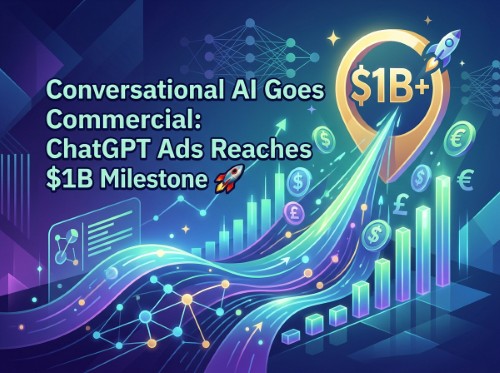
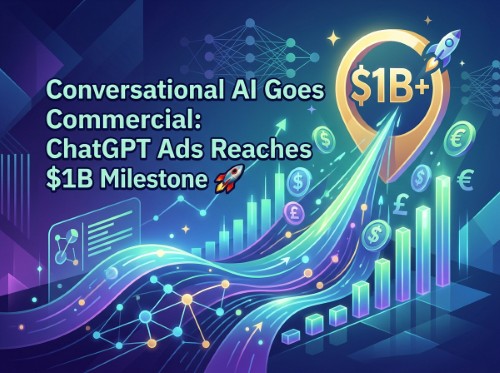
The landscape of digital advertising is undergoing a seismic shift. In fewer than 200 days, OpenAI’s advertising platform—ChatGPT Ads—has shattered industry expectations by reaching a staggering $1 billion annualised revenue run rate.
What began as an experimental managed-sales model has quickly morphed into a global commercial powerhouse. With self-service access now rolling out across India, Europe, the Middle East, and North Africa (MENA), businesses of all sizes are rushing to capture consumer attention where it matters most: inside active, real-time conversations.
Here is an in-depth breakdown of how ChatGPT Ads achieved this record-breaking trajectory, how conversational targeting operates, and what the European Union's latest regulatory moves mean for the platform's future.
When OpenAI initially introduced advertising on ChatGPT, it relied heavily on managed sales, direct agency partnerships, and technology integrations. However, the real catalyst for growth arrived with the introduction of Ads Manager, a self-service portal that opened the platform to small and medium-sized businesses (SMBs).
Today, SMBs account for a substantial share of total ad revenue. The ecosystem now spans more than 40 countries, supported by over 50 technology and measurement partners.
By expanding self-service access to India, Europe, and the MENA region, OpenAI is eliminating friction for international marketers. Advertisers in these key territories no longer need to wait for sales team approvals or route their media buys through third-party agencies. Instead, they can set up an Ads Manager account, configure their budgets, and go live within minutes.
Traditional search engine advertising relies on matching static keywords to query results pages. In contrast, ChatGPT Ads operates directly within an ongoing dialogue.
According to OpenAI, users frequently consult ChatGPT when they are already midway through a critical decision-making process. Whether they are:
By positioning advertisements inside these active conversations, brands can deliver relevant solutions precisely when intent is at its peak.
The underlying ad-serving technology evaluates the immediate context of a user's prompt to surface relevant recommendations. Where permitted by local regulations and user permissions, the system can also draw upon broader account context to refine campaign relevancy over time.
To maintain user trust, OpenAI has established several core advertising principles:
As OpenAI scales its advertising infrastructure across Europe, it faces heightened legal scrutiny from Brussels.
The European Commission recently designated ChatGPT as a Very Large Online Search Engine (VLOSE) under the Digital Services Act (DSA), following confirmation that the platform has surpassed 45 million average monthly users within the European Union. Because ChatGPT integrates web-browsing capabilities alongside conversational responses, regulators classify it as a hybrid service subject to stringent search engine governance.
OpenAI has been granted a four-month compliance window, setting a strict deadline for early 2027. Under VLOSE obligations, the platform must proactively assess and mitigate systemic risks, including:
Regulatory enforcement will be jointly managed by the European Commission and Ireland’s Digital Services Coordinator, Coimisiún na Meán (reflecting OpenAI's European operational base). While this added layer of accountability increases compliance overhead, it also establishes a transparent framework for safe, high-volume ad delivery across EU member states.
As the platform matures, so too do its campaign capabilities. Cost-per-click (CPC) and outcome-optimised bidding strategies now constitute the vast majority of ad spend on ChatGPT.
To help performance marketers measure true business impact, OpenAI has introduced a robust suite of optimisation tools:
Early adopters are reporting impressive returns. In one documented case, an e-commerce retailer achieved a 3x return on ad spend (ROAS) over a 28-day window. Another technology partner revealed that over 80 per cent of traffic driven via ChatGPT Ads originated from brand-new customers, demonstrating the platform’s potential for top-of-funnel customer acquisition.
Reaching a $1 billion run rate in under 200 days is a landmark achievement, but OpenAI is already preparing its next phase of commercial growth.
Future developments are set to include deeper regional rollouts, richer reporting dashboards, and new campaign objectives. Most intriguingly, OpenAI has signalled plans to explore native interactive experiences within ChatGPT—allowing consumers to interact directly with brand tools, configurators, and checkout flows without leaving the conversational interface.
For digital marketers and brand strategists, the message is clear: conversational search is no longer an emerging experiment. It is a vital, high-performing revenue channel that is fundamentally redefining modern digital media strategy.
Disclaimer: This article is provided for informational purposes only, mistakes may be made, and it's not offered or intended to be used as legal, tax, investment, financial, or any other advice.