x




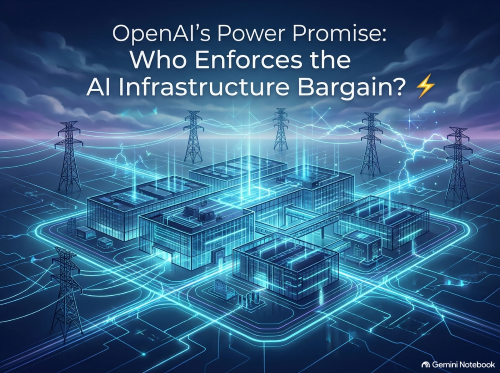
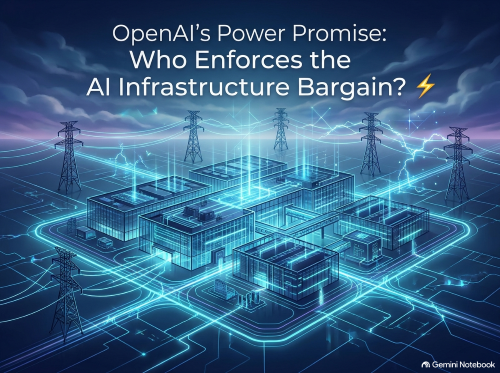
When artificial intelligence models require vast swathes of land, gigawatts of electricity, and millions of gallons of water, the digital revolution stops feeling abstract. Across American towns and suburbs, local communities have voiced severe frustration over the rapid expansion of power-hungry data centres. Rising household utility bills, strain on local electrical grids, and secretive negotiations behind non-disclosure agreements have provoked a distinct voter backlash.
In response to this growing political resistance, OpenAI launched a high-profile charm offensive designed to reshape public perception. The company released a series of commitments promising that local residents will not be forced to foot the bill for AI's immense energy appetite. Yet behind the polished public relations campaign lies a far tougher legal and regulatory question: if OpenAI fails to honour these pledges, who actually has the power to make the company comply?
The friction between artificial intelligence developers and local residents reached a tipping point during recent US midterm elections. Across multiple states, voters and elected officials sent an unmistakable message to Silicon Valley. Out of 41 local ballot measures concerning data centre development, 40 went against unchecked expansion. Gubernatorial candidates who campaigned on promises to halt new permits and tighten construction rules scored major upsets in key states like Georgia, Ohio, Texas, and Pennsylvania.
As detailed in Reuters coverage of OpenAI's charm offensive, industry executives quickly realised that public hostility posed a direct threat to their growth plans. For years, traditional data centres operated as secretive industrial boxes in rural pastures, offering few long-term jobs while placing heavy burdens on municipal water supplies and power grids. When utility commissions approved infrastructure upgrades to accommodate tech giants, the financial burden frequently trickled down to ordinary households through higher monthly electricity rates.
Recognising that public opposition could derail the physical infrastructure needed for frontier AI models, OpenAI moved to overhaul its public strategy and rewrite the rules of engagement with host communities.
Part of OpenAI's strategy involves a deliberate shift in terminology. The company has moved away from the term "data centre," favouring instead the phrase "AI compute campus." Beyond a simple naming rebrand, OpenAI argues that these facilities represent a fundamental shift in economic utility, featuring recurring hardware upgrades every three to five years, ongoing technical employment, and deep integration with regional energy grids.
Central to this effort is the Grid Protectors Program. Under this initiative, OpenAI proposes that future compute campuses will actively support regional electricity grids rather than simply draining them. For instance, at a planned 3.2-gigawatt facility in Effingham County, Georgia, OpenAI entered into a 25-year agreement with Georgia Power that includes up to 1,000 megawatts of flexible demand response. During severe heatwaves, winter storms, or grid emergencies, the campus can temporarily curtail its power consumption, freeing up capacity for local households and helping to keep the lights on.
According to OpenAI's official announcement on responsible AI infrastructure, these arrangements allow massive industrial electricity users to pay for grid modernisation while acting as a shock absorber during peak demand periods. In Georgia, utility projections suggest the broader expansion portfolio could eventually save typical residential customers around $15 per month starting in 2029.
To codify its commitments to host cities, the company published its National Community Compact. The framework outlines several core promises aimed at addressing the primary complaints of local residents:
As highlighted in reporting on OpenAI's power pledges, these promises mark a significant departure from the historical operating habits of major technology companies.
While the commitments made in the National Community Compact sound reassuring on paper, policy analysts and legal experts point out a critical flaw: a corporate pledge is not a legally binding permit condition.
The compact itself contains no statutory enforcement mechanisms, no defined financial penalties for non-compliance, no formal dispute resolution process, and no mandate for independent third-party auditing of energy or water metrics. If a facility produces excessive noise, consumes more water than anticipated, or fails to deliver on its demand-reduction targets during a power grid crunch, the compact provides residents with no clear legal mechanism to compel corrections or recover losses.
Without statutory backing, voluntary corporate commitments rely entirely on corporate goodwill and public pressure. In fast-moving corporate environments—where executive priorities shift, financial pressure mounts, or market conditions change—unenforceable promises can easily fall by the wayside once construction permits are approved and concrete is poured.
An even larger question mark surrounds the scope of OpenAI's commitments. The National Community Compact explicitly states that its rules apply exclusively to compute campuses that OpenAI directly "owns and operates."
In reality, OpenAI does not own or operate the vast majority of the physical infrastructure housing its models. Instead, third-party technology partners, infrastructure funds, and cloud providers—such as Oracle, Microsoft, and SB Energy—build, fund, and maintain these massive facilities, leasing the compute capacity back to OpenAI.
OpenAI has not stated that its compact automatically applies to these partner-owned facilities. This creates a substantial structural loophole: a community could host a giant facility running OpenAI models, only to find that the third-party developer operating the building is under no obligation to honour OpenAI's voluntary ratepayer, environmental, or transparency commitments.
Recognising that voluntary measures alone cannot establish long-term trust, OpenAI simultaneously published its Compute Campus Policy Blueprint. In this document, the company calls upon state legislators, federal regulators, and public utility commissions to translate these concepts into actual law.
The blueprint urges policymakers to mandate large-load utility tariffs, enforce public reporting standards on energy and water usage, prohibit public official NDAs across the entire data centre industry, and establish contractual clawback provisions that allow local governments to reclaim tax breaks if developers fail to meet hiring or investment targets.
For local communities facing the arrival of massive AI infrastructure, the lesson is clear: corporate promises provide a helpful starting point, but true protection requires legislative action. Rather than relying on voluntary compacts, municipal leaders and state lawmakers must codify these standards directly into zoning ordinances, utility contracts, and building permits. Only when pledges carry the force of law can host communities ensure that the benefits of the AI expansion are genuinely shared—and that the bill for powering the future does not end up in the local postbox.
Disclaimer: This article is provided for informational purposes only, mistakes may be made, and it's not offered or intended to be used as legal, tax, investment, financial, or any other advice.