x




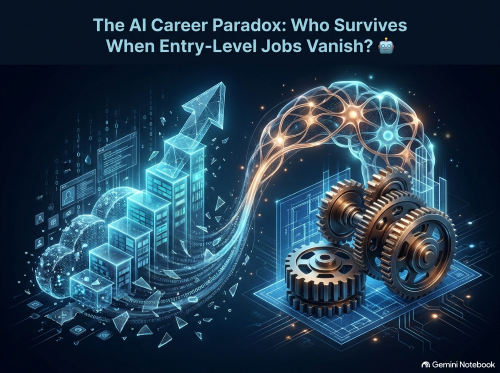
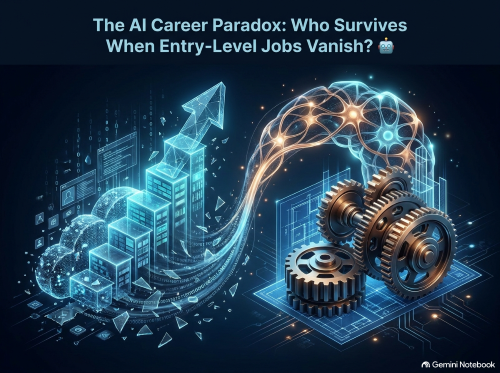
In a compelling episode of the Finance Bureau podcast, host Guy unpacks a stark warning from Palantir chief executive Alex Karp regarding the future of work. Contrary to popular belief, artificial intelligence is not coming for executive boardrooms first. Instead, it is quietly eroding the bottom rungs of the career ladder—the entry-level roles that have long served as the ultimate training ground for young professionals. From junior coders to graduate legal associates, the routine tasks that once taught new entrants the ropes are rapidly being automated away. However, Karp argues that the future is far from hopeless. In fact, he highlights two distinct groups of workers who are poised to thrive in this new landscape: skilled tradespeople and neurodivergent thinkers.
For decades, entering the professional world followed a familiar pattern. University graduates landed entry-level roles at tech firms, law practices, or publishing houses. Junior software engineers spent their days debugging code and resolving minor ticket queues. Graduate solicitors laboured over routine contracts, scanning endless clauses to catch potential pitfalls. Young copywriters crafted basic product descriptions and standard marketing emails.
These tasks were undoubtedly repetitive, but they served a vital purpose. They functioned as a practical apprenticeship, building the deep intuition and professional judgment needed to handle complex senior responsibilities. Today, large language models and automated workflows complete these initial tasks in seconds. While senior executives, partners, and lead editors remain secure for now, the elimination of junior roles creates a worrying dilemma: if the starting steps disappear, how does anyone gain the experience required to reach the top?
This workplace shift exposes a fundamental flaw in traditional higher education. For years, universities have conditioned students to follow rigid frameworks, absorb standardised information, and produce predictable outputs. According to Karp, this emphasis on academic compliance is precisely what makes traditional graduates vulnerable.
Generic humanities degrees and corporate training playbooks teach people how to run pre-existing processes. Yet, any process that can be written down step-by-step is inherently easy for artificial intelligence to master. As software takes over routine cognitive tasks, holding a degree that merely proves an ability to follow instructions is no longer a guarantee of job security.
The first group positioned to flourish in the AI era consists of practical, hands-on workers: electricians, plumbers, carpenters, and welders. For years, school guidance counsellors steered ambitious students away from these fields, framing vocational paths as secondary options. Today, those very trades boast a structural advantage against automation.
This phenomenon is explained by Moravec’s paradox—the principle that tasks humans find intellectually demanding, such as advanced logic or coding, are relatively straightforward for computers, whereas basic physical interactions are extraordinarily difficult for machines. Imagine a plumber entering an old property with flooded foundations and no architectural diagrams. Diagnosing a cracked cast-iron pipe requires physical inspection, subtle acoustic cues, tactile feedback, and real-time problem-solving in a cramped space. A computer model can recite building regulations perfectly, but it cannot navigate the physical, unpredictable reality of a wet basement.
The second group set to succeed includes individuals whose minds naturally depart from conventional patterns—those with dyslexia, ADHD, or autism. In traditional corporate environments, neurodivergent traits were frequently viewed as obstacles because they conflicted with rigid hiring metrics and standardised performance evaluations.
In an AI-driven economy, however, non-linear thinking becomes an invaluable asset. Karp, who is severely dyslexic himself, notes that individuals who struggle with traditional step-by-step instructions are forced to develop alternative ways of processing information. When algorithms execute standard business playbooks faster and more accurately than any human, the greatest value lies in those who cannot help but see problems from unconventional angles. An ADHD thinker who thrives in ambiguity, a dyslexic strategist who grasps big-picture connections instantly, or an autistic engineer who detects subtle anomalies in data brings something no language model can replicate.
Rather than merely talking about these shifts, Palantir has actively reorganised its talent acquisition strategies. The firm launched the Meritocracy Fellowship, recruiting high school leavers with strong quantitative aptitude directly into paid roles, completely bypassing university credentials. Uniquely, the programme opens with five weeks of intensive study in history, philosophy, and classic literature to cultivate independent critical reasoning before fellows join live engineering projects.
Additionally, Palantir introduced a specialised Neurodivergent Fellowship designed to recruit self-taught talent and non-traditional thinkers across software and operational roles, with Karp personally conducting final interviews. By removing traditional academic filters, the company is assembling a workforce built on practical capability and creative problem-solving rather than institutional compliance.
The evolving job market demands a fundamental mindset shift. Safety no longer lies in memorising standard procedures or collecting generalist credentials. Moving forward, the most secure careers will belong to those who either master the physical complexities of the real world or cultivate distinctive, non-standard ways of thinking. Whether fitting specialised infrastructure or solving intricate data puzzles, resilience in the age of AI belongs to the workers machines cannot easily copy.
"AI isn’t coming after your boss’s job. It’s coming after the starting roles. The easy tasks that used to teach people the ropes. Coders, lawyers, and writers who started at the bottom now find their work automated away.
But Palantir’s CEO says two types of workers will come out ahead: skilled tradespeople and neurodivergent thinkers. This video shows which jobs are vanishing first, which jobs are safest from AI, and what it means for anyone choosing a path today."
~ TIMESTAMPS ~
00:00 - The White-Collar Job Crisis & AI Takeover
01:57 - The 2 Types of People Safe From AI (Palantir CEO)
04:36 - Why Universities Are Preparing You For Failure
06:08 - Group 1: The High-Paying Skilled Trades Boom
07:20 - Moravec’s Paradox: Why AI Can't Fix Physical Problems
08:14 - Group 2: Why Neurodivergent Thinkers Outsmart AI
10:48 - Inside Palantir’s Unconventional $200k/Yr AI Hiring Strategy
13:48 - What the Future Job Market Looks Like After AI
Source: 👉 https://www.youtube.com/watch?v=RU83c3cSXxw
Disclaimer: This article is provided for informational purposes only, mistakes may be made, and it's not offered or intended to be used as legal, tax, investment, financial, or any other advice.