x



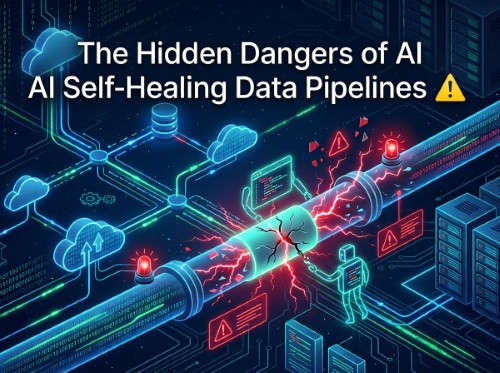
In modern cloud-native environments, infrastructure failures are handled with astonishing elegance. When a microservice crashes, circuit breakers trip, network traffic reroutes seamlessly, and container orchestration platforms like Kubernetes spin up replacement pods in seconds. The end user rarely notices even a momentary flicker in service.
Yet, inside the enterprise data stack, reliability remains surprisingly fragile.
A third-party vendor updates an API schema overnight; a legacy upstream system silently alters an integer field into a string; or an extract, transform, load (ETL) pipeline completes without error while quietly dropping fifteen per cent of its payload. Downstream, executive dashboards showcase skewed revenue figures, regulatory compliance breaks, and automated financial engines make decisions based on corrupted inputs.
To solve this, many tech leaders have embraced the concept of "self-healing data pipelines" driven by artificial intelligence. The promise is tempting: let autonomous AI agents monitor, diagnose, and automatically patch broken data pipelines in real time.
However, delegating automatic repair duties to AI introduces severe operational risks. In mission-critical environments, allowing AI to repair data pipelines with heuristic guesswork is a recipe for silent data corruption.
To build robust, future-proof data ecosystems, organisations must move away from reactive, AI-driven auto-repair and instead adopt Autonomous Data Governance built on resilient, deterministic infrastructure.
The central flaw of relying on AI to repair data pipelines lies in how machine learning models handle ambiguity. AI agents excel at pattern recognition and anomaly detection, but when tasked with repairing broken datasets or fixing schema mismatches on the fly, they rely on probability and heuristics.
If an autonomous script "guesses" how to impute a missing primary key in healthcare records or infers a missing currency conversion in financial transactions, it introduces synthetic errors.
Unlike a clean pipeline crash—which immediately alerts engineering teams—synthetic errors quietly pollute downstream reporting and machine learning models. The system appears healthy, but the underlying data is compromised.
As enterprise data footprints expand across multi-cloud environments, data failures rarely manifest as simple, hard stops. Instead, they appear as silent degradation that traditional monitoring tools miss:
1. Schema Drift
Upstream source systems continuously evolve. When an engineer alters a field name or data type without informing downstream data teams, analytical pipelines break or misinterpret the incoming payload.
2. Semantic Corruption
Data may arrive on time, fully formatted, and pass basic structural validation. However, if the business logic behind the data has shifted—such as a change in how "active users" or "gross revenue" is calculated upstream—the data becomes semantically misaligned with business operations.
3. Lineage Darkness
When a pipeline encounters an anomaly, legacy architectures often fail to map the blast radius. Engineering teams know a failure occurred, but they cannot identify which executive reports, customer-facing recommendation models, or regulatory filings were infected by the bad data.
Rather than allowing AI models to patch pipelines with unverified fixes, modern enterprise data architectures require embedded, deterministic safeguards. True resilience is achieved by embedding governance directly into the execution engine through three foundational pillars:
Pillar 1: Declarative Data Contracts with Dynamic Negotiation
Traditional ETL pipelines operate on hardcoded assumptions—if incoming data deviates from expected rules, the entire job halts.
A resilient architecture uses declarative data contracts enforced at ingestion. When source data violates an established schema or business logic rule, the platform dynamically negotiates the payload. Anomalous records are instantly quarantined into isolated staging environments for investigation, while valid records continue downstream uninterrupted. This prevents pipeline halts without compromising data quality.
Pillar 2: Deterministic Remediation Over Heuristic Guesswork
While machine learning is invaluable for identifying subtle anomalies, remediation in mission-critical environments must remain strictly deterministic and auditable.
Autonomous data governance pairs ML anomaly detection with pre-defined, policy-driven remediation workflows. If an unexpected drift is detected, the platform isolates the affected batch, applies historical, rule-based fallback logic, and generates a pre-computed diagnostic report for human review. The platform manages the workflow autonomously, but the repair rules remain transparent and auditable.
Pillar 3: Zero-Trust Data Lineage
Data pipelines must adopt a zero-trust model. Every transformation stage should explicitly verify the provenance, quality score, and security classification of a dataset before permitting it to advance to the next step.
If a dataset's quality score drops below a pre-configured threshold, downstream dependencies—such as real-time decision engines or financial dashboards—automatically pause updates or switch to verified, cached data states until the anomaly is resolved.
Architectural frameworks are only as effective as the engineering practices behind them. Achieving true operational agility requires a fundamental shift in leadership strategy and engineering culture:
As organisations transition from passive business intelligence to active, autonomous AI workflows, data pipeline reliability is no longer merely an IT maintenance issue—it is a core business risk.
Relying on unguided AI agents to repair broken data workflows creates a false sense of security while introducing hidden corruption. By combining predictive AI detection with deterministic remediation, dynamic data contracts, and zero-trust lineage, enterprise data leaders can build a resilient foundation capable of supporting the next generation of artificial intelligence.
Disclaimer: This article is provided for informational purposes only, mistakes may be made, and it's not offered or intended to be used as legal, tax, investment, financial, or any other advice.