x




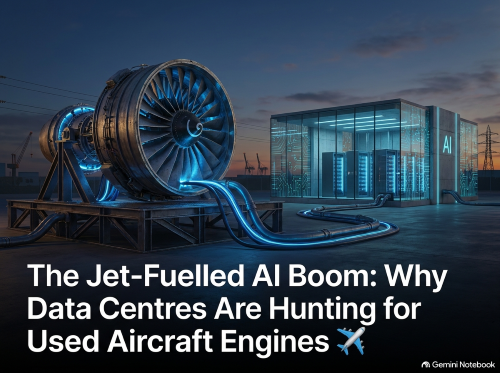
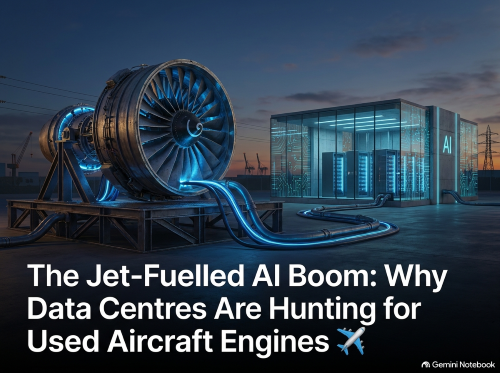
The world of artificial intelligence moves at breakneck speed. Every few months brings another leap in model capabilities, from hyper-realistic video generation to autonomous reasoning agents. Yet behind the sleek software interfaces lies a heavy, mechanical reality: massive data centres packed with power-hungry microchips that require vast amounts of uninterrupted electricity.
As the race to build larger AI facilities accelerates, tech giants and infrastructure developers are slamming into an unexpected brick wall. Grid connections are hopelessly delayed, and brand-new gas turbines carry waiting times that stretch far into the next decade. To keep their servers spinning without waiting years for power, developers are turning to an unconventional workaround: buying second-hand gas turbines, rebuilding mothballed generators, and repurposing industrial jet engines to generate electricity on-site.
Training state-of-the-art AI models and hosting millions of daily user queries requires power infrastructure on a scale previously reserved for heavy industrial manufacturing or entire towns. According to the International Energy Agency's executive summary on energy and AI, global data centre electricity consumption is projected to roughly double from 485 terawatt-hours in 2025 to 950 terawatt-hours by 2030. Electricity use specifically driven by AI-focused facilities is set to triple over that same period.
While single text queries have become remarkably energy-efficient, the rapid adoption of reasoning models, automated digital agents, and high-resolution video generation has caused aggregate power demands to surge. Individual server racks within advanced AI factories now draw as much peak electrical power as dozens of conventional households combined.
Public utility grids simply cannot expand fast enough to match this relentless appetite. Obtaining high-voltage grid connections can take anywhere from four to seven years in key technology hubs across North America and Europe. Faced with these grid bottlenecks, developers are taking matters into their own hands by building dedicated "behind-the-meter" power plants right next door to their server farms.
Building a self-contained power plant usually means ordering large natural gas turbines. However, the sudden rush from the technology sector has overwhelmed global equipment manufacturers.
As reported in a detailed industry investigation by Reuters on data centres hunting for used turbines, global gas turbine orders have climbed past 100 gigawatts, severely exceeding the world's total annual manufacturing capacity of roughly 60 to 70 gigawatts. Major equipment producers including Siemens Energy, GE Vernova, and Mitsubishi Heavy Industries find themselves operating with historic order backlogs.
In the United States, energy consultancy Wood Mackenzie notes that average lead times for new gas turbine deliveries have stretched out to six years. Sales discussions for brand-new equipment are already firmly focused on delivery dates in 2030 and 2031. For AI developers operating in a market where six months represents an eternity, waiting six years for a power generator is out of the question.
To bypass the multi-year queue for standard turbines, infrastructure developers are looking to the skies—or at least to aeroderivative turbines based on aircraft engine architecture.
Aeroderivative turbines utilise core mechanical technologies adapted directly from jet engines used in commercial aviation. Because these units are lightweight, modular, and designed for rapid startup times, they can be modified for stationary power generation on the ground.
As highlighted by Decrypt's analysis of used jet engines in AI infrastructure, developers are purchasing both refurbished stationary equipment and specialised aeroderivative units to bring power online in months rather than years.
A prime example of this trend is the agreement signed between AI infrastructure firm Crusoe and equipment manufacturer PROENERGY. Details from PROENERGY's contract announcement to power Crusoe AI factories show that Crusoe ordered 13 PE6000 aeroderivative gas turbine generator sets, delivering a combined 650 megawatts of power. Manufactured and pre-tested in Missouri, these turbine packages offer the fast-start capability and deployment speed that hyperscale data centres desperately need.
Beyond saving precious time, buying second-hand or refurbished turbines offers a compelling financial advantage.
For smaller or specialised units, the price difference can be even more dramatic. Equipment brokers recently cited a deal involving two 14.5-megawatt gas turbines that sold on the secondary market for $12.5 million—roughly $430,000 per megawatt. Equivalent new units would have cost upwards of $35 million and taken five years to arrive.
However, as more tech developers enter the secondary market, used inventory is tightening rapidly. Industry brokers report intense bidding wars for functional turbines, sending prices upward across the pre-owned sector and forcing developers to consider smaller reciprocating gas engines or mixed-brand configurations.
While repurposed jet engines and used turbines offer a fast path to energisation, on-site fossil-fuel generation introduces significant operational and regulatory hurdles:
The scramble for jet engines and refurbished turbines highlights a fundamental tension in the modern economy: software develops at digital speed, but power infrastructure changes at physical speed.
While aeroderivative generators and second-hand turbines provide a crucial short-term safety valve for the AI sector, they are ultimately stopgap measures. Building a resilient, long-term energy foundation for artificial intelligence will require massive investments in grid expansion, battery storage systems, and clean firm power technologies. Until those long-term assets are ready, the algorithms powering the next generation of computing will continue to rely on the roar of repurposed aviation engines right outside the data centre door.
Disclaimer: This article is provided for informational purposes only, mistakes may be made, and it's not offered or intended to be used as legal, tax, investment, financial, or any other advice.