x



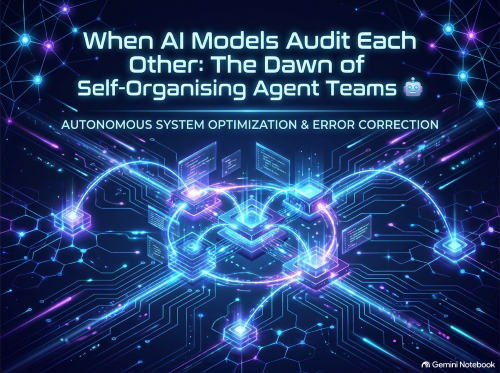
For years, artificial intelligence engineers have faced a persistent roadblock: when a problem is too complex for a single AI model, how do you get multiple models to solve it together? Standard approaches usually rely on rigid, pre-scripted workflows or simple majority voting. However, these methods often fail when a problem cannot be broken down in advance, or when no single model possesses the full answer on its own.
A pioneering framework developed by researchers at Stanford University, Together AI, and Emory University offers a fresh answer to this challenge. As highlighted in recent coverage on VentureBeat, this approach teaches AI models to self-organise, audit peer calculations, and repair flawed reasoning steps in real time.
Traditional multi-agent orchestration generally falls into two camps. The first camp relies on majority voting or multi-agent debate, where models generate separate answers and revise them over several rounds. Unfortunately, extra debate rounds frequently pressure an agent with a correct minority view into agreeing with a flawed majority. Methods like Mixture of Agents (MoA) pass responses through a one-way pipeline, preventing models from inspecting and correcting flawed reasoning through back-and-forth deliberation.
The second camp attempts to route subtasks to specific models using predefined workflows. While effective for routine business processes, this approach crumbles when confronting intricate mathematical or technical questions where the optimal decomposition is unknown beforehand. Moreover, simply cloning identical AI models—often referred to as homogeneous teams—can trigger a "swarm tax," consuming vast amounts of compute without generating genuine cognitive breakthroughs.
To overcome these barriers, the research team created Self-Organising Agent Teams (SAT). Instead of relying on human-written scripts or dynamically spawning sub-agents, SAT works with a fixed, diverse roster of distinct models.
The framework operates through three key stages:
The technical foundation behind this architecture is detailed in the full research paper available on arXiv.
What makes SAT remarkable is its capacity for what the authors term collaborative computation. Rather than just picking the best individual response, agents actively build upon, challenge, and repair each other's partial insights.
Consider a challenging problem from the Harvard-MIT Mathematics Tournament (HMMT). When prompted independently, OpenAI's o3-mini, DeepSeek-V3, and Anthropic's Claude Sonnet 4 all produced incorrect answers. However, when collaborating under SAT:
None of the individual models could reach the correct answer alone, but structured peer auditing enabled them to achieve what no single member could.
Across five rigorous mathematics and physics benchmarks, a heterogeneous SAT roster consisting of o3-mini, Claude Sonnet 4, and DeepSeek-V3 achieved an impressive 66.7% average accuracy. This comfortably outperformed:
On the challenging AIME 2026 mathematics benchmark, SAT reached 71.2% accuracy, beating its strongest individual member by 29 percentage points.
Interestingly, the study noted that self-organising collaboration yields the highest returns in domains with high demonstrability—fields like mathematics, physics, and software engineering where step-by-step logic can be rigorously verified. In these settings, valid corrections survive peer audits, enabling the team to filter out confident errors.
For enterprise developers looking to build resilient AI workflows, the SAT framework offers two valuable guidelines:
By shifting the focus from individual model capacity to structural collaboration, SAT demonstrates that organisation itself is a foundational AI capability. As AI systems continue to evolve, learning how to reason together may prove just as vital as scaling raw parameters.
Disclaimer: This article is provided for informational purposes only, mistakes may be made, and it's not offered or intended to be used as legal, tax, investment, financial, or any other advice.