x




Mutual Bombardment Ignites the Gulf and Buries the Memorandum of Understanding... Trump Tests Erdogan in the NATO Trap, and Millions in Najaf and Karbala Pave the Way for the Hour of Decision After "Mashhad" — Talal Nahle
Wednesday, July 8, 2026 (Day 130 of the War – Day 21 since the signing of the Memorandum of Understanding)
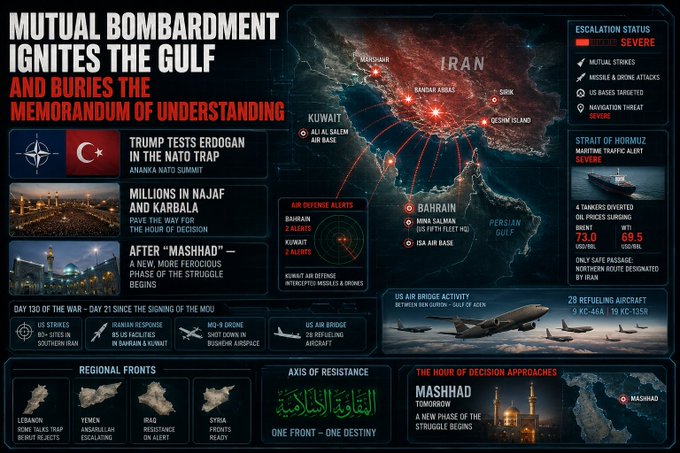
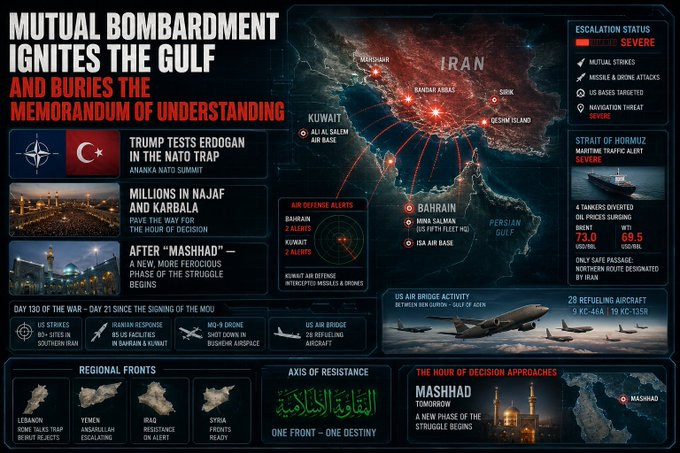
The regional confrontation entered a phase of massive explosion today, signaling the de facto collapse of the Memorandum of Understanding (MoU) between Washington and Tehran on its twenty-first day. The Gulf arena has transformed into a mutual ballistic and drone firing range, as the US Central Command carried out extensive strikes on southern Iran, to which Tehran responded with a sweeping targeting of US military facilities in Bahrain and Kuwait.
This accelerating military escalation coincides with a dangerous strategic shift led by US President Donald Trump from Ankara, exploiting the NATO summit to incite his European allies and place Turkish President Recep Tayyip Erdogan before a historic and decisive test. On the other side, the crowds of millions in holy Najaf and Karbala, who are mourning the body of the martyred Imam Ali Khamenei today, are drawing the features of the ideological and field cohesion of the capital of the Axis of Resistance. This paves the way for his burial tomorrow, Thursday, in Mashhad—a moment that will signal the launch of a new, more ferocious phase of the military and political struggle.
First: The Gulf Inferno... Extensive US Strikes and an Iranian Response Striking Deep in Bahrain and Kuwait
The past hours witnessed an unprecedented military escalation since the signing of the MoU, as both parties bypassed the stage of warning messages into a direct and extensive firefight:
US Raids on Southern Iran: President Donald Trump issued orders from his residence in Turkey to carry out massive aggressive attacks, described as four to five times stronger than last week's strikes. The US Central Command (CENTCOM) announced targeting over 80 sites with precision munitions, including air defense systems, command networks, coastal radar sites, and cruise missile sites in Hormozgan Province, the city of Mahshahr, Bandar Abbas, Sirik, and Qeshm Island, in addition to targeting about 60 Revolutionary Guard boats. The aggression resulted in the martyrdom of one Revolutionary Guard Navy personnel in Mahshahr and damage to commercial and fishing port docks.
The Devastating Iranian Response (85 Military Facilities): Tehran did not delay in activating its "offensive doctrine"; the naval and air forces of the Revolutionary Guard and the Iranian Army carried out vast, joint operations using ballistic missiles and drones. They targeted 85 US military facilities at the Fifth Fleet headquarters in Mina Salman and Isa Air Base in Bahrain, as well as Ali Al Salem Air Base in Kuwait.
Downing the US Drone and Air Defense Alert: The Revolutionary Guard's air defenses successfully shot down an advanced American MQ-9 spy drone in the airspace of Bushehr Province. Conversely, warning sirens sounded twice in Bahrain and Kuwait, with the Kuwaiti army announcing that its air defenses intercepted intense missile and drone attacks.
The US Air Bridge (28 Refueling Aircraft): Navigational monitoring devices revealed intense US aerial activity between Ben Gurion and the Gulf of Aden, represented by the flight of 28 mid-air refueling tankers (9 KC-46A and 19 KC-135R aircraft). This confirms that Washington is managing a continuous and complex aerial operation to provide cover for its fighters and drones in the inflamed airspace of the region.
Second: The Paralysis of Hormuz and the Energy Shock... Tehran Establishes the "Sole Corridor" Equation
The military developments have paralyzed navigation in Western-backed corridors and imposed harsh economic and maritime realities:
Fleeing Tankers and Surging Oil Prices: Vessel tracking data (Reuters) confirmed that at least four oil and gas tankers immediately abandoned attempts to cross the Strait of Hormuz and changed course, following the UK Maritime Trade Operations (UKMTO) raising the threat level to "severe," and after the targeting of the Qatari gas tanker "Al Rekayyat" and the Saudi tanker "Wadiyan." This paralysis led to an immediate jump in energy prices, with Brent crude rising to 73 USD per barrel and US crude to 69.5 USD.
Diplomatic Clash and the Cancellation of Oil Waivers: The US State Department announced the cancellation of the temporary suspension of sanctions imposed on Iranian oil. The Iranian response came decisively through the Foreign Ministry, Parliament Speaker Mohammad Bagher Ghalibaf, and the Khatam al-Anbiya Headquarters, asserting that America has emptied the MoU of its substance. They declared that the only safe passage for ships is the northern route designated by Iran, and America will not be allowed to interfere in the management of the strait. Tehran also issued a stern warning to neighboring countries that any base from which aggression is launched will be a legitimate target for strikes.
Third: The NATO Trap in Turkey... Trump Incites Europe and Erdogan Faces Decisive Hours
The Turkish capital, Ankara, is witnessing one of the most dangerous geopolitical maneuvers today. President Donald Trump succeeded in turning the NATO summit into a platform for military mobilization against Iran, using the symbolic location of the summit in Turkey to exert pressure on the Turkish leadership.
American Entanglement of Europe: Statements by NATO Secretary-General Mark Rutte, in which he considered the US attacks on Iran "absolutely necessary" and announced the alliance's support for them, confirm that Trump has managed to drag European countries into the regional struggle. He aims to share the cost of the economic and military confrontation with them after realizing America's inability to bear the burden alone.
Erdogan's Existential Test: Placing the NATO summit specifically in Ankara was designed to force a choice upon President Recep Tayyip Erdogan. Trump is publicly offering the Turkish leadership an ultimatum: either stand completely with NATO and join the Western axis against Tehran (along with incentives tied to lifting sanctions and returning Turkey to the F-35 fighter program, currently being discussed by US Secretary of Defense Pete Hegseth in Tel Aviv), or align with its Iranian neighbor and the Axis of Resistance, which rejects Zionist hegemony. The coming hours will be absolutely critical in revealing the final Turkish stance, which will determine the balance of power in the Middle East for decades to come.
Fourth: The Flood of Najaf and Karbala... Ideological Cohesion Precedes the Hour of Decision in Mashhad
The eyes of the world turn to Iraq today, as the holy cities of Najaf and Karbala witness a majestic funeral and a million-man farewell march for the body of the martyred Imam Ali Khamenei, in a scene that exceeds expectations and redraws the religious and political map of the region.
The Historic Farewell in Najaf and Karbala: The pure coffin arrived at Najaf International Airport, where it was officially received by the Iraqi leadership with the participation of Iranian President Masoud Pezeshkian. Crowds of millions marched between the Two Holy Shrines, where Sheikh Abdul Mahdi Al-Karbalaei is leading the masses of believers in the funeral prayer at the Holy Imam Hussein Shrine. This visually echoes the funerals of the martyrs Qasem Soleimani and Abu Mahdi al-Muhandis, proving that Iraq and Iran form a single, cohesive front against American schemes.
After the Mashhad Burial... The Launch of the New Phase: This massive Iraqi and Iranian popular rallying is not merely a farewell, but a comprehensive spiritual and military mobilization preceding the transfer of the body tomorrow, Thursday, to the city of Mashhad to be laid to rest at the shrine of Imam Ali ibn Musa al-Ridha. The conclusion of the burial ceremonies tomorrow will shatter the temporary timeframe for de-escalation and field restraint to which the resistance committed across various fronts. Immediately thereafter, a new and accelerated phase of military and political struggle will begin, governed by the doctrine of existential revenge and retribution.
Fifth: The Lebanon Front... The Rome Negotiations Trap and Maneuvers to Hand Over the Litani
In light of the Gulf's ignition, Washington and Tel Aviv are attempting to bypass the Lebanese arena by engineering a new political trap in Europe:
Lebanese Rejection of the Rome Negotiations: The Italian Foreign Ministry announced it would host direct talks between the Lebanese and Israeli ambassadors on July 15 and 16 at an American request. While the Lebanese Ambassador in Washington, Nada Mouawad, advised President Joseph Aoun to participate, a Lebanese diplomatic source told Al Jazeera, along with official sources, that Beirut refuses to hold this sixth round.
Simon Karam's Warnings and Enemy Intentions: The Lebanese rejection was backed by decisive advice from former Ambassador Simon Karam to Presidents Aoun and Salam not to participate, affirming that Israel has no intention of implementing any withdrawal steps. Karam revealed that Tel Aviv pledged, the day after signing the Washington agreement, to hand over positions north of the Litani and a village to its south to the Lebanese Army, but it quickly backtracked and tied the move to new, impossible conditions. He asserted that all messages received from the occupation prove it only wants a return to war, which the occupation army translates on the ground by continuing its aggressions and announcing the assassination of a resistance fighter in Bint Jbeil today.
Conclusion and Strategic Trajectories
Today's events confirm that the Middle East has definitively turned the page on the "Memorandum of Understanding" to enter an open clash. Trump made a mistake when he thought that striking southern Iran would force Tehran to back down; the response came swiftly from the heart of Bahrain and Kuwait, proving that American bases have become hostages at the mercy of Iranian missiles and drones.
Trump's incitement of NATO and his cornering of Erdogan into a difficult choice at the Ankara summit will not change the reality of the maritime arena in Hormuz, where Tehran has imposed its absolute sovereignty with iron and fire and emptied the Western corridors of tankers.
Therefore, the coming hours until the burial of the martyred leader in Mashhad tomorrow, Thursday, represent the calm before the great storm. With the laying of the body to rest, the resistance will be freed from the chains of its temporary discipline, launching the accelerating military and political struggle with all its weight. Israel will find itself powerless to impose its conditions in Rome or southern Lebanon, while Washington and its allies sink into a war of attrition over energy and bases that will not end except with a structural and comprehensive change in the balance of power in the region.
source https://x.com/Intel_Sky/status/2074769834752057756?s=20