x




The "Economic Strangulation" Dilemma and the Exposure of Allies: Washington Halts the Diplomatic Track, and Tehran Threatens to Bring the Fire to Europe and Cut Submarine Cables — Talal Nahle
Introduction (The General Strategic Scene)
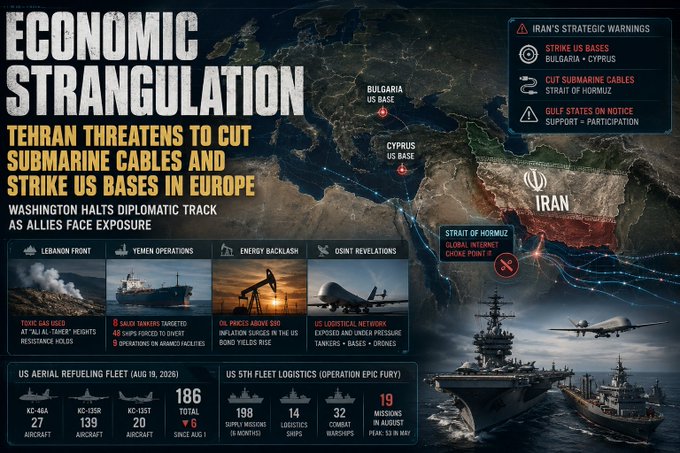
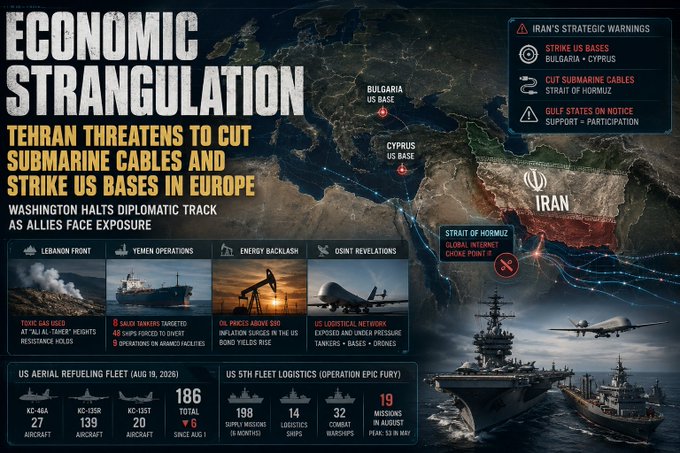
On the sixty-third day since the collapse of the memorandum of understanding (Wednesday, August 19, 2026 - Day 172 of the war), the regional conflict has entered a phase of "comprehensive deadlock" after the expiration of the temporary understanding's timeframe without any political progress. While President Donald Trump ordered the suspension of diplomatic contacts with Tehran and a shift toward a strategy of "gradual economic strangulation" and expanded sanctions, Tehran dealt a crushing blow to these orientations by asserting that there were never any direct negotiations with Washington to begin with. Furthermore, Tehran threatened to move the battle to US bases in southeastern Europe (Bulgaria and Cyprus) and to cut the fiber-optic cables in the Strait of Hormuz.
This escalation coincided with the backlash of inflation and oil prices rising above $90 taking a toll on the US economy. Meanwhile, Sana'a continued to choke the Saudi oil lifeline by targeting 8 tankers, and the resistance in southern Lebanon confronted an Israeli advance attempt at the "Ali Al-Taher" heights, during which the occupation utilized toxic gases. All of this unfolds amid sweeping open-source intelligence (OSINT) revelations exposing US naval and aerial logistical and supply networks.
Axis I: The Death of Diplomacy and the Threat to Strike the European Depth and Internet Cables
The Collapse of the MoU and Washington's Shift to "Strangulation": The US administration officially announced the end of the temporary understanding's effects. Trump instructed his team to halt the diplomatic track, pivot toward tightening economic sanctions, and activate a naval blockade to force Tehran's surrender and prevent it from acquiring a nuclear weapon. In response, Iranian sources denied allegations of canceled negotiations, emphasizing that "there are no negotiations with Washington to be canceled," and that previous dialogue was limited to Muscat solely for organizing navigation, which halted after US violations.
A Target Bank in Southeast Europe: The Financial Times revealed that the Iranian leadership is studying options to strike US military targets and bases in southeastern Europe, specifically in Bulgaria and Cyprus (where previously targeted British bases are located), should Washington choose to escalate the war.
The Submarine Cables Card... "The Digital Earthquake": Tehran has placed the option of severing submarine fiber-optic cables passing through the Strait of Hormuz on the strategic pressure table. This step represents a paralysis of over 30% of global internet traffic. It would devastate banking transactions and the data centers of major tech companies (Amazon, Meta, and Google) in the Gulf states (UAE, Qatar, Kuwait, and Bahrain) at a near-zero execution cost, while creating repair complications that would require weeks and sovereign maritime approvals.
A Stern Warning to Gulf States: The Iranian Armed Forces issued a direct warning to the southern Gulf states, asserting that the deployment of refueling aircraft and US bases on their territories cannot happen without their governments' knowledge. They warned that providing these facilities constitutes actual participation in the war, placing those countries in the crosshairs of direct targeting. Tehran also accused Abu Dhabi of engaging in the economic war by fabricating missile narratives to justify US Treasury actions.
Axis II: The Lebanese Front... Toxic Gas in "Ali Al-Taher" and the Israeli Right's Maneuvers
Toxic Gas in "Ali Al-Taher": In an attempt to isolate a key resistance stronghold, an Israeli force attempted to advance toward a small facility in the "Ali Al-Taher" heights. The resistance valiantly confronted the advancing force, prompting the enemy to heavily deploy toxic gases toward the facility. This forced the fighters into a tactical retreat, resulting in the martyrdom of two fighters while the rest of the group withdrew safely, leaving the hill as an intractable knot preventing total collapse.
Systematic Destruction in the Villages: The occupation army continued its scorched-earth strategy, executing 3 massive explosions that shook the towns of Bani Haiyyan and Tallousa in an attempt to obliterate residential neighborhoods and eliminate any possibility of the residents' return.
Naftali Bennett's Security Proposals: Former Israeli Prime Minister Naftali Bennett revealed his security approach should he return to lead the government. He called for "flipping the equation" by making any gunfire from Hezbollah a direct pretext to strike Iran, officially classifying Qatar as an "enemy state," expelling Doha and Ankara from the Peace Council arrangements, and bringing in Egypt as a replacement. This reflects the Israeli right's inclination to expand the regional war to escape the military deadlock in Lebanon.
Axis III: The Energy War and Sana'a's Strikes... The Blockade Backfires on the US Economy
The Harvest of Yemeni Operations Against Aramco and Shipping: The Yemeni Armed Forces announced the toll of their military operations over a full month (from July 20 to August 19). They executed naval operations targeting 8 Saudi oil tankers and forced 48 other ships to retreat and alter their course. They also carried out 9 operations targeting vital facilities in Yanbu, Najran, Jizan, Abha, and the Eastern Province, alongside 14 attacks on land and naval mobilizations that resulted in extensive losses.
The Inflationary Backlash on Washington: Politico confirmed that Trump's gamble to economically bleed Iran has begun to backfire domestically in the US. Oil has stabilized above the $90-per-barrel mark, government borrowing costs and bond yields have risen, and fears of a prolonged inflationary wave paralyzing the markets ahead of the midterm elections are mounting.
The Navigational Dilemma in Hormuz: Shipping traffic recorded operational confusion as the oil tanker (Hestia) suddenly changed its course off the Emirati coast after attempting to cross via the Omani safe corridor, retreating back toward the Gulf of Oman to hold in the waiting area. Contrary to US propaganda claiming that 80% of ships cross through the Omani corridor, field tracking data confirms that more than 80% of actual transit traffic continues to pass under the supervision of the Iranian corridor.
Axis IV: Open-Source Intelligence (OSINT)... Dissecting the US Logistical Nerve
Decline in the Aerial Refueling Fleet (Tankers ORBAT): Aerial tracking data documented the presence of 186 US Air Force refueling aircraft in the (CENTCOM / EUCOM) theaters on August 19, 2026 (a decrease of 6 aircraft since the beginning of the month):
27 KC-46A Pegasus aircraft: (10 in the occupied territories, 6 in Qatar, 10 in Lajes, Portugal, 1 in the UK).
139 KC-135R Stratotanker aircraft: (54 in Israeli bases, 23 in Saudi Arabia, 3 in the UAE, 1 in Diego Garcia, with the rest distributed among Romania, Greece, Italy, France, and the UK).
20 KC-135T aircraft: (4 in Israel, 2 in the UAE, 1 in Saudi Arabia, and the rest in Europe).
Analysis of the Naval Supply Network (Operation Epic Fury Logistics): Logistical auditing data of the US 5th Fleet's operations (across 198 documented supply missions over 6 months involving 14 logistical ships and 32 combat warships) revealed a notable decline in the pace of logistical support. May marked the peak of operations with 53 supply missions, whereas activity dropped in August to just 19 missions. Fleet replenishment oilers (Henry J. Kaiser and John Lewis) and dry cargo ships (Lewis and Clark Class) bore the brunt of securing aircraft carriers and destroyers (such as the destroyer Delbert D. Black and the aircraft carrier Abraham Lincoln).
The Return of Reconnaissance Drones: The strategic maritime reconnaissance drone (MQ-4C Triton, tail number 169660) was spotted returning to operation from the "Prince Hassan" base in Jordan after being previously withdrawn to Sicily. This aims to compensate for the losses of the MQ-9 and intensify surveillance over Gulf waters.
Conclusion and Strategic Outcomes
The events of August 19 prove that the war has entered a blind alley where the options for Washington and Tel Aviv are rapidly eroding. The Trump administration's transition to a policy of "economic strangulation" is an indirect admission of the inability to achieve a military resolution. However, this weapon is directly backfiring in the form of rising energy prices, inflation, and an inability to protect regional allies who have become financially and securely exposed.
Faced with the Iranian threat of "asymmetrical warfare" (cutting internet cables and striking US bases in Eastern Europe), Sana'a's continued depletion of the Saudi oil nerve, and the resistance of the southern Lebanese hills against toxic gases, the United States finds itself in a strategic dilemma: the blockade has failed to break Tehran, and aerial superiority has failed to protect energy corridors.
The Upcoming Trajectory: We are facing a phase of "critical economic and security engagement," where Iran will seek to establish its sovereignty over Hormuz as a permanent reality and direct its revenues to arm its military infrastructure. Meanwhile, the Israeli entity will live with the obsession of responding across multiple fronts amidst the depletion of its traditional target bank. Consequently, any US miscalculation in the Gulf could act as the spark for an explosion that simultaneously engulfs the cables, banks, and ports of West Asia and the European depth.
source https://x.com/Intel_Sky/status/2090131960576315578?s=20